Introduction to Financial Accounting, 11e (Horngren)
Chapter 2 Measuring Income to Assess Performance
Learning Objective 2.1 Questions
1) The operating cycle begins with
A) the acquisition of goods.
B) the receipt of cash from customers.
C) the payment for goods.
D) the initial investment by owners.
E) the sales to customers.
Answer: A
Diff: 1
Objective: L.O. 2-1
2) Net income is
A) the difference between revenues and dividends
B) the difference between revenues and retained earnings.
C) the difference between cash and dividends.
D) the difference between revenues and total assets.
E) the difference between revenues and expenses.
Answer: E
Diff: 1
Objective: L.O. 2-1
3) Revenues are
A) increases in liabilities resulting from delivering goods or services to customers.
B) decreases in net assets resulting from delivering goods or services to customers.
C) increases in net assets resulting from delivering goods or services to customers.
D) decreases in retained earnings resulting from delivering goods or services to customers.
E) another term for assets.
Answer: C
Diff: 2
Objective: L.O. 2-1
4) For which company would it seem sensible to use a fiscal year ending on June 30?
A) A landscaping company
B) A retail store that sells lawn mowers and lawn equipment
C) A swimming pool retailer
D) A snowboard retailer
E) A hardware store
Answer: D
Diff: 2
Objective: L.O. 2-1
5) Kronic Enterprises sold inventory costing $500 for $900 on account. If Kronic
Enterprises operates under the accrual basis, what net effect will this transaction have on
the owners’ equity side of the balance sheet?
A) None, since the customer to whom the inventory was sold has not yet paid
B) None, since sales and/or cost of goods sold are income statement accounts
C) Decrease owners’ equity by $1,400
D) Increase owners’ equity by $400
E) Increase owners’ equity by $1,400
Answer: D
Diff: 3
Objective: L.O. 2-1
6) An accountant records a transaction when cash is paid or received under which basis of
accounting?
A) Cash
B) Accrual
C) Deferral
D) Prepaid
E) Cost recovery
Answer: A
Diff: 1
Objective: L.O. 2-1
7) Which of the following circumstances would result in a decrease in income under the
accrual basis but would not result in a decrease in income under the cash basis?
A) Purchase of inventory on account
B) Payment of 2 months’ rent in advance
C) The expiration of prepaid rent
D) The return of defective inventory purchased on account, where full credit was given
E) The payment of the current period’s utility bill
Answer: C
Diff: 3
Objective: L.O. 2-1
8) Hilac Plumbing records revenue as cash is received. Which method of income
measurement is Hilac Plumbing using?
A) The accrual basis
B) The cash basis
C) The recognition basis
D) The revenue basis
E) The realization basis
Answer: B
Diff: 2
Objective: L.O. 2-1
9) Which of the following circumstances would result in an increase in income under the
cash basis and an increase in income under the accrual basis?
A) The return of defective inventory purchased on account, where full credit was given
B) Cash collection from a credit customer
C) The cash sale of inventory at a sales price in excess of cost
D) The expiration of prepaid rent
E) The sale of inventory on account, at a sales price in excess of cost
Answer: C
Diff: 3
Objective: L.O. 2-1
10) Which of the following circumstances would result in a decrease in income under both
the accrual and cash basis?
A) The payment of last period’s rent
B) The payment of this period’s rent
C) The payment of next period’s rent
D) The cash purchase of land
E) The purchase of equipment on account
Answer: B
Diff: 2
Objective: L.O. 2-1
11) An operating loss occurs when
A) revenues exceed expenses.
B) expenses exceed revenues.
C) assets exceed liabilities.
D) liabilities exceed assets.
E) liabilities exceed owners equity.
Answer: B
Diff: 1
Objective: L.O. 2-1
12) Expenses are
A) increases in net assets as a result of consuming resources in the process of providing
services to a customer.
B) decreases in net assets as a result of consuming resources in the process of providing
services to a customer.
C) increases in liabilities resulting from purchasing assets.
D) increases in retained earnings resulting from operations.
E) increases in equity resulting from operations.
Answer: B
Diff: 2
Objective: L.O. 2-1
13) The operating cycle is the time it takes for a company to buy goods.
Answer: FALSE
Diff: 1
Objective: L.O. 2-1
14) Because of the difficulty of measuring income, there is no reason to compare income
levels between different companies.
Answer: FALSE
Diff: 1
Objective: L.O. 2-1
15) The additional owners’ equity generated by net income or net profits is used to increase
retained earnings.
Answer: TRUE
Diff: 1
Objective: L.O. 2-1
16) Because net income is the excess of revenues over liabilities, retained earnings
increases by the amount of net income reported during the period less any dividends.
Answer: FALSE
Diff: 1
Objective: L.O. 2-1
17) According to accounting rules, fiscal years are required to be established over calendar
years.
Answer: FALSE
Diff: 1
Objective: L.O. 2-1
18) An interim period is a time span that is less than a year and is established for
accounting purposes.
Answer: TRUE
Diff: 1
Objective: L.O. 2-1
19) For revenue to be earned under the cash basis of accounting, the cash from the
customer must be received.
Answer: TRUE
Diff: 1
Objective: L.O. 2-1
20) Cash for services performed in 20X8 is received in 20X9. Using the accrual basis of
accounting, the revenue would appear on the 20X9 income statement.
Answer: FALSE
Diff: 2
Objective: L.O. 2-1
21) Revenue is recorded when accounts receivable are collected under the cash basis of
accounting.
Answer: TRUE
Diff: 1
Objective: L.O. 2-1
22) Under the cash method, revenue is recorded when cash is collected.
Answer: TRUE
Diff: 1
Objective: L.O. 2-1
23) The accrual basis of accounting provides a better measure of economic performance
than the cash basis.
Answer: TRUE
Diff: 1
Objective: L.O. 2-1
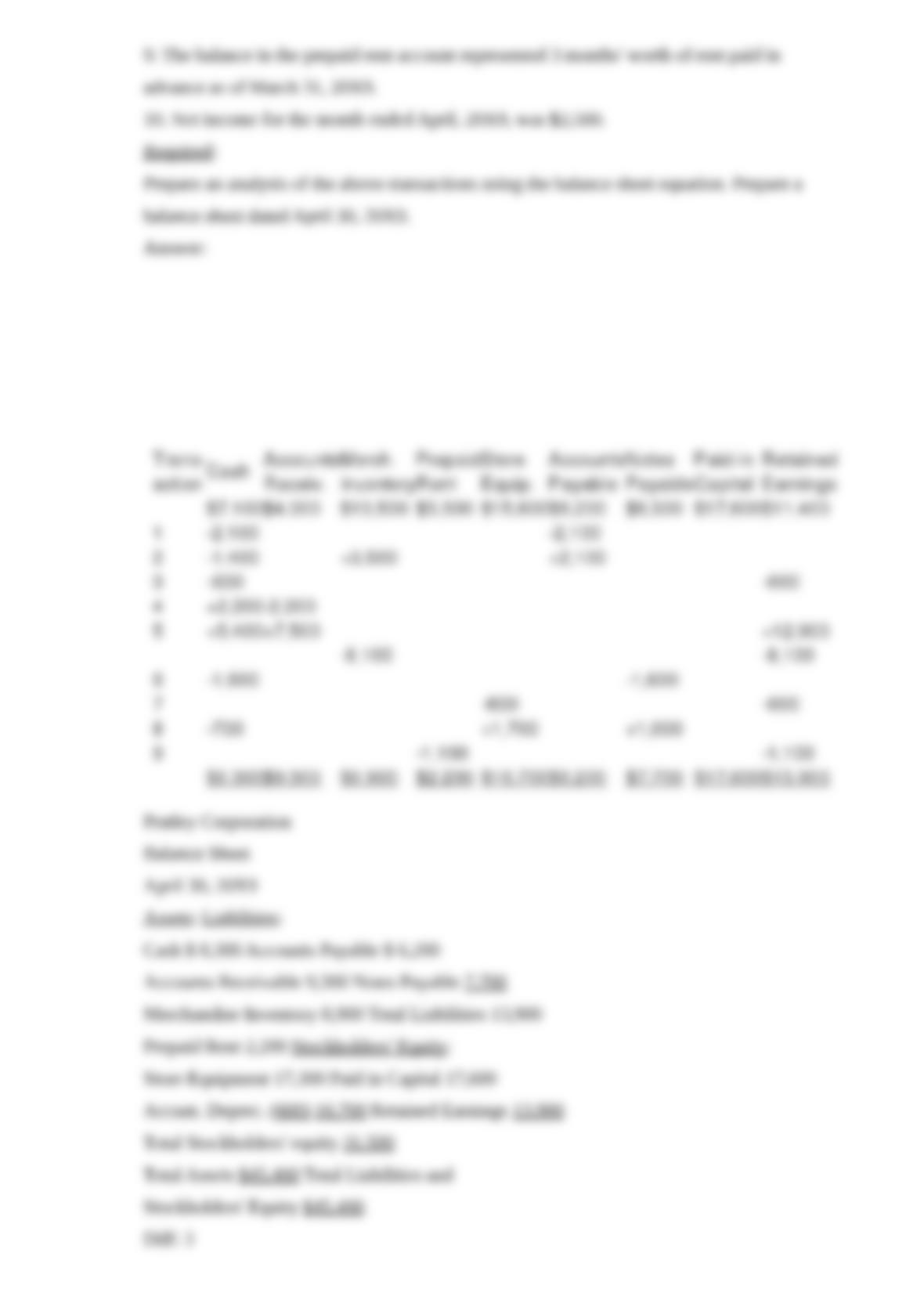
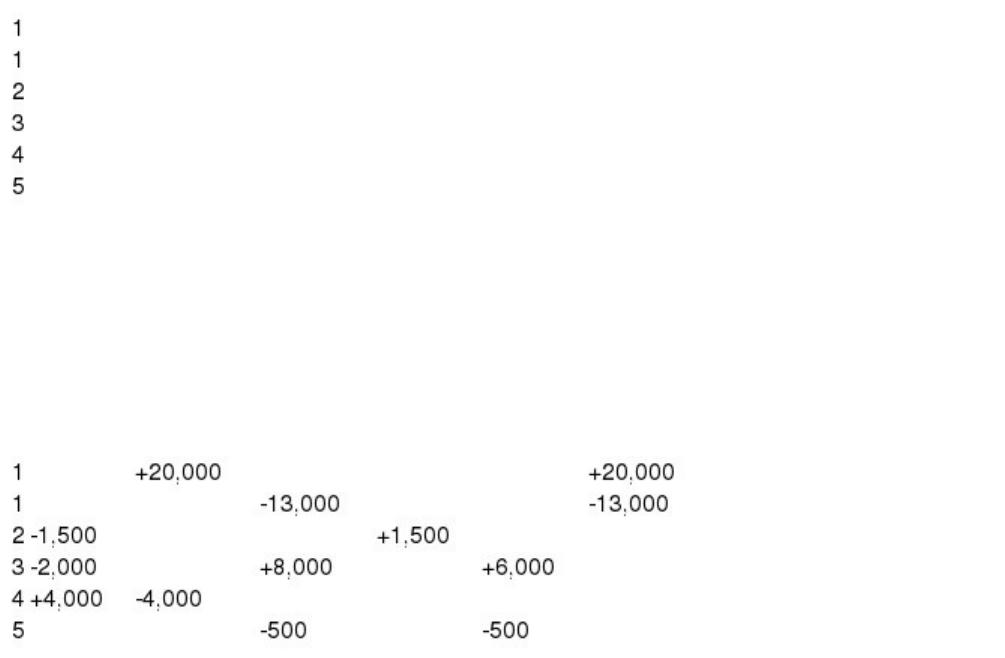
24) Analyze the following transactions in the accounting equation using the following
worksheet.
1. Sales of inventory for $20,000 on account; merchandise cost is $13,000.
2. Rent payment made in advance for $1,500.
3. Acquire additional inventory for $8,000; paid $2,000 cash with remainder on credit.
4. Received payment of $4,000 from customer who purchased goods on credit last month.
5. Returned defective inventory in the amount of $500. The inventory was purchased on
account.
Accounts Prepaid Accounts Retained
Cash Receivable Inventory Rent Payable Earnings
Answer:
Accounts Prepaid Accounts Retained
Cash Receivable Inventory Rent Payable Earnings
Diff: 3
Objective: L.O. 2-1
25) Why doesn’t the cash basis of accounting require adjusting accounts with accruals?
Answer: The cash basis of accounting only records revenues and expenses when cash
changes hands, while the accrual basis of accounting recognizes revenues when they are
earned and expenses when they are incurred. Adjustments are necessary under the accrual
basis of accounting since revenue can be earned even if cash is not received and expenses
can be incurred even if cash is not paid.
Diff: 2
Objective: L.O. 2-1
26) Describe the advantages of the accrual basis of accounting and the cash basis of
accounting.
Answer: The cash basis of accounting has the advantage of producing financial statements
when cash is received and paid, giving users a clearer picture of the company’s cash
position. Proponents suggest that this is important since companies can appear to be doing
well based on net income, yet go bankrupt for a lack of cash. The accrual basis of
accounting has the advantage of producing a more complete summary of the entity’s
value-producing activities since it recognizes revenues when they are earned and expenses
when they are incurred.
Diff: 2
Objective: L.O. 2-1
Learning Objective 2.2 Questions
1) According to U.S. GAAP, revenue is recognized when it is
A) realized or realizable only.
B) earned only.
C) received in a timely fashion.
D) earned and realized or realizable.
E) received in cash.
Answer: D
Diff: 2
Objective: L.O. 2-2
2) Which of the following is an example of revenue that may be realized but not yet
earned?
A) A customer paying in advance for services to be performed in the future.
B) A credit sale made to a customer who has a strong credit history. The goods have been
delivered.
C) A credit sale made to a customer with a weak credit history such that the collection of
the outstanding receivable is questionable. The goods have been delivered.
D) The cash sale of a fixed asset, as opposed to the sale of inventory. The fixed asset has
been delivered.
E) It is impossible to have revenue that is realized but not earned.
Answer: A
Diff: 3
Objective: L.O. 2-2
3) Performing a service and receiving a promise to pay from the customer would
A) increase revenue.
B) decrease assets.
C) increase liabilities.
D) decrease expenses.
E) decrease revenue.
Answer: A
Diff: 1
Objective: L.O. 2-2
4) Ace Office Equipment is an office equipment company specializing in sales of printers,
scanners, and copiers. When should Ace Office Equipment recognize revenue from its
sales?
A) When the customer calls to accept delivery of a new copier
B) When the customer signs a contract to buy a copier
C) When the copier is delivered to the customer
D) When the payment is received from the customer
E) When the financial statements are prepared that includes this sale
Answer: C
Diff: 2
Objective: L.O. 2-2
5) Armingham Cable Company sells cable services and related accessories. Which of these
situations demonstrate proper revenue recognition for Armingham Cable Company?
A) Insurance is paid one month in advance of the due date because the Armingham Cable
Company has extra cash.
B) Cable services are sold to customers, and customers are billed in advance of receiving
services. Revenue is recorded before rendering services.
C) Cable boxes are purchased for sale to customers, but the accountant has not yet paid the
bill.
D) An interest bearing certificate of deposit is purchased. Interest will be received at the
end of 60 days. Interest revenue will be recorded at the end of 60 days.
E) Employees are paid for hours worked last month.
Answer: D
Diff: 2
Objective: L.O. 2-2
6) Revenue is recognized when a customer’s promise to pay exists, even if the company is