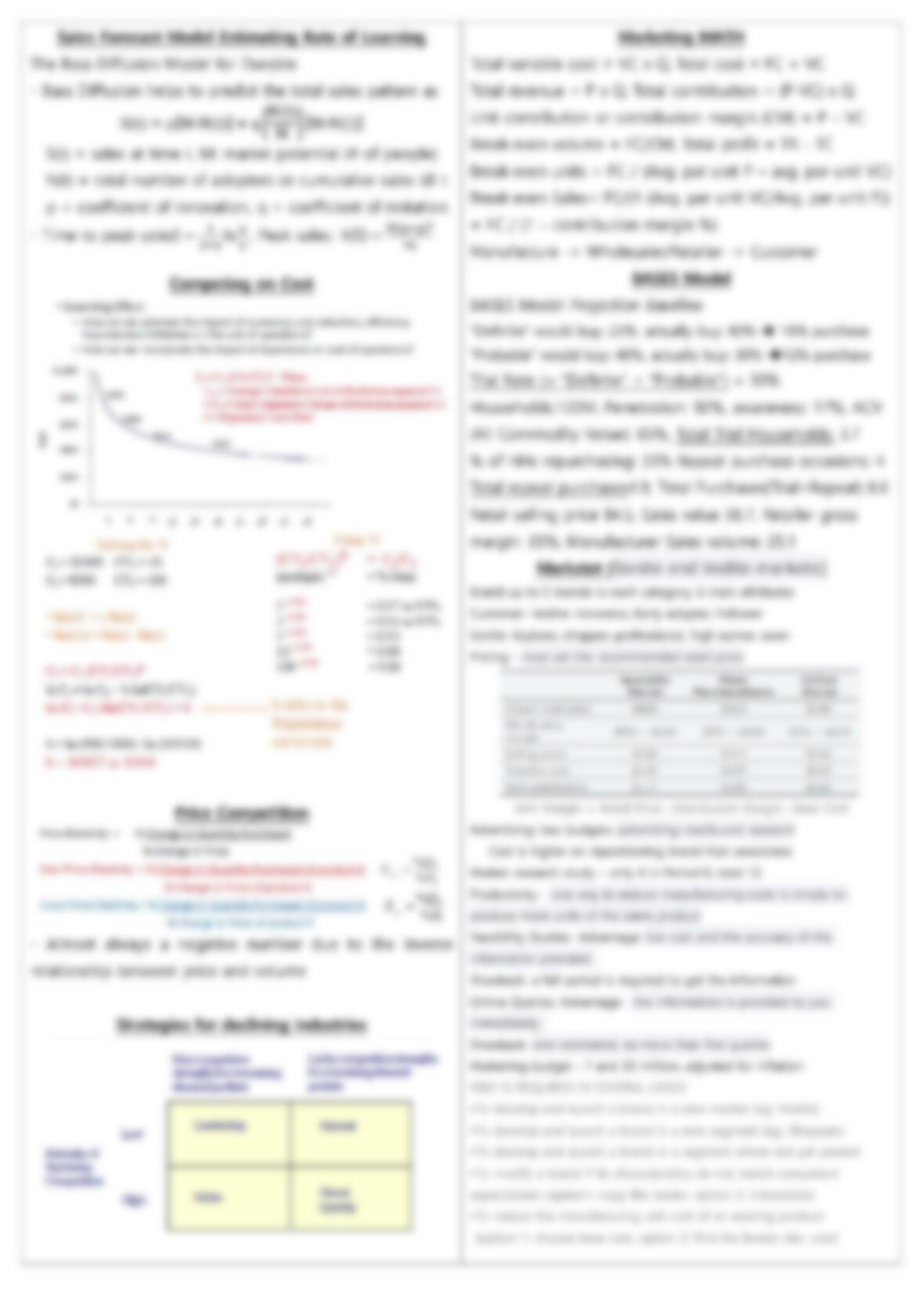
Product Life Cycle
Introduction Stage
– Market condition: little competition, High uncertainty,
Tech & markets underdeveloped, need for large investment
– Strategy: sufficient penetration; build primary demand
Pre–empt later entrants
Growth Stage
– Market condition: many new entrants, accelerating
acquisition of new customer, Significant gains in profitability
– Strategy: Expand choices (add product models, create new
features, expand distribution), Reduce costs (Streamline
value chain and logistics, long-term relationship w/ supplier)
Mature Stage
-Market condition: intense competition, static segmentation
-Strategy: Repeat/replacement sales, squeeze out profits,
niche branding, minor differentiation, cost-cutting
Decline Stage
-Market condition: no new customer or firm investment
-Strategy: withdraw, harvest, niche
Conjoint Analysis
Weakness of Direct Questioning – “everything important”
How? Step 1: Compile Utility Function
The coefficients are called the utility weights or “part-worths.”The utility
Function is a regression equation with dummy variables given as follows:
Step 2: Compute Market Share from Utility Weights of Conjoint
Where Ui is the utility of production and Uj is the utility of any product
available in the market.
ASSESSOR Modeling
Trial-Repeat Model: long-run market share = t x r x w
= Trial x Repeat x Usage Rate
t = PKD(aware,available,trial)+CU(samle,trial) – (PKD)x(CU)
𝑟 = Pon
1-Pnn+Pon t [Pnn Pno
Pon Poo]
Preference Model: Relative Preference (before/after trial)
Preference for a brand / Sum of Preferences of others
Resource Allocation Model
Allocating Resources across Marketing Inputs
Market Share = Awareness × Intention
Awareness ×Market Share
Intention
MSHt= 𝛼 ×Advt-1
𝜀A×Pricet
𝜀P×SalesForcet
𝜀S
log(MSHt) = log(𝛼) +𝜀Alog(Advt-1)+𝜀Plog(Pricet)+ 𝜀Slog(Sforcet)
From elasticities to allocations
-Allocating resources across marketing mix for a product
chasm