Page 1
A.P. Dr Shahrul Kamaruddin
Manufacturing Technology II MDB 3073
MAY 2017
Course Outcomes
:
At the end of the course, the students should be able to:
Analyze performance of manufacturing processes using the
available analytical techniques.
Apply the quality control principles in manufacturing.
3
4
Differentiate various techniques used in the processing of
metals, polymers, glass, ceramics and composites.
1
Appraise various surface treatments and coatings that can be
performed for technical and aesthetic reasons subsequent to
manufacturing a part.
2
Students will be assessed using Bloom’s Taxonomy:
1. Cognitive/Knowledge
2. Affective/Attitude
3. Psychomotor/Skill
Manufacturing Technology II (MDB 3073)
Page 2
A.P. Dr Shahrul Kamaruddin
Manufacturing Technology II MDB 3073
MAY 2017
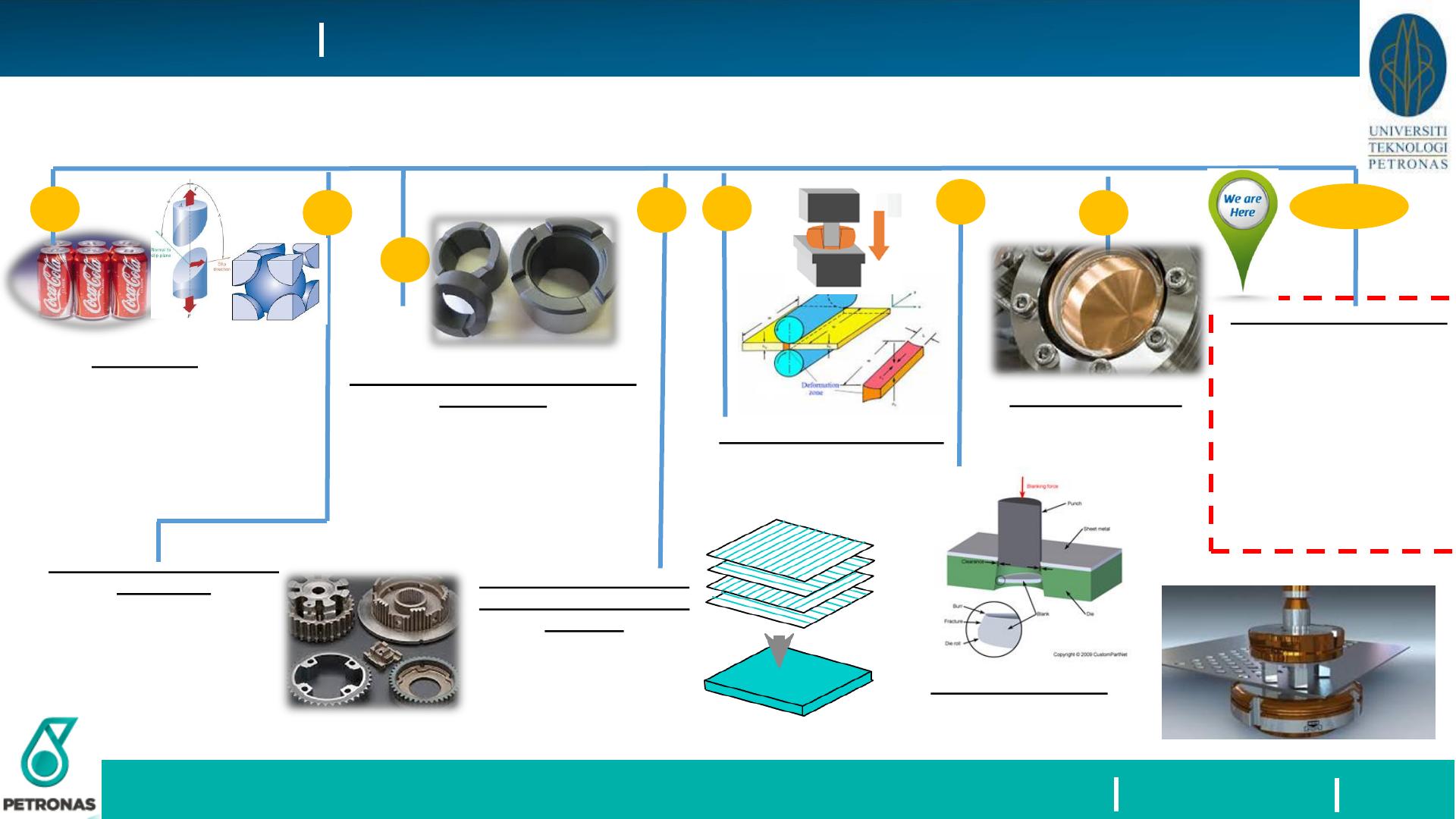
Manufacturing Technology II (Lesson Plan)
Introduction
Fundamental of materials:
Behaviour and manufacturing
properties
WEEK 1: 16–21 /05/16
12
Forming and Shaping of Ceramic
and Glasses
Shaping ceramics
Forming and shaping of glasses
Strengthening and annealing
glasses
WEEK 3: 30/05—03/06/16
4
Forming and Shaping of
Plastics and Composite
Materials
Injection molding
Extrusion
Processing of metal
matrix composites
WEEK 4: 06–10/06/16
5
Bulk deformation process
Rolling of metals
Forging of metals
WEEK 5: 13–17/06/16
678 –14
Powder Metal Process and
Equipment
Production of Metal Powders
Compaction of Metal Powder
Sintering
WEEK 2: 23–28/05/16
3
Sheet metal process
Shearing
Bending and drawing
WEEK 6: 20–24/06/16
Surface Technology
Surface Roughness
Surface Coating
WEEK 7: 27/06—01/07/16
Manufacturing Operation
Manufacturing industries
and products
Product / production
relationships
Production concepts and
mathematical models
Cellular Manufacturing
WEEK 8-14: 04/07—
18/08/16
Page 3
A.P. Dr Shahrul Kamaruddin
Manufacturing Technology II MDB 3073
MAY 2017
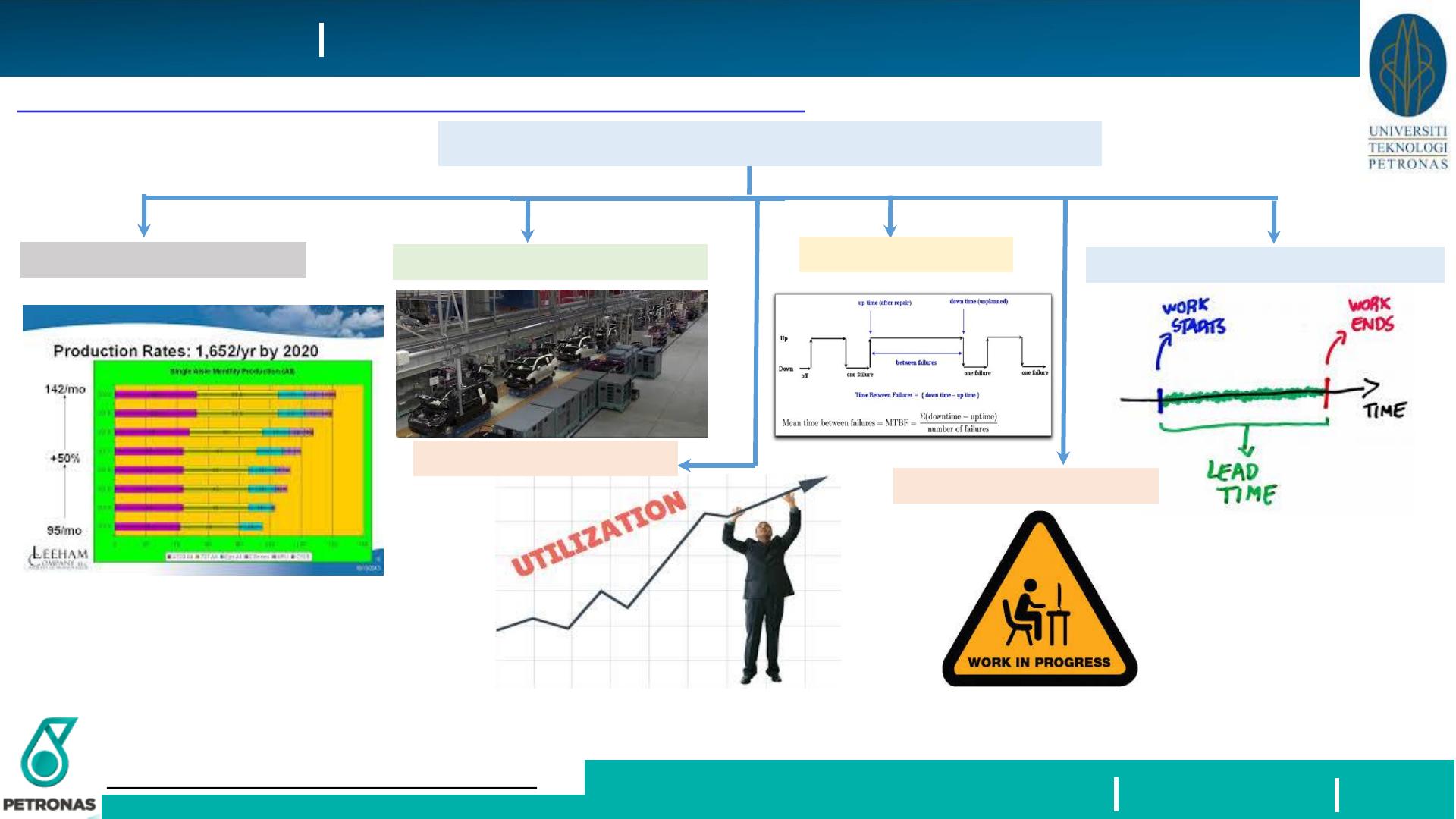
MATHEMATICAL MODELS OF PRODUCTION PERFORMANCE
Mathematical Models and Production Concepts
Production rate RpProduction capacity PC
2. Mathematical Models and Production Concepts
Manufacturing lead time MLT
Availability A
REFERENCE:
1. Groover (2001), Automation, Production Systems and Computer Integrated Manufacturing: 3rd Edition,
Prentice Hall. (Chapter 3 pp.64–72)
Utilization UWork-in-progress WIP

Page 4
A.P. Dr Shahrul Kamaruddin
Manufacturing Technology II MDB 3073
MAY 2017
Production rate Rp
Production rate for individual processing or assembly operation is usually expressed as hourly rate i.e. works unit
completed per hour (pc/hr).
Operation Cycle Time
2. Mathematical Models and Production Concepts
Typical cycle time for a production operation:
Tc=To+Th+Tth
where Tc= cycle time, To= processing time for the operation, Th= handling time (e.g., loading and unloading the production
machine), and Tth = tool handling time (e.g., time to change tools)
Batch production
In batch production, the time to process one batch consisting of Q work units: batch time Tb=Tsu +QTc
where Tb= batch processing time (min), Tsu= setup time to prepare for the batch (min), Q= batch quantity, Tc= cycle
time per work unit (min/cycle)
Average production time per work unit Tp=Tb/Q
Production rate (pc/hr)Rp=60/Tp

Manufacturing Technology II MDB 3073
Production rate Rp
For job shop production when the quantity Q= 1, production time per work unit Tp=Tsu +Tc
Mass production
For quantity high production:
Rp= Rc= 60/Tcsince Tsu/Q0
where Rc= operation cycle rate of the machine (pc/hr), and Tc= operation cycle time (min/pc)
Flow line production
Job shop production
For job shop production when the quantity is greater than 1, Production rate (pc/hr)Rp= 1/Tp
The production rate approximates the cycle rate of the production line, neglecting set up time. The operation of production