The Federal Democratic Republic of Ethiopia
Public Procurement and Property Administration Agency
MANUAL ON PUBLIC
PROCUREMENT COMPLAINT
PROCEDURE
Addis Ababa, April 2011

Manual on Public Procurement Complaint Procedure (Version 2, April 2011)
Page I
Manual on Public Procurement Complaint Procedure
Table of Contents
Section 1. GENERAL 1
1.1 Foreword 1
1.2 Background 1
1.3 Context and Scope 1
1.3.1 Principles of the Legal Protection 2
1.3.2 Material Scope – What is Covered? 2
1.3.3 Personal Scope – Who is Covered? 2
1.4 Definitions 2
Section 2. PARTIES TO THE COMPLAINT PROCEDURE 3
2.1 The Board for Review and Resolution of Complaints in Public Procurement
and Property Disposal 3
2.1.1 Establishment of the Board 3
2.1.2 Appointment of the Board Members and Terms of Service 3
2.1.2.1 Board Members 3
2.1.2.2 Term of Service 3
2.1.2.3 Training of the Board Members 3
2.1.2.4 Decisions of the Board 3
2.1.2.5 Meetings of the Board 4
2.1.3 Board Membership 4
2.1.3.1 Resignation of Membership 4
2.1.3.2 Termination of Membership 4
2.1.4 Disclosing Conflict of Interest 4
2.1.5 Board Member Appointment Challenge 4
2.1.6 Powers of the Board 4
2.1.7 Duties of the Board 5
2.2 The Secretariat of the Board 6
2.2.1 Organization of Secretariat 6
2.2.2 Functions of the Secretariat 6
2.2.3 The Register of Complaints for Review 6
2.2.4 Forms 7
2.3 The Public Body 7
2.4 The Public Procurement and Property Administration Agency 9
Section 3. PROCEDURE FOR SUBMISSION OF COMPLAINT FOR REVIEW 10
3.1 Who May Submit a Complaint? 10
3.2 When Complaint May Not be Lodged? 10
3.3 What Can be Subject to the Complaint Procedure? 11
3.4 Contents of Complaint 11
3.5 Evidence 12
3.6 Method of Submission of Complaint 12
3.7 Timing of Complaint Procedure 12
3.8 Consequences of Submission of Complaint 13
3.9 Conciliation and Mutual Agreement 13
Section 4. CONDUCT OF COMPLAINT PROCESS 14
4.1 Review of Complaints by the Public Body 14
4.1.1 Lodging a Complaint 14
4.1.2 Results of Lodging a Complaint 15
4.1.3 Powers of the Public Body Concerning Complaints 15

Manual on Public Procurement Complaint Procedure (Version 2, April 2011)
Page II
4.1.4 Deciding on Complaints 15
4.1.5 Procedure with Bids Submitted in Two Envelopes 15
4.2 Review of Complaints by the Board 16
4.2.1 Lodging a Complaint 16
4.2.2 Receipt and Registration of Complaint 16
4.2.3 Scrutiny 16
4.2.4 Results of Lodging a Complaint 17
4.2.5 Response of the Public Body 17
4.2.6 Powers of the Board Concerning Complaints 17
4.2.7 Complaint Review Process 17
4.2.7.1 Commencement of Complaint Review Process 17
4.2.7.2 Representation 18
4.2.7.3 Hearing 18
4.2.7.4 Evidence 18
4.2.7.5 Assistance to the Board 18
4.2.8 Deciding on Complaints 19
4.2.9 Board Meeting Minutes 19
4.2.10 Publicity of the Board’s Decisions 20
4.3 Review of complaints on misconduct of candidates and suppliers 20
Section 5. ANNEXES 23
5.1 FORM CR-01: Complaint for Review by the Public Body 23
5.2 FORM CR-02: Confirmation of Receipt of the Complaint by the Public Body 25
5.3 FORM CR 03: Decision of the Public Body on Complaint 26
5.4 FORM CR-04: Complaint for Review by the Board 27
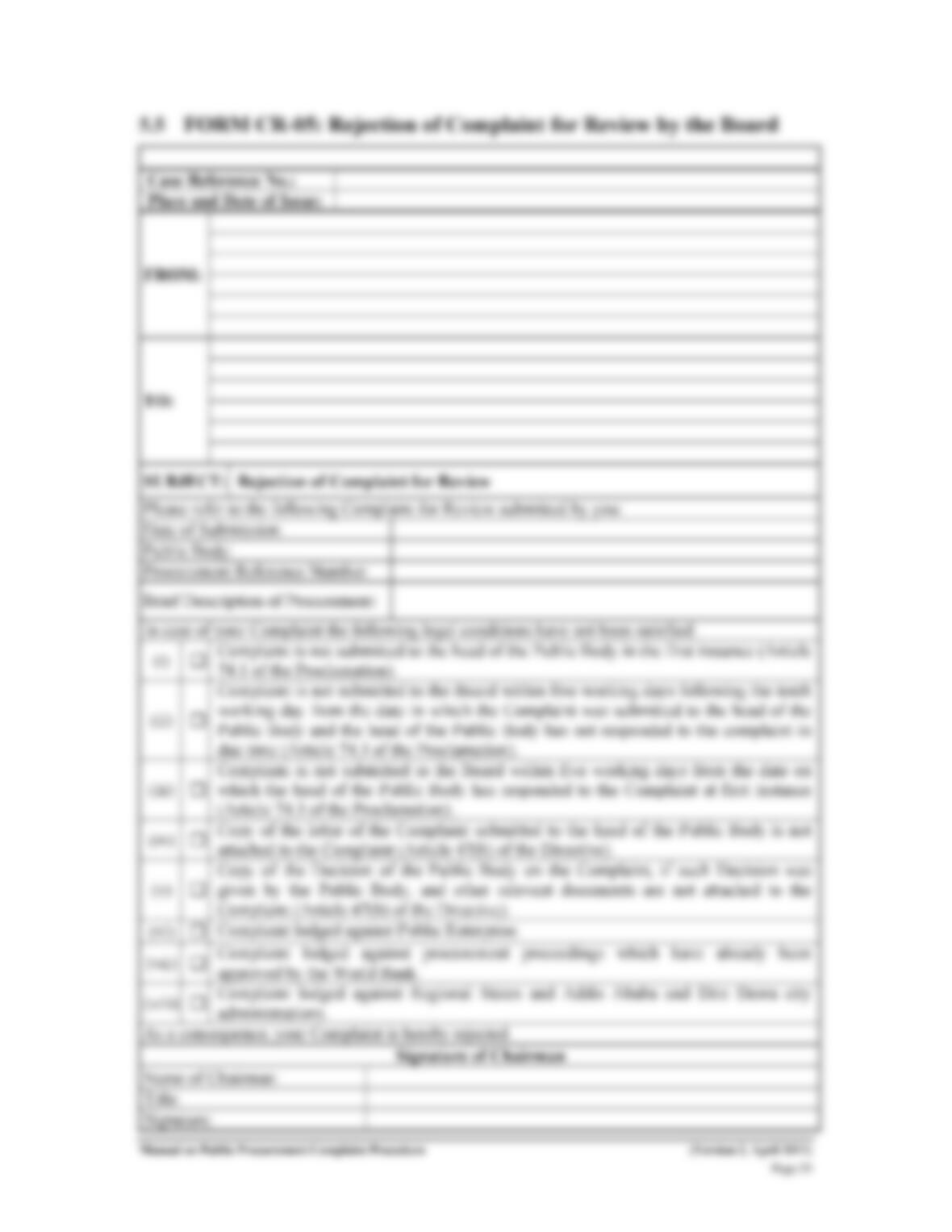
5.5 FORM CR-05: Rejection of Complaint for Review by the Board 29
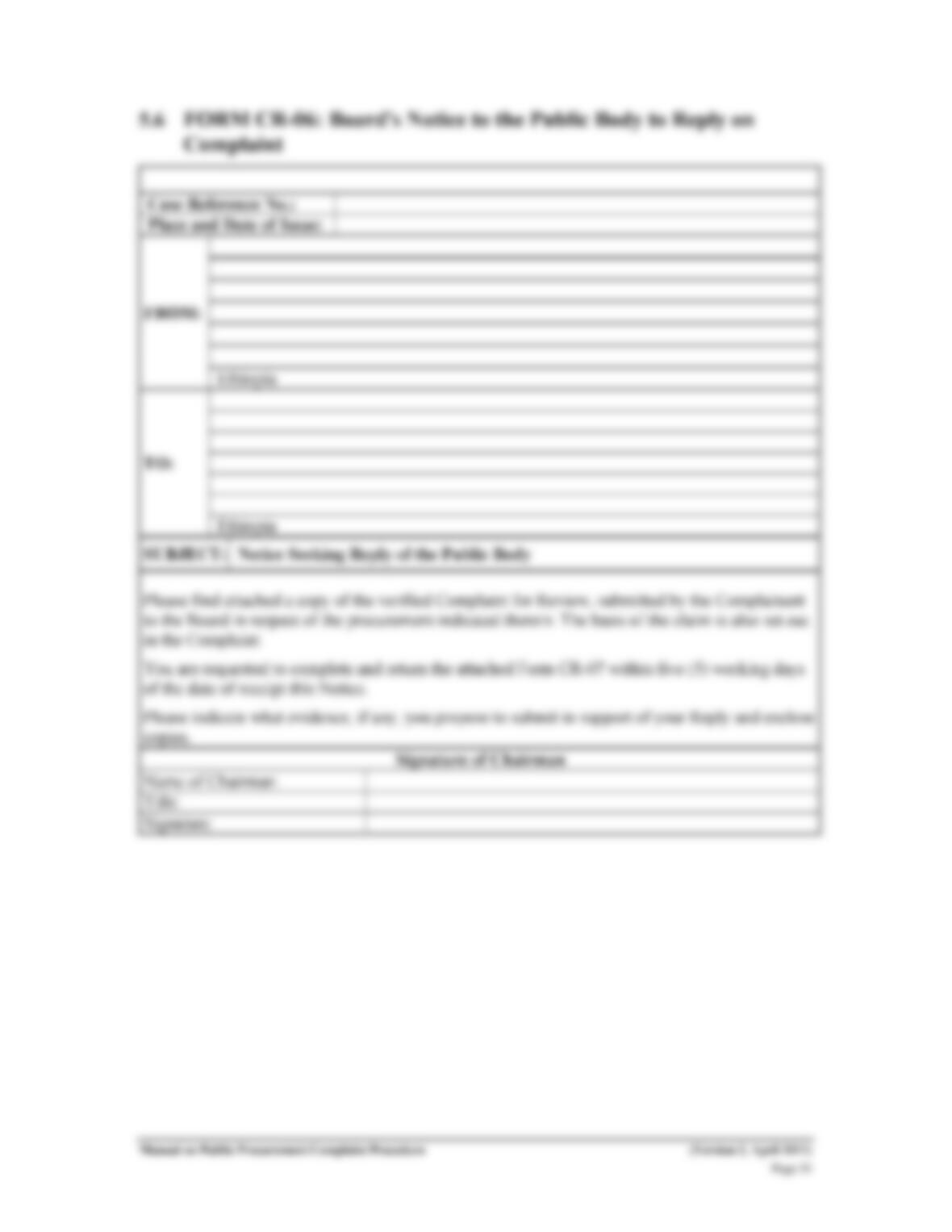
5.6 FORM CR-06: Board’s Notice to the Public Body to Reply on Complaint 30
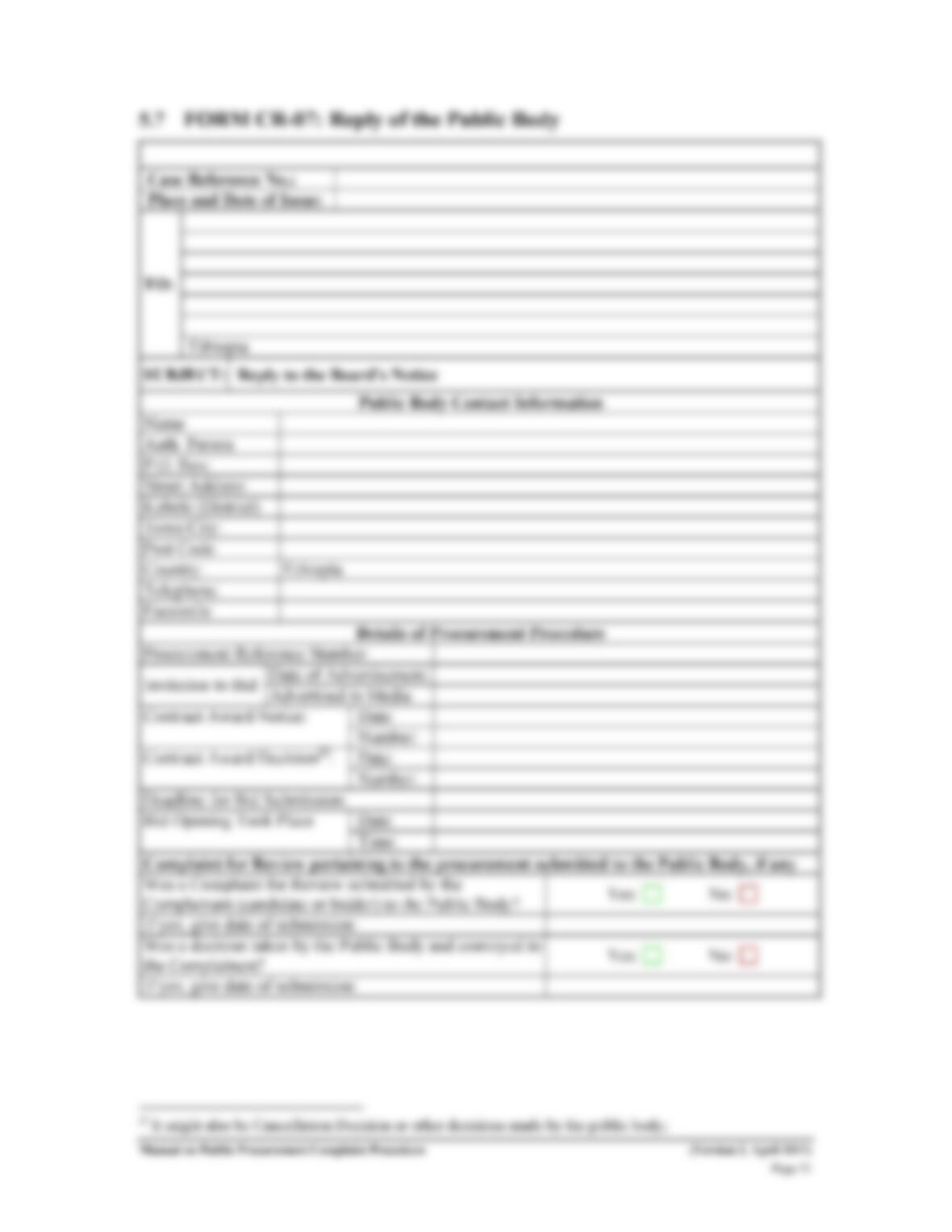
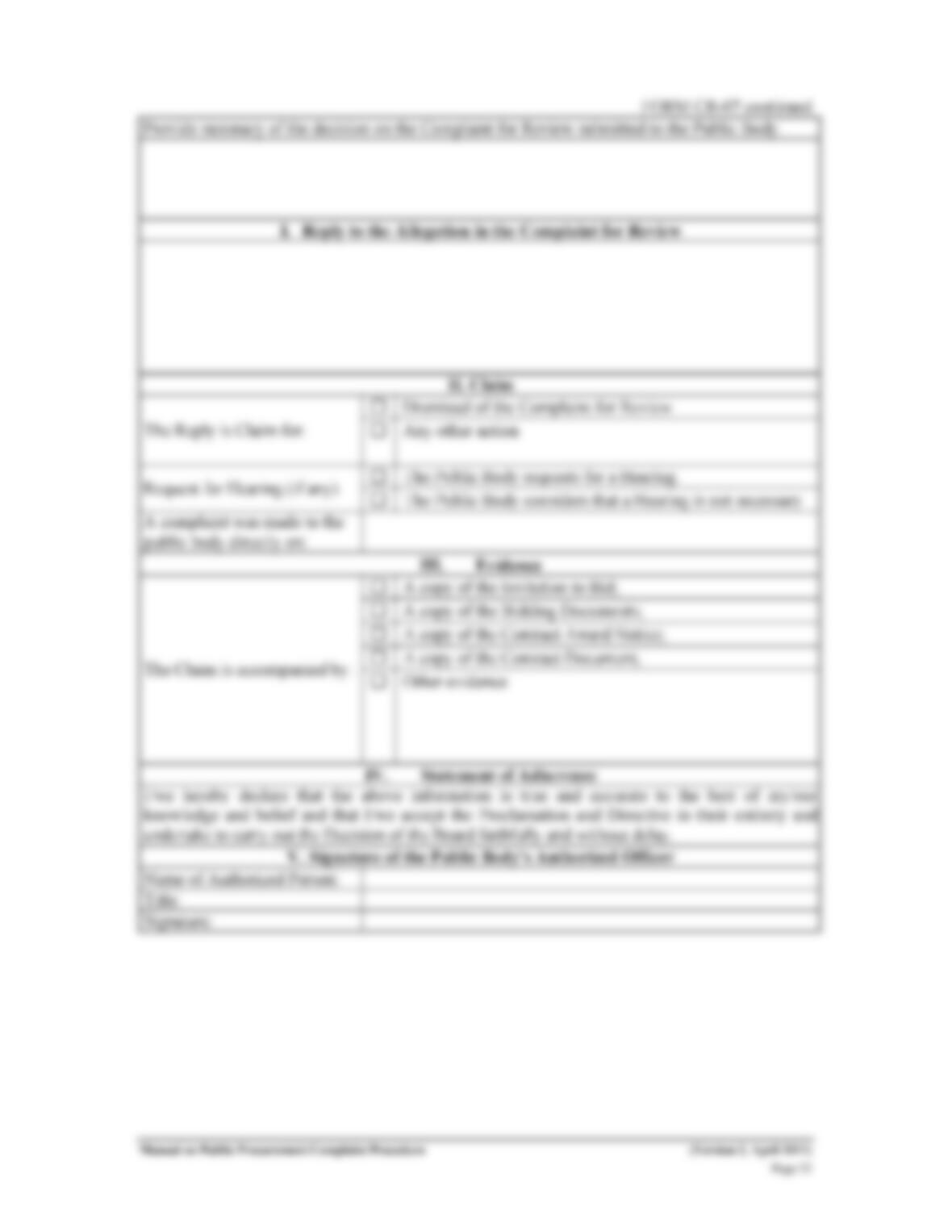
5.7 FORM CR-07: Reply of the Public Body 31
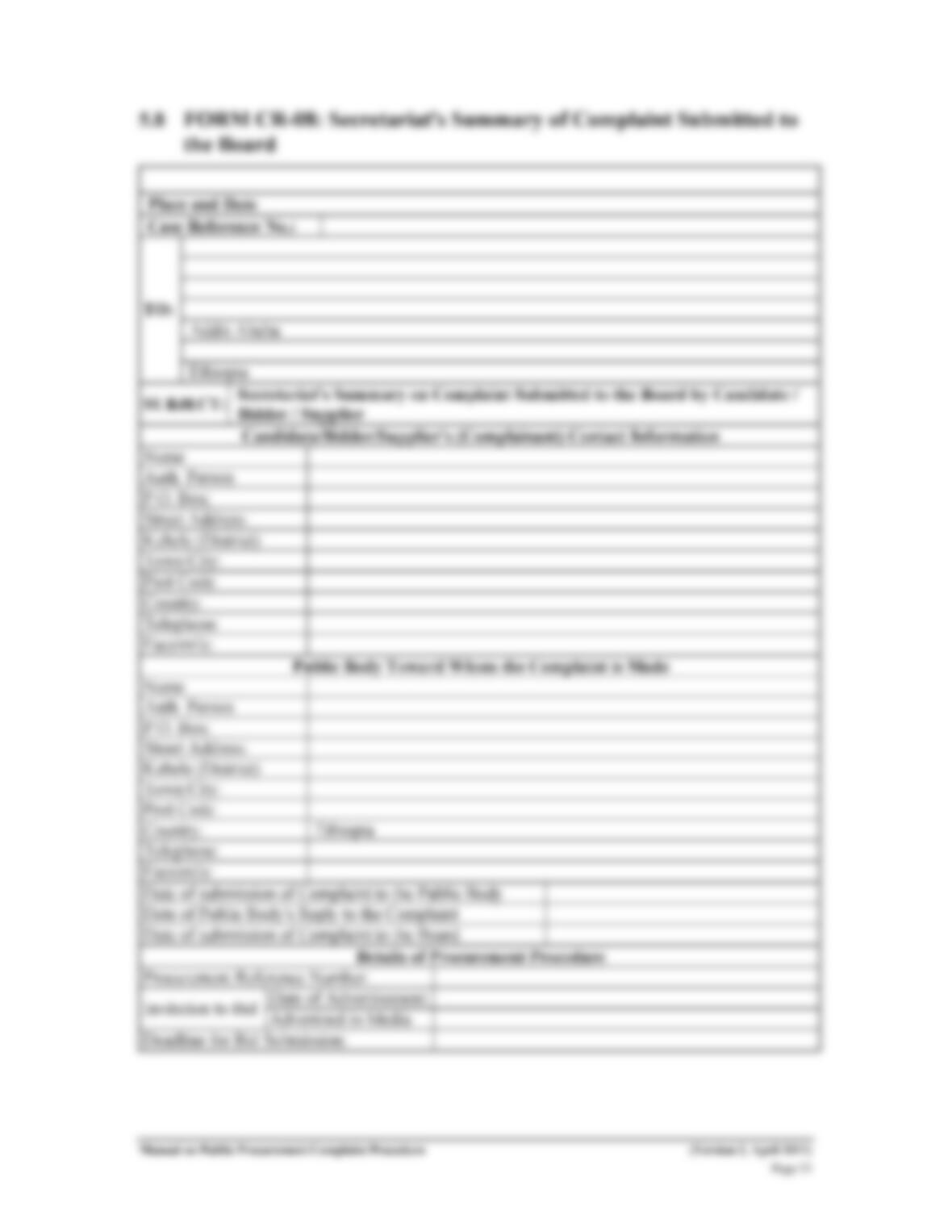
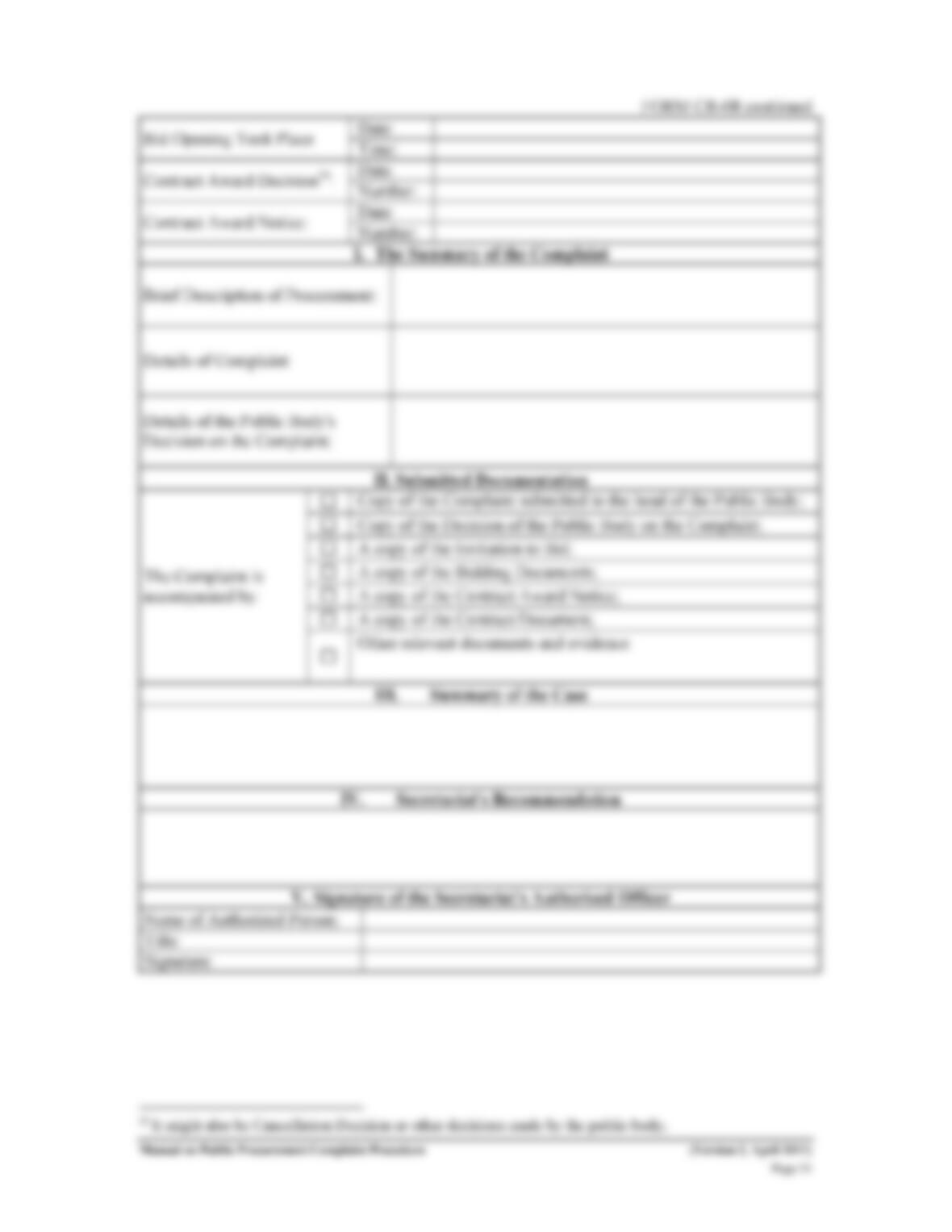
5.8 FORM CR-08: Secretariat’s Summary of Complaint Submitted to the Board 33
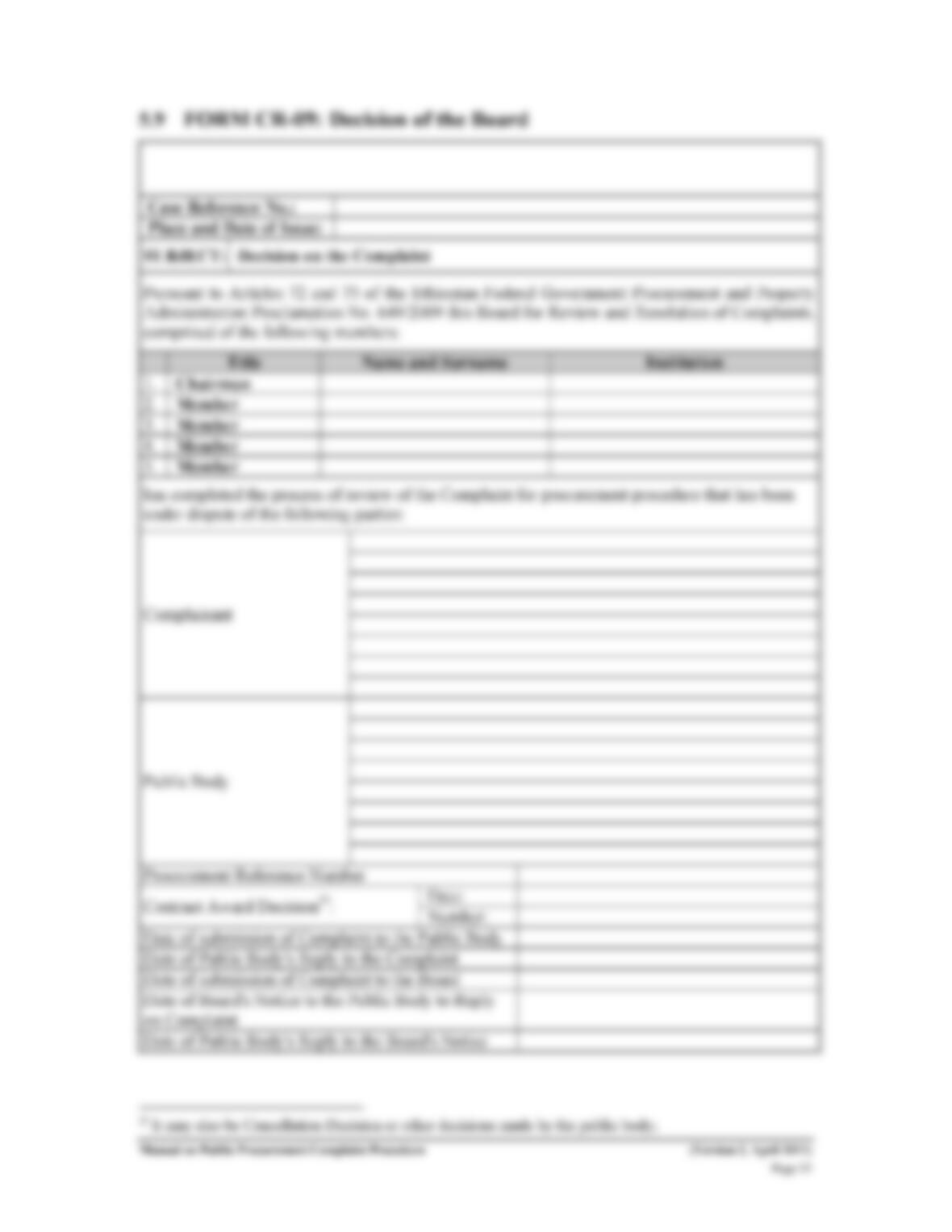
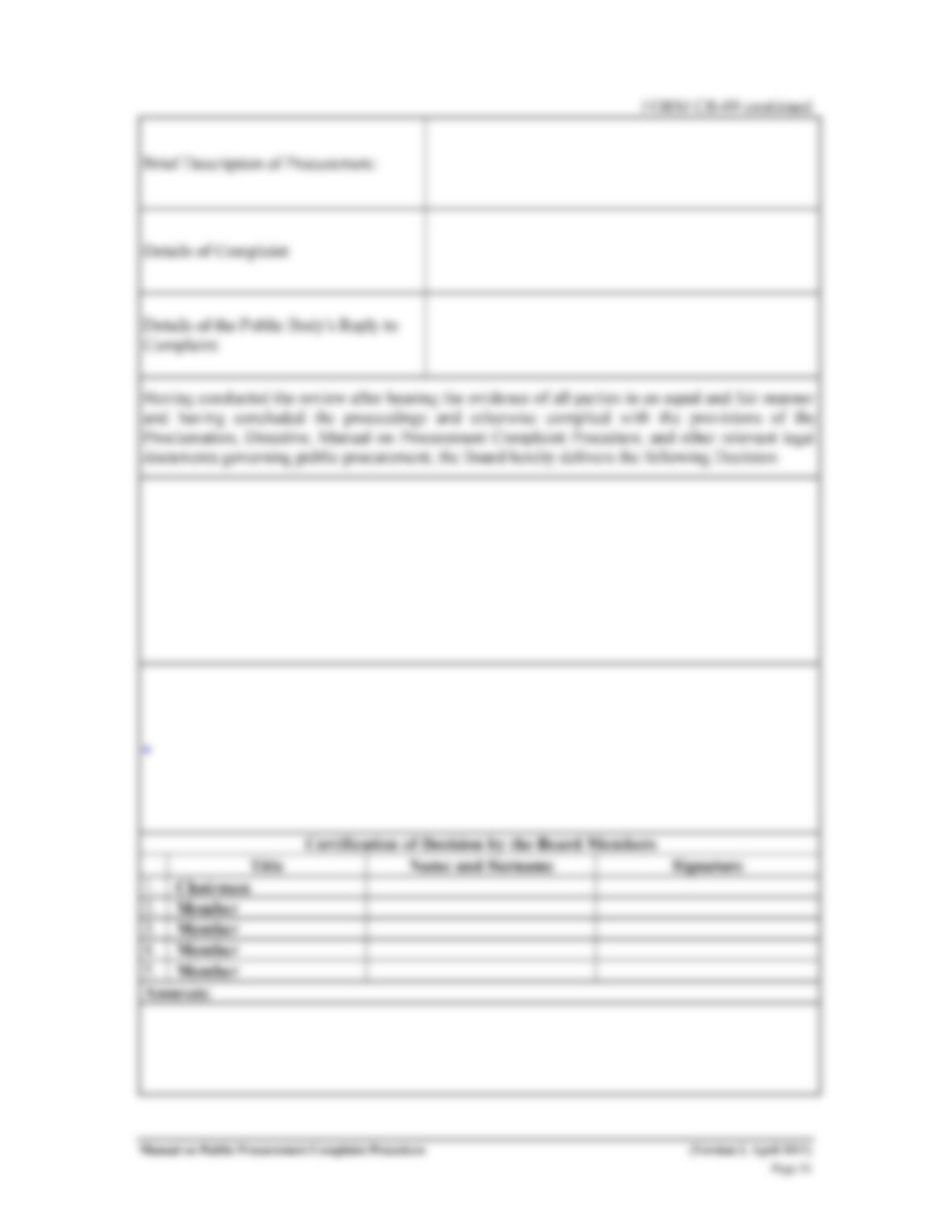
5.9 FORM CR-09: Decision of the Board 35
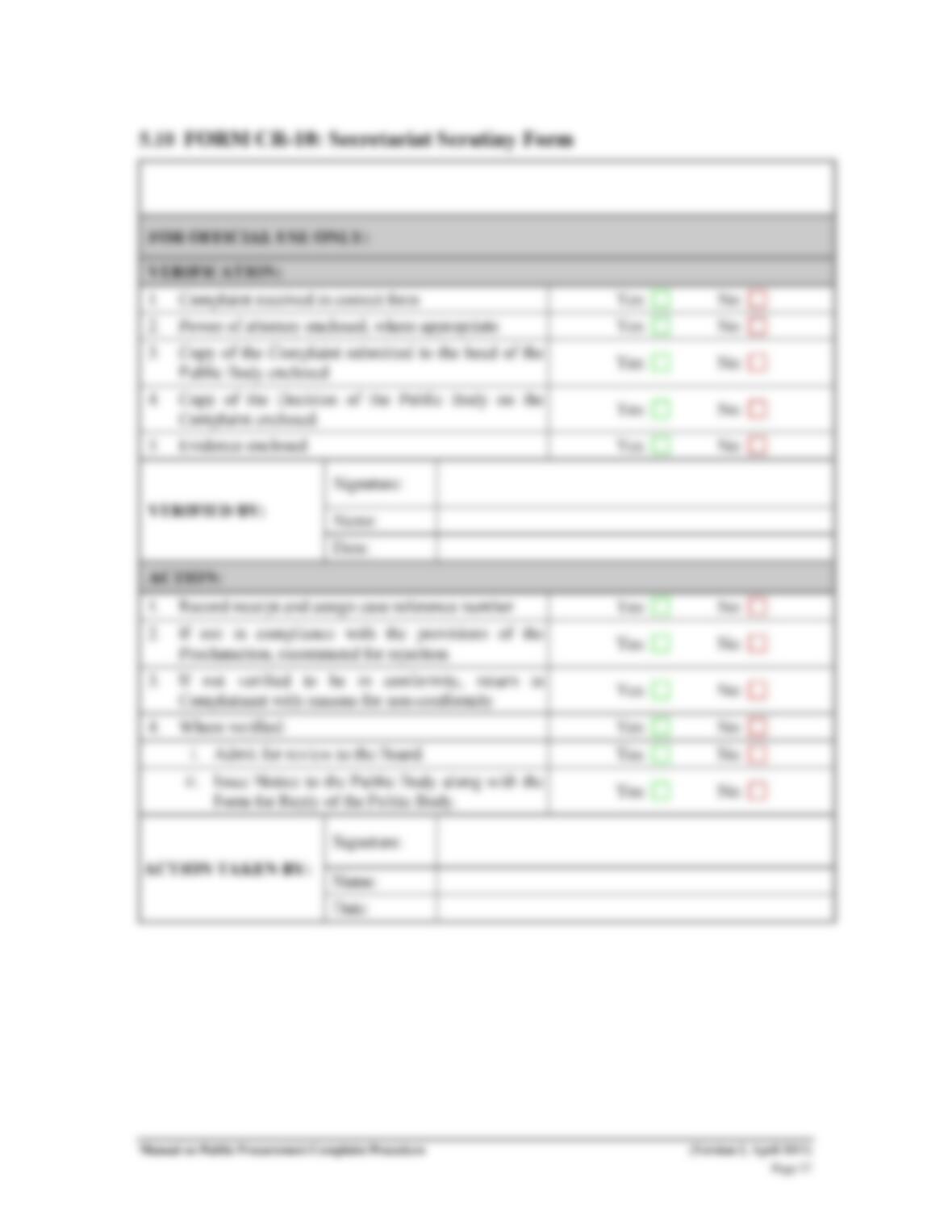
5.10 FORM CR-10: Secretariat Scrutiny Form 37
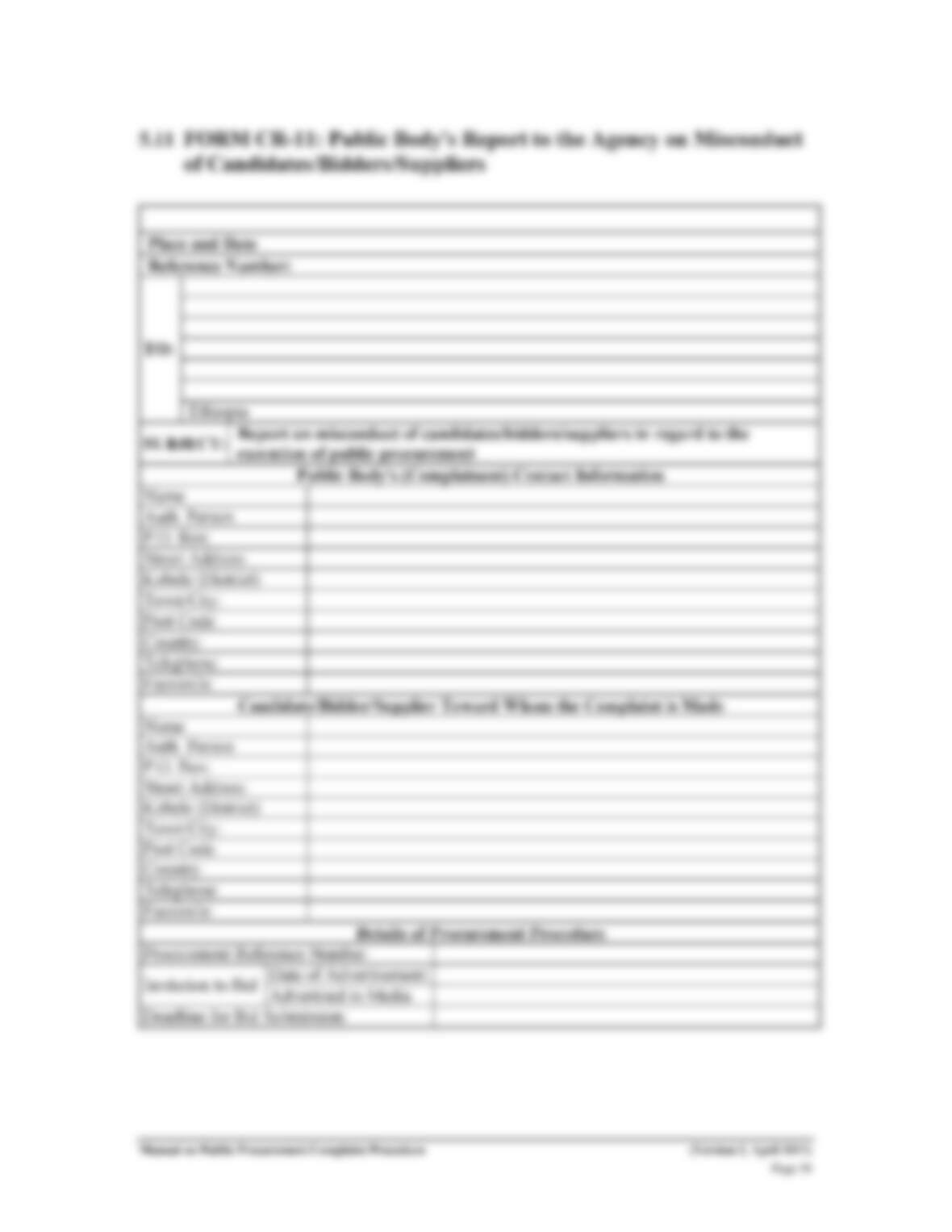
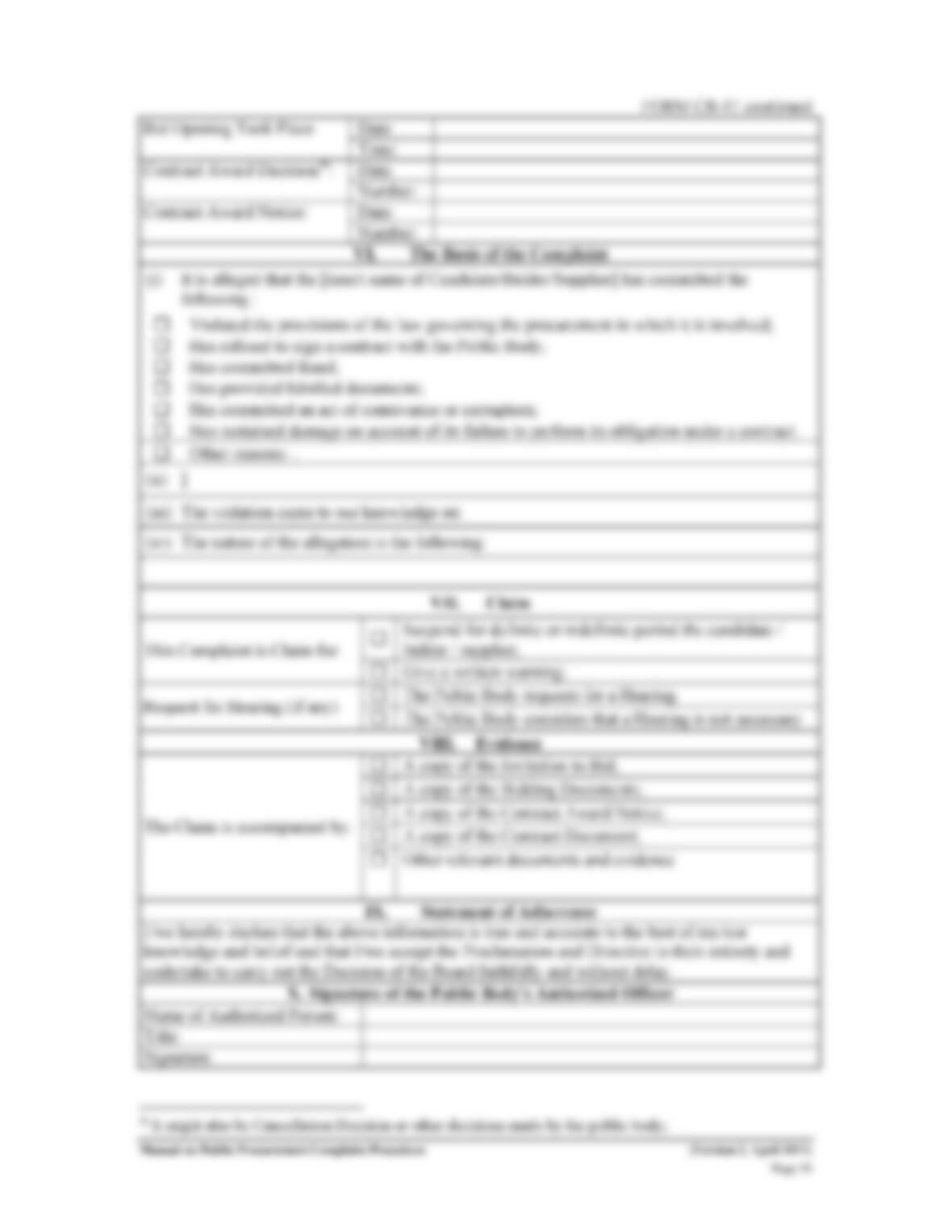
5.11 FORM CR-11: Public Body’s Report to the Agency on Misconduct of
Candidates/Bidders/Suppliers 38

Manual on Public Procurement Complaint Procedure (Version 2, April 2011)
Page 1
Section 1. GENERAL
1.1 Foreword
In the Federal Democratic Republic of Ethiopia basic legal act regulating questions
related to the public procurement procedures, including those which refer to the legal protection
measures is the Ethiopian Federal Government Procurement and Property Administration
Proclamation No. 649/2009 (hereinafter called the Proclamation) that entered into force on the
date of publication in the Federal Negarit Gazeta No. 60 on 9th day of September 2009.
Apart from the Proclamation, there is also the Federal Government Public Procurement Directive
(hereinafter called the Directive) issued by the Minister of Finance and Economic Development
(hereinafter called the Minister) that entered into force on 8th day of June 2010, which establishes
the following procedures:
(a) Procedure of reviewing complaints presented to the head of a Public Body and to the Board;
and
(b) Procedure of reviewing reports submitted by public bodies to the Public Procurement and
Property Administration Agency (hereinafter called the Agency) on misconduct of bidders and
suppliers.
As regards the institutional set up of complaints on public procurement system in Ethiopia the
basic provision in that regard is Chapter thirteen of the Proclamation and Directive’s Parts X to
XII.
These provisions establish the Board for Review and Resolution of Complaints (hereinafter called
the Board) which is the body responsible for review and settlement of complaints on public
procurement and property disposal and determine its competencies and organization.
The procedure of review of complaints is regulated by the Chapter fourteen of the Proclamation
and Part XI of the Directive.
Legal protection procedure applies to all Federal Government procurement contracts governed by
the Proclamation. Complaints may be lodged at all stages of the procurement procedure.
1.2 Background
The purpose of this Manual on Public Procurement Complaint Procedures (hereinafter called the
Manual) is to assist the Federal Government of Ethiopia’s public bodies, the Agency, and the
Board to manage complaints with regard to proceedings of public procurement.
The Manual also includes necessary information for candidates or bidders about how to submit a
complaint to the head of the public body or, if not resolved, to the Board against any act or
omission of the public body in regard to a public procurement proceeding. It also includes
procedures on submission and review of reports submitted by public bodies to the Agency
concerning misconduct of bidders or suppliers in regard to the execution of public procurement,
submitted to it by public bodies pursuant to article 76 of the Proclamation.
1.3 Context and Scope
This Manual takes account of the Proclamation‘s and Directive‘s provisions dealing with remedies
that are designed to help ensure that the procurement that is not carried out fairly and
transparently will be remedied through complaint procedure.
The purpose of the complaint procedure is to ensure that basic national public procurement
principles and procedures stipulated in the Proclamation and Directive are observed and all
decisions taken by the public body contrary to those principles and procedures may be reviewed
effectively and at the stage when irregularities could be corrected or removed and possible
damage could be still prevented.

Manual on Public Procurement Complaint Procedure (Version 2, April 2011)
Page 2
1.3.1 Principles of the Legal Protection
Proclamation and Directive guarantee that complaint procedures respect the following
fundamental principles:
(a). The Complaint procedures are available (principle of availability);
(b). Any actions taken during this procedure should be done within the limits determined by the
Proclamation and Directive (principle of legality);
(c). Complaint procedures do not limit access to those procedures for any eligible entity
(candidate or bidder) and do not violate competition rules (principle of non-
discrimination);
(d). Compulsory Prior Review by the public body (principle of additional procedure);
(e). Decisions taken by the public bodies must be reviewed effectively and, as rapidly as
possible, to minimize disruption to procurement (principle of effectiveness and rapidity);
(f). Submission an application for review to the contracting authority results in immediate
suspension of the possibility to conclude the contract (principle of suspension);
(g). During procedure of reviewing complaints all parties to this procedure should be given a
chance to present their claims and arguments on which they base them to the impartial,
non-biased and independent from all parties review body (adversarial or contradictory
nature of the procedure). Such a body in Ethiopia is the Board which is described in more
detail in Section 2.
1.3.2 Material Scope – What is Covered?1
The Proclamation regulates all Federal Government public procurement procedures of all values,
wherever public bodies and bidders conclude works, goods, services or consultancy services
contracts. It deals also with the competences of the Public Procurement and Property
Administration Agency, the body responsible for the public procurement system, and the Board
for review and resolution of complaints as well as prescribes legal protection measures in the field
of public procurement and property disposal.
Proclamation does not apply to contracts a public body enters into with another public body for
the provision of goods, works, consultancy or other services at cost.
1.3.3 Personal Scope – Who is Covered?
According to the Article 2 of the Proclamation, which explains the meaning of the basic terms
used in the Proclamation, the term Public Body covers any public body, which is partly or wholly
financed by the Federal Government Budget, higher education institutions, and public institutions
of like nature.
1.4 Definitions
For the purpose of this Manual the following words and expressions shall have the meanings
hereby assigned to them:
“Bidder”
means a natural or juridical person submitting a bid;
“Board”
means an entity established under the Proclamation to review and decide on
complaints from candidates, bidders or suppliers lodged in regard to the conduct
of public procurements and disposal of property of the Federal Government;
“Candidate”
means a natural or juridical person invited to take part in public procurement or
seeking to be invited;
“Complainant”
means bidder or candidate submitting a complaint;
“Secretariat”
refers to the office organized within the Agency for carrying out the functions
associated with the organization and procedures of the Board, as set out in the
Proclamation and Directive.
1 Proclamation, Article 3;

Manual on Public Procurement Complaint Procedure (Version 2, April 2011)
Page 3
Section 2. PARTIES TO THE COMPLAINT PROCEDURE
2.1 The Board for Review and Resolution of Complaints in Public
Procurement and Property Disposal
2.1.1 Establishment of the Board2
The Board is established under the Proclamation to review and decide on complaints from
candidates lodged in regard to the conduct of public procurements and disposal of property of the
Federal Government.
The Board is accountable to the Minister.
2.1.2 Appointment of the Board Members and Terms of Service3
2.1.2.1 Board Members
The Minister shall appoint five persons representing the private business sector, the relevant
public bodies, Agency, and public enterprises to serve as members of the Board for review and
resolution of complaints lodged by candidates or bidders in public procurement. Board members
shall be drawn from:-
1. The Ministry of Finance and Economic Development Chairperson
2. The Chamber of Commerce Member
3. Public bodies Member
4. Public enterprises Member
5. Public Procurement and Property Administration Agency Member
Minister shall appoint one more member to be drawn from the Agency, who shall serve as
secretary and expert advisor to the Board with no voting power.
Eligibility for membership of the Board shall be based on knowledge and experience in public
procurement, good manner and ethical standing.
Minister shall determine the amount of allowance to be paid to the members of the Board and the
mode of payment.
2.1.2.2 Term of Service
The term of service of members of the Board shall be three years. However, considering their
suitability for the job in terms of their performance and their integrity, their term of service may
be extended for another three years.
Any member of the Board failing to properly discharge his/her duty may be replaced at any time
before his/her term of service expires.
2.1.2.3 Training of the Board Members
All members of the Board shall be required to undertake the specialized training organized by the
Agency, after their appointment. Training for members of the Board shall be conducted as and
when appointment is made by the Minister.
The Agency shall, in cooperation with the Chairman of the Board, organize a program of
continuing training for the members of the Board in areas of relevance.
2.1.2.4 Decisions of the Board
2 Proclamation, Article 70;
3 Proclamation, Article 71, Directive, Article 36;
The Board shall make decisions by consensus without prejudice to the possibility that decisions
may also be made by vote if necessary. The chairman of the Board shall have a casting vote
where a vote is tied.
2.1.2.5 Meetings of the Board4
(a). Members of the Board shall meet once a week regularly. However, they may convene more
than once a week if the complaints to be reviewed arise.
(b). There shall be a quorum where the majority of members are present in a meeting.
(c). The chairperson may represent a member to act on his behalf where he can not attend a
meeting of the Board for good reason.
2.1.3 Board Membership
2.1.3.1 Resignation of Membership5
Any member of the Board, including the chair person, may resign from the Board at any time by
tendering a letter of resignation to the Minister where the resignation is accepted by the Minister.
2.1.3.2 Termination of Membership6
The Minister may terminate membership of the Board of any member for any of the following
reasons,
(a). Where he can not continue to discharge his duty by reason of mental or preventive
physical disability;
(b). Where he is convicted of crime by a competent court; or
(c). Where he is found to be involved in ethical or disciplinary misconduct.
2.1.4 Disclosing Conflict of Interest7
Every person appointed to the Board must be and must remain independent of the parties to the