Chapter 2
Managing
Business
Environment
Copyright © 2016 Pearson Education, Ltd.
Nguyen Thi Phuong Dung, MSc
Foreign Trade University – HCMC Campus

Learning Objectives
2
1. Contrast the actions of managers according to the
omnipotent and symbolic views.
2. Describe the constraints and challenges facing managers
in today’s external environment.
•Develop your skill at scanning the environment so
you can anticipate and interpret changes taking
place.
3. Discuss the characteristics and importance of
organizational culture.
•Know how to read and assess an organization’s
culture.
Copyright © 2016 Pearson Education, Ltd.

➝Omnipotent view of management: The view
that managers are directly responsible for an
organization’s success or failure.
➝Symbolic view of management: The view that
much of an organization’s success or failure is
due to external forces outside managers’ control.
3
Copyright © 2016 Pearson Education, Ltd.
2.1 The Manager’s View
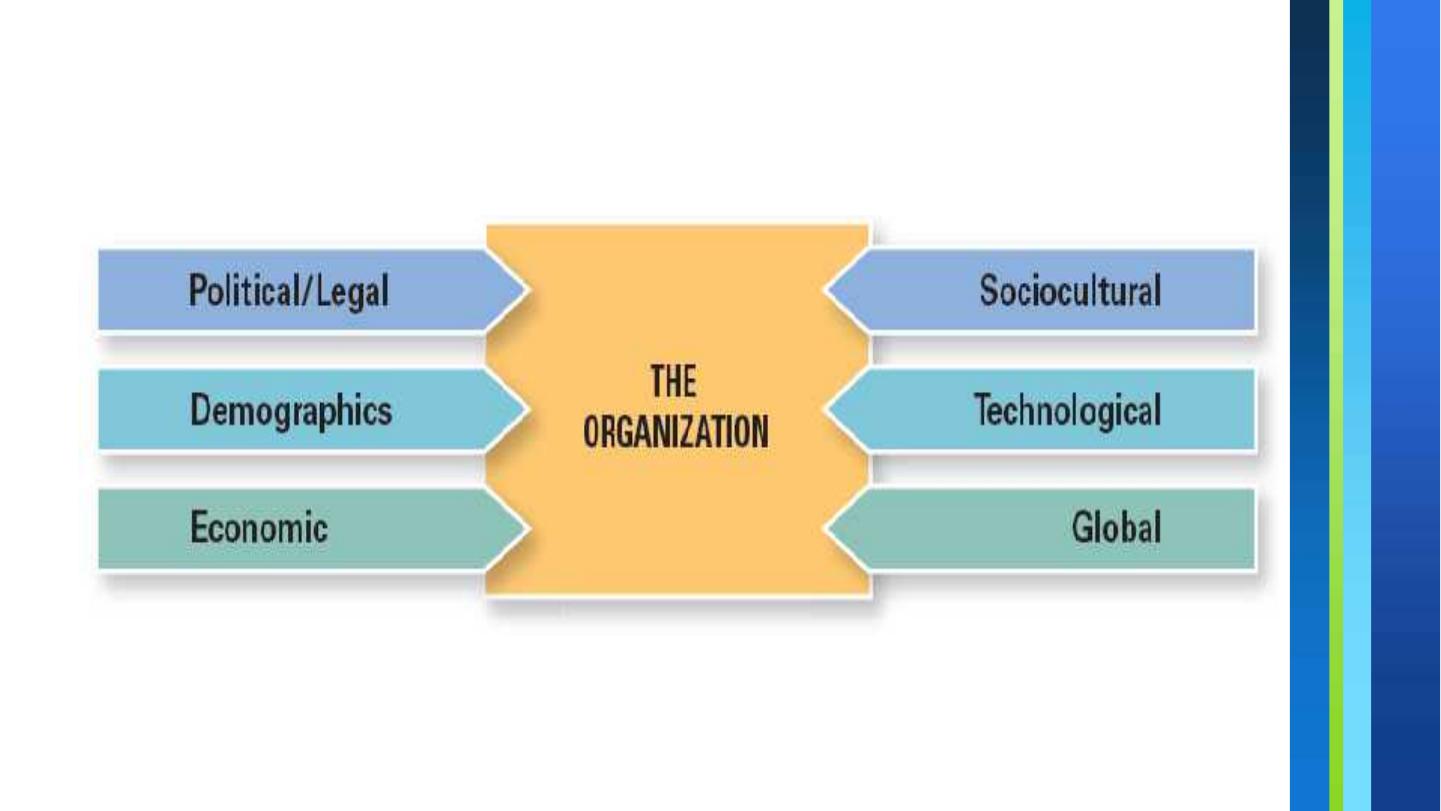
Exhibit 2-1
Components of the External Environment
4
Copyright © 2016 Pearson Education, Ltd.

2.2 External Environment
5
Copyright © 2016 Pearson Education, Ltd.
➝The External Environment: Those factors and forces outside
the organization that affect its performance. The external
environment includes several different components.
⇾Economic – Encompasses factors such as interest rates,
inflation, changes in disposable income, stock market
fluctuations, and business cycle stages.
⇾Demographic – Concerned with trends in population
characteristics such as age, race, gender, education level,
geographic location, income and family composition.
⇾Political/Legal – Concerned with federal, state and local
laws, and global laws.

2.2 External Environment
6
Copyright © 2016 Pearson Education, Ltd.
➝Technological – Concerned with scientific or industrial
innovations.
➝The Sociocultural – Concerned with societal and
cultural factors such as values, attitudes, trends,
traditions and lifestyles, beliefs, tastes, and patterns of
behavior.
➝Global – Encompasses issues associated with
globalization and a world economy.
2.2 External Environment
2.2.1 Political
➝Government type and stability.
➝Freedom of the press, rule of law and levels of
bureaucracy and corruption.
➝Regulation and de-regulation trends.