1
Mandatory Assignment 1: Solutions
Exercise 1 (Spring 2012)
Fundamental analysis is the method of analyzing information, forecasting payoffs from that
information, and arriving at a valuation based on those forecasts. The process can be split into 5
steps:
1. Knowing the business. Know the products, knowledge base, competition, regulatory
constraints, management, etc.
2. Analyzing information. The most important information is often found in the financial
statements, but other information, both quantitative and qualitative, may also be highly
relevant.
3. Developing forecasts. First, specify how payoffs are measured. Then, forecast the specified
payoffs.
4. Converting the forecast to a valuation. Since payoffs are in the future and investors prefer
value now rather than in the future, expected payoffs must be discounted for the time value
of money.
5. Trading on the valuation. If outside investor; compare value with price to buy, sell or hold. If
inside investor; compare value with cost to accept or reject strategy.
Exercise 2 (Spring 2012)
Cash flow from operations:
Reported cash flow from operations $14,300
Interest paid $405
Interest received 236
Net interest paid 169
Tax deduction (at 36%) 61 108
Cash from operations $14.408 million
Cash investment:
Reported cash investment $13,438
Sale of investments $ 448
Purchase of investments (99) 349
Cash investment in operations $13,787
The company’s free cash flow was $14,408 – 13,787 = $621.
Exercise 3 (Fall 2009)
a) Earnings = Levered cash flow from operations + Accruals
Levered cash flow from operations = Earnings – Accruals = 7430 – 1100 = 6330
b) Free cash flow = Earnings + Net interest payments – Investments – Accruals

2
= 7430 + 700 * (1 – 0.35) – 1500 – 1100 = 5285
Alternatively:
Free cash flow = Levered cash flow from operations + Net interest payments – Investment =
5285
Note that Investment = Purchase of machinery. Purchase of/sales of short term investments
refer to financial assets.
Exercise 4 (Fall 2012)
Net dividend = Dividends + share repurchases – share issues
= $72 + 90 – 460 = -$298million
(There was a net payment into the firm from shareholders.)
Comprehensive Earnings = CSE (end) – CSE (beginning) + net dividend
= $2,584 – 2,162 – 298
= $124 million
Exercise 5 (Fall 2010)
a)
No growth:
3
32 10.1
10.0
4900
10.1
4900
10.1
4825
10.1
4350
firm of Value
+++=
= 3955 + 3988 + 3681 + 36814
= 48438
Continuing value: The present value of a perpetuity of 4900 is equal to
4900/0.1 = 49000. However, this is the value at the end of 2013. The present value at the end
of 2010 is 49000/1.103 = 36814
Value of equity = Value of firm – value of net debt
= 48438 – (4990 – 2850)
= 46298
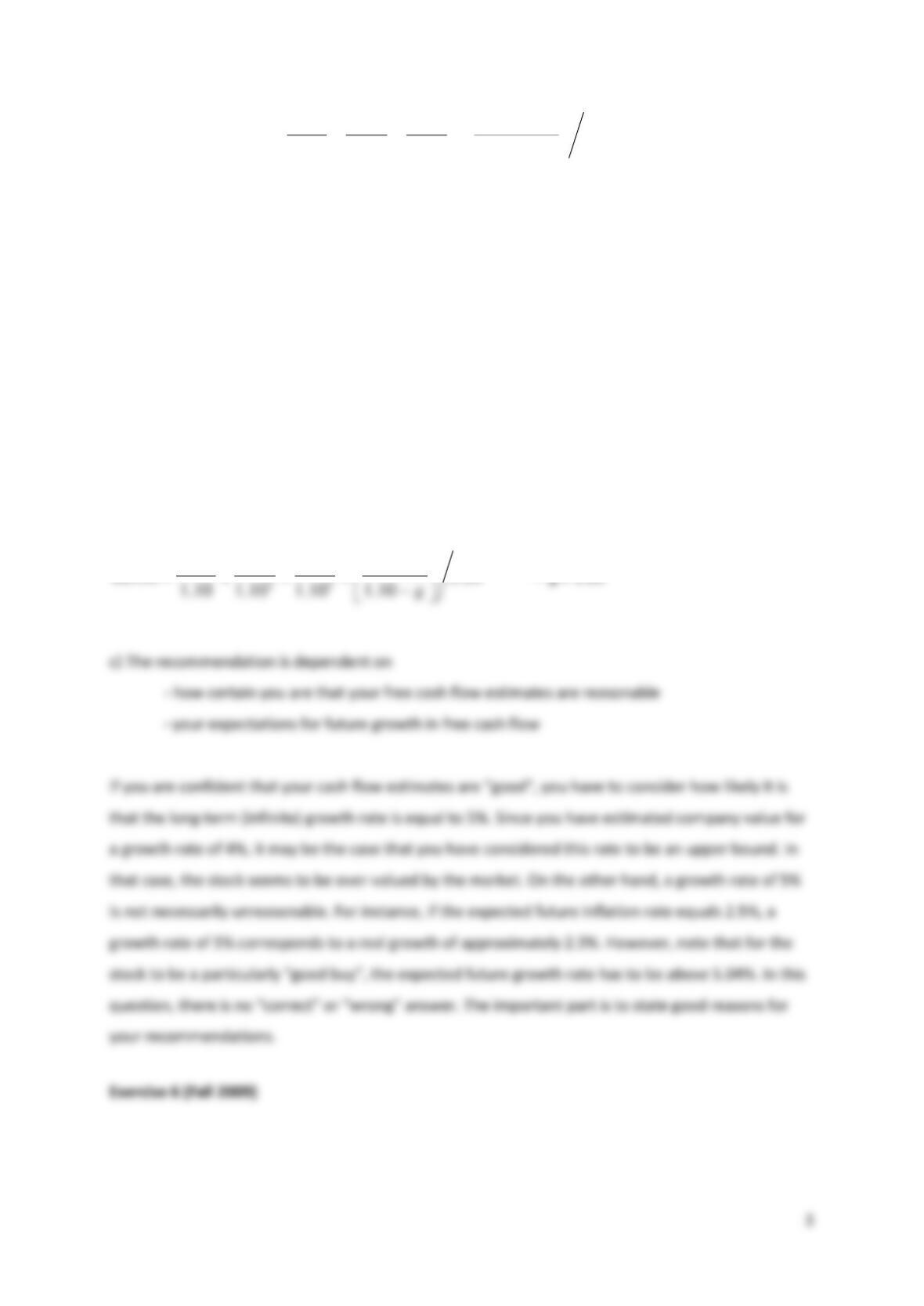
4 % growth:
3
32 10.1
04.010.0
04.1*4900
10.1
4900
10.1
4825
10.1
4350
firm of Value
−
+++=
= 3955 + 3988 + 3681 + 63812
= 75435
Value of equity = Value of firm – Value of net debt
= 75435 – (4990 – 2850)
= 73295
b) Market value of equity = 86.79*1000 = 86790
Market value of firm = Market value of equity + Value of net debt
= 86790 + (4990 – 2850) = 88930
The implicit growth rate is found by solving for g:
3
*4900
4900
4825
4350
88930
+++= g
g