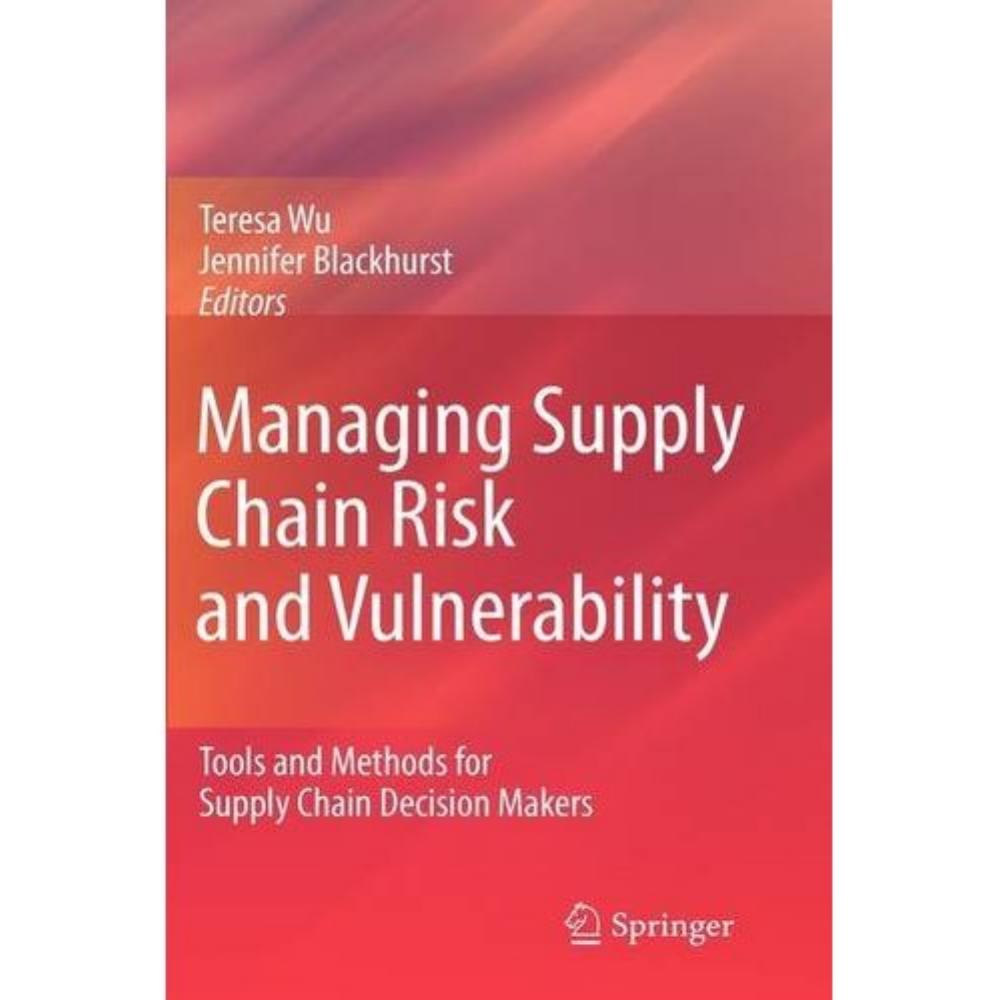
Managing Supply Chain Risk and Vulnerability
Teresa Wu Jennifer Blackhurst
Editors
Managing Supply Chain Risk
and Vulnerability
Tools and Methods
for Supply Chain Decision Makers
123
Editors
Assoc. Prof. Teresa Wu
Department of Industrial Engineering
Ira A. Fulton School of Engineering
Arizona State University
P.O. Box 875906
Tempe, AZ 85287-5906
USA
teresa.wu@asu.edu
Assoc. Prof. Jennifer Blackhurst
Department of Logistics, Operations
and Management Information Studies
College of Business
Iowa State University
Ames, IA 50011
USA
jvblackh@iastate.edu
ISBN 978-1-84882-633-5 e-ISBN 978-1-84882-634-2
DOI 10.1007/978-1-84882-634-2
Springer Dordrecht Heidelberg London New York
British Library Cataloguing in Publication Data
A catalogue record for this book is available from the British Library
Library of Congress Control Number: 2009933639
© Springer-Verlag London Limited 2009
Apart from any fair dealing for the purposes of research or private study, or criticism or review, as per-
mitted under the Copyright, Designs and Patents Act 1988, this publication may only be reproduced,
stored or transmitted, in any form or by any means, with the prior permission in writing of the publish-
ers, or in the case of reprographic reproduction in accordance with the terms of licenses issued by the
Copyright Licensing Agency. Enquiries concerning reproduction outside those terms should be sent to
the publishers.
The use of registered names, trademarks, etc., in this publication does not imply, even in the absence of a
specific statement, that such names are exempt from the relevant laws and regulations and therefore free
for general use.
The publisher makes no representation, express or implied, with regard to the accuracy of the information
contained in this book and cannot accept any legal responsibility or liability for any errors or omissions
that may be made.
Cover design: eStudioCalamar, Figueres/Berlin
Printed on acid-free paper
Springer is part of Springer Science+Business Media (www.springer.com)

Contents
1 Book Introduction ::::::::::::::::::::::::::::::::::::::::::: 1
Jennifer Blackhurst, Teresa Wu
References…………………………………………….. 5
Section I Understanding and Assessing Risk in the Supply Chain
2 Effective Management of Supply Chains: Risks and Performance ::: 9
Bob Ritchie, Clare Brindley
2.1 Introduction . ….………………………………….. 9
2.2 Supply Chain Risk …………………………….…… 10
2.2.1 RiskandUncertainty………………..……….. 10
2.2.2 RiskandOutcomes.…………………….…… 12
2.3 Supply Chain Risk Management . . . …..………………… 16
2.4 Performance ……………….…………………….. 17
2.4.1 PerformanceCriteria………………..……….. 18
2.4.2 RiskandPerformance–Timeframe ..……………. 19
2.5 PerformanceandRiskMetrics ………………………… 20
2.6 Risk–Performance:Sources,ProfilesandDrivers …………... 22
2.7 Risk Management Responses …………………….…… 24
2.8 Conclusions………………………………………. 26
References…………………………………………….. 26
3 Managing Supply Chain Disruptions
via Time-Based Risk Management :::::::::::::::::::::::::::::: 29
ManMohan S. Sodhi, Christopher S. Tang
3.1 Introduction . ….………………………………….. 29
3.2 Background . …………………………….……….. 30
3.3 Time–BasedRiskManagement…………..……….…… 31
3.3.1 Response Time and Impact ……………………. 32
3.3.2 ModelingDisruptionImpactoverTime …………... 33
3.3.3 Time–BasedRiskManagementinPractice…………. 35
v

vi Contents
3.4 RiskandRewardConsiderations ………..……….……. 37
3.5 Conclusion…………………….…………………. 38
References.……….…………………………………… 39
4 Prioritization of Risks in Supply Chains ::::::::::::::::::::::::: 41
Mohd. Nishat Faisal
4.1 Introduction . . . . …………………………………… 41
4.2 LiteratureReview……………….…………………. 43
4.2.1 Risk………….……….…………………. 43
4.2.2 Supply Chain Risk Management …………..……. 44
4.2.3 Supply Chain Risk Mitigation Strategies . . ………… 45
4.3 Supply Chain Risks Taxonomy . . . …..…………………. 46
4.3.1 RisksinPhysicalSub–Chain ..……….………… 47
4.3.2 RisksinFinancialSub–Chain.…………….……. 49
4.3.3 RisksinRelationalSub–Chain………………..… 49
4.3.4 RisksinInformationalSub–Chain……………..… 51
4.4 Methodology . . . ……….………………………..… 52
4.4.1 ANumericalApplication …………………..… 56
4.5 ConcludingRemarks ………………………….……. 61
References.……….…………………………………… 63
5 A Generalized Simulation Framework
for Responsive Supply Network Management :::::::::::::::::::: 67
Jin Dong, Wei Wang, Teresa Wu
5.1 Introduction . . . . …………………………………… 67
5.2 Review of Supply Chain Simulation . . . . …………………. 68
5.3 GBSE: A Supply Chain Simulation Environment . . ………… 70
5.3.1 GBSEArchitecture…..……….…………..… 71
5.3.2 GBSE for Supply Chain Simulation . …………..… 73
5.4 Experiments……………….……………………… 78
5.4.1 Notation ………………………………..… 80
5.4.2 Scenario I: Impact of Demand Forecast Accuracy . . . . . . . 81
5.4.3 ScenarioII:ImpactofSupplierSelection………..… 83
5.4.4 Scenario III: Impact of Different Transportation Mode. . . 83
5.4.5 Scenario IV: Impact of Quality Uncertainty . ……..… 85
5.5 Conclusion…………………….…………………. 87
References.……….…………………………………… 87
Section II Decision Making and Risk Mitigation in the Supply Chain
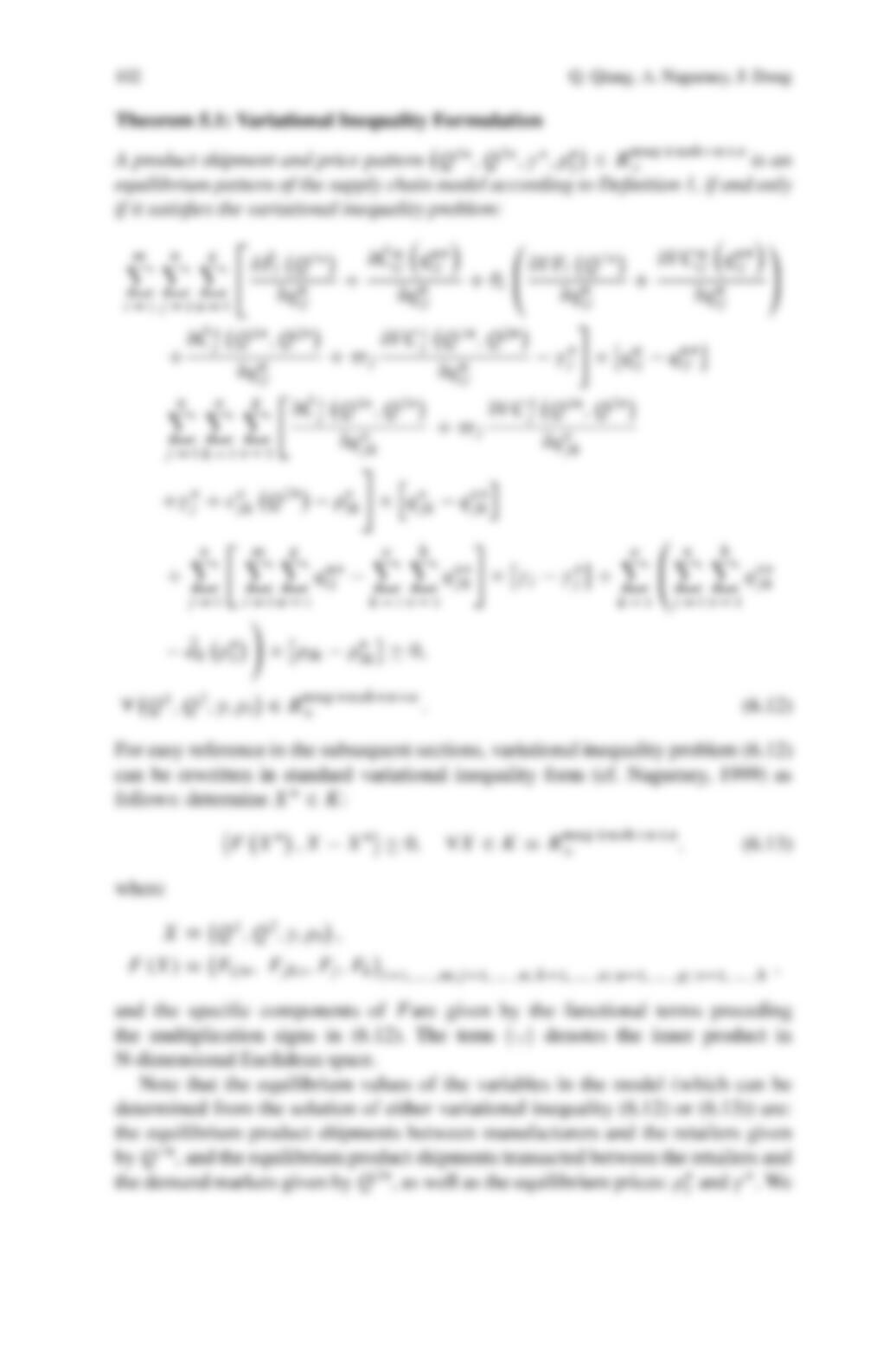
6 Modeling of Supply Chain Risk Under Disruptions
with Performance Measurement and Robustness Analysis :::::::::: 91
Qiang Qiang, Anna Nagurney, June Dong
6.1 Introduction . . . . …..………………………………. 91
6.2 The Supply Chain Model with Disruption Risks
and Random Demands …..……….…………………. 94
Contents vii
6.2.1 TheBehavioroftheManufacturers.……………… 97
6.2.2 TheBehavioroftheRetailers ……………..…… 98
6.2.3 The Market Equilibrium Conditions . . …..………..100
6.2.4 The Equilibrium Conditions of the Supply Chain . ……101
6.3 A Weighted Supply Chain Performance Measure ….………..103
6.3.1 A Supply Chain Network Performance Measure . . ……103
6.3.2 Supply Chain Robustness Measurement . . . . ………..104
6.4 Examples………………….……………………..105
6.5 SummaryandConclusions ………………….………..109
References……………………………………………..109
7 The Effects of Network Relationships
on Global Supply Chain Vulnerability :::::::::::::::::::::::::::113
Jose M. Cruz
7.1 Introduction . ….…………………………………..113
7.2 The Global Supply Chain Networks Model . . . . …………….115
7.2.1 TheBehavioroftheManufacturers...……….……120
7.2.2 The Multicriteria Decision-Making Problem
Faced by a Manufacturer . ……………………..121
7.2.3 The Optimality Conditions of Manufacturers. ….……122
7.2.4 TheBehavioroftheRetailers ……………..……122
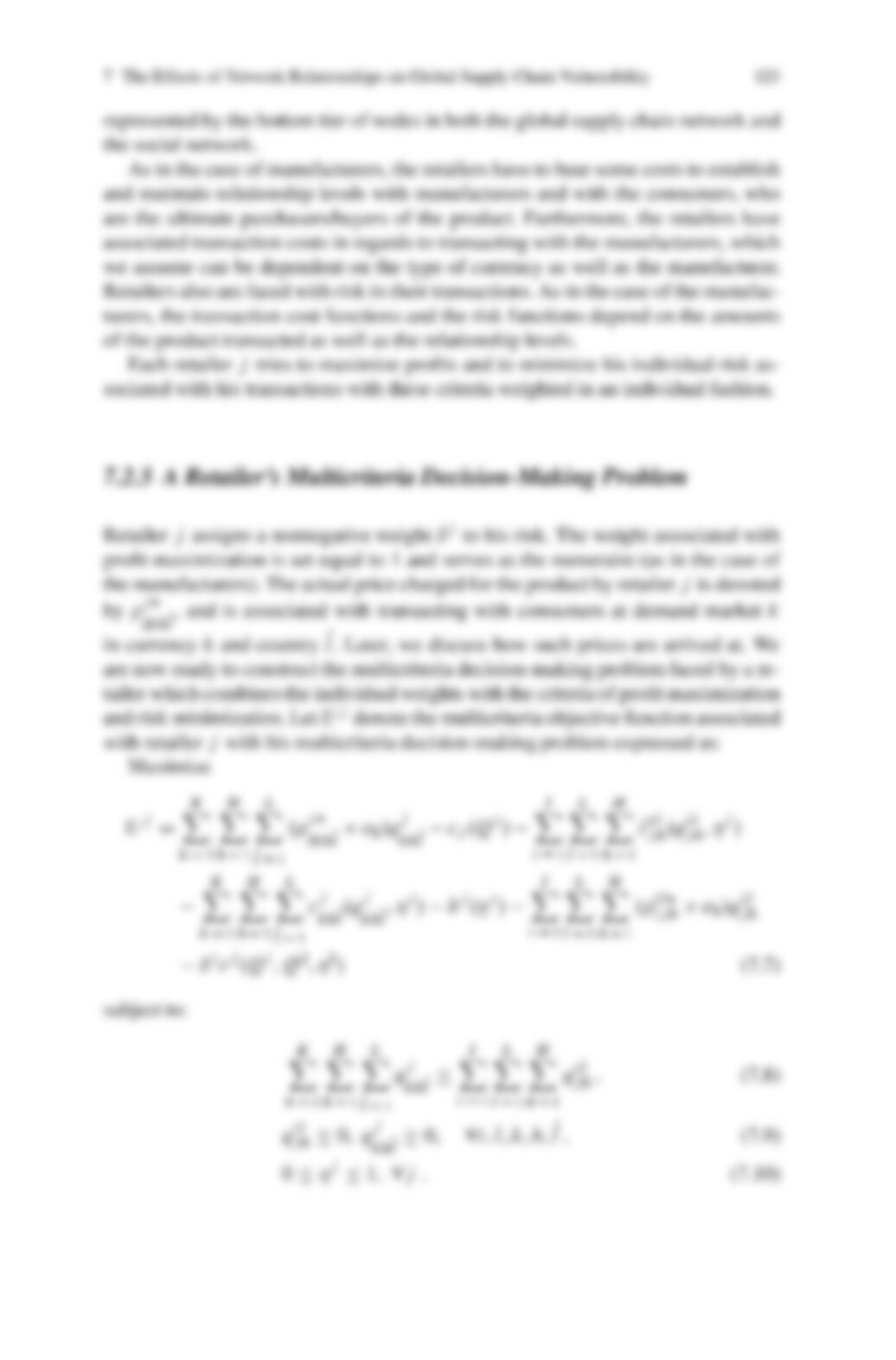
7.2.5 A Retailer’s Multicriteria Decision-Making Problem . . . . 123
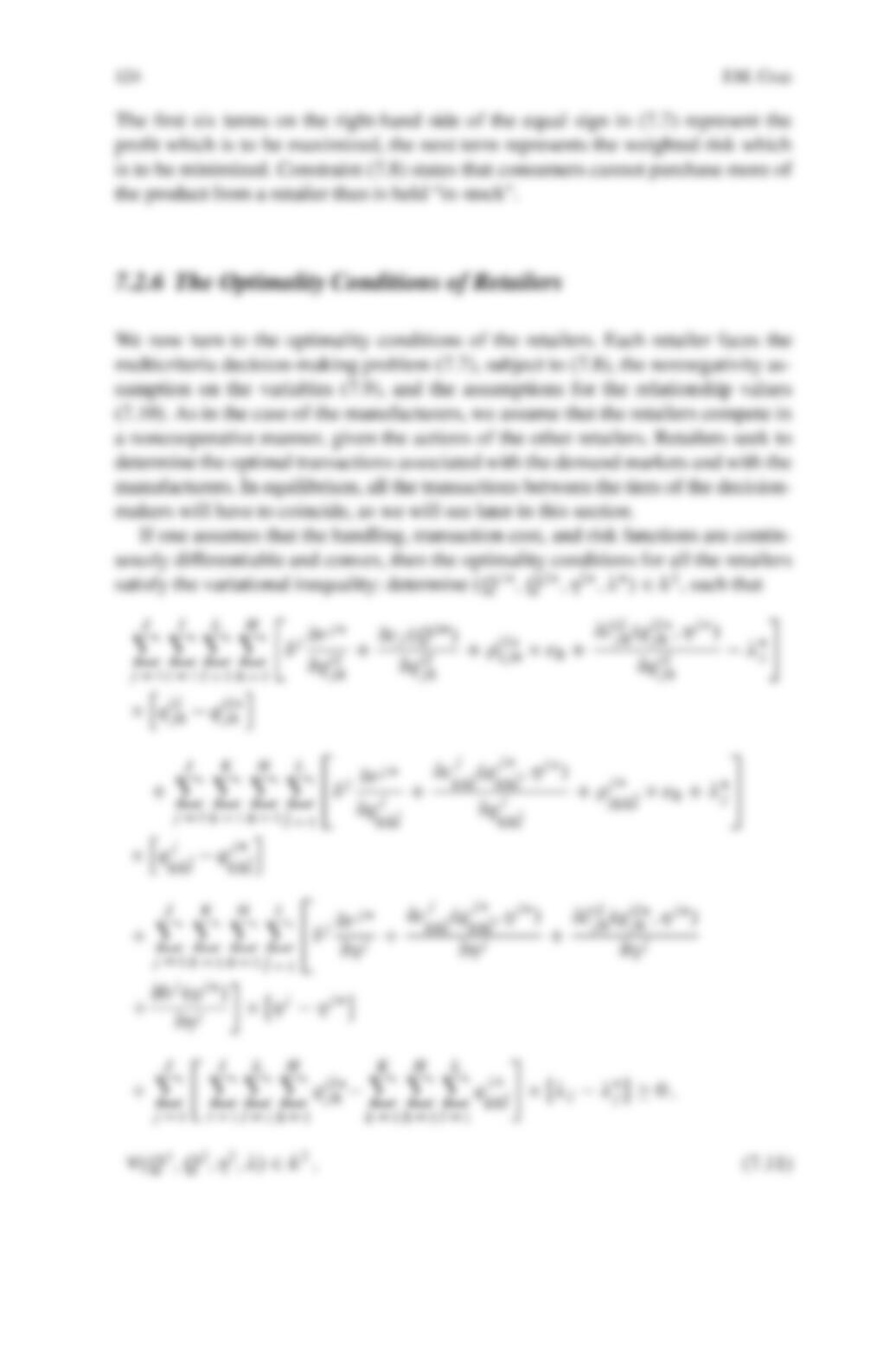
7.2.6 The Optimality Conditions of Retailers ….………..124
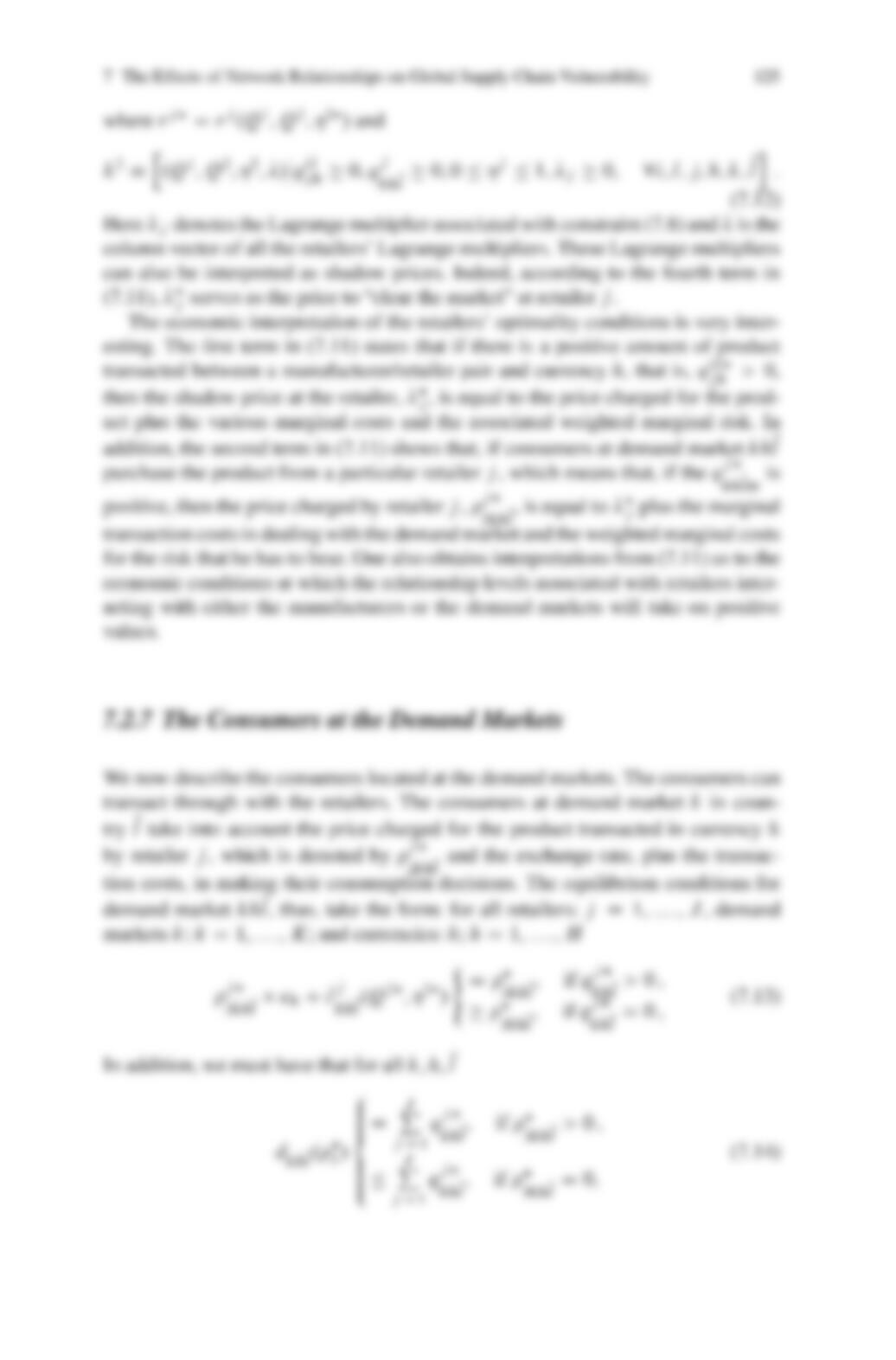
7.2.7 TheConsumersattheDemandMarkets…………...125
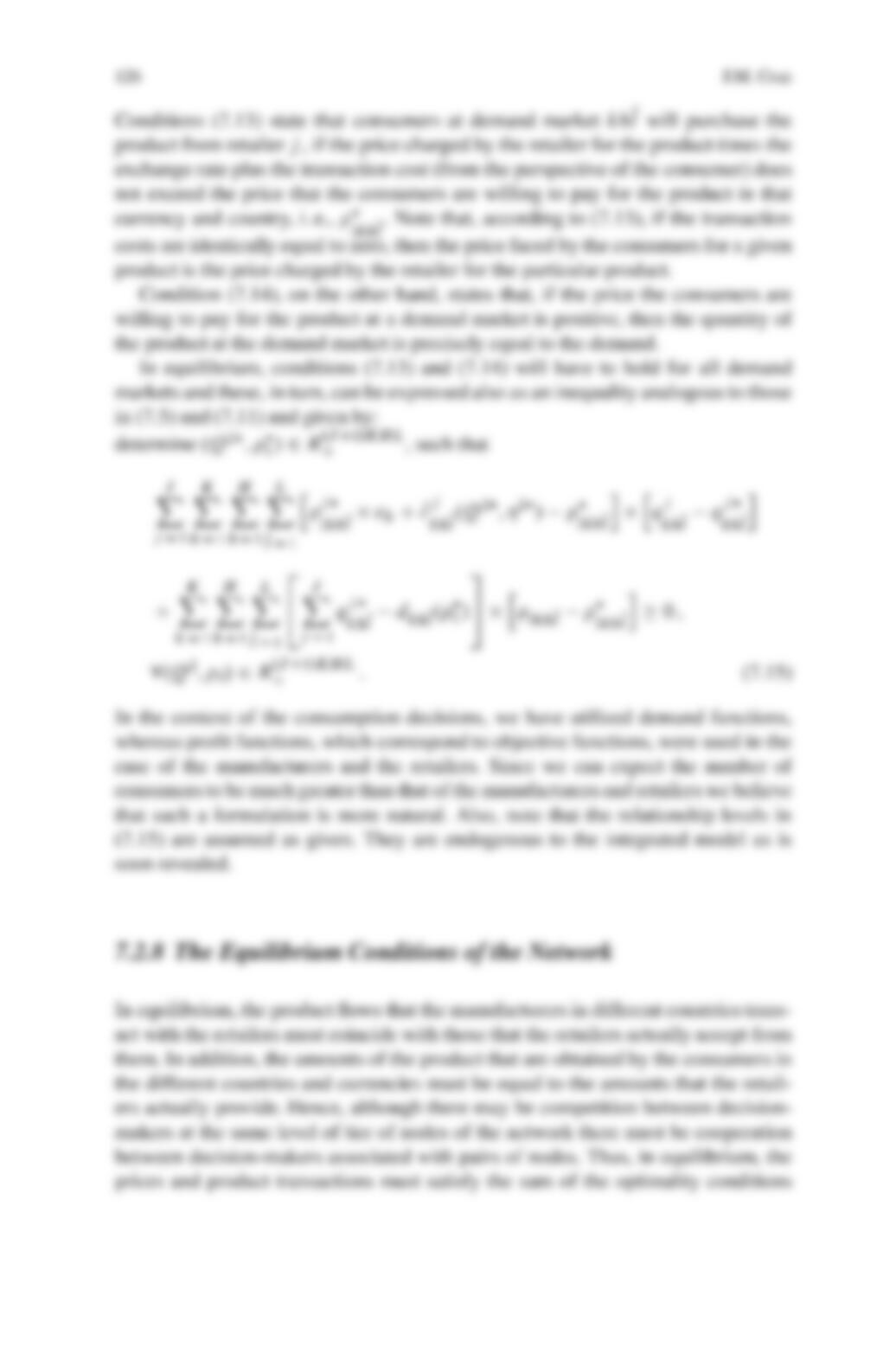
7.2.8 The Equilibrium Conditions of the Network …..……126
7.2.9 Remark.……….………………………….129
7.3 The Supply Chain Network Efficiency
and Vulnerability Measures . . ………………..………..129
7.4 NumericalExamples ..………………………………131
7.5 ManagerialImplications ….…………………….……137
7.6 Conclusions……….………………………………138
References……………………………………………..138
8 A Stochastic Model for Supply Chain Risk Management
Using Conditional Value at Risk ::::::::::::::::::::::::::::::::141
Mark Goh, Fanwen Meng
8.1 Introduction . ….…………………………………..141
8.2 AStochasticModelwithConditionalValueatRisk………….143
8.3 SampleAverageApproximationProgram …………………146
8.4 AnIllustrationoftheStochasticModel …………………..149
8.5 A Wine Supply Chain Problem . . . . ……….…………….151
8.6 Conclusion………..……….……………………..155
References……………………………………………..156
viii Contents
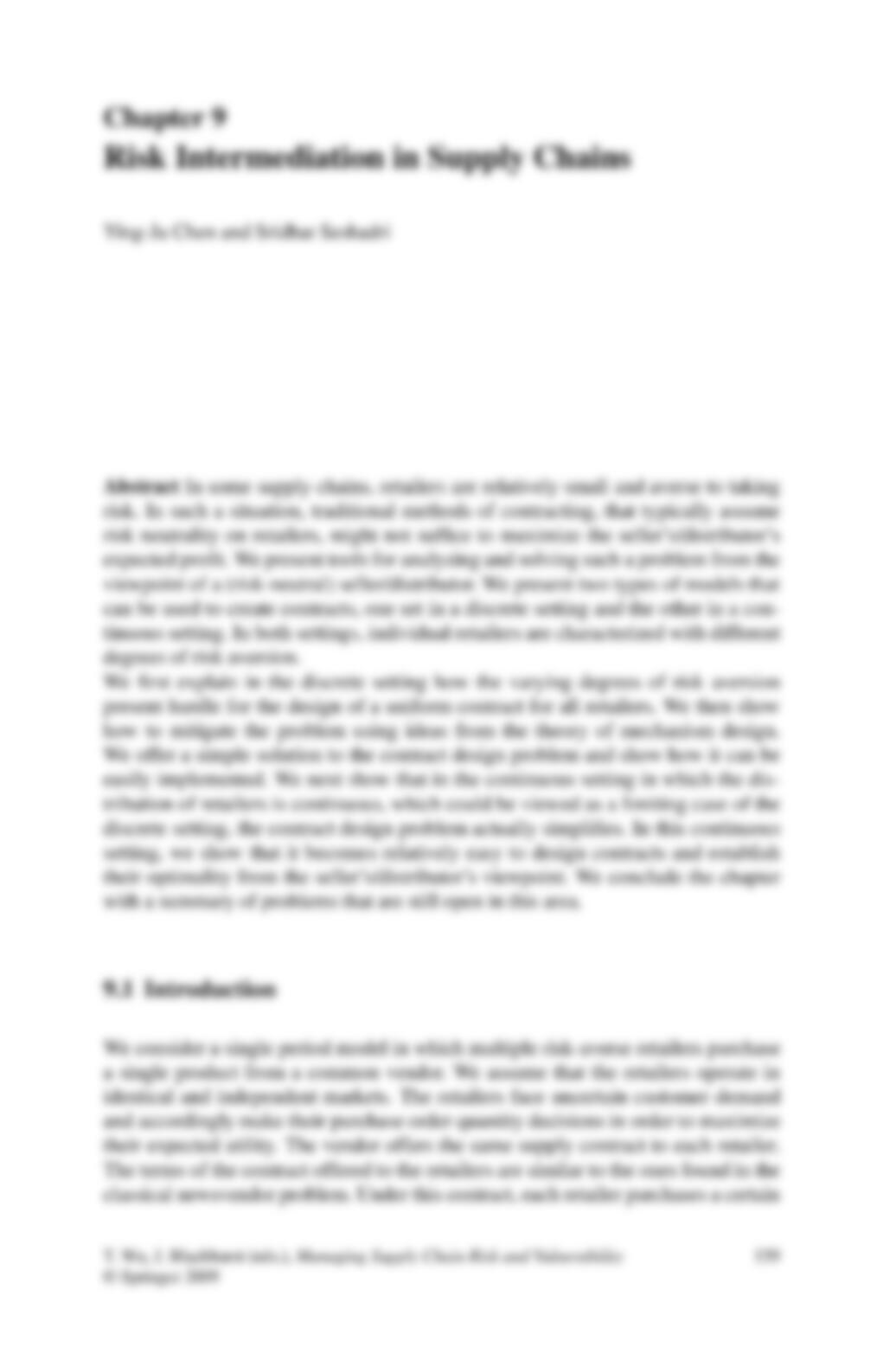
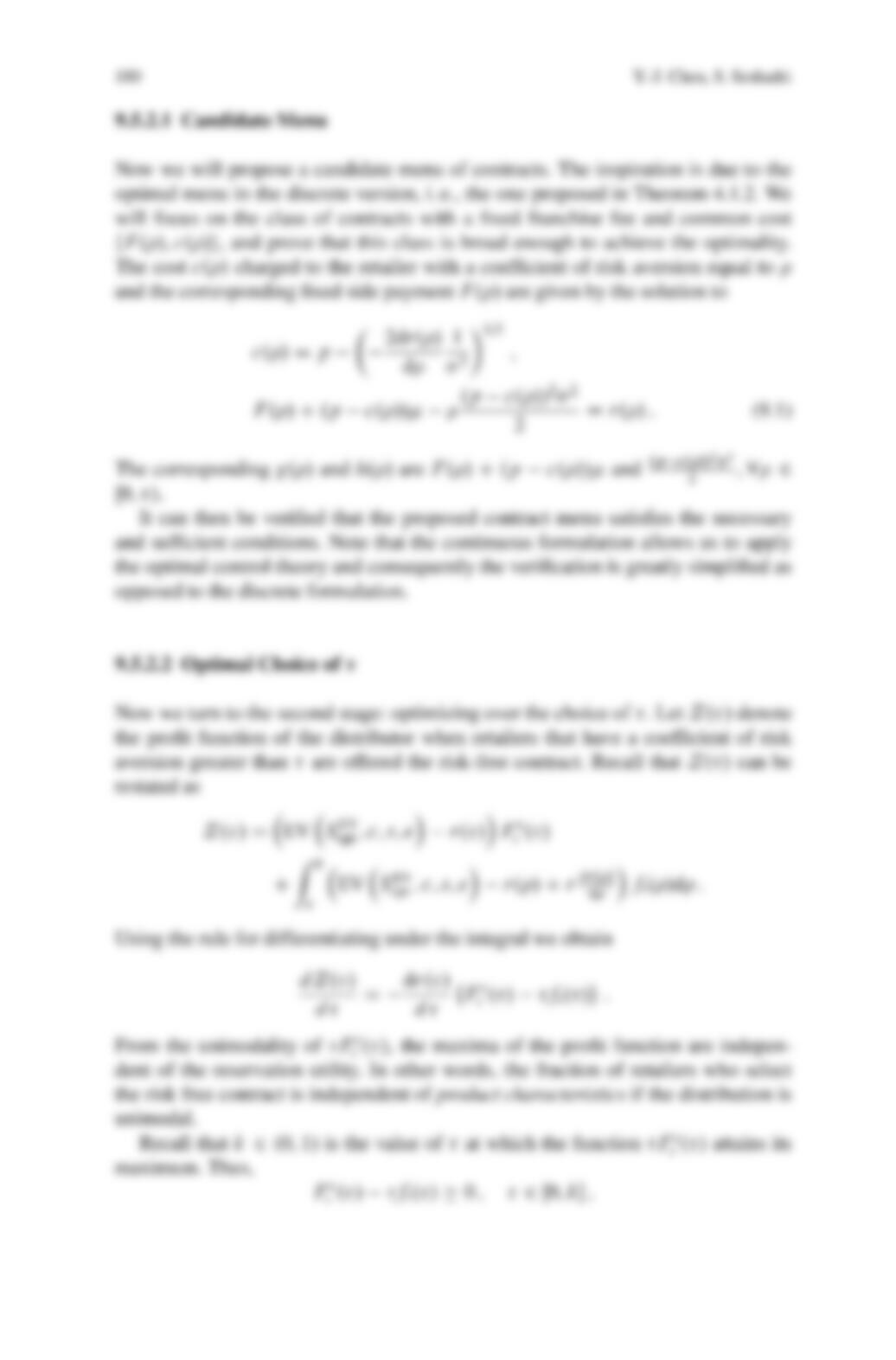
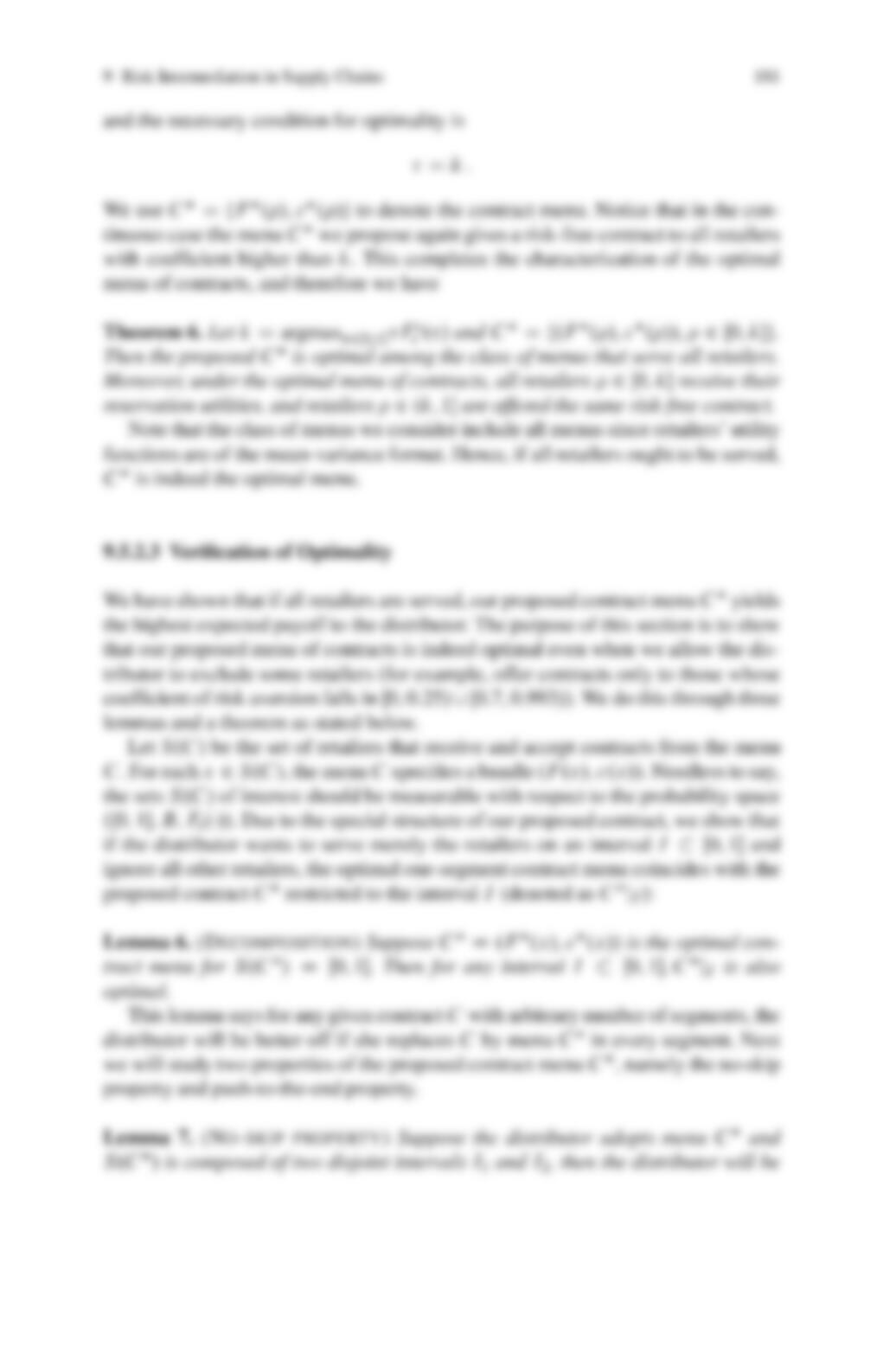
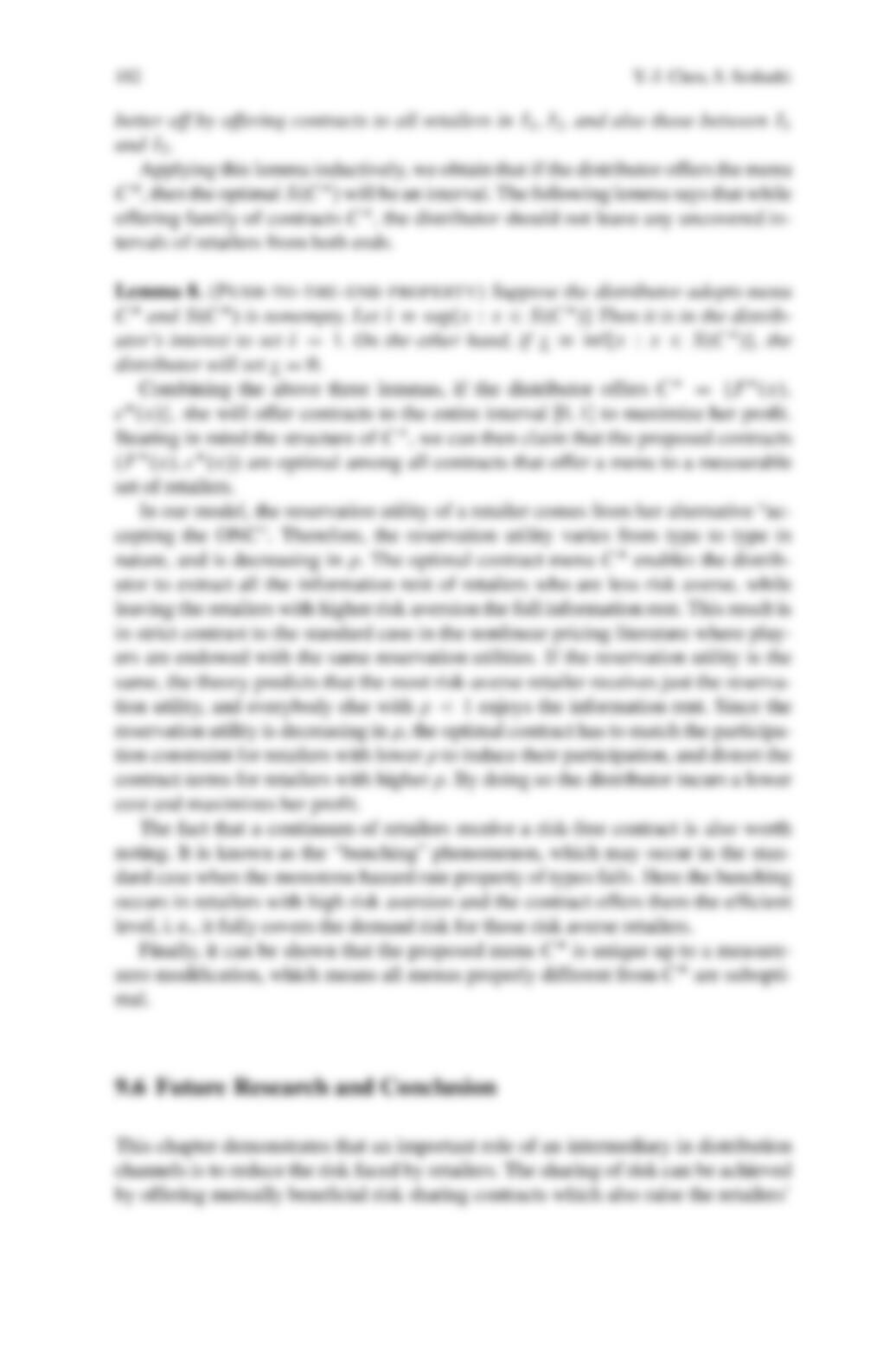
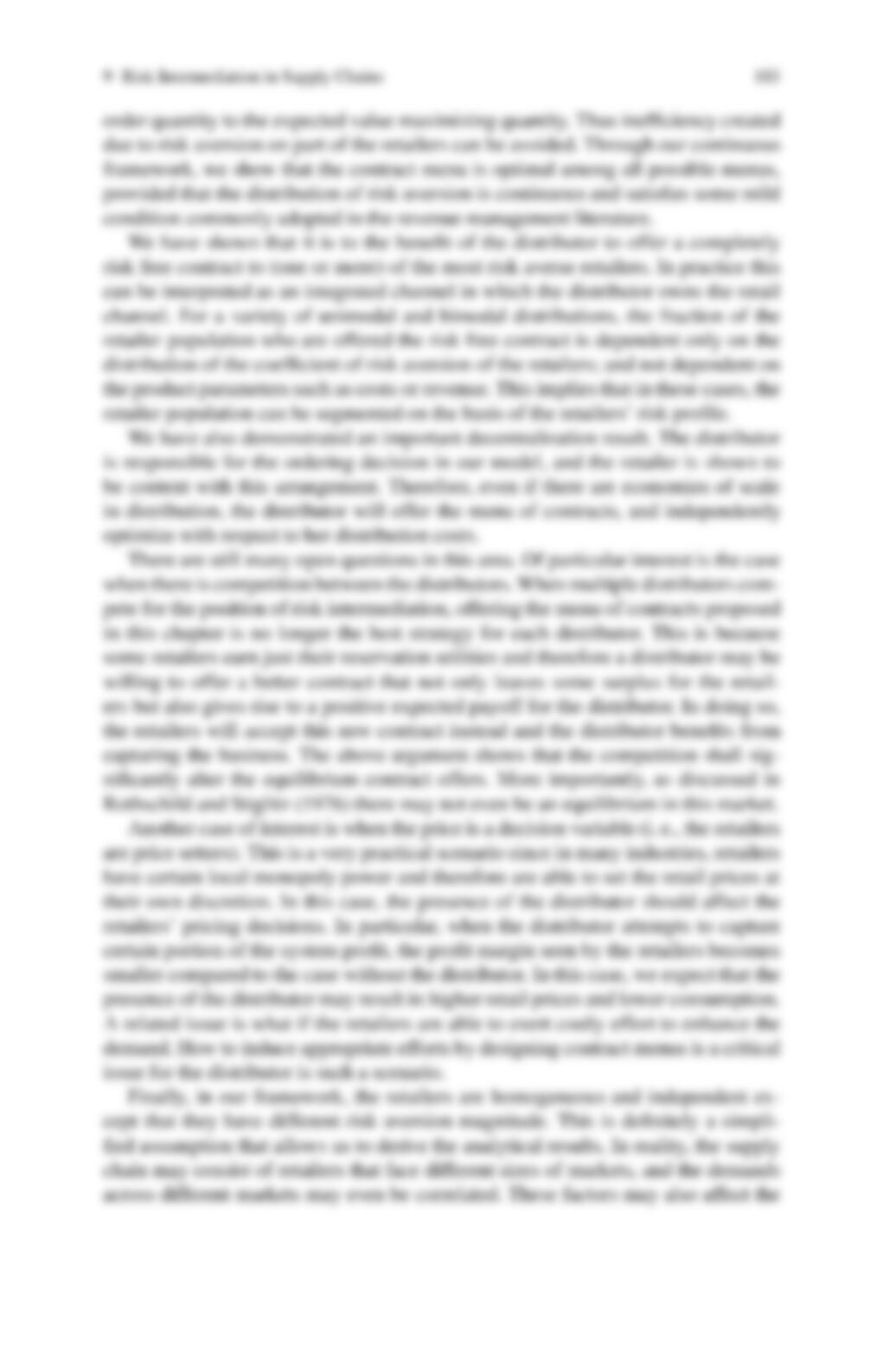
9 Risk Intermediation in Supply Chains ::::::::::::::::::::::::::: 159
Ying-Ju Chen, Sridhar Seshadri
9.1 Introduction . . . . …..……………………………….159
9.1.1 RelevantLiterature …..……….…………..…164
9.2 Model,Assumptions,andAnalysis………………………165
9.2.1 ASingleRetailer…………………………….166
9.3 Multiple Contracts . . . …..………………………..…172
9.4 RiskAversionandChannelStructure…………………….174
9.5 Continuous Formulation and the Optimality of the Menu . …….177
9.5.1 Continuous Type Space . ……….…………..…178
9.5.2 Optimal Contract Menu in the Continuous Case . …….178
9.6 FutureResearchandConclusion.………..……….…….182
References.……….……………………………………184
10 Forecasting and Risk Analysis in Supply Chain Management:
GARCH Proof of Concept ::::::::::::::::::::::::::::::::::::: 187
Shoumen Datta, Don P. Graham, Nikhil Sagar, Pat Doody,
Reuben Slone, Olli-Pekka Hilmola
10.1 Introduction . . . . …..……………………………….187
10.2 Supply Chain Management and Demand Amplification . . …….188
10.3 Beer Game and Role of Advanced Forecasting Methods . . ….…191
10.4 AdvancedStatisticalModels…..………………………194
10.5 TemporaryConclusion………………..……….…….200
References.……….……………………………………201
11 Supply Chain Risk Management: Annotation of Knowledge
Using a Semi-Structured Knowledge Model :::::::::::::::::::::: 205
Chun-Che Huang, Tzu-Liang (Bill) Tseng
11.1 Introduction . . . . …..……………………………….205
11.2 The Generation and Representation
ofSemi–StructuredKnowledge…………………..…….208
11.2.1 TheGenerationofSemi–StructuredKnowledge .…….208
11.2.2 Semi–StructuredKnowledgeRepresentation ……..…211
11.3 Annotation Framework for Supply Chain Risk Management
Knowledge……………………………………..…216
11.4 Interaction of Annotated SCRM Knowledge Documents
withtheBenchmarkOntology……………….…………223
11.4.1 ExtractingandMapping.……….…………..…223
11.4.2 Interaction Between SSK and the Benchmark Ontology . 226
11.5 Conclusions…………..………………………..…230
References.……….……………………………………231
List of Contributors
Jennifer Blackhurst
Department of Logistics, Operations and MIS College of Business, Iowa State
University, Ames, IA 50011, USA
Clare Brindley
Nottingham Business School, Nottingham Trent University, UK,
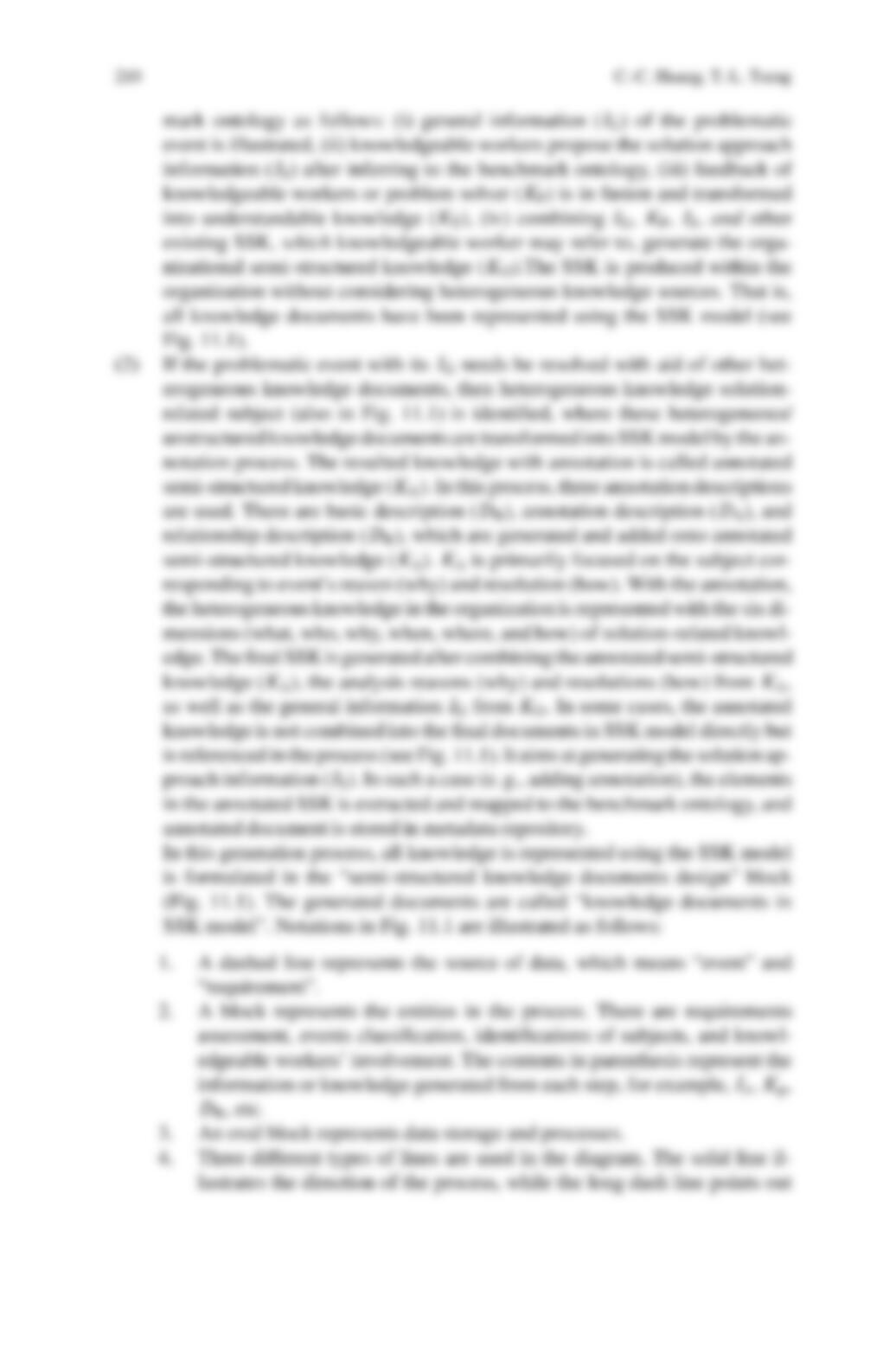
e-mail: clare.brindley@ntu.ac.uk
Ying-Ju Chen
University of California, Berkeley and University of Texas, Austin
Jose M. Cruz
Department of Operations and Information Management, School of Business,
University of Connecticut, Storrs, CT 06269, e-mail: jcruz@business.uconn.edu
Shoumen Datta
Engineering Systems Division, Department of Civil and Environmental En-
gineering, MIT Forum for Supply Chain Innovation, School of Engineering,
Massachusetts Institute of Technology, 77 Massachusetts Avenue,
Cambridge MA 02139
Jin Dong
IBM China Research Lab, Zhongguancun Software Park, Beijing 100193,
P.R. China
June Dong
Department of Marketing and Management, School of Business, State University
of New York at Oswego, Oswego, New York, 13126
ix
x List of Contributors
Pat Doody
Department of Mathematics and Computing, Centre for Innovation in Distributed
Systems, Institute of Technology Tralee, County Kerry, Ireland
Mohd. Nishat Faisal
Institute of Management Technology Dubai, P.O. Box 345006, Dubai International
Academic City, Dubai, United Arab Emirates, e-mail: nishat786@yahoo.com
Mark Goh
NUS Business School, The Logistics Institute – Asia Pacific, National Uni-
versity of Singapore, 7 Engineering Drive 1, Singapore 117543, Singapore,
e-mail: mark_goh@nus.edu.sg
Don P. Graham
INNOVEX LLC
Olli-Pekka Hilmola
Lappeenranta University of Technology, Kouvola Research Unit, Prikaatintie 9,
FIN-45100 Kouvola, Finland
Chun-Che Huang
Department of Information Management, National Chi Nan University, No. 1,
University Road, Pu-Li, Na-Tau, 545, Taiwan, R. O. C.
Fanwen Meng
NUS Business School, The Logistics Institute – Asia Pacific, National Uni-
versity of Singapore, 7 Engineering Drive 1, Singapore 117543, Singapore,
e-mail: tlimf@nus.edu.sg
Anna Nagurney
Department of Finance and Operations Management, Isenberg School of Manage-
ment, University of Massachusetts, Amherst, Massachusetts 01003
Qiang Qiang
Department of Finance and Operations Management, Isenberg School of Manage-
ment, University of Massachusetts, Amherst, Massachusetts 01003
Bob Ritchie
Lancashire Business School, University of Central Lancashire,
e-mail: rritchie@uclan.ac.uk
List of Contributors xi
Nikhil Sagar
Retail Inventory Management, OfficeMax Inc, 263 Shuman Boulevard, Naperville,
IL 60563
Sridhar Seshadri
University of California, Berkeley and University of Texas, Austin
Reuben Slone
OfficeMax Inc, 263 Shuman Boulevard, Naperville, IL 60563
ManMohan S. Sodhi
Cass Business School, City University of London, e-mail: m.sodhi@city.ac.uk
Christopher S. Tang
UCLA Anderson School, e-mail: ctang@anderson.ucla.edu
Tzu-Liang (Bill) Tseng
Department of Industrial Engineering, University of Texas at El Paso, 500 W.
University Ave., El Paso, TX 79968, USA
Wei Wang
IBM China Research Lab, Zhongguancun Software Park, Beijing 100193,
P.R. China
Teresa Wu
Department of Industrial Engineering, College of Engineering, Arizona State
University, Tempe, AZ 85287, USA
Chapter 1
Book Introduction
Jennifer Blackhurst and Teresa Wu
A supply chain is a network of entities such as manufacturer, suppliers and distrib-
utors working together to transform goods from raw material to final product while
moving them to the end customer. Effective supply chain management is a critical
component of a firm’s ability to fill consumer demand, regardless of the industry.
Supply chain performance may be decreased by disruptive events occurring in the
supply chain system. Supply chain disruptions are “unplanned events that may oc-
cur in the supply chain which might affect the normal or expected flow of materials
and components” (Svensson, 2000).
Managing the risk of these events occurring in the supply chain has become
known as supply chain risk management (SCRM) and may be defined as “the man-
agement of supply chain risks through coordination or collaboration among the sup-
ply chain partners so as to ensure profitability and continuity” (Tang, 2006). SCRM
has recently raised the attention of both academics and practitioners and is the focus
of this book.
One needs only to check the daily news to hear about disruptive events affecting
supply chain performance. Some of the better known examples include the 2002
longshoreman union strike at a U.S. West Coast port and affected supply chain per-
formance for up to 6 months for some firms (Cavinato, 2004) or the 2000 lightning
bolt at a Philips semiconductor plant in New Mexico which resulted in a small fire,
destroying millions of chips and ultimately their customers Nokia and Ericsson (La-
tour, 2001).
Because a supply chain disruption can potentially be so harmful and costly, there
has been a recent surge in interest and publications in the area of SCRM – from
academics and practitioners alike – regarding supply chain disruptions and related
issues. The purpose of this book will be to present tools and techniques for decision
making related to supply chain risk.
In general, a supply risk management process consists of four components:
(1) Risk identification; (2) Risk assessment; (3) Risk management decisions and
implementation; and (4) Risk monitoring (Hallikas et al., 2004). In the risk iden-
tification step, risks facing the firm’s supply chain are identified. Exemplary re-
T. Wu, J. Blackhurst (eds.), Managing Supply Chain Risk and Vulnerability 1
© Springer 2009
2 J. Blackhurst, T. Wu
search in this step may be found in Chopra and Sodhi (2004) where general risks
in the supply chain are categorized and discussed. The risk assessment step in-
volves understanding the impact of risks facing the supply chain. Examples of
previous risk assessment work includes that by Zsidisin et al. (2004) and Hal–
likas et al. (2004). Assessing risk is a complicated step and can help a firm to
prioritize which risks will affect the vulnerability of a supply chain. Risk man-
agement decision making requires supply chain managers to decide which mitiga-
tion strategies should be employed and where scarce resources may be allocated.
Certainly, these are by no means easy decisions with many aspects and factors
affecting these decisions. Finally, risk monitoring includes monitoring risks over
time.
In this book, the chapters presents tools and methods to assist supply chain man-
agers and researchers alike in the tasks of risk impact and assessment and decision
making in the supply chain considering risk. We feel these areas are the most dif-
ficult steps of the supply chain risk management process. Therefore, the book is
divided into two main sections:
1. Understanding and Assessing Risk in the Supply Chain
2. Decision Making and Risk Mitigation in the Supply Chain
These sections consist of 10 chapters from world class researchers from around the
world and employ a variety of methods to address timely issues in SCRM. The