Chapter 11 – Managing Products and Brands 1
Chapter 11 – Managing Products
and Brands
Learning Objectives
After reading this chapter, you should be able to:
LO1 – Explain the product life cycle.
LO2 – Identify ways that marketing executives manage a product’s life cycle.
LO3 – Recognize the importance of branding and alternative branding strategies.
LO4 – Describe the role of packaging, labelling, and warranties in the marketing of a
product.
A recent survey of Canadian shoppers revealed the brands that they most “trusted.” Survey
participants named the brands that they consider their most trusted in more than 130 product
categories. Research reveals that “brand trust” has two key dimensions: functional trust and
emotional trust. Functional trust comes from traditional metrics such as quality, reliability,
and consistency. It is a fundamental requirement for a brand, but it is not necessarily
sufficient. The most trusted brands are winning on emotional trust. Emotional trust comes
from metrics such as workplace practices, environmental policies, community responsibility,
and consumer connection to the brand.
Canada’s top brands, the ones that dominate in their categories, have basically built consumer
trust by offering a positive and consistent product experience. Moreover, they frequently
build on this trust with meaningful innovation while maintaining a perception of strong value.
Consumers’ reasons for citing a brand as their most trusted vary by category. Quality
perceptions and taste drive which food brands are most trusted, while taste preferences
particularly are most cited as the reason for favouring one beverage brand over others. For
health and beauty brands, trust is built on quality perceptions, effectiveness (i.e., meeting
personal needs), and perception of a fair price. For household brands, consumers most often
cite effectiveness, and for kids brands, a guarantee of gentleness is most important.
Product Life Cycle
Products, like people, have been viewed as having a life cycle. The concept of the product
life cycle describes the stages a new product goes through in the marketplace: introduction,
growth, maturity, and decline.
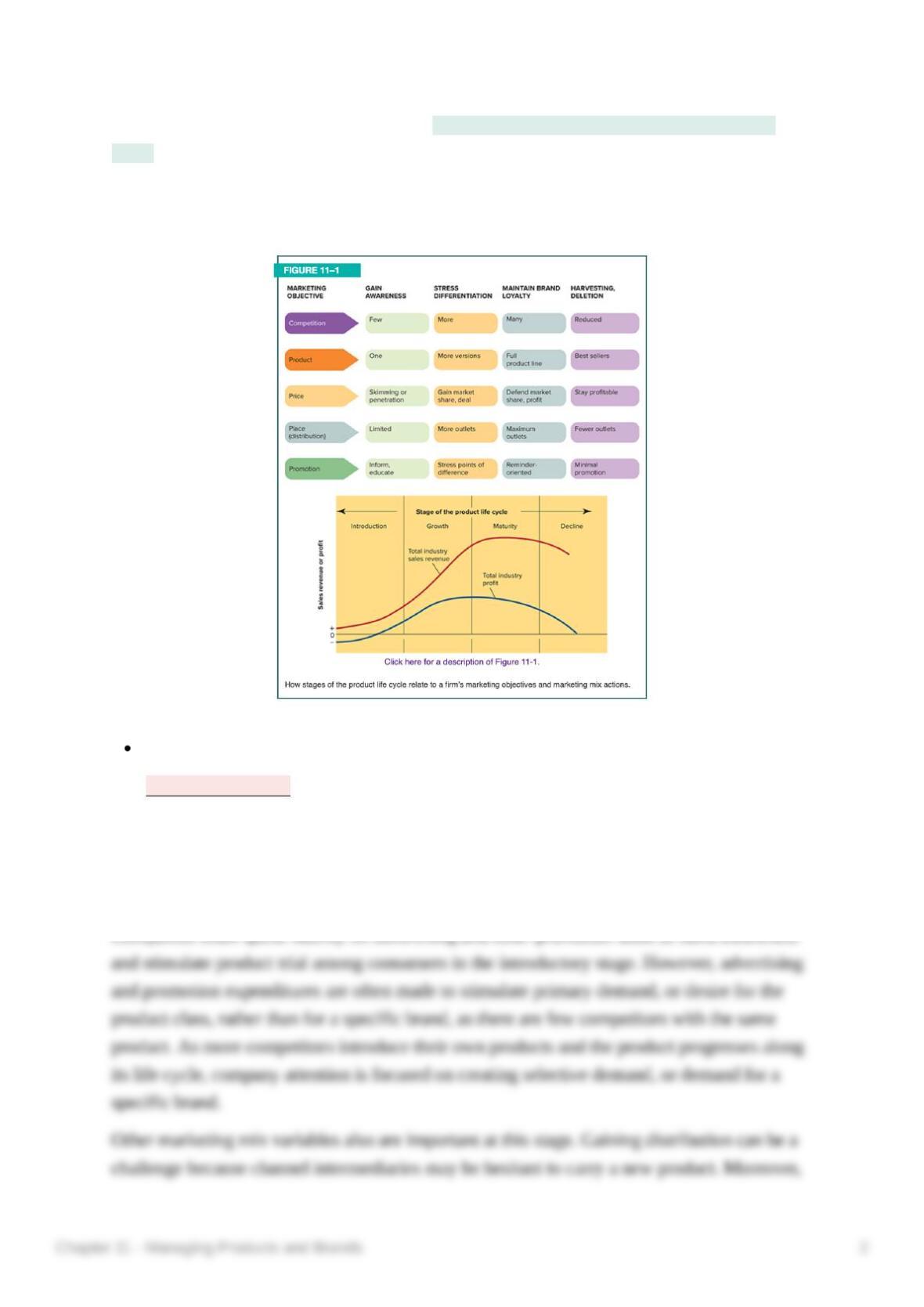
There are two curves shown in this figure: total industry sales revenue and total industry
profit, which represent the sum of sales revenue and profit of all firms producing the product.
The reasons for the changes in each curve and the marketing decisions involved are discussed
on the following pages.
Introduction Stage
Theintroductionstage of the product life cycle occurs when a product is first introduced to
its intended target market. During this period, sales grow slowly and profit is minimal. The
lack of profit is often the result of large investment costs in product development. The
marketing objective for the company at this stage is to create consumer awareness and
stimulatetrial—the initial purchase of a product by a consumer.