Lindsay is a student who has accrued a lot of debt over the past year.
She is so overwhelmed and doesn’t know where to begin.
PART 4 Managing Insurance
Needs
Chapter 8 Insuring Your Life
Chapter 9 Insuring Your Health
Chapter 10 Protecting Your Property
So…your computer and
your stereo were stolen…did you notice
anything else missing?…By the way,
you do have renter’s insurance,
don’t you?
I…I…dunno…if
anything else was stolen
yet…but…I do have
renter’s insurance…
Wow…I don’t have renter’s
insurance…I wonder how I can
get it…I better check with GJ11.
22865_08_c08_p239-271.qxd 10/5/06 12:55 PM Page 239

Insuring Your Life
CHAPTER 8 LEARNING GOALS
LG1 Explain the concept of risk and the basics of insurance
underwriting. p. 240
LG2 Discuss the primary reasons for life insurance and
identify those who need coverage. p. 242
LG3 Calculate how much life insurance you need. p. 244
LG4 Differentiate among the various types of life insurance
policies and describe their advantages and disadvantages. p. 249
LG5 Choose the best life insurance policy for your needs
at the lowest cost. p. 259
LG6 Become familiar with the key features of life insurance
policies. p. 263
8 : 240 Insuring Your Life
LG1 BASIC INSURANCE CONCEPTS
As most people discover, life is full of unexpected events that can have far-reaching con-
sequences. Your car is sideswiped on the highway and damaged beyond repair. A family
member falls ill and can no longer work. A fire or other disaster destroys your home. Your
spouse dies suddenly. Although most people don’t like to think about possibilities like this,
protecting yourself and your family against unforeseen events is part of sound financial
planning. Insurance plays a central role in providing that protection.
Auto and homeowner’s
insurance
, for example, reimburses you if your car or home are destroyed or damaged.
Life insurance
helps replace lost income if premature death occurs, providing funds so that
your loved ones can keep their home, maintain an acceptable lifestyle, pay for education,
and meet other special needs.
Hospitalization and health insurance
covers medical costs
when you get sick, and
disability insurance
protects your income while you’re ill.
All of these types of insurance are intended
to protect you and your dependents from
the financial consequences of losing assets or income when an accident, illness, or death
occurs.
By anticipating the potential risks that your assets and income could be exposed
to and weaving insurance protection into your financial plan, you lend a degree of certainty
to your financial future. We’ll begin this chapter by introducting important insurance con-
cepts such as risk and underwriting before focusing on how to make decisions regarding
life insurance. In Chapters 9, and 10, we’ll discuss other important types of insurance
including health insurance and property insurance.
22865_08_c08_p239-271.qxd 10/5/06 12:55 PM Page 240

The Concept of Risk
An important concept in any discussion of insurance is
risk.
In insurance terms, risk is defined as
uncertainty with respect to economic loss. Whenever you and your family have a financial
interest in something—whether it’s your life, health, home, car, or business—there’s a risk
of financial loss if that item is lost or damaged. Because such losses can be devastating to
your financial security, you must devise strategies for anticipating and dealing with poten-
tial risks. These strategies include risk avoidance, loss prevention and control, risk assump-
tion, and insurance.
Risk Avoidance
The simplest way to deal with risk is to avoid the act that creates it. For example, people
who are afraid they might lose everything they own because of a lawsuit resulting from an
automobile accident could avoid driving. Regarding life and health risks, avid skydivers or
bungee jumpers might want to choose another recreational activity!
Although risk avoidance can be an effective way to handle some risks, it has its
costs. People who avoid driving suffer considerable inconvenience, and the retired sky-
diver may find she now suffers
more
stress, which can lead to different types of health
risks. Risk avoidance is an attractive way to deal with risk only when the estimated cost of
avoidance is less than the estimated cost of handling it in some other way.
Loss Prevention and Control
Generally, loss prevention can be defined as any activity that reduces the probability
that a loss will occur (such as driving within the speed limit to lessen the chance of being
in a car accident). Loss control, in contrast, is any activity that lessens the severity of
loss once it occurs (such as wearing a safety belt or buying a car with air bags). Loss pre-
vention and loss control should be important parts of the risk management program of
every individual and family. In fact, insurance is a reasonable way of handling risk only
when people use effective loss prevention and control measures.
Risk Assumption
With risk assumption, you choose to accept and bear the risk of loss. Risk assumption
can be an effective way to handle many types of potentially small exposures to loss when
insurance would be too expensive. (For example, the risk of having your
Personal Financial
Planning
text stolen probably doesn’t justify buying insurance.) It’s also a reasonable
approach for dealing with very large risks that you can’t ordinarily prevent or secure insur-
ance for (nuclear holocaust, for example). Unfortunately, people often assume risks
unknowingly. They may be unaware of various exposures to loss or think that their insur-
ance policy offers adequate protection when, in fact, it doesn’t.
Insurance
An insurance policy is a contract between you (the insured) and an insurance company
(the insurer) under which the insurance company agrees to reimburse you for any losses
you suffer according to specified terms. From your perspective,
you are transferring your
risk of loss to the insurance company.
You pay a relatively small amount (the insurance
premium) in exchange for a promise from the insurance company that they’ll reimburse
you if you suffer a loss covered by the insurance policy.
Why are insurance companies willing to accept this risk? Simple. They combine
the loss experiences of large numbers of people, and, by using statistical information
known as
actuarial data
, they can estimate the risk of loss faced by the insured popu-
lation. Losses for the entire group of policyholders are thus more predictable than for
any one of the insureds individually. Insurance companies invest the amount they col-
lect from premiums and, if the amount they pay out in losses and expenses is less
than what they earn on those investments, they make a profit. Therefore, accurately
estimating the number and size of insured losses that will occur is critical for insur-
ance companies.
8 : 241
Insuring Your Life
risk avoidance To avoid
an act that would create a
risk.
loss prevention Any
activity that reduces the
probability that a loss will
occur.
loss control Any activity
that lessens the severity of
loss once it occurs.
risk assumption The
choice to accept and bear
the risk of loss.
insurance policy A con-
tract between the insured
and the insurer under which
the insurer agrees to reim-
burse the insured for any
losses suffered according to
specified terms.
underwriting The
process used by insurers to
decide who can be insured
and to determine applicable
rates they will charge for
premiums.
22865_08_c08_p239-271.qxd 10/5/06 12:55 PM Page 241

Underwriting Basics
Insurance companies take great pains to decide whom they will insure and the applicable
rates they will charge for premiums. This function is called underwriting. Underwriters
design rate-classification schedules so that people pay premiums equal with their chance
of loss. Through underwriting, insurance companies try to guard against
adverse selection
,
which happens when only high-risk clients apply for and get insurance coverage.
Underwriting directly impacts an insurance company’s chances of success. If under-
writing standards are too high, people will be unjustly denied insurance coverage, and
insurance sales will drop. On the other hand, if standards are too low, many insureds will
pay less than their fair share based upon their potential for losses, and the insurance com-
pany’s solvency may be jeopardized.
A basic problem facing insurance underwriters is how to select the best criteria for
classifying the people they insure. Because there’s no perfect relationship between avail-
able criteria and loss experience, some people invariably believe they’re being charged
more than they should be for their insurance. Insurers are always trying to improve their
underwriting capabilities in order to set premium rates that will adequately protect policy-
holders against insolvency and yet be attractive and reasonable.
Because underwriting practices and standards also vary between insurance compa-
nies, you can often save money by shopping around for the company offering the most
favorable underwriting policies for your specific characteristics and needs. To make an
effective decision about any insurance product, therefore, you need a basic understanding
of the different types of insurance available as well as insight into your own tolerance for
risk when it comes to protecting your financial assets and your family. The discussion of
life insurance that follows in this chapter, and succeeding chapters that discuss other
types of insurance, will help you accomplish these goals.
8 : 242 Insuring Your Life
underwriting the process
used by insurers to decide
who can be insured and
to determine applicable
rates they will charge for
premiums.
8-1
8-2
Discuss the role insurance plays in the financial planning process. Why is it
important to have enough life insurance?
Define (a)
risk avoidance
, (b)
loss prevention
, (c)
loss control
, (d)
risk assump-
tion
, and (e) an
insurance policy
. Explain their interrelationships, if any.
8-3 Explain the purpose of underwriting. What are some factors underwriters
consider when evaluating a life insurance application?
EPT CHECK • CONCEPT CHECK • CONCEPT CHECK • CONCEPT CHECK • CONCEPT CHECK • CONCEPT CHECK • CONCEPT CHEC
Concept Check
LG2 WHY BUY LIFE INSURANCE?
Life insurance planning is an important part of every successful financial plan. Its primary
purpose is to
protect your dependents from financial loss in the event of your untimely
death
. It’s an umbrella of protection for your loved ones, protecting the assets you’ve built
up during your life and providing funds to help your family reach important financial goals
even after you die.
Benefits of Life Insurance
Despite the importance of life insurance to sound financial planning, many people put off
the decision to buy, it. This happens partly because life insurance is associated with some-
thing unpleasant in many people’s minds—namely, death. People don’t like to talk about
death or the things associated with it, so they often put off considering their life insurance
needs. Life insurance is also intangible. You can’t see, smell, touch, or taste its benefits—
and those benefits mainly happen after you’ve died. However, life insurance does have
some important benefits that should not be ignored in the financial planning process:
22865_08_c08_p239-271.qxd 10/5/06 12:55 PM Page 242

•Financial protection for dependents. If your family or loved ones depend on your
income, what would happen to them after you die? Would they be able to maintain
their current lifestyle, stay in your home, or afford a college education? Life insurance
provides a financial cushion for your dependents, giving them a set amount of money
after your death that they can use for many purposes. For example, your spouse may
use your life insurance proceeds to pay off the mortgage on your home so your family
can continue living there comfortably or set aside funds for your child’s college educa-
tion. In short, the most important benefit of life insurance is providing financial protec-
tion for your dependents after your death.
•Protection from creditors. A life insurance policy can be structured so that death ben-
efits are paid directly to a named beneficiary rather than being considered as part of
your estate. This means that even if you have outstanding bills and debts at the time
of your death, creditors cannot claim the cash benefits from your life insurance policy,
providing further financial protection for your dependents.
•Tax benefits. Life insurance proceeds paid to your heirs, as a rule, aren’t subject to
state or federal income taxes. Further, if certain requirements are met, policy proceeds
can pass to named beneficiaries free of any
estate
taxes.
•Vehicle for savings. Some types of life insurance policies can serve as a savings vehi-
cle, particularly for those who are looking for safety of principal.
Variable life policies
,
which we’ll discuss later in this chapter, are more investment vehicles than they are
life insurance products. But don’t assume that all life insurance products can be con-
sidered savings instruments. As we’ll see later in this chapter, the comparison is often
inappropriate.
Just like other aspects of personal financial planning, life insurance decisions can be
made easier by following a step-by-step approach to answer the following questions:
1. Do you need life insurance?
2. If so, how much life insurance do you need?
3. Which type of life insurance is best given your financial objectives?
4. What factors should be considered in making the final purchase decision?
Do You Need Life Insurance?
The first question to ask when considering the purchase of life insurance is whether you
need it. Not everyone does. Many factors, including your personal situation and other
financial resources, play a role in determining your need for life insurance. Remember, the
major purpose of life insurance is to provide financial security for your dependents in the
event of your death. As we’ve discussed, life insurance provides other benefits, but
they’re all a distant second to this one.
Who needs life insurance? In general, life insurance should be considered if you have
dependents counting on you for financial support. Therefore, a single adult who doesn’t
have children or other relatives to support may not need life insurance at all. Children also
usually don’t require insurance on their life.
Once you marry, your life insurance requirements should be reevaluated, depending on
your spouse’s earning potential and assets—such as a house—that you want to protect.
The need for life insurance increases the most when children enter the picture, because
young families stand to suffer the greatest financial hardship from the premature death of
a parent. Even a non-wage-earning parent may require some life insurance to ensure that
children are adequately cared for if the parent dies.
As families build assets, their life insurance requirements continue to change, both in
terms of the amount of insurance needed and the type of policy necessary to meet their
financial objectives and protect their assets. Other life changes will also affect your life
insurance needs. For example, if you divorce or your spouse dies, you may need additional
life insurance to protect your children. Once your children finish school and are on their
own, the need for life insurance may drop. In later years, life insurance needs vary
depending on the availability of other financial resources, such as pensions and invest-
ments, to provide for your dependents.
8 : 243
Insuring Your Life
HEC
22865_08_c08_p239-271.qxd 10/5/06 12:55 PM Page 243

LG3 HOW MUCH LIFE INSURANCE IS RIGHT FOR YOU?
After deciding that life insurance makes sense for your particular situation, you’ll need to
make more decisions to find the life insurance product that best fits your needs. First, you
must determine how much life insurance you need for adequate coverage. Buying too
much life insurance can be costly; buying too little may prove disastrous. To avoid these
problems, you can use one of two methods to estimate how much insurance is neces-
sary: the
multiple-of-earnings method
and the
needs analysis method
.
The multiple-of-earnings method takes your gross annual earnings and multiplies
it by some selected (often arbitrary) number to arrive at an estimate of adequate life insur-
ance coverage. The rule of thumb used by many insurance agents is that your insurance
coverage should be equal to 5 to 10 times your current income. For example, if you cur-
rently earn $70,000 a year, using the multiple-of-earnings method you’d need between
$350,000 and $700,000 worth of life insurance. Although simple to use, the multiple-of-
earnings method fails to fully recognize the financial obligations and resources of the indi-
vidual and his or her family. Therefore, the multiple-of-earnings method should be used
only to roughly approximate life insurance needs.
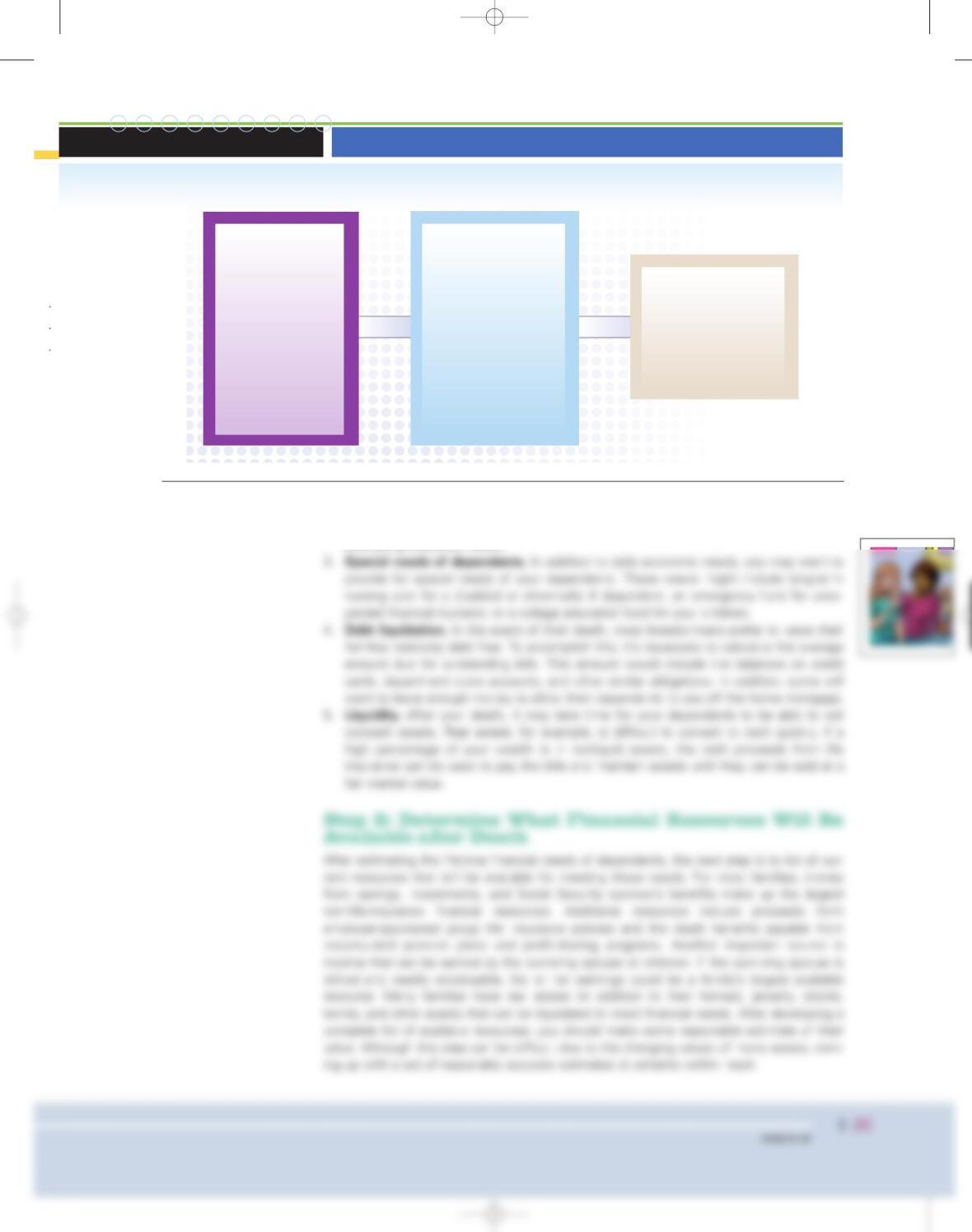
A more detailed approach is the needs analysis method. The needs analysis
method considers both the financial obligations and financial resources of the insured and
his or her dependents. This method involves three steps, as shown in Exhibit 8.1:
1. Estimate the total economic resources needed if the individual were to die.
2. Determine all financial resources that would be available after death, including existing
life insurance and pension plan death benefits.
3. Subtract available resources from the amount needed to calculate how much additional
life insurance is required.
Step 1: Assess Your Family’s Total Economic Needs
The first question the needs analysis method asks is:
What financial resources will my sur-
vivors need should I die tomorrow
? You should consider the following five items in
answering this question:
1. Income needed to maintain an adequate lifestyle. If you died, how much money
would your dependents need each month in order to live a comfortable life? Estimate
this amount by looking at your family’s current monthly budget, including expenses for
housing costs, utilities, food, clothing, and medical and dental needs. Other expenses
to consider include property taxes, insurance, recreation and travel, and savings. Try to
take into account that the amount needed may change over time. For example, once
children are grown, monthly household expenses should decrease substantially but the
surviving spouse may still need monthly support. Therefore, the survivor’s life
expectancy and the income they’ll require may also need to be considered.
2. Extra expenses if the income producer dies. These expenses include funeral costs
and any expenses that might be incurred to replace services you currently provide. For
example, a mother who doesn’t work outside of the home still provides childcare,
cooking, cleaning, and other services. If she were to die or have to return to work,
these services might have to be replaced using the family’s income. Because such
8 : 244 Insuring Your Life
multiple-of-earnings
method A method of deter-
mining the amount of life
insurance coverage needed
by multiplying gross annual
earnings by some selected
number.
needs analysis method
A method of determining the
amount of life insurance
coverage needed by consid-
ering a person’s financial
obligations and available
financial resources in addi-
tion to life insurance.
8-4
8-5
Discuss some benefits of life insurance in addition to protecting family
members financially after the primary wage earner’s death.
Explain the circumstances under which a single college graduate would or
would not need life insurance. What life-cycle events would change this initial
evaluation, and how might they affect his or her life insurance needs?
EPT CHECK • CONCEPT CHECK • CONCEPT CHECK • CONCEPT CHECK • CONCEPT CHECK • CONCEPT CHECK • CONCEPT CHEC
Concept Check
22865_08_c08_p239-271.qxd 10/5/06 12:55 PM Page 244
expenses can stretch a family budget to the breaking point, include them when you’re
HEC
EXHIBIT 8.1 How Much Life Insurance Do You Need?
The needs analysis method uses three steps to estimate life insurance needs.
equalsminus
Step 2:
Determine what
financial resources will
be available after death
Step 1:
Assess your family’s
total economic needs
Step 3:
Amount of additional
life insurance required
to protect your family
Income needed to
maintain an
adequate lifestyle
Extra expenses if the
income producer dies
Special needs of
dependents
Debt liquidation
Liquidity
Savings and invest-
ments Income from
Social Security survivor
benefits; surviving
spouse’s annual
income; other annual
pensions and profit
sharing programs.
Other life insurance
Other resources.
22865_08_c08_p239-271.qxd 10/5/06 12:55 PM Page 245