Jiayi Ruan
Acct 362W
Effective Alliances and Partnerships Development
Executive Summary
Supplier Relationship Management improves relationships with the supply chain by
managing suppliers through alliances and partnerships. Through both integration of resources
and competitive advantages, they jointly develop new markets, expand market demand and
market share, and reduce the high cost of the product early to achieve a win-win enterprise
management goal. The processes and technologies that support Direct and Indirect spending,
Maintenance Repair & Overhaul, and Services expenses are the keys in Supplier Relationship
Management. Each of these spending areas has a strong influence on the specific strategies
company take in response the partner and production needs of their organizations. Direct
spending centralizes on the purchase of materials that directly support the manufacturing of a
company’s products and the reliance on partners in this area. Indirect spending is when the
spending with the partners is associated with the purchase of items that are not connected with
spending on projects or with Bills of Material directly. Maintenance, Repair and Overhaul is the
buying and purchasing of spare parts, those parts used for repair and refurbishment, and
equipment overhaul. As the largest area of spending with suppliers in many companies, this area
of spending and partnering category centers on the procurement of services.
How all these spending categories relate to alliances and partnerships is that the higher
the order velocities, the higher the time pressures on product lifecycles as is the case in the
electronics industry, the more accentuated the need for stable partnerships and alliances. The
strengthen of partnerships and alliances and the corresponding complexity of intersection of the
buyers, manufacturers, supplier and service providers force the need for the development of an
brand new approach to defining these interdependencies. Value Service Architecture was created
to satisfy the need of illustrating these partnership conflicts and the resulting interdependencies.
Value Partnership Architectures Defined
The development of Value Partnership Architectures creates and sustains a positive
balance of equity in any given partners’ account. As with any partnership, it is crucial that each
partner sees continued reciprocity and potential growth for their own. And the shared
partnerships’ growth deposits into this equity account of trust when a supplier and buyer have in
each of the spending categories mentioned in the Introduction paragraph.
Value Partnership Architecture is the definition of loosely coupled combining that point
to Organizational Values and Partner Values, which are two critical elements that define the
essential nature of the interaction of suppliers and buyers. As two values that contradict each
other, the hard wired interconnection between values inside of the companies and their partners,
on the other side is the need for a loosely coupled integration of values that allow the company’s
growth. In Orton and Weick’s theory of tight loose coupling, elements are connected in a loosely
coupled system, but they are not determined completely by the elements with which they are
linked. Elements are absolutely mutually dependent, constrained, and determined in a tightly
coupled system (Orton & Weick, 1990). According to Danneels (2003), tight coupling gives
companies a better understanding of partners ’ demand, determination of suitable products and
services, successfully meets partner’s satisfaction, and closer productive relationships. The
opposite prospect is the loose coupling with partners, which is necessary to remain flexible in an
ever–changing environment, and to look out for opportunities and threats.
The creation of Value Partner Architectures results in a higher level of trust, transparency
and reciprocity. The greater the levels of segmentation of suppliers on trust the higher the
corresponding performance.
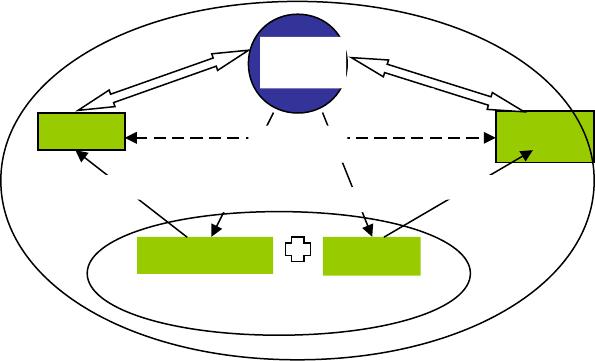
The model below shows the elements of Value Partner Architectures that emphasize the
need for closer interaction between Organizational Values and Partner Values. The model also it
highlights the importance for coherence between how organizations value partnerships and
partners.
Value Service Architectures and Models: Differentiation through Value Equity
Segmenting Partnerships Using Trust as the Differentiator
Some firms are always more profitable than other firms in most industries whether the
average margin of profit in the market is low or high. The superior performers usually come up
with something special that the competitors are difficult to copy. These distinctive resources are
determined as sources of competitive advantage (Stalk et al., 1992). The foundation for a
successful firm over a long period of time is its ability to achieve and maintain a sustainable
competitive advantage. Thus, understanding which resources and firm behaviors lead to such an
Organizational
values
Partnerships and
Partner values
Exploits
Improved Organizational
Performance
Trust and
Alignment of
Partnerships
Superior Partner
value
Actions
Tight
Manifests
and
Illustrates
InterpretsRealizes
ExploresLoose
Coherence
Partnership Advantage
advantage is fundamental to all strategies, most notably the partnership strategies (Varadarajan &
Jayachandran, 1999).
A competitive advantage of one partner, supplier or buyer from another can result either
from the implementation of a value-creating strategy not employed by current or prospective
competitors or from superior execution of the same sourcing or partnership strategy as
competitors. Competitive advantage is sustained when other firms are unable to easily duplicate
the benefits of this strategy (Barney, 1991). When the company protects its advantage from
competitor behavior or partnership and environmental shifts, sustainability is achieved (Porter,
1985). Winer (2004) stated that there are three characteristics of competitive advantage in the
context of partnerships. First, it must be able to conduct partner value, which leads to partner’s
definition of partner value in terms of lower prices, convenience, or other factors. Second, the