Game Theory: Inside Oligopoly
CHAPTER 10

Learning Objec!ves
1. Apply normal form and extensive form representations of
games to formulate decisions in strategic environments
that include pricing, advertising, coordination, bargaining,
innovation, product quality, monitoring employees, and
entry.
2. Distinguish among dominant, secure, Nash, mixed, and
subgame perfect equilibrium strategies, and identify such
strategies in various games.
3. Identify whether cooperative (collusive) outcomes may be
supported as a Nash equilibrium in a repeated game, and
explain the roles of trigger strategies, the interest rate, and
the presence of an inde%nite or uncertain final period in
achieving such outcomes.

Overview of Games and Strategic Thinking
•Game theory is a general framework to aid
decision making when agents’ payo(s depends
on the actions taken by other players.
•Games consist of the following components:
–Players or agents who make decisions.
–Planned actions of players, called strategies.
–Payo( of players under di(erent strategy scenarios.
–A description of the order of play.
–A description of the frequency of play or interaction.
Overview of Games and Strategic Thinking

Order of Decisions in Games is Important
•Simultaneous-move game
–Game in which each player makes decisions without
the knowledge of the other players’ decisions.
–Bertrand duopoly game
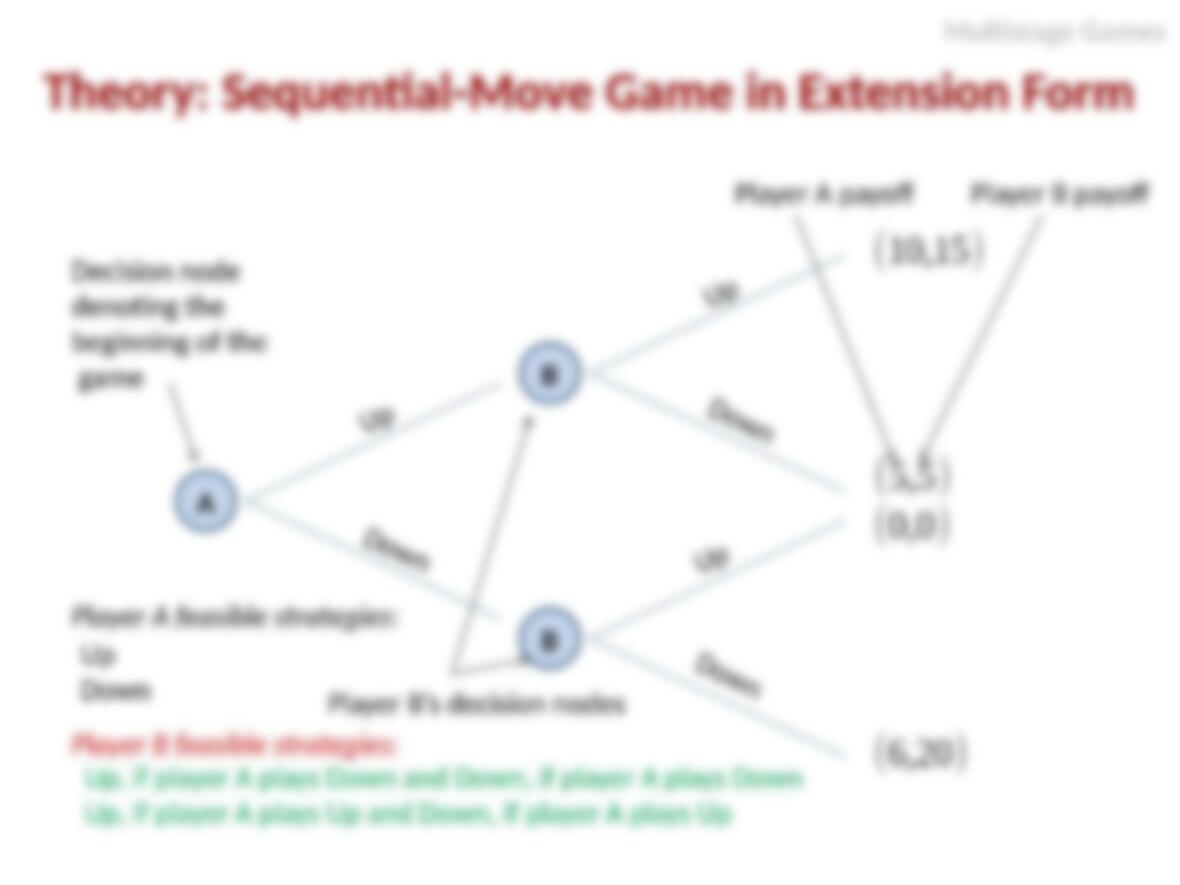
•Sequen!al-move game
–Game in which one player makes a move a-er
observing the other player’s move.
Overview of Games and Strategic Thinking

Frequency of Interac!on in Games
•One-shot game
–Game in which players interact to make decisions
only once.
•Repeated game
–Game in which players interact to make decisions
more than once.
Overview of Games and Strategic Thinking

Simultaneous-Move, One-Shot Games:
Theory
•Strategy
–Decision rule that describes the actions a player
will take at each decision point.
•Normal-form game
–A representation of a game indicating the players,
their possible strategies, and the payo(s resulting
from alternative strategies.
Simultaneous-Move, One-Shot Games
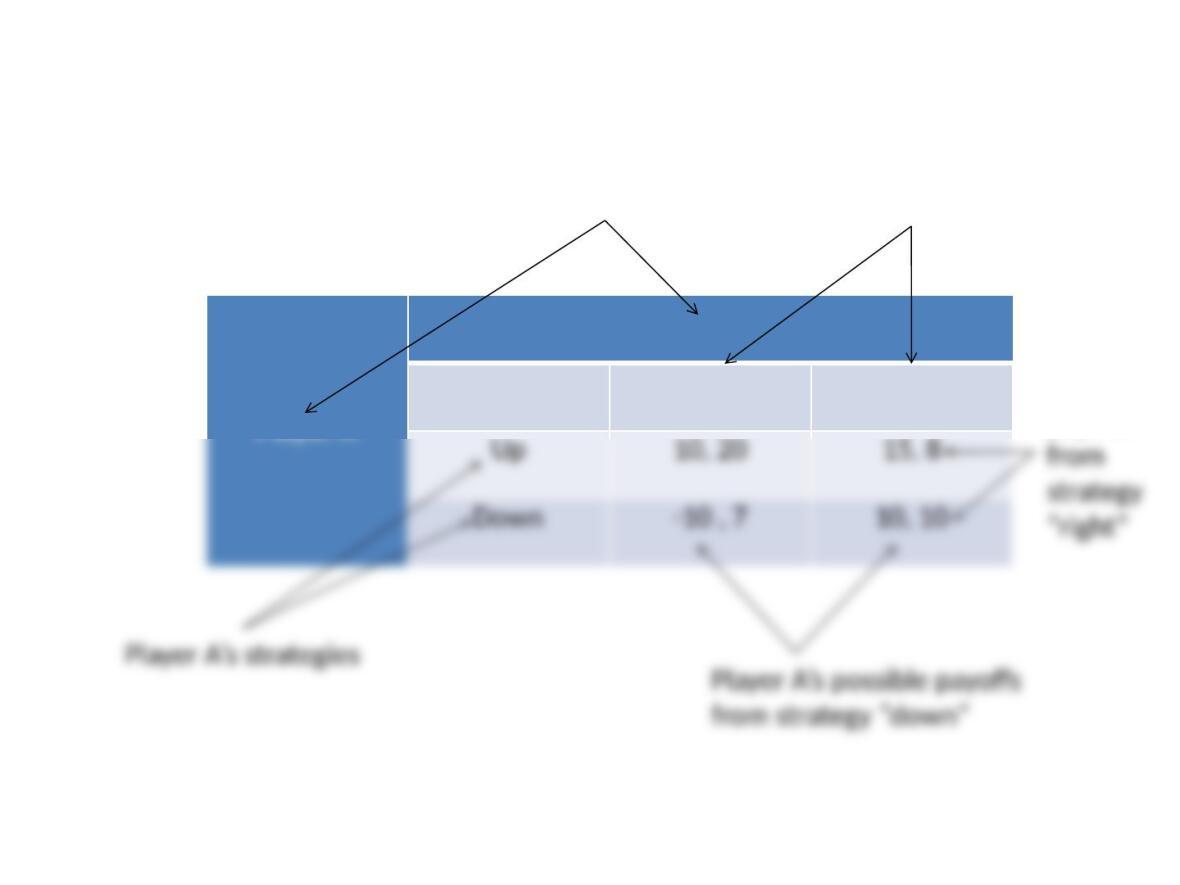
Normal-Form Game
Simultaneous-Move, One-Shot Games
Player B
Strategy Le– Right
Set of players
Player B’s strategies
Player B’s
possible
payo(s