Managerial economics is a branch of economics involving the application of
economic methods in the managerial decision-making process. Managerial
economics aims to provide a frame work for decision making which are
directed to maximise the profits and outcomes of a company.
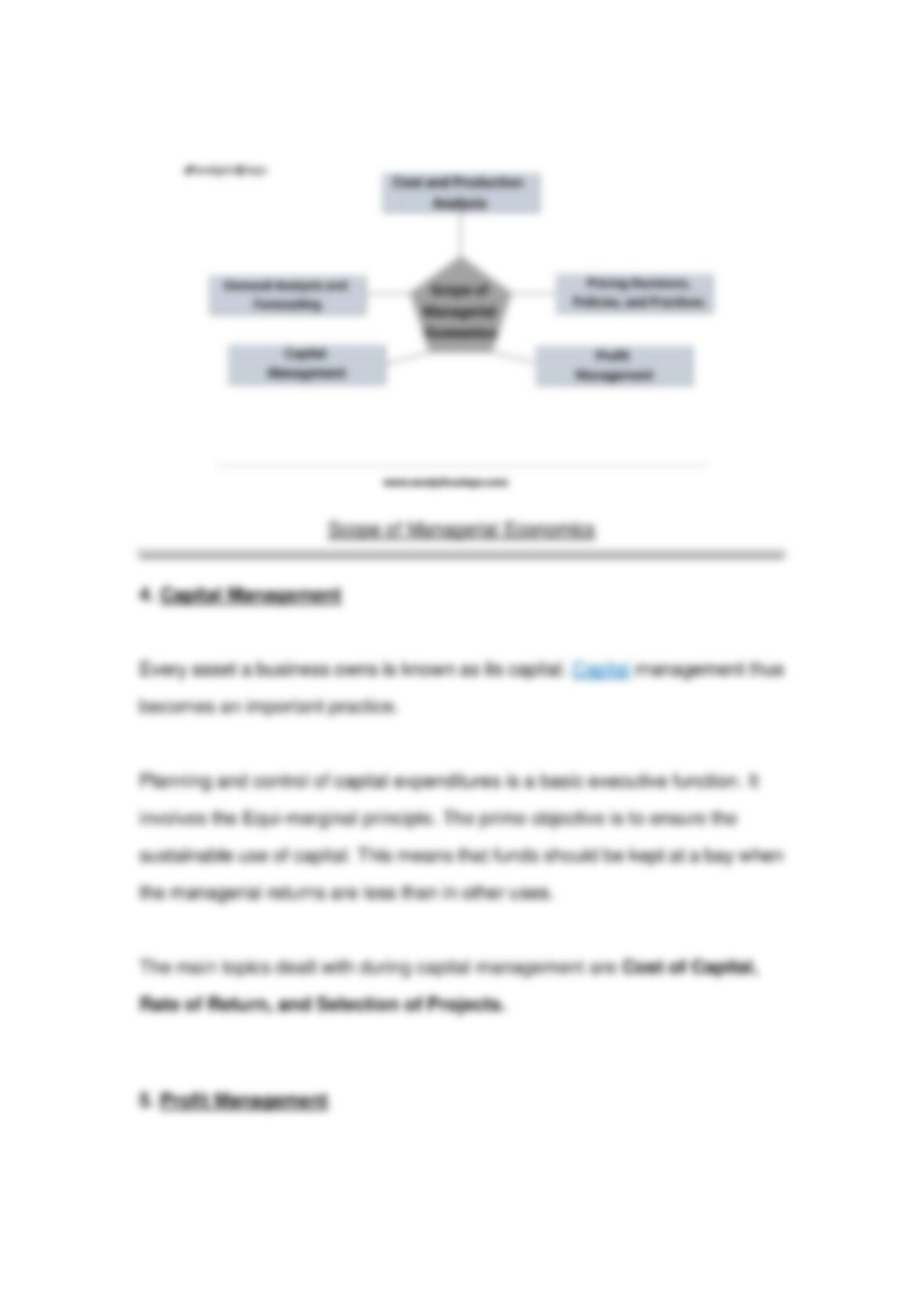
What is the Scope of Managerial Economics?
Managerial economics is a developing subject and its empirical and
perspective nature widens its scope. It works as a tool for businesses that is
used to understand the functioning of a market and also how to sustain
themselves in an ever-changing market.
From analyzing demands and forecasting future demand to capital
management, managerial economics provides help with almost everything. It
also helps companies in Pricing Decisions, Policies, and Practices, cost and
production analysis, and manage their profits.
Recommended blog – Corporate Governance
1. Demand Analysis and Forecasting
A firm relies on converting inputs into outputs and generates revenue from
them. A clear and accurate estimation of demand ensures a continuous
efficiency of the firm. Several external factors like price, income, affect the
demand that need to be analyzed.
Upon analyzing these factors affecting the demand for a product, managers
can decide on the production. After estimating the current demands, managers
move ahead to predict future demands for the product. This is referred to as
demand forecasting.

The ability to forecast demands allows the management to capitalize on the
opportunities available and strengthen the market position of the firm. During
the process of demand analysis, the management also gets to know about the
external factors affecting it and hence work on them to nullify any negative
effect.
2. Cost and Production Analysis
Cost Analysis is yet another function of Managerial economics. A company
makes a profit in two ways: by increasing the demand or by reducing the
cost. The determinants of assessing costs, the connection between cost and
yield, the gauge of cost and benefit are indispensable to a firm.
You can also sneak a peek at our blog on what is inflation.
Cost analysis is an important exercise for any company. A component of cost
vulnerability always exists since all the elements deciding expenses are not
generally known or controllable.
By taking the help of managerial economics, the management of a company
identifies the factors causing a variation in costs. The company then uses the
cost estimates in their decision making like pricing a product.
Production analysis is more of a physical exercise. It involves examining the
factors of production, also known as inputs, and obtaining the best
combination so as to get the least cost combination.
In case of price rise in the inputs, the management looks beyond and tries out
the alternatives. The analysis helps them get instant ideas in such uncertain
situations.
The topics covered during cost and production analysis are production function,
least-cost combination of factor inputs, factor productiveness, returns to scale,
cost concepts and classification, cost-output relationship, and linear
programming.
3. Pricing Decisions, Policies, and Practices