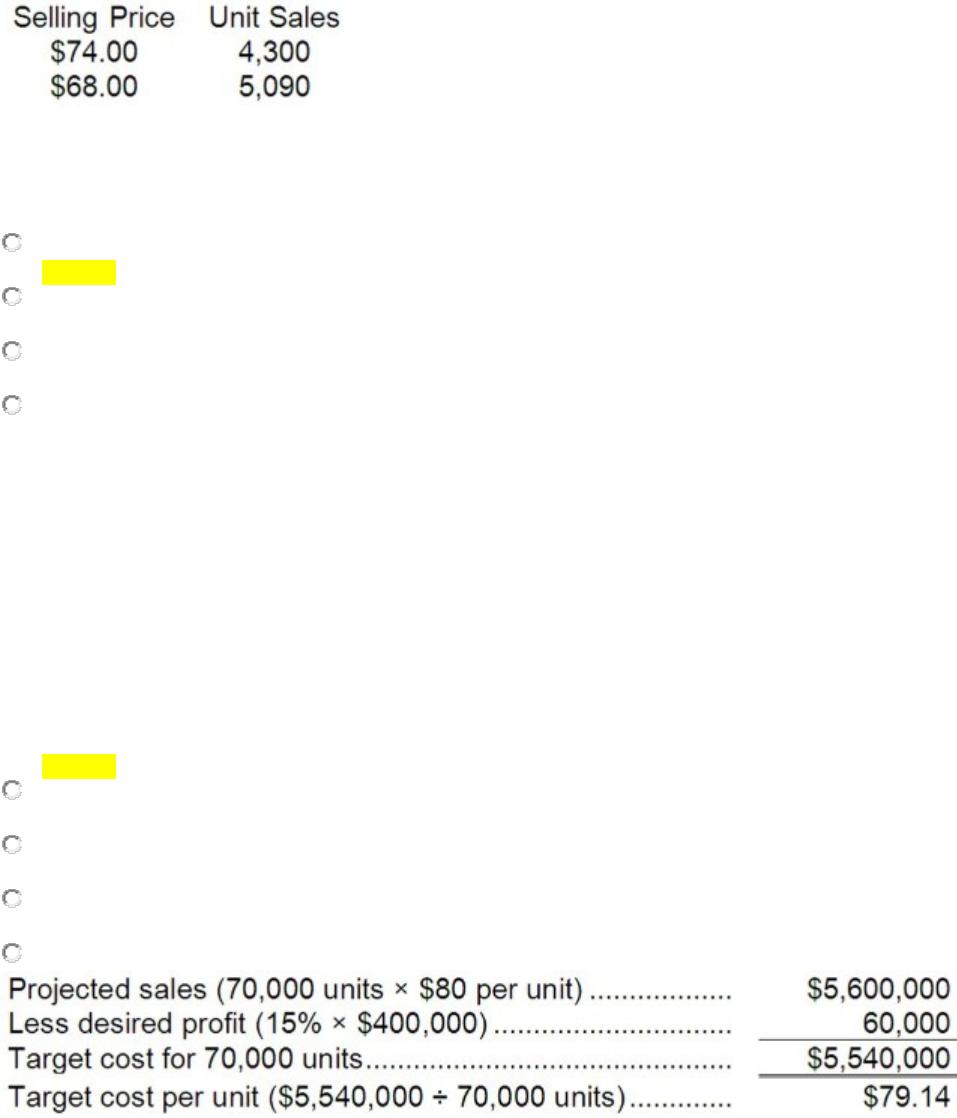
1. Ingham Corporation recently changed the selling price of one of its products. Data concerning sales for
comparable periods before and after the price change are presented below.
The product’s variable cost is $16.40 per unit.
According to the formula in the text, the product’s profit-maximizing price is closest to:
$35.82
$32.89
$35.23
$20.74
% change in quantity sold = (5,090 – 4,300)/4,300 = +18.37%
% change in price = ($11 – $12)/$12 = -8.11%
εd = ln(1 + % change in quantity sold)/ln(1 + % change in price)
= ln(1 + (0.1837))/ln(1 + (-0.0811)) = -1.99
Profit-maximizing markup on variable cost = -1/(1 + εd)
= -1/(1 + (-1.99)) = 1.01
Profit-maximizing price = (1 + Profit-maximizing markup on variable cost) × Variable cost per unit
= (1 + 1.01) × $16.40 = $32.96 (the exact answer without rounding error is $32.89)
2. The management of Brockington Corporation is considering introducing a new product–a compact
barbecue. At a selling price of $80 per unit, management projects sales of 70,000 units. Launching the
barbecue as a new product would require an investment of $400,000. The desired return on investment is 15%.
The target cost per barbecue is closest to:
$79.14
$92.00
$91.01
$80.00
3. Timax Corporation, a manufacturer of moderate-priced time pieces, would like to introduce a new electronic
watch. To compete effectively, the watch could not be priced at more than $50. The company requires a return
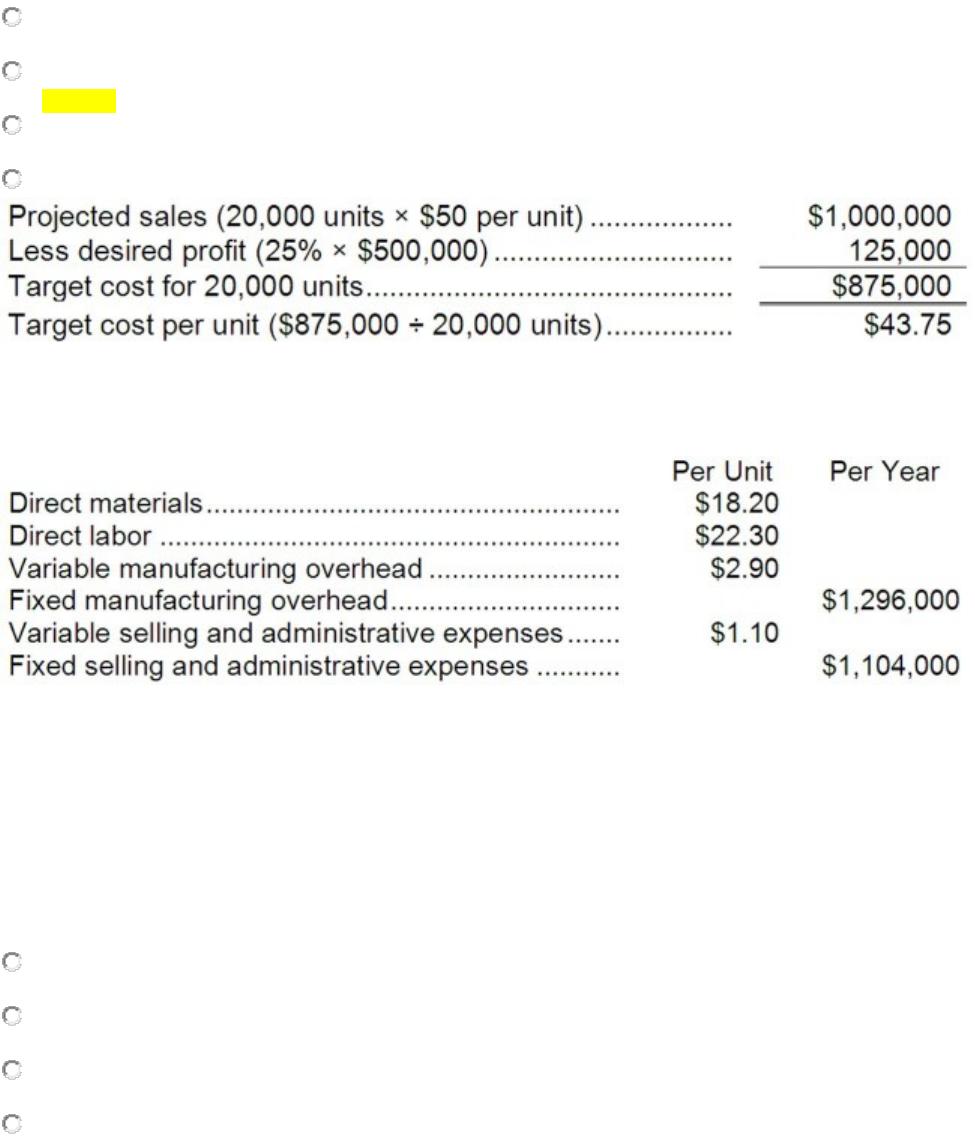
on investment of 25% on all new products. The plan is to produce and sell 20,000 watches each year. This
would require a $500,000 investment. The target cost per watch would be:
$64.00
$25.00
$43.75
$39.00
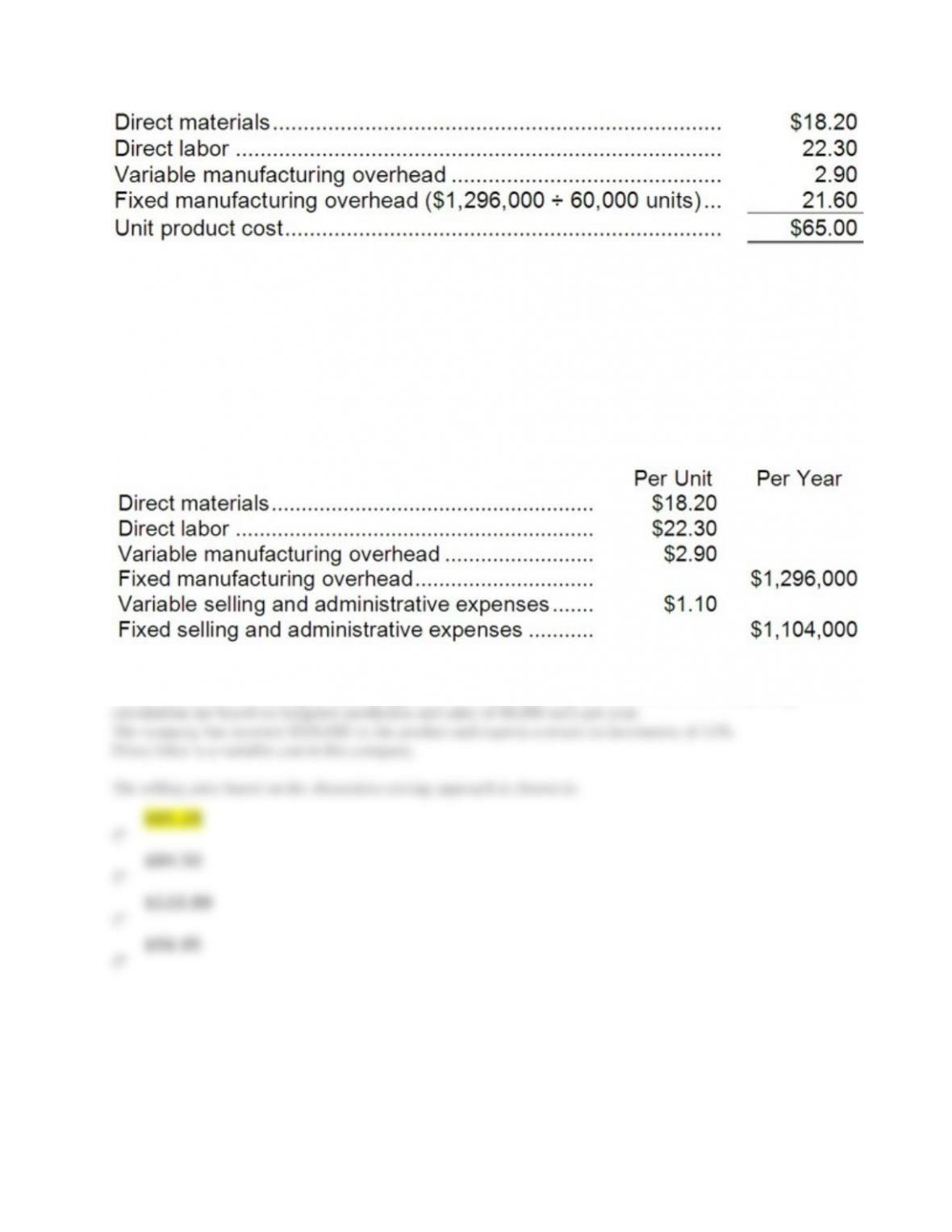
4. Dickson Corporation makes a product with the following costs:
The company uses the absorption costing approach to cost-plus pricing described in the text. The pricing
calculations are based on budgeted production and sales of 60,000 units per year.
The company has invested $320,000 in this product and expects a return on investment of 15%.
Direct labor is a variable cost in this company.
The markup on absorption cost is closest to:
96.5%
15.0%
31.2%
30.0%
Selling and administrative expenses = ($1.10 per unit × 60,000 units) + $1,104,000 = $1,170,000
Markup percentage on absorption cost = [(Required ROI × Investment) + Selling and administrative expenses]
÷ (Unit product cost × Unit sales)
= [(15% × $320,000) + $1,170,000] ÷ ($65.00 per unit × 60,000 units)
= [($48,000) + $1,170,000] ÷ ($3,900,000)
= [$1,218,000] ÷ $3,900,000 = 31.2%
Dickson Corporation makes a product with the following costs:
The company uses the absorption costing approach to cost-plus pricing described in the text. The pricing