1. Rocky Top Homes manufactures prefabricated chalets in Colorado. They use a job order costing system in which each
chalet is a job. The following events occurred during May:
a. Purchased raw materials for $405,000.
b. Incurred manufacturing wages of $111,600, which included both direct labor and indirect labor. Used direct
labor on jobs as follows:
1. Chalet 13 $14,800
2. Chalet 14 28,500
3. Chalet 15 19,200
4. Chalet 16 21,000
c. Requisitions from raw materials for jobs were made and filled (to direct materials) as follows:
1. Chalet 13 $41,100
2. Chalet 14 56,800
3. Chalet 15 62,100
4. Chalet 16 66,000
d. Depreciation on manufacturing equipment (used to make the chalets) for the month was $20,000.
e. Other overhead costs recorded in May were:
1. Equipment rentals $10,400
2. Insurance expense on the factory 6,000
f. Allocated overhead to each job (chalet) at a rate of 60% of direct labor cost.
g. Completed chalets 13, 15, 16.
h. Sold chalets as follows:
1. Chalet 13 for $99,000.
2. Chalet 16 for $141,900.
1. Set up the following T-accounts: Raw Materials Inventory; Work in Process Inventory (one account for each
chalet); Finished Goods Inventory; Cost of Goods Sold. Record the above transactions to the appropriate
inventory account (identify each by le?er so you can keep track of what you’re doing). Assume the
beginning balance of each account was zero (-0-). Calculate the end balance of each account.
2. Calculate the total costs of the unfinished chalet, and show that this equals the ending balance of Work in
Process (it had be?er!).
3. Calculate the total cost of the chalet that is finished but unsold and show that it equals the end balance of
Finished Goods Inventory (again, it had be?er!).
4. Calculate the gross profit of each chalet sold. What does this gross pro0t have to cover for Rocky Top? Is it
“pure pro0t?”
2. UCal makes calendars with college names and logos on them. The company has fixed expenses of $1,045,000 each
month, and variable expense of $3.90 per carton of calendars. The variable expenses break down as follows:
Cost of goods sold 60%
Variable operating expense 40%
Each carton of calendars sells for $11.50.
1. How many cartons of calendars must UCal sell each month to break even?
2. UCal would like to earn a pro0t of $275,000 (before tax) each month. What dollar amount of sales would be
required to do this?
3. Prepare a contribution margin format income statement for March for sales of 460,000 cartons of calendars.
NOTE: before you do this, do you anticipate that it will show net income or a net loss? Explain how you know.
4. What is the margin of safety (in cartons) in March?
5. What is UCal’s degree of operating leverage in March?
6. By what percentage will April’s net income change if April’s sales are 10% higher than March sales?
AC222 1 pd 3/5/15
3. Unholy Foods (UF) makes a full line of delicious, unhealthy snacks including chips, puKs and crisps, using three
productions lines within the same manufacturing plant. Currently, UF uses a single, plant-wide overhead rate to
allocate its $3,500,000 of annual manufacturing overhead. Of this amount, $1,800,000 is associated with the potato
chip line, $1,000,000 is associated with the corn chip line, and $700,000 is associated with the cheese puK line. UF’s
plant is currently running a total of 17,500 machine hours. 11,250 MH are used by the potato chip line, 3,450 MH by
the corn chip line, and 2,800 MH by the cheese puK line. UF traditionally believed that machine hours are the cost
driver of manufacturing overhead costs.
POTATO CHIPS
Unholy Foods produces diKerent styles of potato chips – ruMed, Nat, thick-cut, gourmet – for diKerent corporate
customers. Each style of potato chip requires diKerent preparation time, diKerent cooking and draining times
(depending on desired fat content), and diKerent packaging (single serving versus bulk). Therefore, UF has decided to try
ABC costing to be?er capture the manufacturing overhead costs incurred by each style of chip. UF has identi0ed the
following activities related to yearly manufacturing overhead costs and cost drivers associated with producing potato
chips.
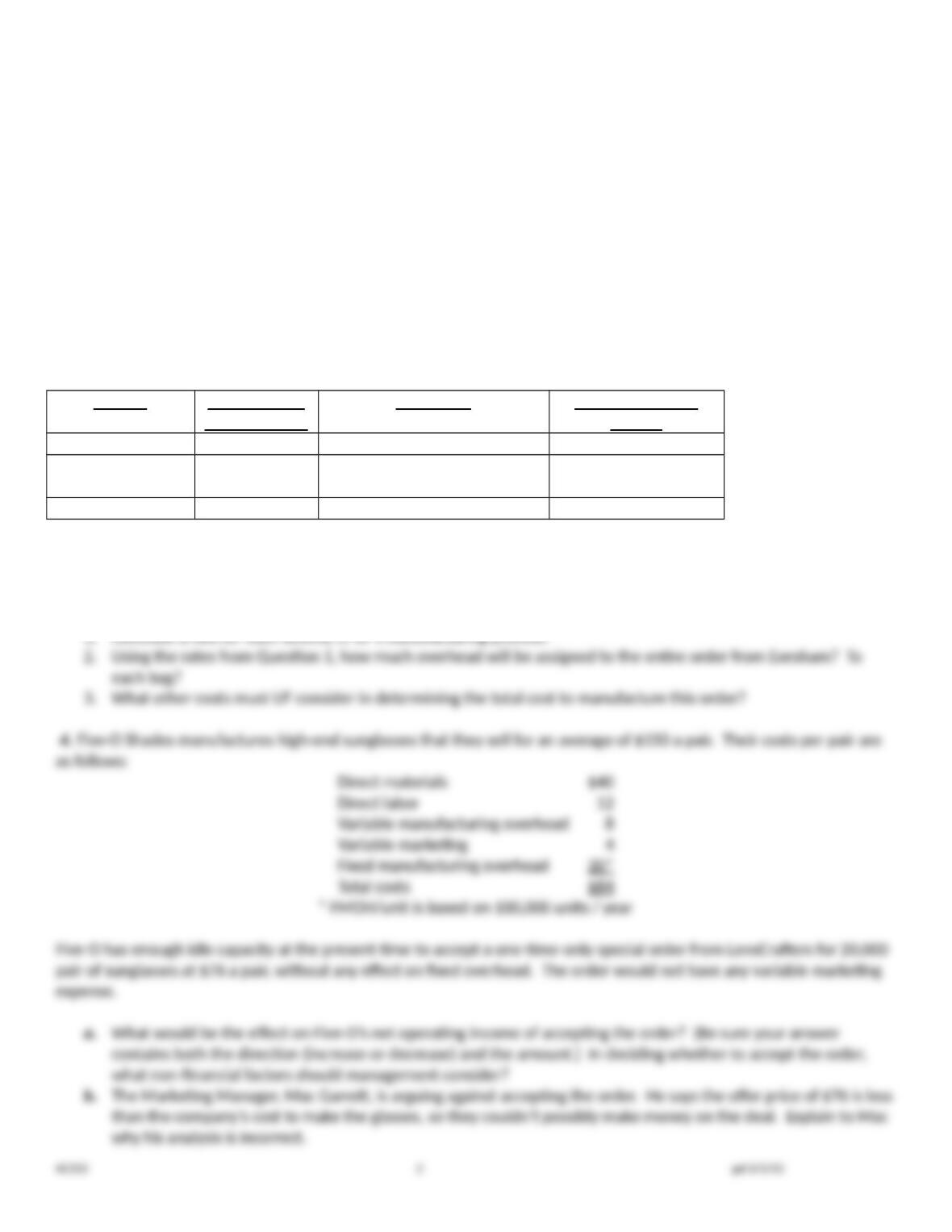
Activity Manufacturin
g overhead ($)
Cost driver Estimated annual
activity
Preparation $600,000 Preparation hours (PH) 12,000 PH
Cooking &
draining
$900,000 Cooking & draining hours
(CDH)
30,000 CDH
Packaging $300,000 Units packaged (P) 6 million P
UF just received an order from Evesham Industries for 12,000 single-serving bags of gourmet, fancy-cut, low-fat potato
chips. The order will require 16 preparation hours (PH), and 32 cooking and draining hours (CDH).
REQUIRED: