Managerial Ability and Earnings Quality*
Peter Demerjian
University of Michigan
Baruch Lev
New York University
Sarah McVay
New York University
November 20, 2006
Abstract:
We examine the relation between managerial ability and earnings quality. We
identify manager-specific effects by creating a measure of managerial ability
using frontier analysis and separating manager-specific from firm-specific effects
by following managers across firms. We find that earnings quality, measured by
the extent that accruals map into cash flows, is increasing with managerial ability.
This finding is consistent with the premise that more capable managers are better
able to estimate accruals.
*
We would like to thank Venky Nagar, Larry Seiford, Ram Venkataraman (AAA discussant), and workshop
participants at the 2006 AAA annual meeting, the University of California–Berkeley, and the University of Indiana
for their comments and suggestions.

1
1. Introduction
We examine the relation between managerial ability and earnings quality. We anticipate
that superior managers will report higher quality accruals, all else equal, as they are more
knowledgeable of their business and therefore are better able to estimate accruals. While the
empirical literature in the area of earnings quality has largely focused on firm-specific
characteristics, such as size and board independence (Dechow and Dichev, 2002; Klein, 2002),
we examine manager-specific effects by creating a measure of managerial ability using frontier
analysis (e.g., Leverty and Grace, 2005). We further distinguish manager-specific from firm-
specific effects by following managers (specifically CFOs) across firms. Our study is in the vein
of Bertrand and Schoar (2003) who find that managers have an effect on firm choices, such as
acquisitions or research and development expenditures, and Francis et al. (2006) who document
that earnings quality varies inversely with CEO reputation.
1
We find that earnings quality,
measured by the extent that accruals map into cash flows, is increasing with managerial ability;
this relation holds after including controls for innate characteristics of firms that make it more or
less difficult to estimate accruals (e.g., operating cycle and sales volatility) as well as structural
characteristics shown to affect the quality of earnings (e.g., board independence and internal
control quality). This finding is consistent with the premise that capable managers are better able
to estimate accruals resulting in a more precise measure of earnings. We also consider two
additional earnings quality measures: earnings persistence and a reduced frequency of
restatements. These results also support the notion that more able managers produce higher
quality earnings.
1
Francis et al. (2006) measure CEO reputation with the number of articles mentioning the executive. They find that
the number of news articles pertaining to the company’s CEO and earnings quality are negatively associated.
2
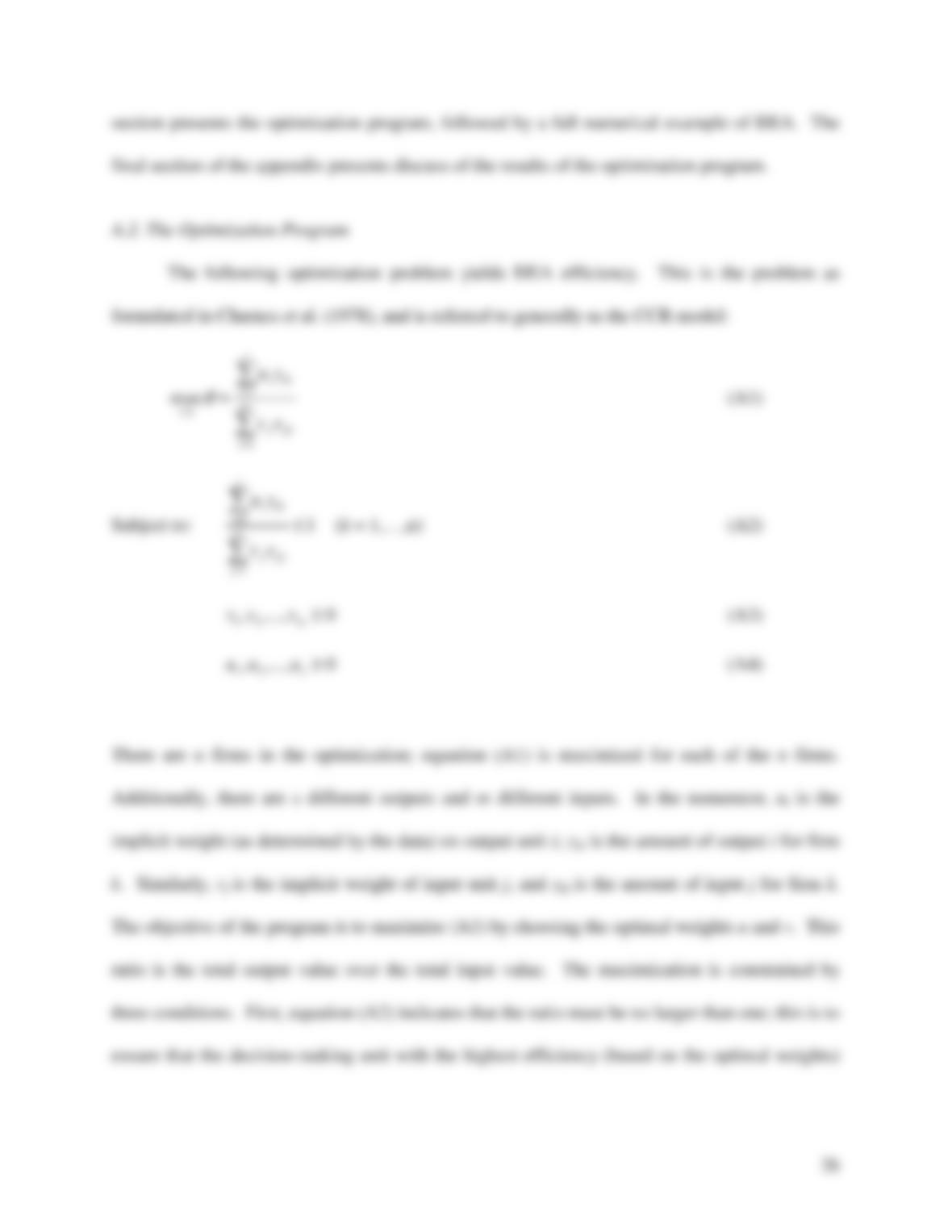
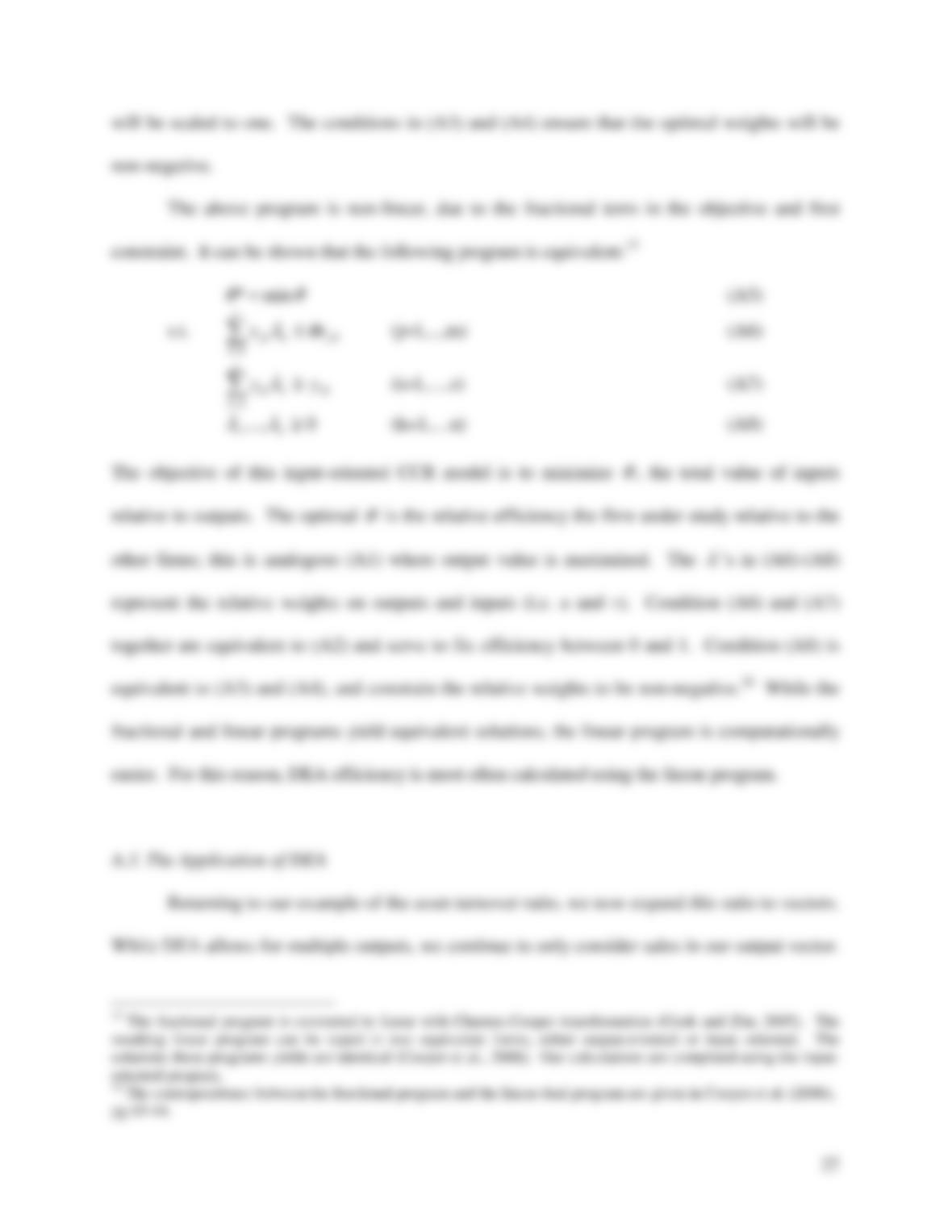
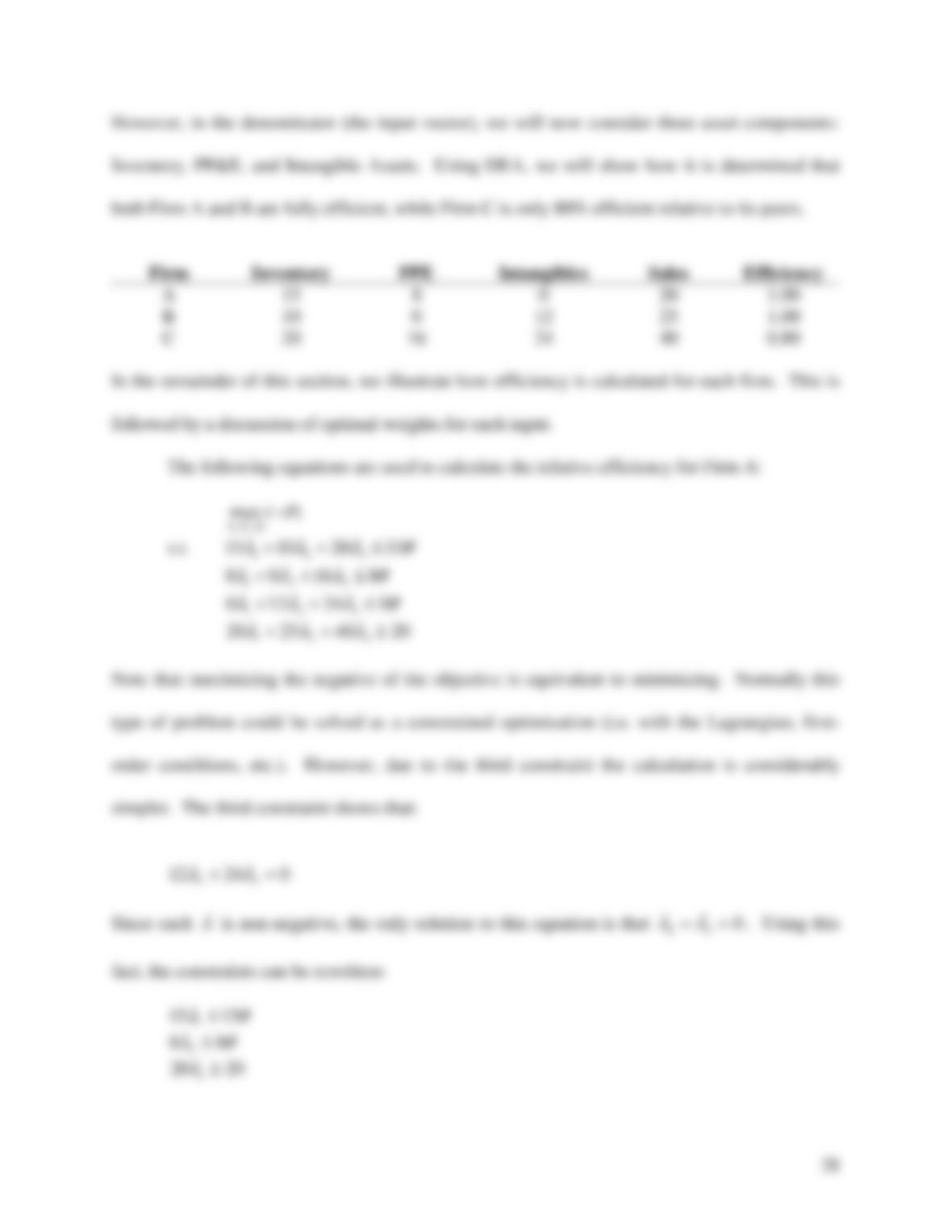
Our managerial ability measure is generated using Data Envelopment Analysis (or
frontier analysis), which assigns an efficiency score to each firm based on a vector of inputs
(e.g., capital and expenses) and outputs (e.g., revenue) of the company. We thus estimate the
relative efficiencies of firms in an industry and attribute these efficiencies to managerial ability.
We find that this efficiency score is positively associated with earnings quality, after controlling
for known determinants of earnings quality, such as firm size, cash flow volatility, and operating
cycle, and structural choices, such as board independence. We then triangulate our results to
verify that the efficiency score measures managerial ability rather than simply firm-specific
effects. For a sub-sample of our firms where we can track a manager across two firms, we
include both firm-specific and manager-specific indicator variables, interacted with the
efficiency score. We find that, after controlling for firm-specific effects, manager-specific
efficiency continues to be associated with earnings quality.
This paper is the first to examine the relation between earnings quality and managerial
ability. We examine a multi-dimensional measure of relative efficiency, and find that superior
managers report higher quality earnings. This finding contributes to both the earnings quality
literature and the managerial accounting literature. Although past anecdotal evidence suggests
that firms choose managers who can most efficiently operate the firm, these results apply a new
measure of managerial efficiency and find corroborating evidence.
In the next section, we develop our hypotheses with a review of the literature. Section 3
describes our managerial ability measure, obtained using Data Envelopment Analysis. In
Section 4, we describe our sample, test variables, and descriptive statistics. Section 5 presents
the results and the final section concludes the study.
3
2. Prior Research and Hypothesis Development
To date, the bulk of the literature on earnings quality has examined firm-specific
characteristics. Dechow and Dichev (2002) define higher earnings quality to be when more
accruals are realized as cash (described in detail in Section 4.2.1). They document that earnings
quality is poorer for firms that are smaller, are experiencing losses, have greater sales and cash
flow volatility, and have longer operating cycles. Each of these innate characteristics makes
accruals more difficult to estimate.
In addition to these innate characteristics, earnings quality has been found to vary with
firm infrastructure. Klein (2002) finds that firms with more independent board members have
higher quality accruals, consistent with stronger governance constraining earnings management.
Ashbaugh-Skaife et al. (2006) and Doyle et al. (2006) find that earnings quality is poorer in firms
that have weaker internal controls over financial reporting, where it is less likely that errors or
intentional misstatements are discovered and corrected.
However, only Francis et al. (2006) examine whether earnings quality varies with
managerial characteristics. Their study examines the relation between earnings quality and CEO
reputation, measured by the number of business press articles mentioning each CEO. The
authors conduct their analysis for a sample of about 2,000 firm-year observations from the S&P
500 over 1992–2001 and find a negative relation between CEO reputation and earnings quality.
They conclude “boards of directors hire specific managers due to the reputation and expertise
these individuals bring to managing the more complex and volatile operating environments of
these firms.” In other words, it is the volatile operating environments or other innate
characteristics of the firm causing the lower earnings quality, not managerial actions.
In support of manager-specific effects, Bertrand and Schoar (2003) document that
managers have a real impact on the firms they manage—that firm decision-making reflects the
“style” of different managers. They follow managers in the Forbes 800 files, from 1969–1999.
As they examine an array of decisions, they follow CEOs, CFOs and COOs. Their final sample
has about 600 firms and just over 500 individuals. Bertrand and Schoar (2003) show that these
managers have an impact on the choices made by the firm as a whole. In a similar vein,