IMPACT MANAGEMENT PROJECT
1 |impactmanagementproject.com
THE
INVESTOR’S
PERSPECTIVE
How an asset manager can
map its portfolio by the
effects it has on people and
planet – and what we can
learn from this.
impactmanagementproject.com

IMPACT MANAGEMENT PROJECT
2 |impactmanagementproject.com
INTRODUCTION
The Impact Management Project is a collaborative effort by
over 700 organizations, from across the impact value chain
globally, to agree some shared fundamentals for how we
talk about, measure and manage impact – and therefore our
goals and performance.
If we can agree on these shared fundamentals for describing
the effects that different underlying businesses – or
portfolios of businesses – have on people and planet, it will
be easier for investors to understand the different options
available to them within each asset class. Investors can then
build a portfolio that allows them to achieve their impact
goals within the constraints of their financial goals.
PGGM has a total of €220 billion of assets under
management, as the manager of the second biggest pension
fund in the Netherlands, PFZW, as well as a few smaller
pension funds. In working with the Impact Management
Project, PGGM sought to more accurately understand and
communicate what impact their investments are making, and
precisely what their role has been in the process.
PGGM has mapped its portfolio in terms of effects on people
and the planet. The results, along with insights we gained
along the way, are showcased in this paper, in the hope that
we can contribute to the ongoing discussion about how best
to categorise investment products by their impact.
This report has been co-authored by PGGM and the Impact
Management Project team. Please direct any feedback or
further enquiries about this report to:
Piet Klop piet.klop@pggm.nl
or team@impactmanagementproject.com
Contents
INTRODUCTION ……………………………2
CONTEXT SETTING………………………3
The five dimensions of
impact………………………………………3
How businesses
describe their expected
impact………………………………………4
How investors describe
their contribution to the
expected impact of the
business..…………………………………5
Describing the
impact goals of an
investment.………………………………6
PGGM ILLUSTRATION………………....7
Context……..……………………………..7
Mapping PGGM’s SDI
framework to the five
dimensions……………………………….8
Mapping PGGM’s total
portfolio to the matrix……………10
Findings & learnings.………………11
CALL TO ACTION………………………….13
APPENDIX…………………………………..14

IMPACT MANAGEMENT PROJECT
3 |impactmanagementproject.com
CONTEXT SETTING
In finance, we use shared fundamentals to
describe our expected level of return, volatility
and liquidity (etc.) and manage against our
respective financial goals. We also use asset
classes, which group investments with similar
financial characteristics, to facilitate alignment
with investor expectations. Financial capital
flows and the investment management
ecosystem have grown, not just because we
have common accounting standards, but
because we have developed these shared
fundamentals for communicating and aligning our
expectations. It would be impossible to uphold
any notion of “fiduciary duty” without this shared
understanding.
All businesses – and therefore all investments –
have effects on people and planet, both positive
and negative. Through the Impact Management
Project we reached a consensus that our impact is
the combination of our material effects on people
and planet. To understand these effects we need
to consider performance across 5 dimensions and
then set goals to manage material effects. Effects
are material if they:
1. Relate to important positive or negative
outcomes (WHAT).
2. Are significant (HOW MUCH), based on:
• how deep the effect is, based on data about
whether the effect is a deep or marginal driver
of the outcome
• how many people the effect occurs for,
• how long the effect lasts for,
• how quickly the effect occurs
Figure 1: Five dimensions of impact
For examples on each dimension please follow this link.
3. Occur for underserved people or the planet
(WHO), where ‘underserved’ is defined as a
population, species or the planet that does not
currently experience the important positive
outcome (WHAT) that the effect relates to.
Where the effect is related to a negative
outcome (WHAT), people or the planet are
underserved insofar as they experience this
effect. For example, the planet is always
underserved in relation to important negative
outcomes (e.g. resource scarcity or climate
change).
When deciding if and how to manage the material
effects we are having, we also consider:
4. Whether our role makes the effect better or
worse than what would likely occur anyway
(CONTRIBUTION), by benchmarking whether
the effect:
• leads to more important positive or negative
outcomes than are currently occuring for people
or planet (WHAT), and/or
• is more or less significant than the effect
that people (or the planet) are currently
experiencing, in terms of depth or the number
of people it occurs for, or how long it lasts for, or
how long it takes to occur (HOW MUCH), and/or
• occurs for people (or the planet) who are more
or less underserved than those currently
experiencing it (WHO)
5. The likelihood that the effect is different
from our expectation (RISK).
Shared fundamentals for understanding impact
What outcomes(s) does
the effect relate to, and
how important are they
to the people (or planet)
experiencing it?
How significant is the
effect that occurs in
the time period?
Who experiences
the effect and how
underserved are
they in relation to the
outcome(s)?
How does the
effect compare and
contribute to what
is likely to occur
anyway?
Which risk factors
are material and how
likely is the effect
different from the
expectation?
WHO
WHAT HOW MUCH CONTRIBUTION RISK
123 4 5
IMPACT MANAGEMENT PROJECT
4 |impactmanagementproject.com
CONTEXT SETTING cont’d
These five dimensions help us all to understand a
business’s material effects on people and planet –
and therefore help investors to select investments
that are most likely to meet their impact goals.
In practice, most business models generate a
range of good and bad effects. For example,
businesses with harmful products or sourcing
practices might support high quality jobs in an
economically distressed community. Conversely,
business models that provide life-saving services
might cause significant environmental emissions,
nonbiodegradable waste, or require animal testing.
Since positive and negative effects do not cancel
each other out (except in cases such as carbon
emissions), impact management can involve
businesses and their investors having to decide
that achieving a certain material positive effect is
worth generating a possible negative effect. But
impact management will also involve setting goals
to try to mitigate that negative effect over time.
How can businesses describe their expected
impact?
The extent to which businesses set goals to
prevent negative impact and increase positive
impact depends on their intentions. These
typically fall into one of three broad categories:
• Those who try to avoid harm to their
stakeholders, either because they care about
being responsible citizens or because they want
to mitigate risk, or both
• Those who do not just try to avoid harm but also
want to generate benefits for their stakeholders,
either because they believe businesses that
have positive effects on the world will sustain
long-term financial performance or because
they believe that businesses should serve
society, or both
• Those who try to avoid harm and generate
benefits for their stakeholders but also want
to contribute to solutions to specific social
or environmental challenges for a particular
stakeholder group.
Avoid harm
C
ontribute
to solutions
A
void harm
“I want to help tackle
climate change”
“I want to help tackle
the education gap”
“I have regulatory
requirements to
meet (e.g. I have
to cut my carbon
emissions)”
“I want to behave
responsibly”
Don’t consider
“I am aware of potential
negative impact
but do not try to
mitigate it”
INTENTIONS
positive outcome(s)
Deep, and/or for many
and/or long-term
Underserved
Various
Underserved
Likely same or worse
Various
Important positive
outcomes
Various
Various
Likely same or better
Various
Underserved
Likely same or better
Various
BUSINESSES’ GOALS ACROSS
THE 5 DIMENSIONS OF IMPACT
WHO
WHAT
HOW MUCH
CONTRIBUTION
RISK
Likely better
Importa
nt negativ
e
outcomes
Important negative
outcomes
AND
AND
Marginal and
For few
Various
“I want to mitigate
risk”
Figure 2: Mapping intentions to high-level impact goals of businesses
CONTEXT SETTING cont’d
The impact goals of an investment are a function
of the impact goals of the underlying business,
or portfolio of businesses, that the investment
supports (as shown on the previous page), plus
the contribution that the investor makes to enable
the business(es) to achieve those impact goals.
Investors use a variety of strategies to contribute
to businesses’ ability to generate impact. There
was consensus from the Impact Management
Project that it is helpful to indicate up-front
which strategies an investor intends to employ.
Investors can:
+ Signal that impact matters: choose not
to invest in or to favour certain investments
such that, if all investors did the same, it would
ultimately lead to a ‘pricing-in’ of effects on
people and planet by the capital markets more
broadly. Some people think of this as ‘values
alignment’.
+ Engage actively: use expertise and
networks to improve the environmental/societal
performance of businesses. Engagement can
cover a wide spectrum of approaches – from
dialogue with companies to investors taking board
subscribed issuances (which is just a signalling
strategy) to participating in a higher proportion of
undersubscribed issuances.
+ Provide flexible capital: recognise
that certain types of businesses will require
acceptance of lower risk-adjusted return in order
to generate certain kinds of impact. For example,
creating a new market for previously marginalised
populations might require very patient capital
that cannot offer a commercial return.
The types of contribution that we make are driven
by our constraints as much as our intentions.
For example, a retail investor, who does not have
the expertise to engage directly with businesses
and who needs a greater level of liquidity,
may be satisfied with making a different type
of contribution than that which a non-profit
organisation or ultra-high net worth individual
might want to make.
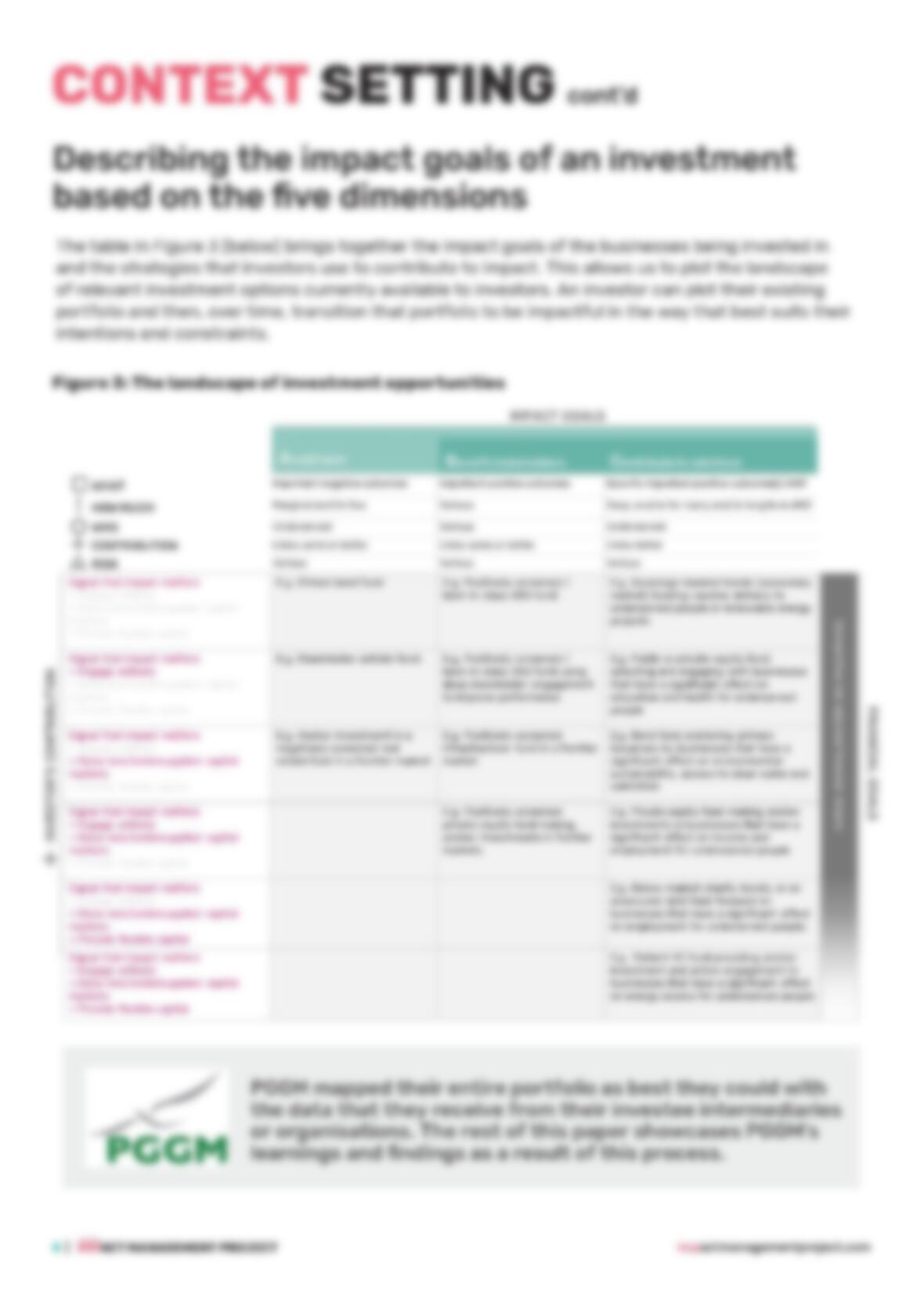
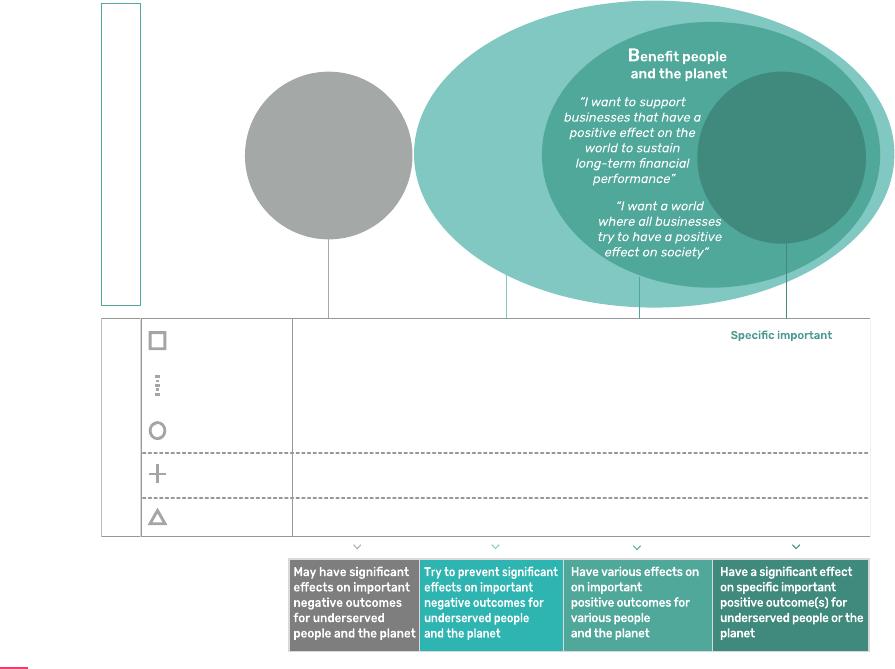
An investor’s intentions inform the impact goals
they set across the five dimensions, as shown in
Figure 3 (p.6). Taken together, the five dimensions
therefore provide a lens for an investor to
understand the impact goals of different
CONTRIBUTION
How can investors describe their contribution to
the impact of the business?