Full Length Article
Factors affecting the study of important marketing issues:
Implications and recommendations
Ajay K. Kohli
a
,Michael Haenlein
b,
⁎
,1
a
Scheller College of Business, Georgia Institute of Technology, 800 West Peachtree Street NW, Atlanta, GA 30308, USA
b
Marketing Group, ESCP Europe, 79 Avenue de la République, F-75011 Paris, France
article info abstract
Article history:
First received on April 14, 2018 and Area
Editor: Peter C. Verhoef
Available online xxxx
Area Editor: Peter C. Verhoef
Academic research in marketing has produced many useful insights and tools over the years.
Lately, however, an increasing number of scholars have voiced concern that much of the cur-
rent academic research is not particularly useful. We explore reasons why this may be the
case, and offer a set of recommendations to address them. We first identify three general fac-
tors that must be present in order for academics to develop important marketing insights:
(i) awareness of important marketing issues, (ii) ability to address these issues, and (iii) moti–
vation to address them. Using this as a framework, we identify several variables that may be
reducing the likelihood of our studying important marketing issues. These variables suggest ac-
tions that we may take to increase the likelihood of our producing important marketing in-
sights and tools.
© 2020 Elsevier B.V. All rights reserved.
Keywords:
Academic research
Impact
Marketing academia
Marketing science
Marketing thought
Marketing domain
Over the last several decades, academic research in marketing has generated a number of important theories, frameworks,
models and decision-making tools. There are many examples of such work: Howard and Sheth (1969) build a theory of buyer be-
havior; Parasuraman, Zeithaml, and Berry (1985) develop a theory of service quality; Tuli, Kohli, and Bharadwaj (2007) propose a
new view of customer solutions; Srivastava, Shervani, and Fahey (1998) develop a framework that links market-based asset man-
agement to shareholder value; Guadagni and Little (1983) develop a model for predicting effects of marketing actions on brand
choices; Green and Srinivasan (1990) discuss conjoint analyses for designing products; and Rust, Lemon, and Zeithaml (2004) de-
velop a customer-equity based approach for comparing marketing investments.
In recent years, however, an increasing number of scholars has voiced concern that the usefulness of research published in ac-
ademic journals has diminished substantially. For example, Reibstein, Day, and Wind (2009) suggest marketing academia may be
losing its way. Similar concerns are raised by other scholars including Lehmann, McAlister, and Staelin (2011),Coulter (2016),
Moorman (2016) and Steenkamp (2017). Prompted by these concerns, editors of major journals have made calls for more relevant
research (e.g., Inman, Campbell, Kirmani, & Price, 2018;Moorman, van Heerde, Page Moreau, & Palmatier, 2019). Similarly, Re-
sponsible Research in Business and Management (RRBM), a relatively new organization formed by prominent academics, notes
that current research is often disconnected with real-world challenges. These developments suggest that while some articles pub-
lished in recent years address important issues, their proportion relative to the total number of articles published has declined.
Similar observations have been made outside of the marketing discipline (e.g., Bartunek, Rynes, & Duane Ireland, 2006;Gunther
McGrath, 2007;Rynes, Bartunek, & Daft, 2001;Shapiro, Kirkman, & Courtney, 2007).
International Journal of Research in Marketing xxx (xxxx) xxx
⁎Corresponding author.
E-mail addresses: kohli@gatech.edu, (A.K. Kohli), haenlein@escpeurope.eu.(M.Haenlein).
1
The authors thank the Editor, Area Editor and four anonymous reviewers for their very helpful comments.
IJRM-01350; No of Pages 11
https://doi.org/10.1016/j.ijresmar.2020.02.009
0167-8116/© 2020 Elsevier B.V. All rights reserved.
Contents lists available at ScienceDirect
IJRM
International Journal of Research in Marketing
journal homepage: www.elsevier.com/locate/ijresmar
Please cite this article as: A.K. Kohli and M. Haenlein, Factors affecting the study of important marketing issues: Implications and
recommendations, International Journal of Research in Marketing, https://doi.org/10.1016/j.ijresmar.2020.02.009

Why might this be the case and what can be done about it? RRBM’s position paper observes that the reasons for this decline lie
in the research ecosystem that focuses on scholarly impact more than societal impact. The position paper highlights the need to
change the incentives and culture around publications.
2
The paper lists a number of high-level suggestions such as (i) elite
journals should encourage and publish problem-centered research, (ii) scholarly associations should reinforce professional com-
mitment among members, (iii) university administrators should develop a vision and strategy to encourage faculty to work on re-
search that would make a positive difference in society, (iv) accrediting agencies should convene deans and academic leaders to
discuss responsible research, and so on.
We complement the above-noted work by approaching the problem from the perspective of scholars working individually or
in teams, making choices at the “workbench”level about what research problems to study. We develop a simple but comprehen-
sive framework to identify a broad set of reasons why scholars may choose to study less important research questions/issues –the
“lost before translation”problem (Shapiro et al., 2007)–and suggest ways to deal with them at a more specific, granular level.
Briefly, we argue that scholars are likely to address important marketing issues if three conditions are satisfied: First, scholars
are aware of (at least some) important marketing issues. Second, scholars have the conceptual and methodological ability to ad-
dress those marketing issues along with the ability to make judicious tradeoffs between research importance and methodological
rigor. Third, scholars have the intrinsic and extrinsic motivation to address important issues.
3
The framework is a variation of the
ability-motivation-opportunity (AMO) framework employed by previous research in several disciplines (e.g., Appelbaum, Bailey,
Berg, & Kalleberg, 2000;Boxall & Macky, 2009;MacInnis, Moorman, & Jaworski, 1991). Our framework incorporates “awareness”
rather than “opportunity”because the former likely is a more critical antecedent in our context (see Fig. 1).
4
This framework helps pull together a number of individual and institutional variables that may explain the decline in the “mar-
ket share”of articles dealing with important marketing questions. The framework provides an organized grouping of the anteced-
ent variables, and has the potential to help identify additional antecedents in future research. Importantly, the antecedents
suggested by the framework directly point to practical, fine-grained actions that may be taken by researchers, promotion & tenure
committees and administrators to increase the likelihood of scholars studying important marketing issues.
5
We consider in turn each of the three factors comprising the framework—awareness, ability, motivation—and develop a num-
ber of ideas for enhancing each of the three factors. Where pertinent, we note ideas offered by other scholars along with ours in
order to increase the formers’ accessibility to readers. Our recommendations are summarized in Table 1. We start our discussion,
however, by suggesting that the use of the term “relevance”to refer to research that is important for the field may actually be
contributing to the decline of impactful papers.
1. Importance versus relevance of a research issue
Scholars often highlight the need for greater relevance in research. For example, a frequent debate in the discipline revolves
around whether there is a trade-off between research rigor and relevance (e.g., Kumar, 2017;Rust, 2018). The term “relevance”
in such discourses is used to imply the importance (or significance) of a research issue/question addressed in a paper. However,
the term “relevance”has a much narrower meaning. The Oxford Dictionary defines relevance as “the quality or state of being
closely connected or appropriate”to something (emphasis added). Being connected to something, however, is very different
from being important.“Importance”is “the state or fact of being of great significance or value”to something, per the Oxford Dic-
tionary (emphasis added).
While all marketing issues/questions are by definition connected to marketing phenomena (and therefore relevant to market-
ing), answers to some marketing issues are of greater significance or value (and therefore more important) than others. For exam–
ple, consider two issues: (1) do consumers find four-color brochures more appealing than five-color brochures, and (2) under
what conditions do online channels serve as substitutes versus complements to offline channels? Both issues are about marketing
and therefore of relevance to marketing. However, the first issue is less important than the second issue because answers to the
latter issue are likely to change the behaviors of senior practitioners in a more significant way than answers to the first issue.
In sum, not all issues relevant to marketing are important (but not vice versa).
There are multiple reasons why marketing scholars may choose to address research questions/issues that are relevant but not
particularly important. First, it is possible that marketing scholars evaluate research questions/issues through the lens of relevance
rather than importance given the widespread use of the term “relevance”in marketing discourses (e.g., Kumar, 2017;Rust, 2018).
Second, scholars may choose to study relatively less important questions/issues because it is easier to isolate effects for such issues
with the level of methodological rigor expected by major journals, and the reward system in schools encourages research quantity
over research importance. Issues of greater importance tend to be more ambiguous and hence more difficult to study with com-
parable rigor (Roberts et al., 2014a). A central point of this paper is that while it is essential for academic papers to be rigorous, a
narrow or heuristic interpretation of its meaning inhibits the development of research on important questions/issues. In a later
2
https://rrbm.network/position-paper/
3
In addition to having awareness, ability and motivation, scholars must also believe that others (e.g., editors, reviewers) believe a given topic is important.
4
We note that opportunities presented by financial resources and connections can play an important role, and these may be distributed unevenly across schools.
These resource issues, however, are not the focus of this paper.
5
Our framework focuses on factors which impact the likelihood of scholars studying important marketing issues. It addresses the “lost before translation”problem
(Shapiro et al., 2007). It does not address the “lost in translation”problem –that of poor communications of research findings/conclusions to target stakeholders.
2A.K. Kohli, M. Haenlein / International Journal of Research in Marketing xxx (xxxx) xxx
Please cite this article as: A.K. Kohli and M. Haenlein, Factors affecting the study of important marketing issues: Implications and
recommendations, International Journal of Research in Marketing, https://doi.org/10.1016/j.ijresmar.2020.02.009

section, we suggest a broader and more appropriate construal of rigor, and recommend balancing it with the importance of an
issue investigated in a research project.
Moreover, we lack a common understanding of how “importance”may be operationalized. Drawing on Zaltman (1983) and
Jaworski (2011), we suggest that a research issue’s importance may be operationalized by three inter-related criteria:
i. Number of stakeholders that are likely to change their behavior because of the answer to the issue. We define marketing stake–
holders in a broad way and include managers as well as public policy makers, consumers, academics, consultants, law enforce–
ment and societal groups. An issue that affects a greater number of stakeholders (in an affected subgroup) is arguably more
important than one that affects just a few.
6
ii. Status
7
of the target stakeholders (within a given subgroup) who are likely to change their behaviors. Changes in the behavior
of higher status individuals have greater impact, and are arguably more important. For example, an issue with implications for
changes in the behavior of CMOs is likely to involve bigger budgets and lead to more extensive organizational changes than an
issue with implications for assistant brand managers, and hence may be considered to be more important. The same applies to
issues with implications for high-level public policy makers, key opinion leaders or social media influencers or consumer ac-
tivist groups.
iii. Magnitude of expected change in stakeholder behaviors. Research on an issue that could lead to major changes in a manager’s
strategies, tactics, investment patterns, and the overall nature of work is arguably more important than research on another
issue likely to lead to smaller behavioral changes of the manager. The same applies to research on issues that may lead to
major changes in behaviors of consumers at points-of-purchase.
Importantly, the above-noted inter-related variables—number, status and magnitude—help assess the importance of a specificre-
search issue or question rather than that of a broad research topic. For example, while the broad topic of digital marketing is an
important one, some issues/questions belonging to this topic (e.g., location of a banner ad on a web page) are less important than
other issues (e.g., developing an ecosystem for launching new products).
In many cases, answers to research issues may immediately suggest specific actions for the marketing practitioners impacted
by the issues. In such cases, assessing the importance of the research issues is relatively straightforward. In other cases—for exam-
ple when a research project develops a new scale/measure or a new estimator—the actions these stakeholders might take based
on the research may be less clear. We suggest that in such cases the research issue’s importance be assessed using a “line of sight”
Awareness of
Important Marketing Issues
Ability to Study
Important Marketing Issues
Motivation to Study
Important Marketing Issues
Likelihood of Studying
Important Marketing Issues
Fig. 1. Factors influencing the likelihood of studying important marketing issues.
6
We make an explicit distinction between academic stakeholders and non-academic stakeholders. While academic stakeholders are important to consider, this pa-
per primarily focuses on non-academic stakeholders.
7
Where applicable.
3A.K. Kohli, M. Haenlein / International Journal of Research in Marketing xxx (xxxx) xxx
Please cite this article as: A.K. Kohli and M. Haenlein, Factors affecting the study of important marketing issues: Implications and
recommendations, International Journal of Research in Marketing, https://doi.org/10.1016/j.ijresmar.2020.02.009
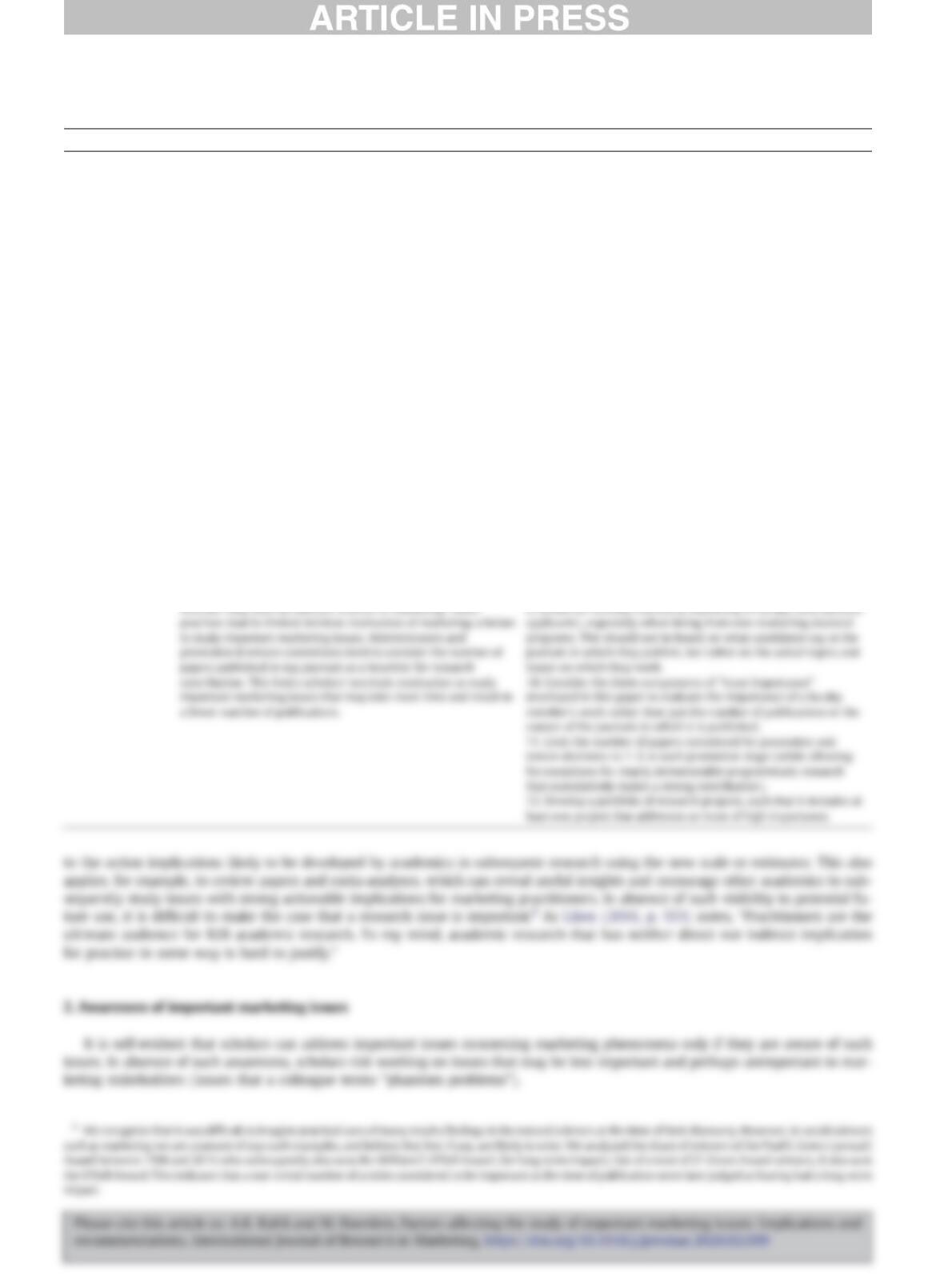
Table 1
Recommended practices for increasing the likelihood of studying important marketing issues.
Factor Current practices/status Recommended practices
Importance vs.
Relevance of a
research issue
Marketing scholars (including reviewers) tend to evaluate
research questions/issues through the lens of relevance rather than
importance. This overestimates the importance of issues examined
in a paper.
1. Evaluate research projects based on the “importance”of the
issue investigated and not its (mere) “relevance.”The importance
of an issue can be operationalized by the number of marketing
stakeholders that are likely to change their behaviors, the status of
the target stakeholders, and the magnitude of expected change in
stakeholder behaviors.
Awareness of
important
marketing issues
Scholars tend to select research problems without adequate
awareness of issues of importance to marketing stakeholders. This
can lead to their working on “phantom problems”–research
problems that are less important and even unimportant to
marketing stakeholders.
2. Institute and encourage mechanisms for increasing direct
interactions between scholars and marketing stakeholders
(e.g., such as consulting, internships in commercial and non–
commercial organizations, executive education, sponsored
research and community-engaged research).
3. Rebalance curricula of doctoral programs, giving more weight to
seminars focusing on substantive marketing issues.
Ability to study
important
marketing issues
Researchers often refrain from working on important research
issues/questions because they think they do not have the ability to
do the research well, or that knowledge gatekeepers (editors,
reviewers) do not have the ability to evaluate the research
appropriately. These abilities include (i) conceptual ability, (ii)
methodological ability, and (iii) the ability to make judicious
trade-offs among research design elements.
4. Develop conceptual and theory construction abilities of doctoral
students and faculty via doctoral seminars, research workshops,
and developmental sessions at conferences.
5. Evaluate the conceptual rigor of papers based not on whether
they incorporate a currently fashionable or prominent theory from
another discipline, but rather based on the intrinsic soundness of
the conceptual work.
6. Assess the probability of a study’s conclusions being false
considering the study’s aim (testing for presence of effects versus
estimating effect sizes). An insistence on using state-of-the-art
methods in all papers regardless of their aims is counterproductive.
7. Make judicious tradeoffs between the importance of the issues
examined in a studies and the probability of the study’s
conclusions being false.
Motivation to study
important
marketing issues
Marketing researchers self-identify themselves as “behavioral,”
“quantitative”and “strategy.”Doctoral students are admitted and
faculty members are hired with little consideration given to
8. Move away from identifying ourselves as “behavioral,”
“quantitative”and “strategy”and instead develop self-identities
around substantive topics that are uniquely or largely marketing.
4A.K. Kohli, M. Haenlein / International Journal of Research in Marketing xxx (xxxx) xxx