Fixing for Better Care 2015
The Affordable Care Act (ACA): Improving ObamaCare for Continued
Enrollment and Access to Specialty Care
MGMT 512 Decision Analysis
Professor Dr. Shakil M. Rahman
Taina Hogu
Fall 2015
Table of Contents
MGMT 512 Page 1

Fixing for Better Care 2015
Executive Summary………………………………………………….Page 3
Introduction……………………………………………………………Page 4
Failures of Obamacare………………………………………………..Page 6
Fixing the ACA………………………………………………………Page 8
More Federal Control for Obamacare?………………………………………….Page 9
Best Approach to ACA’s future………………………………………Page 10
Conclusion…………………………………………………………….Page 11
Bibliography…………………………………………………………..Page 12
Appendix: Tables for Illustration…………..…………………………Page 14
Executive Summary
MGMT 512 Page 2

Fixing for Better Care 2015
The Affordable Care Act also known as Obamacare is a controversial health plan that
covers some Americans but not all. Although President Obama promised greater access to health
care with the ACA, it falls short of meeting that goal for many Americans including the working
poor, elderly, and those needing specialty care (Graham, 2015). Nevertheless, Obamacare is
touted by supporters as the most comprehensive reform of the U.S. medical system in the last 45
years. Arguments for passing the ACA included transforming the non-group insurance market in
the United States, mandating that most residents have health insurance, significantly expanding
public insurance and subsidizing private insurance coverage while raising revenues from a
variety of new taxes, reducing and reorganizing spending under the nation’s largest health
insurance plan, Medicare. Post-Obamacare shows that the health mandate falls flat in key areas
including functioning exchanges at the state level, clear guidelines for retailers to enroll part-time
working employees, and providing access to care for those needing specialty care (Graham,
2015).
The present paper reviews the ACA, discusses failures and proposes solutions that may
impact its’ future success. Critics agree Obamacare needs fixing including earlier proponent
Hillary Clinton. However, with many states experiencing fewer enrollments and looming
bankruptcy for some, researchers are at a loss for which problem to address first and what
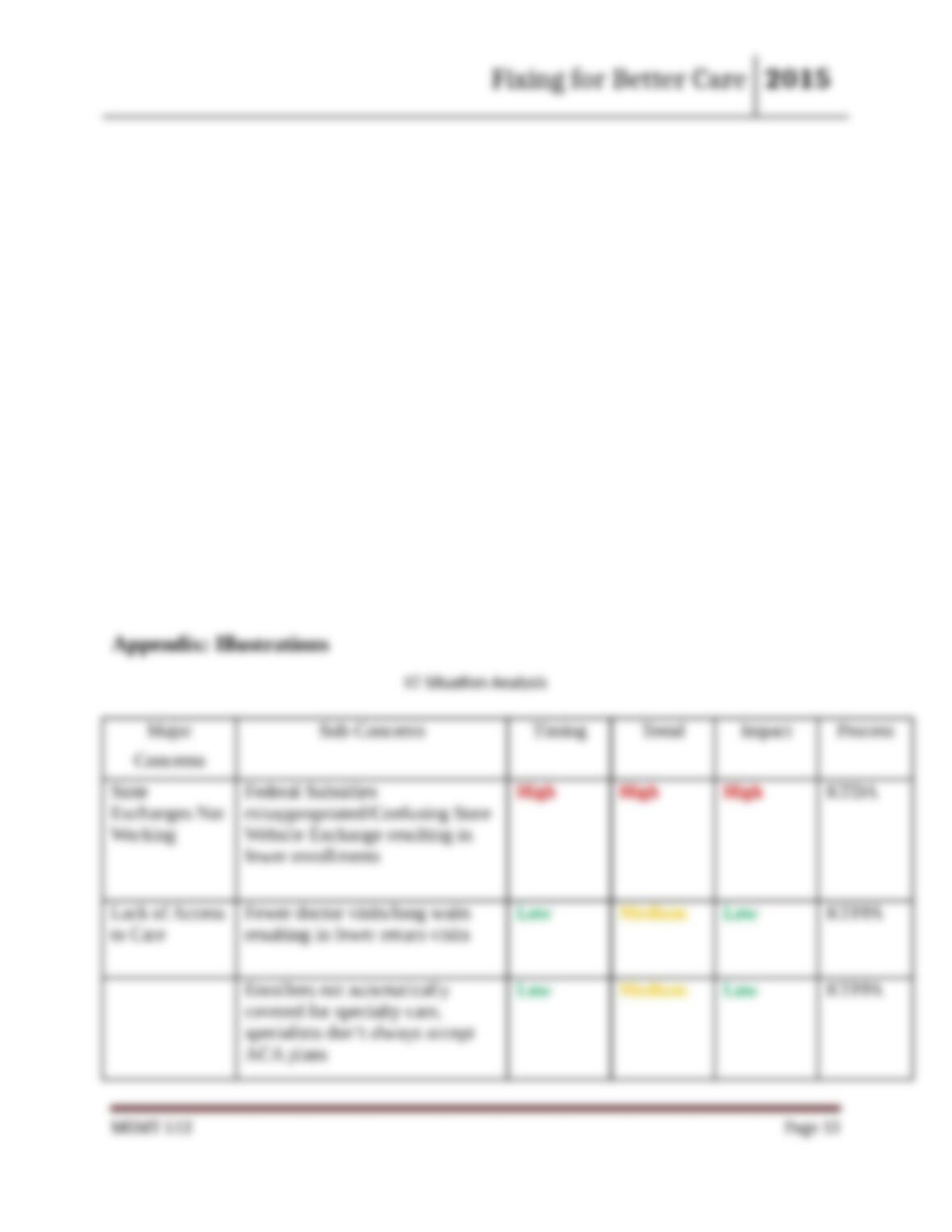
solution to implement at the national and state levels. In the present paper, KT situation analysis
identifies state exchanges and lack of access to specialty care as problems that need to be fixed.
KT decision analysis will demonstrate that adding federal subsidies for specialty care coverage
can address existing shortage while keeping some specialty doctors facing bankruptcy in
operation. The paper also discusses best approaches for Obamacare moving forward and what
steps can be taken for greater access to health care while decreasing waste due to poorly run
exchanges at the state level. The ACA had noble intentions from inception but poor carry through
at the state level due in great part to ambiguous guidelines and reporting standards which may
explain some failures seen by state officials.
Obamacare’s future success rests in the hands of lawmakers and the U.S. Supreme Court
who recently decided that giving states federal subsidies to expand Medicaid and run exchanges
is constitutional. ACA faces bipartisan criticism and lawsuits that threaten to dismantle the
program altogether. Barring any decision to dismantle the ACA, the present paper proposes
recommendations for the plan to perform optimally in the future while reducing costs moving
forward.
Introduction
President Obama won his first election predominantly on the much anticipated health
care reform bill. Patient advocates, uninsured and many Americans looked up to Obama as the
savior of a health care system in dire straits. In 2013, the United States spent 17.4% of its’ Gross
Domestic Product (GDP) on healthcare (Luhby, 2015). Obamacare was to reduce health care
MGMT 512 Page 3

Fixing for Better Care 2015
spending and reign in out-of-control costs. President Obama touted this cost-control goal as a
reason to implement the ACA in 2010 but experts now say it actually increased health care
spending by 5% hitting 3.1 Trillion last year (Luhby, 2015). Hindsight is 20/20 but back then
President Obama advocated for the largely bi-partisan bill with no Republican congressional
support. Approved by the U.S. House of Representative on March 21, 2010 with a 219-212 vote
and no Republican support, Obamacare went on to be one of the reasons why Obama won re-
election (Harrington, 2010). Obama signed the original bill in 2009 which passed the Senate by
a 60-39 vote with no Republican support in the Senate either (Harrington, 2010). After several
amendments, the ACA passed in 2010 making it the biggest piece of social change legislature
since Medicaid in 1965. Many hoped the ACA would reduce key health disparities like infant
mortality between whites and blacks being 5.1 per 1000 and 11.3 per 1000 births respectively
from 2011-2013 (Matthews et. al, 2015). However, disparities remain including lack of access to
specialty care among rich versus poor (Graham, 2015).
Key features of the ACA are expansion of health insurance coverage by: (1) requiring
individuals to obtain qualified health insurance, (2) subsidizing the cost of coverage for low- to
moderate-income people, (3) requiring other than small employers to offer health coverage to
employees, and (4) significantly expanding eligibility for Medicaid (Harrington, 2010). By 2014,
most legal residents we’re required to have health insurance that met minimum requirements,
unless the cost of minimum qualified coverage exceeded 8 percent of their income. The penalty
for noncompliance with the “individual mandate” is greater of $95 or 1 percent of taxable
income in 2014, increasing to the greater of $695 or 2.5 percent of taxable income in 2016, and
indexed to inflation in later years (Harrington, 2010). Non-compliance taxes and other penalties
was predicted in 2010 to off-set rising health care costs which it does however overall failures of
many state exchanges created other costs that the ACA couldn’t envision back then (Makin,
2015).
Subsidies are given to families with an income between 133 and 400% of the federal
poverty level (FPL) (Harrington, 2010). ACA reduces cost sharing for individuals making above
400% of the poverty level and eligibility for the tax-funded Medicaid program be expanded to
people with incomes up to 133% of the poverty level (Harrington, 2010). For businesses,
employers with 50 or more employees must pay a $2000 fee (for first 30 workers) if employees
are not covered by insurance but at least one is receiving a federal credit for the public option
(Harrington, 2010). Employers with 50 or more workers that do offer coverage but at least one
worker receives a federal subsidy must pay a fee as well (Harrington, 2010). Employers with 25
workers or less with average annual wages of 50K or less are eligible for a tax credit
(Harrington, 2010).
The ACA was to expand coverage to 32 million uninsured Americans reported by Henry
J. Kaiser Family Foundation (Shi & Singh, 2012). Statistics show that 8.4 Million Americans did
obtain health care coverage under Obamacare (Luhby, 2015). This may be in part due to the
public option plan that Obamacare includes which grandfathered in those under existing plans
like Medicaid and qualify them for newer services offered (Harrington, 2010). The ACA requires
existing plans to stop turning potential enrollees with pre-existing conditions away and extend
MGMT 512 Page 4
Fixing for Better Care 2015
coverage to adult children of beneficiaries up to age 26 (Harrington, 2010). Existing plans
grandfathered also eliminated lifetime limits, waiting periods of greater than 90 days for
enrollment, and prohibit rescissions absent fraud (Harrington, 2010). The projected cost of
covering an additional 32 million Americans was $820 billion over a ten year period with $358
in exchange subsidies, $434 going to Medicaid/CHIP expansion, and an additional $37 billion
going to small employer tax credits (Harrington, 2010). However, with state exchanges incurring
lost or misappropriating funds, it may still be too early to see any real gains (Graham, 2015).
President Obama’s plan requires additional taxes to cover new services and enrollees. A
total of $438 billion in new taxes was projected including $210 billion additional Medicare taxes;
$32 billion from 40% excise taxes on high-cost plans, $65 billion projected from individual and
employer penalties, $27 billion tax on pharmaceutical companies, $20 billion tax on medical
device companies, and $60 billion tax on health insurers (Harrington, 2010). Obama also
projected recovering monies for running the ACA through $455 billion spending reduction on
Medicare; primarily Medicare Advantage ($136 billion) (Harrington, 2010). The shift from
Medicare Advantage to Obamacare however, left many vulnerable elderly with chronic ailments
without access to specialty care since the plan does not pay for those services nor are states
required to insure such services (Blahous, 2015). The ACA was projected to help with the
national deficit to the tune of $143 billion with $70 billion coming from the CLASS program
(Harrington, 2010). CLASS stands for Community Living Assistance Services and Supports