1
000
001
002
003
004
005
006
007
008
009
010
011
012
013
014
015
016
017
018
019
020
021
022
023
024
025
026
027
028
029
030
031
032
033
034
035
036
037
038
039
040
041
042
043
044
045
046
047
048
049
050
051
052
053
054
055
056
057
058
059
060
061
062
063
064
065
066
067
068
069
070
071
072
073
074
075
076
077
078
079
080
081
082
083
084
085
086
087
088
089
090
091
092
093
094
095
096
097
098
099
ACL 2017 Submission ***. Confidential Review Copy. DO NOT DISTRIBUTE.
Emotional Conversation Generation
Anonymous ACL submission
Abstract
In this report, we address the emo-
tional conversation generation task
with Emotional Chatting Machine
(ECM) in two ways: modeling high-
level emotion expression by embedding
categories and capturing the change of
internal emotion states. Experiments
show that our model is capable of gen-
erating responses not only meaningful
in content but also specific in emotion.
1 Introduction
Recently, it is becoming more and more pop-
ular in AI research to enhance the interaction
between human and machine. And to cre-
ate a machine capable of acting and talking
at human levels, an important factor is un-
derstanding and expressing human emotions.
Due to the rapid development of deep learn-
ing, large-scale conversation generation prob-
lem have been investigated.(Ritter et al.,2011)
But these studies are more concentrated on
contents and has not address the emotional
factor explicitly. Recently Emotional Chat-
ting Machine(Zhou et al.,2017) is proposed
as the first work which addresses the emotion
factor in large scale generation models.
In this report, we tackle emotional con-
versation generation problem with ECM as
our main reference. Our model consists of
encoder-decoder network for large scale se-
quence generation which can respond to users
emotionally. Emotional factors in conversa-
tion generation is modeled in two ways: a
high-level astraction of emotion categories is
modeled by embedding emotion categories and
feeding it into the decoder and an internal
memory module is used to model the change
of internal emotion state of the decoder.
2 Related work
A common approach towards large-scale con-
versation generation is to learn a response
generation model within a Statistical machine
transation problem (SMT). (Ritter et al.,
2011). Recently, neural network based meth-
ods is becoming the mainstream because of
their capability to capture semantic and syn-
tactic relations between messages and re-
sponses in an end-to-end way. Sequence-
to-sequence with attention (Bahdanau et al.,
2014) introduced attention mechanism into
seq2seq framework and was soon applied to
conversation generation. Recently, Convolu-
tional neural network is introduced (Gehring
et al.,2017) to accelerate training process
and outperform common LSTM-based seq2seq
models. And new simple architecture based
solely on attention mechanisms (Vaswani and
Uszkoreit,2017) achieves the state-of-the-art
performance.
Memory network (Weston et al.,2015) is
introduced and further refined (Sukhbaatar
and Szlam) to improve the ability of model-
ing long-range sequences by augmenting RNNs
with additional memory structures. Our
model use a dynamic memory to model the
change of internal emotion state, which is
trained end-to-end and yields improved results
over vanilla RNNs.
3 Methodology
3.1 Task definition
The task is defined as follows:Given a Chinese
post X= (x1, x2, . . . , xn)and a user-specified
emotion category of the response to be
generated, our goal is to generate a response
100
101
102
103
104
105
106
107
108
109
110
111
112
113
114
115
116
117
118
119
120
121
122
123
150
151
152
153
154
155
156
157
158
159
160
161
162
163
164
165
166
167
168
169
170
171
172
173
ACL 2017 Submission ***. Confidential Review Copy. DO NOT DISTRIBUTE.
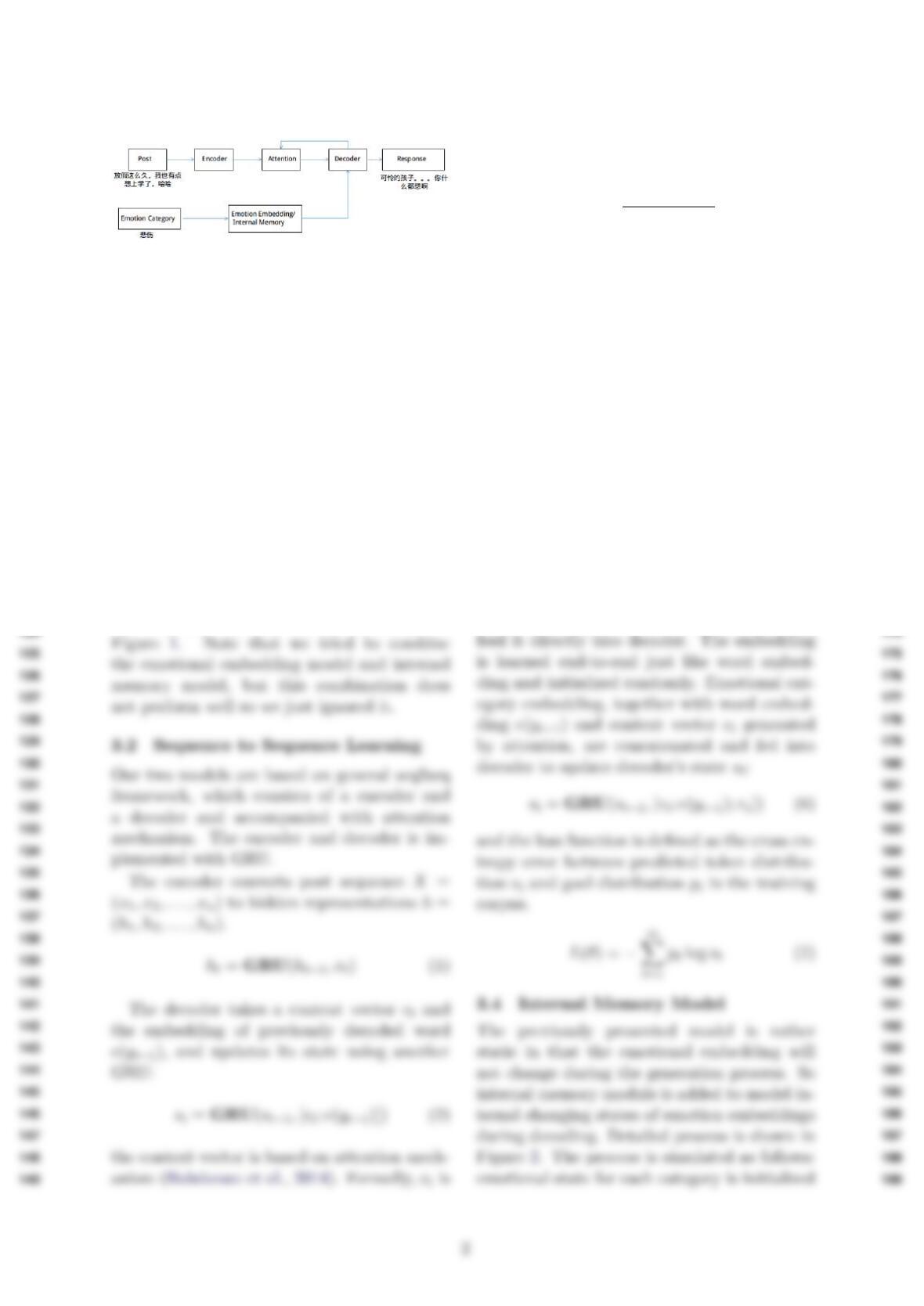
Figure 1: Model Overview
Y= (y1, y2, . . . , yn)that is coherent with the
emotion category. The emotion categories are
{Anger,Disgust,Happiness,Like,Sadness,Other}.
Build upon the generation framework in pre-
vious section, we implemented two models
for generating emotional expressions: For the
first one, since emotion category is a kind
of high-level abstraction, emotion category
is embedded and fed into the decoder. For
the second one, we assume that the internal
emotion state is changing during decoding
phase and in order to capture the implicit
change of emotion state, a memory module is
introduced.The main difference between two
models is whether the emotional embedding
is dynamic or static during training process.
An overview the two models is shown in
calculated as:
ct=
n
∑
k=1
αtkhk
αtk =exp etk
∑n
j=1 exp etj
etk =f(st−1, hk)
(3)
Once state vector stis obtained, the decoder
generates a token by choosing the next word
yt+1 with maximum probability over the dis-
tribution otcomputed from decoder’s state st
as follows:
yt=argmaxytP(yt|y1, y2, . . . , yn, ct)(4)
where the decoding probability distribution is
calculated as follows:
P(yt|y1, y2, . . . , yn, ct) = softmax(Wost)(5)
3.3 Emotional Category Embedding
Model
As a high-level abstraction of emotion, it is
intuitive to model the emotional category by
embedding each category eas an vector veand