Macroeconomics
Tenth Edition, Global Edition
Chapter 11
Keynesianism: The Macroeconomics
of Wage and Price Rigidity
Copyright © 2020 Pearson Education Ltd.

Copyright © 2020 Pearson Education Ltd.
Learning Objectives
11.1 Summarize the Keynesian explanations for real–wage
rigidity (Sec. 11.1: Real–Wage Rigidity)
11.2 Describe the causes and effects of price stickiness
according to the Keynesian model (Sec. 11.2: Price
Stickiness)
11.3 Analyze the effects of monetary and fiscal policy in
the Keynesian model (Sec. 11.3: Monetary and Fiscal
Policy in the Keynesian Model)
11.4 Explain Keynesian theories about business cycles
and macroeconomic stabilization (Sec. 11.4: The
Keynesian Theory of Business Cycles and
Macroeconomic Stabilization)

Copyright © 2020 Pearson Education Ltd.
•Wage rigidity is important in explaining unemployment
–In the classical model, unemployment is due to
mismatches between workers and firms
–Keynesians are skeptical, believing that recessions
lead to substantial cyclical employment
–Keynesians view equilibrium as a situation in which
there is no upward or downward pressure on wages
–To get a m o d e l in w hich unem p loyment pers ists ,
Keynesian theory posits that the real wage is slow to
adjust to equilibrate the labor market
Real–Wage Rigidity

Copyright © 2020 Pearson Education Ltd.
•Some reasons for real–wage rigidity
–For unemployment to exist, the real wage must exceed the
market–clearing wage
–If the real wage is too high, why don’t firms reduce the
wage?
§One possibility is that the minimum wage and labor
unions prevent wages from being reduced
–But most U.S. workers are not minimum wage
workers, nor are they in unions
–The minimum wage would explain why the nominal
wage is rigid, but not why the real wage is rigid
–This might be a better explanation in Europe, where
unions are far more powerful
Real–Wage Rigidity

Copyright © 2020 Pearson Education Ltd.
•Some reasons for real–wage rigidity
–If the real wage is too high, why don’t firms reduce the
wage?
§Another possibility is that a firm may want to pay
high wages to get a stable labor force and avoid
turnover costs—costs of hiring and training new
workers
§A third reason is that workers‘ productivity may
depend on the wages they‘re paid—the efficiency
wage model
Real–Wage Rigidity

Copyright © 2020 Pearson Education Ltd.
•The Efficiency Wage Model
–Workers who feel well treated will work harder and
more efficiently (the “carrot“); this is Akerlof’s gift
exchange motive
–Workers who are well paid will not risk losing their jobs
by shirking (the “stick”)
–Both the gift exchange motive and shirking model imply
that a worker‘s effort depends on the real wage
Real–Wage Rigidity
Copyright © 2020 Pearson Education Ltd.
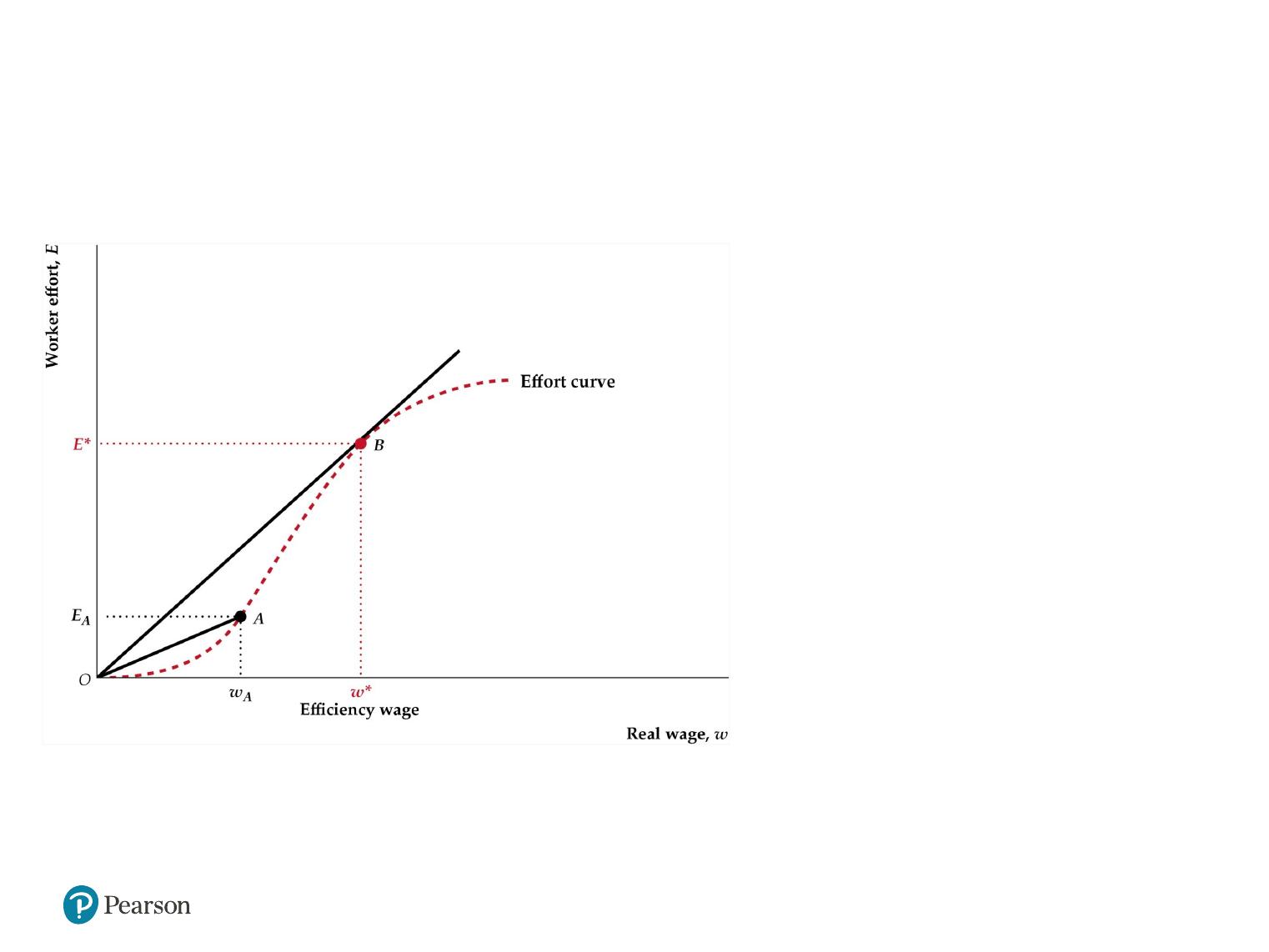
Determination of the Efficiency Wage
•The Efficiency Wage Model
–The effort curve, plotting effort
against the real wage, is S–
shaped
§At low levels of the real
wage, workers make hardly
any effort
§Effort rises as the real wage
increases
§As the real wage becomes
very high, effort flattens out
as it reaches the maximum
possible level
Copyright © 2020 Pearson Education Ltd.
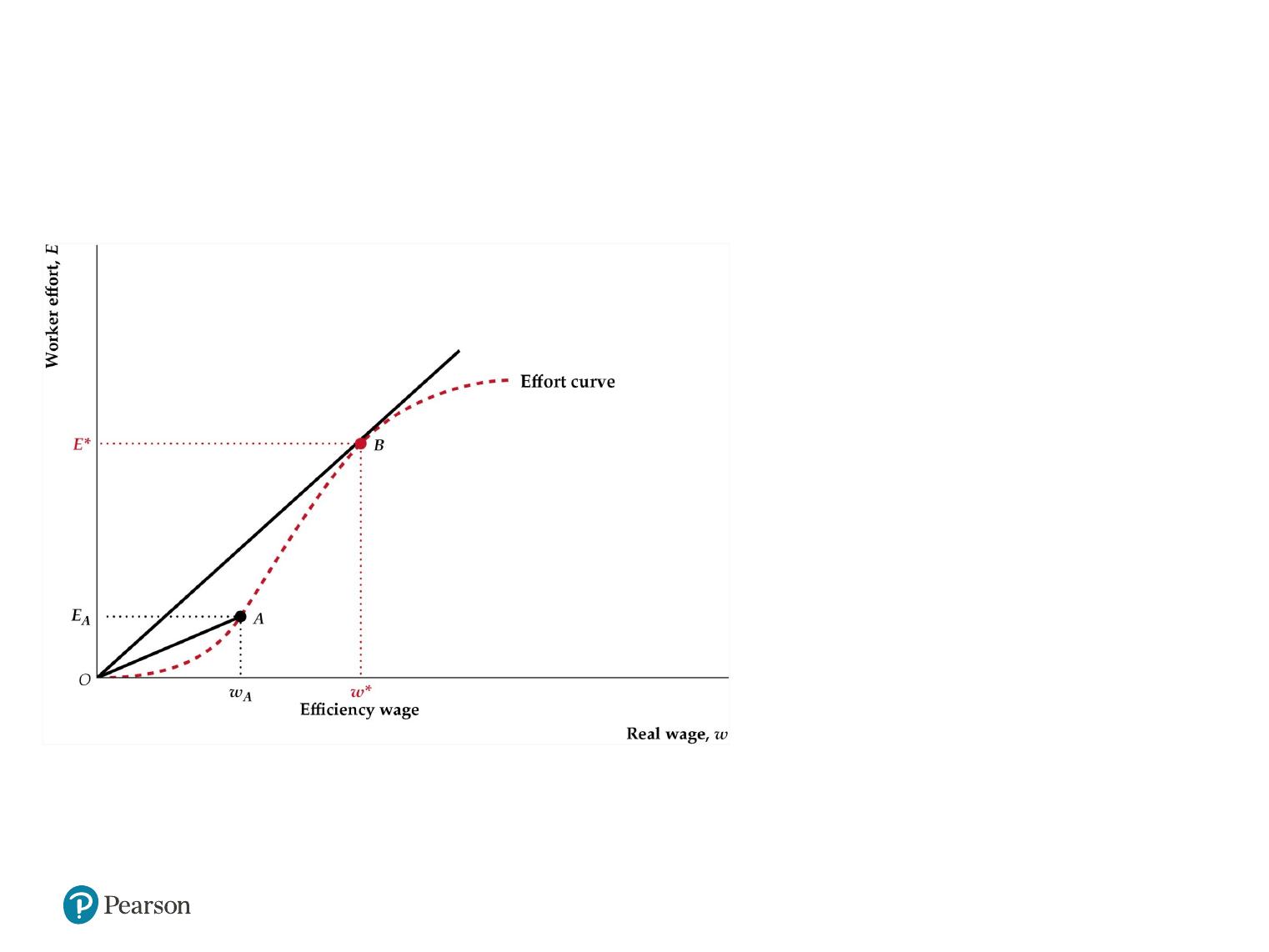
Determination of the Efficiency Wage
•Wage determination in the
efficiency wage model
–To maximiz e p r o f i t , f i r m s
choose the real wage that
gets the most effort from
workers for each dollar of real
wages paid
–This occurs at point B, where
a line from the origin is just
tangent to the effort curve
–The wage rate at point Bis
called the efficiency wage
–The real wage is rigid as long
as the effort curve does not
change
Copyright © 2020 Pearson Education Ltd.
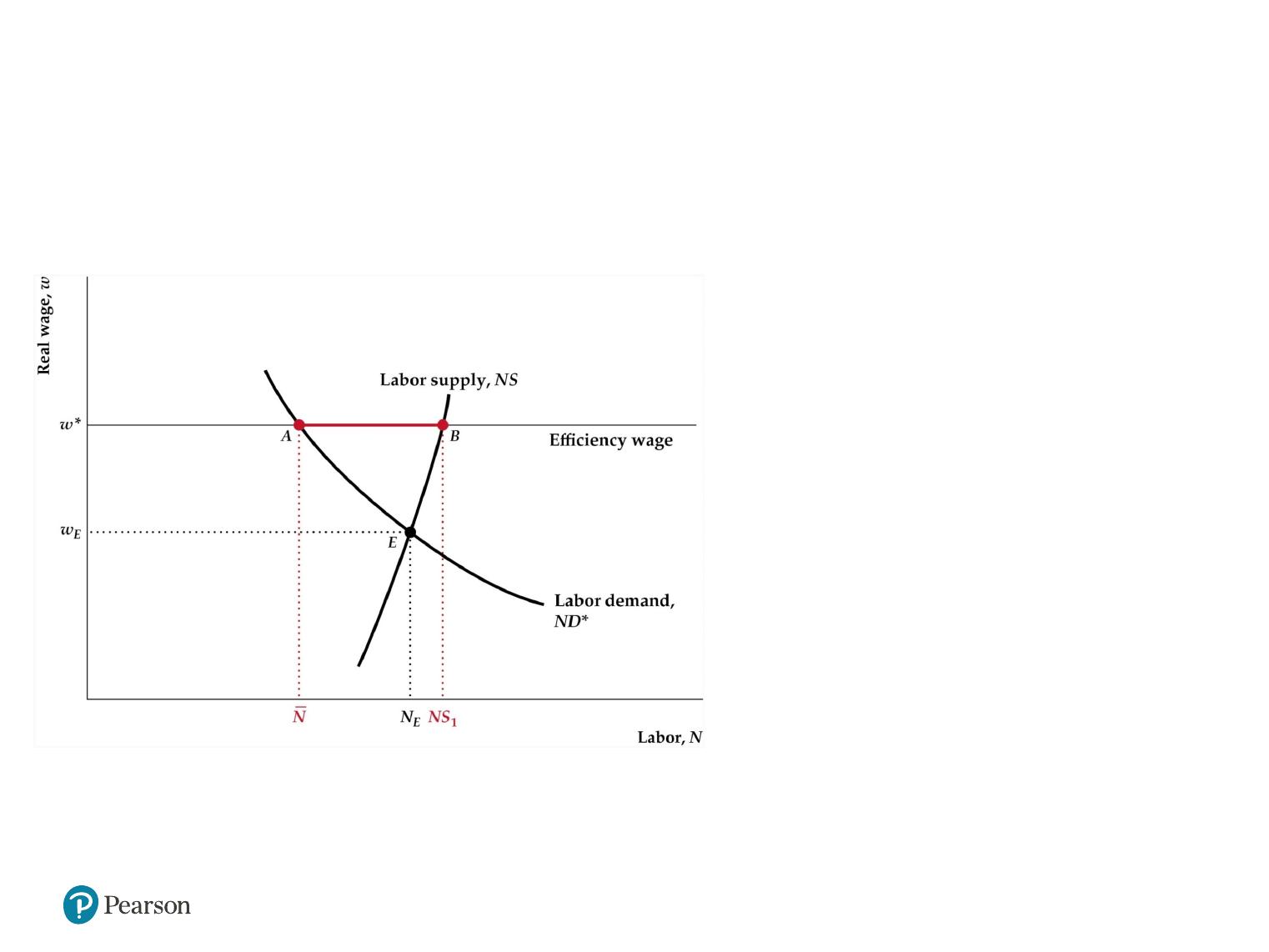
•Employment and Unemployment in the
Efficiency Wage Model
–The labor market determines
employment and unemployment,
depending on how far above the
market–clearing wage is the
efficiency wage
–The labor supply curve is upward
sloping, while the labor demand
curve is the MPN when the effort
level is determined by the efficiency
wage
–The difference between labor supply
and labor demand is the amount of
unemployment
–The fact that there is unemployment
puts no downward pressure on the
real wage, since firms know that if
they reduce the real wage, effort will
decline
Real–Wage Rigidity

Copyright © 2020 Pearson Education Ltd.
•Employment and Unemployment in the Efficiency Wage
Model
–Does the efficiency wage theory match up with the
data?
–It seems to have worked for Henry Ford in 1914
–Plants that pay higher wages appear to experience less
shirking
–But the theory implies that the real wage is completely
rigid, whereas the data suggests that the real wage
moves over time and over the business cycle
Real–Wage Rigidity

Copyright © 2020 Pearson Education Ltd.
•Employment and Unemployment in the Efficiency Wage
Model
–It is possible to jazz up the model to allow for the
efficiency wage to change over time
§Workers would be less likely to shirk and would work
harder during a recession if the probability of losing
their jobs increased
§This would cause the effort curve to rise and may
cause the efficiency wage to decline somewhat
§This would lead to a lower real wage rate in
recessions, which is consistent with the data
Real–Wage Rigidity

•Efficiency wages and the FE line
–The FE line is vertical, as in the classical model, since
full–employment output is determined in the labor
market and does not depend on the real interest rate
Real–Wage Rigidity