1
Monetary Policy Analysis Paper: Depression of 1920
Macroeconomics BUS 603_31
By: Payton N. Rissman
Policy Analysis: Depression of 1920
Historical Context
The leading events such as World War I and, the overproduction of economic goods in the
United States of America led to the small unknown depression of the 1920’s that is now known a
major turning point that eventually was coined as one of the leading causes of The Great
Depression. Looking back in time are Pre-WWI America, the post gilded-age fueled new
inventions, a high-class economy, and the industrial revolution that made the U.S. a major power
house in the World as we know it. However, when Arch-Duke Franz Ferdinand of then Austria-
Hungary was assassinated and, the rise of Nationalism in Europe occurred, World War I began
(Kelly, 2018, p. 3). After many European countries declared war on one another, the United
States planned on remaining neutral and avoiding war in general until 1917, this is when the U.S.
joined forces with allies in France, Russia and Britain. During this time, international trading
came to a strong halt due to men joining the military and going overseas to fight for their country
and halting the goods production in their respective countries. With a little over four million
Americans serving in the armed forces during WWI, the United States during that time recruited
women and ran ad campaigns encouraging any and all state-side Americans to begin working in
mills and warehouses to ‘help the boys overseas’ by outputting an extreme supply of
ammunition, raw materials and machinery. During WWI because the international trade stopped

2
the domestic price level of goods and services in both the United States and the surrounding
countries grew to over the national average and doubled more than 10 percent, creating a surge
in credit debt. According to Rockoff (2008), Britain and France were able to be sustained by the
United States due to the production of goods created by the Americas and gifted to the allies for
purposed of domestic market imports. With the size of the ‘ideal’ army being so large in
numbers, the goods produced; (guns, food, ammunition, clothing, automobiles, etc.), were unable
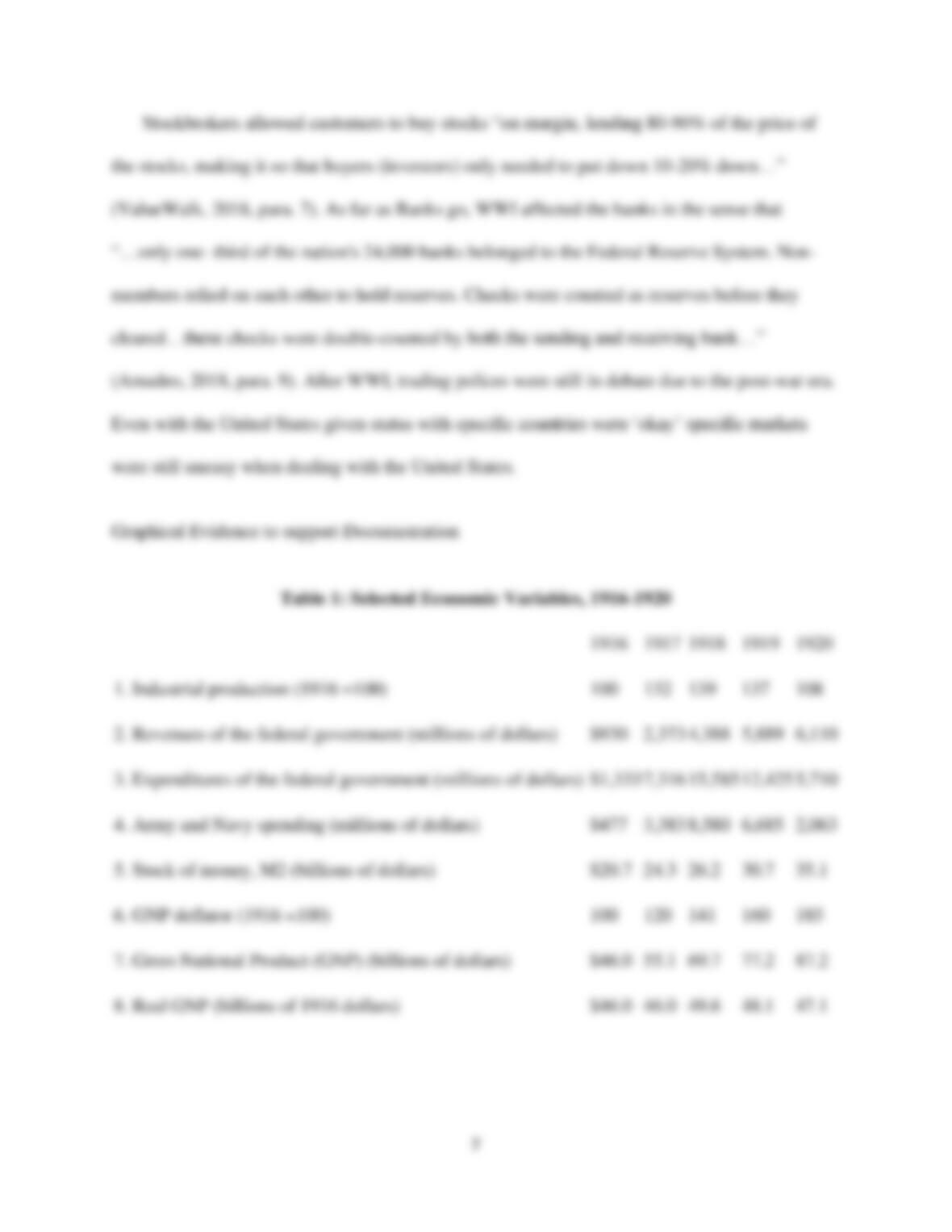
to meet the demand of the military standards (See Table 1, Selected Economic Variables from
1916-1920).
As a result of the impact that WWI had on the economy, many industries perished as well as
boomed due to the necessary means of weaponry used during warfare. This included but was not
limited to the revolution of organic chemistry in both the heightened use of various gunpowder’s
and poison gases, as well as, the decrease of available natural coal being mined in the United
States. It is no wonder why the impact of WWI was extreme, with no international trade
occurring, Europe could also no longer supply textiles, machinery and chemicals to the rest of
the world. Similarly, Japan also hand had a huge shortage of high-quality machines: causing
industrial inputs while domestic demand skyrocketed throughout the world (Weiher, 1998, p.
42). This forced saving through inflation, and export-led boom caused domestic consumption of
products to be over crowded by foreign demand while contributing to millions of dollars in
national debt that was accumulated to supplement WWI and its fighters. Towards the end of
1918, WWI ended, and the mass production of weapons became more popular in the United
States than ever before and a wistfulness to boom the economy with credit funded by the
government. Fast-forward to the beginning of January 1920 the monumental turning point of a
deflationary recession occurred not only in the United States but also in other countries as a

3
result of the end of World War I. A major result of WWI was the government’s decision to
implement monetary policies that ballooned the quantity of money and credit within the
economy, resulting in what we now know as the 1930’s era ‘Great Depression.’ Although the
economy was in a national debt due to the government racking up a relatively large amount of
surplus ($509M) in order to start paying down the debt accumulated in WWI, the economy grew
due to the mass production on new consumer goods created.
Effect of WWI
WWI caused many changes that led to the depression of 1920’s, one of the biggest effects
that changed in the United States was the unemployment rate. A majority of men fighting in the
war came home to no jobs and the unemployment rate jumped from 4% to 12 percent in 1920.
With the unemployment rate at an all-time high with tariffs and trading abilities still being
negotiated amongst the world powers manufacturing from the United States, Japan and the
Europe allies increased. Ultimately, because it was temporary as a result of the end of WWI, it
was classified as an “artificial” boost and the quick import substitution was excessive,
inefficient, unrealistic and unsustainable for all relative economies. Rockoff states that the
reasoning behind such a drastic decline in the everchanging economy is due to the “long period
of U.S. neutrality that made the ultimate conversion of the economy to a wartime basis easier…”
(2008, p. 4). Another result of the unemployment rate was the post-war recession price deflation
that made it difficult for new veterans to get their lives “back on track” and adjust back to the
normality of everyday life.
One of the Federal Reserve perks of the 1920’s was based on the United States’ ideal ‘high’
of participating in the win of their first global victory, leading to the loaning of money based on
credit lines that were before nonexistent. When the unemployed veterans started to buy homes,
appliances, and pretty much everything else, they lacked the funds to make these purchases and
needed an open new line of credit in order to make this happen. This resulted in the GDP to
decline 17 percent; lowering Income in the 1920’s from an average of $6,500 to $8,000 per
person, while real GDP was only an average of $687 billion dollars per year (Weiher, 1992, para.
5). With real GDP and expected GDP missing the mark, President Warren saw fit to alter the
high marginal tax rate of the time (73%) to a staggering 53%, slowly decreasing it over time;
unfortunately, this act let to a massive price inflation that the Federal Reserve caused in order to
supplement the spending that occurred in WWI. “The loss of output in 1917 would have been
$2.031 billion per year…about 3.7 percent of GDP in 1917, and only 6.3 percent of the total U.S.
cost of war (Rockoff, 2008, p. 2).
Due to the government’s intervention, this caused a recessionary gap, during WWI because