Abstract
This term paper is based on Macroeconomic Analysis of the Zambian economy. It affects all of us when
the price of a product you wish to buy rises. But why have prices of products and services in Zambia
been increasing? Has there been a demand for something that there isn’t enough of? Have the products
become more expensive because of the raw materials required to create them? We must look to
macroeconomics to find answers to these problems.
Macroeconomics is basically the study of the economy’s overall behavior. It generally studies general
economic factors. By virtual of that, macroeconomists attempt to foresee economic situations to assist
consumers, businesses, and governments in making more informed decisions.
Macroeconomic Analysis
When it comes to budgeting, creating taxes, deciding on interest rates, and making policy decisions, the
Zambian Government has been known to look to macroeconomics. Macroeconomic analysis is
primarily concerned with three factors: national output (as measured by GDP), unemployment, and
inflation.
Gross Domestic Product (GDP)
The most fundamental notion in macroeconomics is output, which refers to the entire amount of goods
and services produced by a country, often known as GDP. This number represents a snapshot of the
economy at a specific time.
The gross domestic product (GDP) is a measure of a country’s economic output and income. In other
words, the GDP is the sum of all expenditures for all final goods and services generated in a certain
period of time inside the country.
According to Trading Economics global macro models and analysts, Zambia’s GDP is predicted to reach
USD 24.00 billion by the end of 2021. According to our econometric models, Zambia’s GDP is expected
to trend around USD 27.00 billion in 2022. (Zambia GDP, 2021).
1 | P a g e
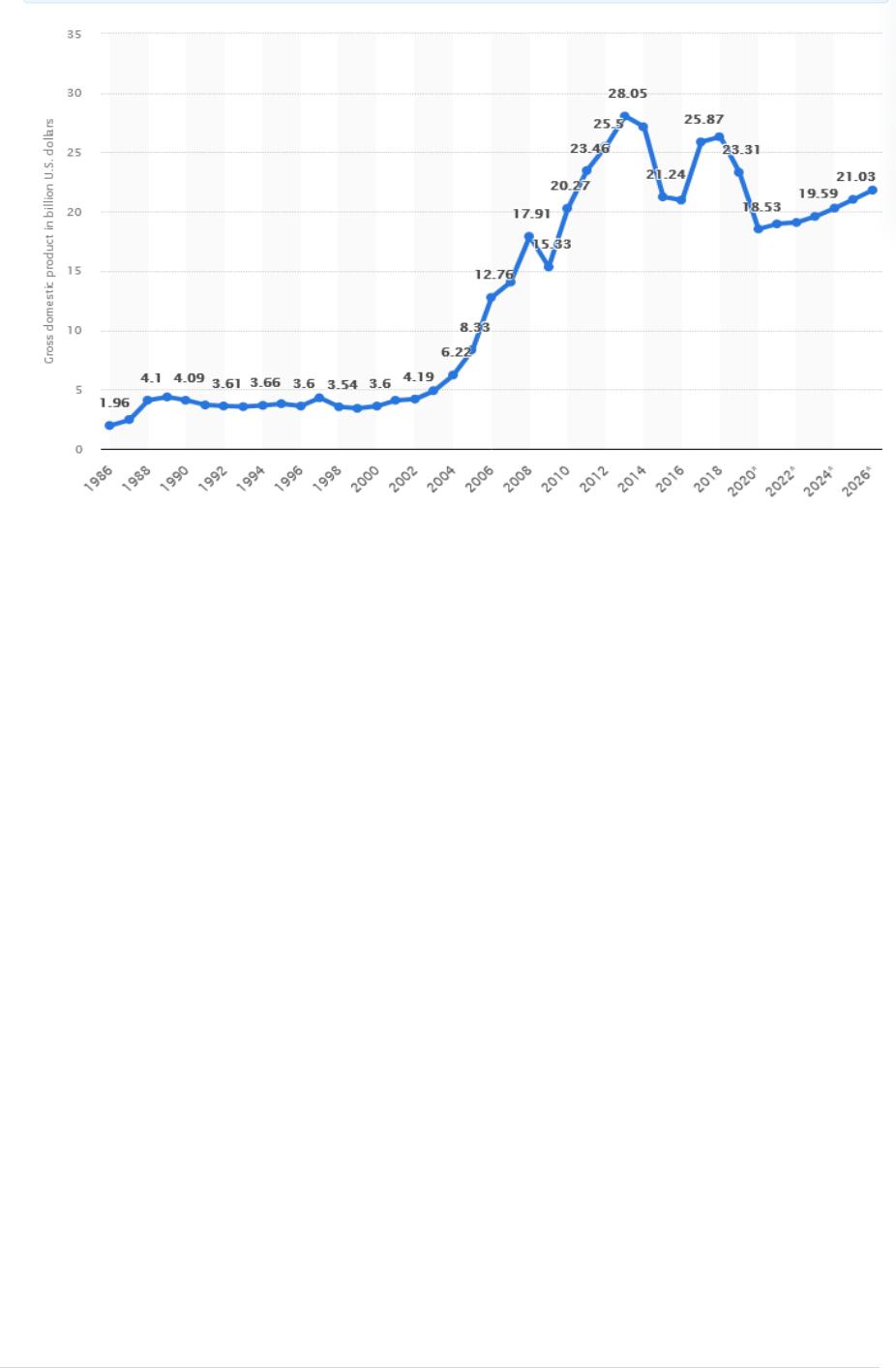
The graph depicts Zambia’s gross domestic product (GDP) from 1986 to 2019, with predictions through
2026. The total value of all services and goods generated inside a country in a given year is referred to
as the gross domestic product (GDP). The Gross Domestic Product (GDP) is a key indicator of a
country’s economic strength. Zambia’s gross domestic product was estimated to be approximately 23.31
billion dollars in 2019. (O’Neill, 2021).
The one disadvantage of GDP is that data must be obtained after a set length of time has passed; hence,
a figure for GDP today would have to be an estimate. Despite this, GDP is a useful starting point for
macroeconomic study. Once a set of numbers has been collected over a period of time, economists and
investors may begin to decode business cycles, which are made up of periods that alternate between
economic recessions (slumps) and expansions (booms) throughout time.
It is from there that the Government can investigate the causes of the cycles, which could include some
government policies, consumer behavior, or international events, among other factors. This data can, of
course, be compared across economies. As a result, they can establish which foreign countries are
economically strong and which are economically poor. Analysts can then begin to forecast the
economy’s future situation based on what they’ve learned in the past. It’s crucial to keep in mind that
the factors that influence human behavior and, eventually, the economy, can never be totally predicted.
According to the proposed budget speech delivered to the National Assembly by the Minister of Finance
and National Planning, Zambia is striving to grow the economy at a faster rate than the current
population growth rate of 2.8 percent. This is necessary to ensure that the economy can fulfill the
demands of an expanding population. He further said, the economy is gradually recovering from the
COVID-19 pandemic’s negative consequences. According to preliminary estimates, real GDP increased
by 0.5 percent in the first quarter of 2021, then improved to 8.1 percent in the second quarter. Overall,
the economy is expected to increase at a rate of 3.3 percent in 2021, compared to 2.8 percent shrinkage