MANAGEMENT ADVISORY SERVICES
Responsibility Accounting & Transfer Pricing
CHIANG KAI SHEK COLLEGE
Page 1 of 21
RETURN ON INVESTMENT
Return on Investment Computation
Based on Operating Income
1. The following selected data pertain to the belt division of Allen Corp. for last year:
Sales $500,000
Average operating assets $200,000
Net operating income $80,000
Turnover 2.5
Minimum required return 20%
How much is the return on investment? (M)
a. 40% c. 20%
b. 16% d. 15% AICPA, Adapted
2. Harstin Corporation has provided the following data:
Sales $625,000
Gross margin 70,000
Net operating income 50,000
Stockholders’ equity 90,000
Average operating assets 250,000
Residual income 20,000
The return on investment for the past year was: (M)
a. 28%. c. 36%.
b. 20%. d. 8%. G & N 9e
Investment
3. Apple Division of the American Fruit Co. had the following statistics for 2002:
Assets available for use $1,000,000
Residual income 100,000
Return on investment 15%
If the manager of Apple Division is evaluated based on return on investment, how much would
she be willing to pay for an investment that promises to increase net segment income by
$50,000? (M)
a. $50,000 c. $1,000,000
b. $333,333 d. $500,000 Barfield
Required Peso Sales
4. The manager of the Strong Division of Powers Company expects the following results in 2003
(pesos in millions);
Sales
P49.60
Variable costs (60%)
29.76
Contribution margin
P19.84
Fixed costs
12.00
Profit
P 7.84
Investment
Plant equipment
P19.51
Working capital
14.88
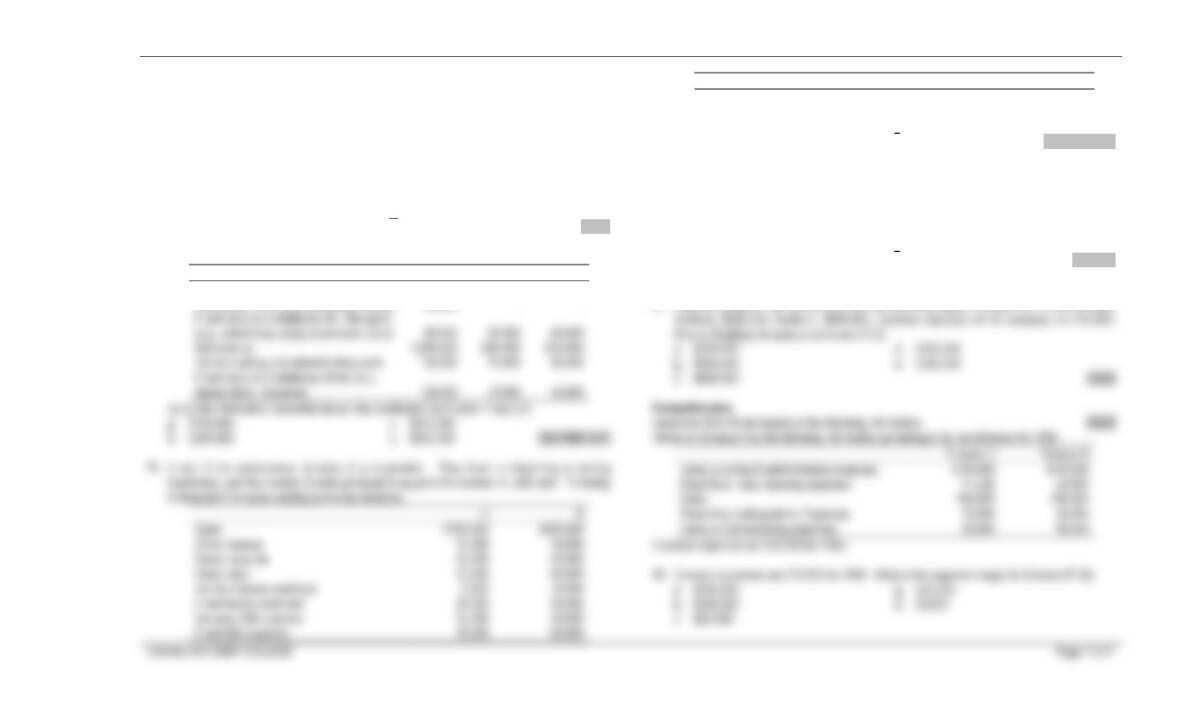
P34.39
ROI (P7.84/P34.39)
22.80%
The division has a target ROI of 30%, and the manager has asked you to determine how much
sales volume the division would need to reach. He states that the sales mix is relatively
constant so variable costs should be close to 60% of sales, fixed cost and plant and
equipment should remain constant, and working capital (cash, receivables and inventories)
should vary closely with sales in the percentage reflected above.
The peso sales that the division needs in order to reach the 30% ROI target is (D)
A. P19,829,032. C. P44,373,871
B. P57,590,322 D. P59,510,000 Pol Bobadilla
Dupont Model
Sensitivity Analysis
5. If the operating income margin of 0.3 stayed the same and the operating asset turnover of 5.0
increased by 10 percent, the ROI (M)
a. increase by 10 percent d. remain the same
b. decrease by 10 percent e. increase to 1.5.
c. increase by 15 percent H & M
6. If the investment turnover increased by 20% and ROS decreased by 30%, the ROI would (M)
a. Increase by 20%. c. Increase by 4%.
b. Decrease by 16%. d. None of the above. D, L & H 9e
7. If the investment turnover decreased by 20% and ROS decreased by 30%, the ROI would (M)
a. Increase by 30%. c. Decrease by 44%.
b. Decrease by 20%. d. None of the above. D, L & H 9e

MANAGEMENT ADVISORY SERVICES
Responsibility Accounting & Transfer Pricing
CHIANG KAI SHEK COLLEGE
Page 2 of 21
8. Company L had its operating asset turnover increased by 50% and the operating income
margin increased by 50%. Company U had its operating asset turnover increased by 30% and
the operating income margin decreased by 30%. What changes are expected for ROI of
Company L and Company U, respectively? (M)
Pol Bobadilla
A.
B.
C.
D.
Company L
50% increase
125% increase
225% increase
125% increase
Company U
9% decrease
9% decrease
No change
No change
RESIDUAL INCOME
Residual Income Computation
9. REB Service Co. is a computer service center. For the month of May 1995, REB had the
following statistics:
Sales $450,000
Operating income 25,000
Net profit after taxes 8,000
Total assets 500,000
Shareholders’ equity 200,000
Cost of capital 6%
Based on the above information, which one of the following statements is correct? REB has a
(M)
a. ROI of 4% c. ROI of 1.6% CMA 0695 3-20
b. Residual income of $(5,000) d. Residual income of $(22,000)
Target Cost
10. James Webb is the general manager of the Industrial Park Division, and his performance is
measured using the residual income method. Webb is reviewing the following forecasted
information for the division for next year.
Category
Amount (thousands)
Working capital
$ 1,800
Revenue
30,000
Plant and equipment
17,200
To establish a standard of performance for the division’s manager using the residual income
approach, four scenarios are being considered. Scenario 1 assumes an imputed interest
charge of 15% and a target residual income of $2,000,000. Scenario 2 assumes an imputed
interest charge of 12% and a target residual income of $1,500,000. Scenario 3 assumes an
imputed interest charge of 18% and a target residual income of $1,250,000. Scenario 4
assumes an imputed interest charge of 10% and a target residual income of $2,500,000.
Which of the scenarios assumes the lowest maximum cost? (M)
a. Scenario 1. c. Scenario 3.
b. Scenario 2. d. Scenario 4. Gleim
RETURN ON INVESMENT, MINIMUM REQUIRED RATE OF RETURN & RESIDUAL INCOME
Minimum Required Rate of Return & Residual Income
Return on Investment
11. Fortree products have a residual net income of P1.8 million. If the imputed interest rate is
16%, compute the ROI (M)
a. 5% c. 15%
b. 10% d. not listed RPCPA 1091
12. Z Division of XYZ Corp. has the following information for 2002:
Assets available for $1,800,000
Target rate of return 10%
Residual income $270,000
What was Z Division‘s return on investment for 2002? (M)
a. 15% c. 25%
b. 10% d. 20% Barfield
13. Pasta Division of We Make Italian, is evaluated based on residual income generated. For
2002, the Division generated a residual income of $2,000,000 and net income of $5,000,000.
The target rate of return for all divisions of We Make Italian is 20 percent. For 2002, what was
the return on investment for Pasta Division? (M)
a. 40% c. 20%
b. 13% d. 33% Barfield
Return on Investment, Minimum Required Rate of Return & Residual Income
Investment Cost
14. In the X Division of S Co., 2002 segment income exceeded 2002 residual income by $15,000.
Also for 2002, return on investment exceeded the target rate of return by 10 percent. What
was the level of investment in the X Division for 2002? (M)
a. $15,000
b. $100,000
c. $150,000
d. An answer can’t be determined from this information. Barfield

MANAGEMENT ADVISORY SERVICES
Responsibility Accounting & Transfer Pricing
CHIANG KAI SHEK COLLEGE
Page 3 of 21
Return on Investment & Residual Income & Units Sold
Questions 15 thru 17 are based on the following information. G & N 9e
The Axle Division of LaBate Company makes and sells only one product. Annual data on the Axle
Division’s single product follow:
Unit selling price $50
Unit variable cost $30
Total fixed costs $200,000
Average operating assets $750,000
Minimum required rate of return 12%
15. If Axle sells 16,000 units per year, the return on investment should be: (M)
a. 12%. c. 16%.
b. 15%. d. 18%.
16. If Axle sells 15,000 units per year, the residual income should be: (M)
a. $30,000. c. $50,000.
b. $100,000. d. $10,000. G & N 9e
17. Suppose the manager of Axle desires an annual residual income of $45,000. In order to
achieve this, Axle should sell how many units per year? (M)
a. 14,500. c. 18,250.
b. 16,750. d. 19,500. G & N 9e
ECONOMIC VALUE-ADDED
EVA Based on Operating Income
18. Division A had the following information:
Asset base in Division A $800,000
Net income in Division A $100,000
Operating income margin for Division A 20%
Target ROI 15%
Weighted-average cost of capital 12%
What is EVA for Division A?
a. $120,000 d. $4,000
b. $96,000 e. $(20,000)
c. $15,000 H & M
19. Watne Company has two divisions, M and N. Information for each division is as follows:
Net earnings for division $65,000
Asset base for division $300,000
Target rate of return 18%
Operating income margin 20%
Weighted average cost of capital 12%
What is EVA for N?
a. $36,000 c. $54,000
b. $29,000 d. $11,000 H & M
20. Family Company has two divisions, Ma and Pa. Information for each division is as follows:
Ma
Pa
Net earnings for division
P20,000
P65,000
Asset base for division
P50,000
P300,000
Target rate of return
15%
18%
Operating income margin
10%
20%
Weighted-average cost of capital
12%
12%
What is the Economic Value Added for Ma and Pa, respectively?
A. P20,000, P36,000 C. P12,500; P11,000
B. P14,000; P29,000 D. P20,000; P29,000 Pol Bobadilla
EVA Based on Operating Income after Tax
EVA – Given Operating Income Before Tax
21. McKenzie Oil had $440,000 in operating income before interest and taxes in the last year.
McKenzie is in the 40% tax bracket. If capital employed by McKenzie was equal to $300,000,
and the company’s weighted-average after-tax cost of capital is 15%, what is McKenzie’s
Economic Value Added?
A. $131,000 C. $198,000
B. $140,000 D. $219,000 Gleim
22. Valecon Co. reported the following information for the year just ended:
Segment A
Segment B
Segment C
Pre-tax operating income
$ 4,000,000
$ 2,000,000
$3,000,000
Current assets
4,000,000
3,000,000
4,000,000
Long-term assets
16,000,000
13,000,000
8,000,000
Current liabilities
2,000,000
1,000,000
1,500,000

MANAGEMENT ADVISORY SERVICES
Responsibility Accounting & Transfer Pricing
CHIANG KAI SHEK COLLEGE
Page 4 of 21
If the applicable income tax rate and after-tax weighted-average cost of capital for each
segment are 30% and 10%, respectively, the segment with the highest economic value added
(EVA) is (M)
A. Segment A. C. Segment C. Gleim
B. Segment B. D. Not determinable from this information.
23. Assume Avionics Industries reported at year-end that operating income before taxes for the
year equaled $2,400,000. Long-term debt issued by Avionics has a coupon rate equal to 6%,
and its cost of equity is 8%. The book value of the debt currently equals its fair value, and the
book value of the equity capital for Avionics is $900,000 less than its fair value. Current assets
are listed at $2,000,000 and long-term assets equal $9,600,000. The claims against those
assets are in the form of $1,500,000 in current liabilities and $2,200,000 in long-term liabilities.
The income tax rate for Avionics is 30%. What is the economic value added (EVA)? (D)
a. $731,240 c. $1,668,760
b. $948,760 d. $1,680,000 Gleim
Questions 24 thru 26 are based on the following information. Horngren
Waldorf Company has two sources of funds: long-term debt with a market and book value of $10
million issued at an interest rate of 12%, and equity capital that has a market value of $8
million (book value of $4 million). Waldorf Company has profit centers in the following locations
with the following operating incomes, total assets, and total liabilities. The cost of equity capital
is 12%, while the tax rate is 25%.
Operating Income
Assets
Current Liabilities
St. Louis
$ 960,000
$ 4,000,000
$ 200,000
Cedar Rapids
$1,200,000
$ 8,000,000
$ 600,000
Wichita
$2,040,000
$12,000,000
$1,200,000
24. What is the EVA for St. Louis? (M)
a. $255,740 c. $392,540
b. $327,460 d. $720,000
25. What is the EVA for Cedar Rapids? (M)
a. $135,580 c. $234,000
b. $220,000 d. $305,000
26. What is the EVA for Wichita? (M)
a. $450,000 c. $414,360
b. $1,530,000 d. $1,115,640
EVA Computation – Given Operating Income after Tax
27. Samovar Company has operating income after taxes of $50,000. It has $200,000 of equity
capital, which has an after-tax weighted-average cost of 12%. Samovar also has $10,000 of
current liabilities (noninterest-bearing) and no long-term liabilities. What is the company’s
economic value added (EVA) for the period?
A. $(24,000) C. $24,000
B. $(26,000) D. $26,000 Gleim
28. Ralph, an investor, is interested in loaning money to a secure corporation. He always bases
his decision on the company with the largest economic value added (EVA). Ralph has
narrowed his choices down to four, and has collected the following information:
Operating
Income after Tax
Equity Capital
WACC
Current Liabilities
Company A
$50,000
$200,000
12%
$10,000
Company B
60,000
150,000
20%
18,000
Company C
45,000
220,000
10%
30,000
Company D
55,000
250,000
15%
5,000
Based on largest EVA and assuming that none of the companies have any long-term liabilities,
which company should Ralph invest in?
A. Company A. C. Company C.
B. Company B. D. Company D. Gleim
Equity Value Creation, Market Value Added & Total Shareholder Return
Questions 29 thru 31 are based on the following information. Gleim
Semibar Co. reports net income of $630,000. The information below or the year just ended is also
available:
January 1
December 31
Shareholders’ equity
$4,200,000
$4,480,000
Share price
$25
$30
Shares outstanding
400,000
400,000
Cost of equity
10%
10%
Dividends per share
$1.00
29. Equity value creation is
a. $630,000 c. $420,000
b. $448,000 d. $210,000

MANAGEMENT ADVISORY SERVICES
Responsibility Accounting & Transfer Pricing
CHIANG KAI SHEK COLLEGE
Page 5 of 21
30. The market value added (MVA) is
a. $2,000,000 c. $400,000
b. $1,720,000 d. $280,000
31. The total shareholder return is
a. 24% c. 16.67%
b. 20% d. 4%
SENSITIVITY ANALYSIS
32. Apple Division of the American Fruit Co. had the following statistics for 2002:
Assets available for use $1,000,000
Residual income 100,000
Return on investment 15%
If expenses increased by $20,000 in Apple Division, (E)
a. return on investment would decrease. c. the target rate of return would decrease.
b. residual income would increase. d. asset turnover would decrease. Barfield
33. Division A had the following information:
Asset base in Division A $800,000
Net income in Division A $100,000
Operating income margin for Division A 20%
Target ROI 15%
Weighted-average cost of capital 12%
If the asset base is decreased by $200,000, with no other changes, the return on investment of
Division A will be
a. 100.0% d. 62.5%
b. 16.7% e. 20.0%
c. 600.0% H & M
Comprehensive
Questions 34 through 38 are based on the following information. AICPA 1186 II-22 to 26
Oslo Co.’s industrial photo-finishing division, Rho, incurred the following costs and expenses in
1992:
Variable
Fixed
Direct materials
$200,000
Direct labor
150,000
Factory overhead
70,000
$42,000
General, selling and administrative
30,000
48,000
Totals
$450,000
$90,000
During 1992, Rho produced 300,000 units of industrial photo-prints, which were sold for $2.00
each. Oslo’s investment in Rho was $500,000 and $700,000 at January 1, 1992 and December
31, 1992, respectively. Oslo normally imputes interest on investments at 15% of average invested
capital.
34. For the year-ended December 31, 1992, Rho’s return on average investment was
a. 15.0% c. 8.6%
b. 10.0% d. (5.0%)
35. Assume that net operating income was $60,000 and that average invested capital was
$600,000. For the year ended December 31, 1992, Rho’s residual income (loss) was
a. $150,000 c. $(45,000)
b. $60,000 d. $(30,000)
36. How many industrial photo-print units did Rho have to sell in 1992 to break-even?
a. 180,000 c. 90,000
b. 120,000 d. 60,000
37. For the year ended December 31, 1992, Rho’s contribution margin was
a. $250,000 c. $150,000
b. $180,000 d. $60,000
38. Assume the variable cost per unit was $1.50. Based on Rho’s 1992 financial data, and an
estimated 1993 production of 350,000 units of industrial photo-prints, Rho’s estimated 1993
total costs and expenses will be
a. $525,000 c. $615,000
b. $540,000 d. $630,000

MANAGEMENT ADVISORY SERVICES
Responsibility Accounting & Transfer Pricing
CHIANG KAI SHEK COLLEGE
Page 6 of 21
Questions 39 through 51 are based on the following information. Gleim
Segment A
Segment B
Segment C
Segment D
Net income
$ 5,000
–
–
$ 90,000
Sales
60,000
$750,000
$135,000
1,800,000
Investment
24,000
500,000
45,000
–
Net income as % of sales
–
–
–
–
Turnover of investment
–
–
–
–
ROI
–
–
20%
7.5%
Minimum ROI-dollars
–
–
–
$120,000
Minimum ROI – %
20%
6%
–
–
Residual income
–
-0-
$2,250
–
39. For Segment B, net income as a percentage of sales is
a. 8% c. 4%
b. 6.67% d. 10%
40. For Segment C, net income as a percentage of sales is
a. 5% c. 4%
b. 6.67% d. 20%
41. For Segment C, the turnover of investment is
a. 3 c. 2.5
b. 1.5 d. 4
42. For Segment D, the turnover of investment is
a. 3 c. 2.5
b. 1.5 d. 4
43. For segment A, ROI is
a. 6% c. 20.8%
b. 20% d. 7.5%
44. For segment B, ROI is
a. 6% c. 20%
b. 20.8% d. 7.5%
45. For segment A, the minimum dollar ROI is
a. $30,000 c. $4,800
b. $6,750 d. $120,000
46. For Segment B, the minimum dollar ROI is
a. $30,000 c. $4,800
b. $6,750 d. $120,000
47. For Segment C, the minimum dollar ROI is
a. $30,000 c. $4,800
b. $6,750 d. $120,000
48. Assume that the minimum dollar ROI is $6,750 for Segment C. The minimum percentage of
ROI is
a. 20% c. 15%
b. 6% d. 10%
49. In Segment D, the minimum percentage of ROI is
a. 20% c. 15%
b. 6% d. 10%
50. In Segment A, the residual income is
a. $200 c. $(30,000)
b. $12,000 d. $4,800
51. In Segment D, the residual income is
a. $12,000 c. $(60,000)
b. $(30,000) d. $9,000
SEGMENTED INCOME STATEMENT
Sales
52. During April, Division D of Carney Company had a segment margin ratio of 15%, a variable
expense ratio of 60% of sales, and traceable fixed expenses of $15,000. Division D’s sales
were closest to: (M)
a. $100,000. c. $33,333.
b. $60,000. d. $22,500. G & N 9e
MANAGEMENT ADVISORY SERVICES
Responsibility Accounting & Transfer Pricing
Segment Margin
53. Assume the following information for a product line:
Sales revenue $500,000
Variable manufacturing costs 100,000
Direct fixed manufacturing costs 75,000
Variable selling/administrative costs 50,000
Direct fixed selling/admin. costs 60,000
What is the segment margin of the product line? (E)
a. $400,000 d. $275,000
b. $325,000 e. $215,000
c. $350,000 H & M
54. The data available for the current year are given below:
Whole Co.
Division 1
Division 2
Variable mfg. cost of goods sold
$ 400,000
$ 220,000
$ 80,000
Unallocated costs (e.g., president’s salary)
100,000
–
–
Central corporate expenses (allocated)
12,000
20,000
What is the total contribution to corporate profits generated by Division A before allocation of
central corporate expenses? (M)
a. $18,000 c. $30,000
b. $20,000 d. $80,000 CIA 1193 IV-20
Common Fixed Costs
56. Lyons Company consists of two divisions, A and B. Lyons Company reported a contribution
margin of $50,000 for Division A, and had a contribution margin ratio of 30% in Division B,
when sales in Division B were $200,000. Net income for the company was $25,000 and
traceable fixed expenses were $40,000. Lyons Company‘s common fixed expenses were: (M)
a. $85,000. c. $45,000.
b. $70,000. d. $40,000. G & N 9e
Company Net Income
CHIANG KAI SHEK COLLEGE
(e.g., advertising, eng’g supervision costs)
Net revenue
600,000
400,000
Variable selling and administrative costs
130,000
depreciation, insurance)
120,000
Sales
Other revenue
10,000
15,000
Direct materials
Direct labor
20,000
40,000
Variable factory overhead
15,000
Fixed factory overhead
25,000
55,000
Variance S&A expense
15,000
30,000
Fixed S&A expense
Variable selling & administrative expenses
Direct fixed manufacturing expenses
Sales
Direct fixed selling/admin. Expenses
Variable manufacturing expenses