Chapter 1
Introduction
A developing world economy has led to rapid growth in world energy
consumption, and the issue of inadequate energy supply is becoming acute
(Currier and Dorraj, 2011). Coal and petroleum oil are the main fuel products
in the world energy consumption structure, however, they cause serious air
pollution problems (Mudakavi, 2010). This will affect the sustainability of
global economic development if there is no change in the near future.
Promoting the use of clean energy and reducing air pollution has become the
consensus of most countries in the world and their top priority (WREP, 2014).
With the speeding up of this global energy structure adjustment, the
proportion of clean energy such as natural gas will continue to increase (Ren
et al., 2015).
Against this background, the international natural gas trade has seen rapid
development in recent years (Bang, 2007). Despite the significant
developments in this industry, still it demands further investment from
companies to transport natural gas over considerable distances. This results
from the fact of uneven distribution of resources, and also most of the trading
parties are separated by vast oceans, which also significantly increases the
transport challenges and technical requirements (Anc, 2015).
Fortunately, natural gas can be converted to liquid natural gas (LNG), which
has only 1/600th the volume of its original form (Greenberg, 2012). Liquefied
natural gas (LNG) carriers are ships that are built for the transportation of
LNG (Rowbotham, 2014). LNG carriers are a crucial part of the natural gas
supply chain, which is able to satisfy the trade of natural gas across oceans.
1
Pipeline transportation is also an effective means of long distance natural gas
transmission, but leakage from pipelines is a serious issue. Pipeline leak
detection is thought of as a challenging problem in the world (Mokhatab, Poe
and Mak, 2015). Beyond that, large-diameter and long-distance pipelines
imply very high capital, and they bring considerable trouble in maintenance
(22nd World Gas Conference, 2003).
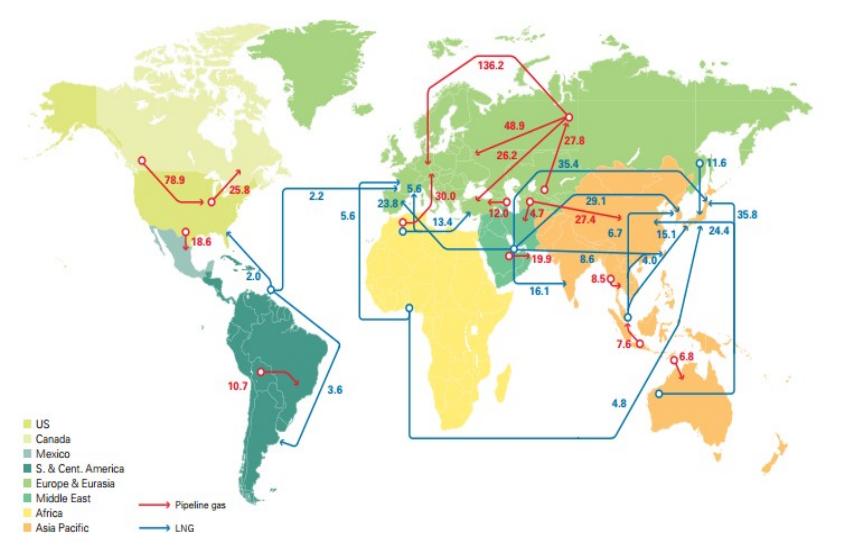
Taking the global natural gas major trade movements in 2013 as an example,
it can be seen that transportation by sea is a key technique of long distance
natural gas transportation in the present world (see Figure 1).
.
Figure 1. The Global Natural Gas Major Trade Movements 2013
Source: BP (2014)
The international natural gas trade has brought tremendous opportunities for
2
the development of the global LNG shipping market. Nonetheless, the world is
full of variables, which will give the global LNG shipping market’s future a lot
of challenges that needs to be addressed.
1.1 Research Motivation, Questions and Scope
1.1.1 Research Motivation
Currently, trading of natural gas has been more and more active, and shipping
is increasingly being used in transporting natural gas (Gudmestad, Zolotukhin
and Jarlsby, 2010). This has contributed to the significant expansion of the
global LNG shipping market. At the same time, this market also faces some
uncertainties and development issues (EY, 2013).
Most studies like Jensen (2004) and Katz (2007) point out that because of the
increased attention on environmental protection and energy demand in the
world, the global LNG shipping market has entered an unprecedented era of
great development, as a vital link in the natural gas supply chain. However,
IMF (2014) argues that the global LNG trade has been going down in the
recent past. Moreover, geopolitical risk and other challenges that are being
experienced in this industry have eaten into the profits that were initially being
realized in the global LNG shipping market (Daiss, 2015). The findings in
these studies tend to contradict the expectations that this industry is profitable
and therefore sustainable on its own.
Thus, it can be concluded that the development of the global LNG shipping
market can be affected by a great many factors. Faced with the complex and
volatile market environment, the world’s LNG trade pattern, price, supply and
demand, and other aspects will change (Mokhatab et al., 2013). Therefore,
3

this investigation has practical significance and some reference value in the
study of the future prospects of the global LNG shipping market. Most studies
like Wright (2011) and IGU (2015) that are later presented in the literature
review chapter do not make comprehensive analysis into the future prospects
of the global LNG shipping market on the basis of the current market.
Furthermore, studies rarely mention the feasibility of sustainable development
of the global LNG shipping market. Lack of sufficient studies that focus on this
research problem makes future prospects of the LNG shipping market in light
of the current market conditions the main motivation for this research study.
1.1.2 Research Questions
The research questions in this research are formulated as follow: