LIFE-SPAN DEVELOPMENT 18e
John W. Santrock
© 2021 McGraw Hill. All rights reserved. Authorized only for instructor use in the classroom. No reproduction or further distribution permitted without the prior written consent of McGraw Hill.

Chapter 2
Biological Beginnings
© 2021 McGraw Hill. All rights reserved. Authorized only for instructor use in the classroom. No reproduction or further distribution permitted without the prior written consent of McGraw Hill.

© McGraw Hill 3
Chapter Outline
•The Evolutionary Perspective.
•Genetic Foundations of Development.
•Reproductive Challenges and Choices.
•Heredity-Environment Interaction: The Nature-Nurture
Debate.

© McGraw Hill 4
The Evolutionary Perspective: Topics
•Natural selection and adaptive behavior.
•Evolutionary psychology.

© McGraw Hill 5
Natural Selection and Adaptive Behavior
•Natural selection: an evolutionary process by which individuals
of a species that are best adapted are the ones that survive and
leave the most fit offspring.
•Adaptive behavior: behavior that promotes an organism’s
survival in the natural habitat, because an organism possesses
characteristics needed for survival.

© McGraw Hill 6
Evolutionary Psychology 1
Evolutionary psychology: emphasizes the importance of
adaptation and reproduction to ensure survival.
•Offspring that adapts, develops behaviors, and possesses
self-protective traits survive.
Evolutionary developmental psychology:
Interest has grown in using the concepts of evolutionary
psychology to understand human development.
Psychological mechanisms are domain-specific.
•For example, we developed sets of problem-solving skills for
recurring problems like finding food.

Evolutionary Psychology 2
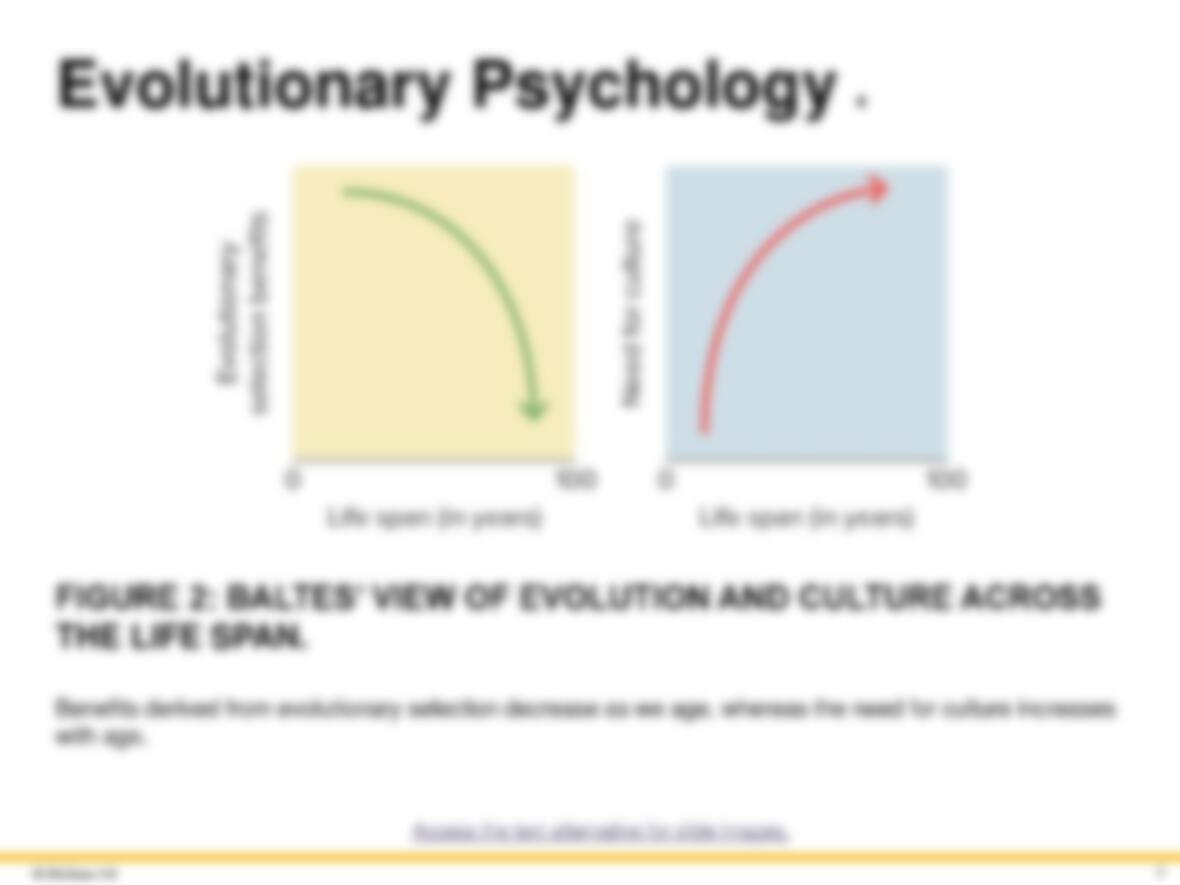
Connecting evolution and life-span development:
•The benefits conferred by evolutionary selection decrease with
age.
•Natural selection primarily operates during the first half of life