ARTICLE
RBI Bulletin November 2020 65
LIBOR: The Rise and the Fall
Against this backdrop, this article looks at the
evolution of LIBOR, the events leading to the decision
to replace it, the search for alternative benchmarks
and the issues involved in transition. Section II of
the article traces the origin of LIBOR and the efforts
at reforming it over the years. Section III delves into
the search for alternate benchmarks and the issues
around the transition to alternate benchmarks.
Section IV examines how the transition affects the
Indian jurisdiction. Section V concludes with policy
perspectives.
II. The Origin
The use of LIBOR interest rates can be traced
to the rise of the Eurodollar market (US dollar
denominated deposits held outside of the US) in
branches of banks outside the US in the 1960s.
The origin of the term ‘LIBOR’ has been credited
to a Greek banker called Minos Zombanakis, who
was running the London branch of Manufacturer’s
Hanover, now part of JPMorgan.2 In 1969, he
organised an $80 million syndicated loan for the
Shah of Iran, referenced to what he called a London
interbank offered rate. These rates were initially
computed for three currencies – the US dollar, the
British pound and the Japanese yen. Over time, more
currencies / maturities got added and, at its peak,
LIBOR rates were announced for ten currencies in 15
maturity terms ranging from overnight to one year.
At present, 35 LIBOR rates are posted each day for
seven maturities each for five major currencies,
viz.,
the Swiss franc, the Euro, the Pound sterling, the
Japanese yen, and the US dollar.
LIBOR rates are computed as a ‘trimmed mean’
of polled rates elicited from major banks based on
responses to the question: ‘
At what rate could you
borrow funds were you to do so by asking for and then
The publication of the most widely used financial
benchmark, the London Interbank Offered Rate
(LIBOR), is expected to cease after end-2021. Issues
around the transition from LIBOR to alternative
benchmarks pose challenges as well as opportunities and
stakeholders need to be aware and prepared.
Introduction
2012 was a landmark year in the world of
financial benchmarks. The most widely used
financial benchmark, the LIBOR, was found to have
been manipulated by individuals at various financial
institutions. The event created shock waves in
the financial system – the credibility of a financial
reference used to price and determine payoffs for
trillions of dollars of loans/bonds/derivatives came
under a cloud. The crux of the problem lay in the
fact that LIBOR prices a market – the market for
unsecured wholesale term lending for banks – in
which dwindling volumes rendered efficient pricing
difficult (Bailey, 2017)1. Structural changes in the
financial markets, especially since the global financial
crisis, meant that transaction-based submissions
leading to LIBOR formation tapered off and what is
left are estimates.
In affirmative action, in 2017, the Financial
Conduct Authority (FCA), UK, announced that it
would not use its legal power to mandate banks to poll
LIBOR beyond end-2021. The search for alternative
reference rates has begun by shifting away from a
benchmark that has been almost universally used in
financial contracts globally for nearly five decades is a
formidable challenge worldwide and in India even as
the end date is fast approaching.
* This article is prepared by Vasudev Hemachandran of the Financial
Markets Regulation Department. The author is grateful to Manoj Kumar for
valuable guidance. The views expressed in this article are those of the author
and do not represent the views of the Reserve Bank of India.
1
https://www.fca.org.uk/news/speeches/the-future-of-libor
LIBOR: The Rise and the Fall*
2
https://www.newyorkfed.org/medialibrary/media/research/staff_reports/
sr667.pdf
ARTICLE
RBI Bulletin November 2020
66
LIBOR: The Rise and the Fall
accepting interbank offers in a reasonable market
size just prior to 11 a.m.
?’ The subjective nature of
the question, especially related to timing and size –
‘
reasonable market size
’ and ‘
just before 11 a.m.
’ –
leave LIBOR vulnerable to manipulation. Concerns
about LIBOR and its governance process are, however,
not new. As the use of LIBOR grew during the 1970s
and 1980s, polling banks started accepting Euordollar
deposits at interest rates linked to LIBOR, leading to
adverse incentives to report lower rates. In view of
these concerns, the British Bankers’ Association took
over the governance process of LIBOR in 1986. Over
time, the evolution of the repo market led to a decline
in the volumes of unsecured interbank transactions.
As these transactions dwindled, LIBOR rates became
increasingly un-verifiable and increasingly reliant
on expert judgement of banks. Conflicts of interest
were inherent – the polling banks have ‘significant’
presence in related markets, but they also hold large
derivative and loan contracts that are priced by using
LIBOR rates.
Discrepancies were first observed during 2007-08
when the polled rates were found to be not reflecting
the actual rates at which banks lent to each other. The
possibility that banks were reporting LIBOR quotes
significantly lower than those implied by prevailing
credit default swap (CDS) spreads was highlighted in
a Wall Street Journal article and in various research
papers in 2008 (Mollenkamo, 2008; Abrates-Metz
et. al
., 2008). This brought attention to the fact
that there were incentives for banks to manipulate
LIBOR rates as instruments through which banks
signal their perceived credit-worthiness, especially in
periods of stress or through which trading positions
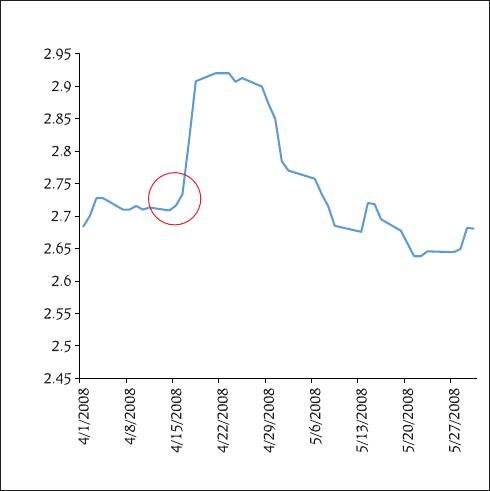
could be influenced. Post this publication, there was
an immediate spike in the 3-month USD LIBOR rate
(Chart 1). This triggered off investigations into the
LIBOR fixation process. By 2012, manipulations in
LIBOR fixations were established and banks were
levied with fines totalling about $ 9 billion for
misconduct.
In response to these developments, the UK
commissioned a review of the structure and
governance of LIBOR. The Wheatley Review (as the
review undertaken in 2011-12 under Mr. Martin
Wheatley, the former Chief Executive Officer of
the Financial Conduct Authority (FCA), came to be
called) concluded that LIBOR should be retained as
a benchmark but that it should be comprehensively
reformed. It made wide-ranging recommendations
about improvements in the benchmark governance
process for LIBOR. It also recommended that
publication of LIBOR in certain currencies and
maturities in which the volumes of trades were
particularly low should be discontinued. Several
reforms to the governance process were undertaken
in the wake of the recommendations. In particular,
the responsibility of benchmark administration was
moved to the Intercontinental Exchange (ICE), an
oversight committee to independently challenge the
benchmark processes was put in place and governance
reforms were carried out in the submitting banks.
Notwithstanding the reforms, the key deficiency
of the LIBOR process – that of insufficient transactions
on which submissions were based – persisted. In
Chart 1: 3 Month USD LIBOR Rate
Source: Bloomberg.
Per cent
Publication of
Article
ARTICLE
LIBOR: The Rise and the Fall
2017, this was highlighted by Andrew Bailey, then
Chief Executive of the FCA, with an example of a
currency–tenor combination for which benchmark
reference rates were published daily by banks who,
between them, executed just fifteen transactions of
potentially qualifying size in that currency and tenor
in the whole of 2016. Against this backdrop, the
FCA concluded that the journey to transaction-based
benchmarks would not be completed if the markets
continue to rely on LIBOR. The FCA thus announced
that it would not compel panel banks to submit LIBOR
beyond 2021.
III. In Search of an Alternative Benchmark
LIBOR serves as a reference rate at which financial
instruments can contract upon to establish the terms
of agreement and also as a benchmark rate that reflects
a relative performance measure for investment
returns (Hou and Skeie, 2014). LIBOR is used almost
that it is based on transactions in liquid markets – has
to satisfy several key attributes; (a) it should provide
a robust and accurate representation of interest rates
in core money markets that is not susceptible to
manipulation; (b) it should offer reference rates for
financial contracts that extend beyond the money
market; and (c) serve as a benchmark for term lending
and funding (BIS, 2019).3
Jurisdictions where LIBOR is the domestic
interbank interest rate benchmark have identified
alternative benchmarks linked to actual transactions
in liquid markets. In practice, this has resulted in
ARRs based on shorter-tenor contracts – essentially
overnight repo markets, which are the most liquid
– and secured rather than unsecured transactions.
Additionally, the ARRs have moved beyond pure
interbank markets to include non-bank wholesale
participants such as money market and investment
funds and insurance companies in a bid to garner a