L E S S O N 3 : E t h i c s f o r I T W o r k e r s a n d I T U s e r s
This lesson contains the following topics:
IT Professionals
Professional Relationships That Must Be Managed
IT Users
Ten Commandments of Computer Ethics
Ethical Issues in Information Technology
WEEK
Learning Objectives
Date of Submission:
June 7 – 11, 2021
1. Distinguish an IT professional from other kinds of workers.
2. Understand the factors transforming the professional services
industry.
3. Recognize relationships must an IT worker manage, and what key
ethical issues can arise in each.
4. Know how codes of ethics, professional organizations, certification,
and licensing affect the ethical behavior of IT professionals.
5. Determine what is meant by compliance, and how does it help
promote the right behaviors and discourage undesirable ones.

Reference: Ethics in Information Technology 5th Edition, by: George W. Reynolds 31 | P a g e
IT PROFESSIONALS
A profession is a calling that requires specialized knowledge and often long and intensive academic preparation.
The United States Code of federal regulations defines a “professional employee” as one who is engaged in the
performance of work:
1. requiring knowledge of an advanced type in a field of science or learning customarily acquired by a prolonged
course of specialized intellectual instruction and study in an institution of higher learning or a hospital (as
distinguished from knowledge acquired by a general academic education, or from an apprenticeship, or from training
in the performance of routine mental, manual, mechanical, or physical activities);
2. requiring the consistent exercise of discretion and judgment in its performance;
3. which is predominantly intellectual and varied in character (as distinguished from routine mental, manual,
mechanical, or physical work); and
4. which is of such character that the output produced or the result accomplished by such work cannot be standardized
in relation to a given period of time.
In other words, professionals such as doctors, lawyers, and accountants require advanced training and experience; they
must exercise discretion and judgment in the course of their work; and their work cannot be standardized. Many people
would also expect professionals to contribute to society, to participate in a lifelong training program (both formal and
informal), to keep abreast of developments in their field, and to assist other professionals in their development. In
addition, many professional roles carry special rights and responsibilities. Doctors, for example, prescribe drugs, perform
surgery, and request confidential patient information while maintaining doctor–patient confidentiality.
ARE IT WORKERS PROFESSIONALS
Many business workers have duties, backgrounds, and training that qualify them to be classified as professionals,
including marketing analysts, financial consultants, and IT specialists such as mobile application developers, software
engineers, systems analysts, and network administrators. One could argue, however, that not every IT role requires
“knowledge of an advanced type in a field of science or learning customarily acquired by a prolonged course of
specialized intellectual instruction and study,” to quote again from the United States Code. From a legal perspective, IT
workers are not recognized as professionals because they are not licensed by the state or federal government. This
distinction is important, for example, in malpractice lawsuits, as many courts have ruled that IT workers are not liable
for malpractice because they do not meet the legal definition of a professional.
7 Forces Changing the Nature of Professional Services
1. Client Sophistication
When clients are more aware of what they need from service providers and are more willing to look for best
possible services.
2. Governance
When tougher laws are enacted to attempt to avoid future scandals.
3. Connectivity
When clients and service providers have built their working relationships on the expectation that they can
communicate easily and instantly (ex. video conference).
4. Transparency
It involves any attempt to reveal and clarify any information or processes that were previously hidden or
unclear. Clients expect to be able to see work-in progress in real-time.
5. Modularization
It is the act of breaking down a production or business process into smaller components.
Reference: Ethics in Information Technology 5th Edition, by: George W. Reynolds 32 | P a g e
6. Globalization
Is the process of interaction and integration among the people, companies and governments of different nations.
7. Commoditization
It is the transformation of goods or services into commodities that offer nothing to differentiate themselves
from those offered by competitors.
PROFESSIONAL RELATIONSHIP THAT MUST BE MANAED
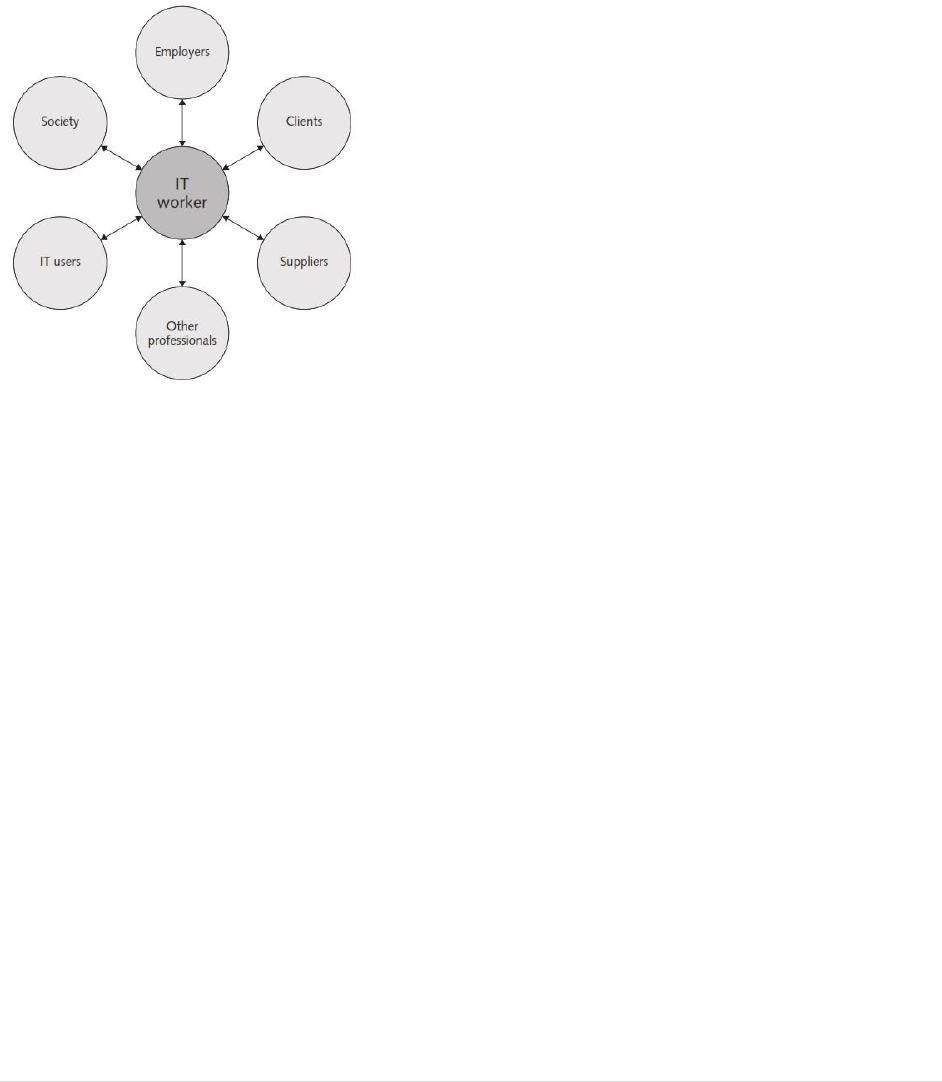
IT workers typically become involved in many different relationships,
including those with employers, clients, and suppliers, other professionals, IT
users, and society at large. In each relationship, an ethical IT worker acts
honestly and appropriately.
Figure 3.1: Professional relationships IT workers must manage
1. Relationship between IT Workers and Employers
2. Relationships between IT Workers and Clients
3. Relationships between IT Workers and Suppliers
4. Relationships between IT Workers and Other Professionals
5. Relationships between IT Workers and IT Users
6. Relationships between IT Workers and Society
Challenges for IT Workers and Employers
1. Trade Secret
It is information, generally unknown to public, that a company has taken strong measures to keep confidential.
It represents something of economic value that has required effort or cost to develop and that has some degree
of uniqueness or novelty
For Example: “Colonel’s secret recipe of 11 herbs and spices to make KFC Chicken • Formula for Coke •
Intel’s manufacturing process for i7 quad core processing chip”
2. Whistle-blowing
It is an effort by an employer to attract attention to a negligent, illegal, unethical, abusive or dangerous act by
a company that threatens the public interest. Whistle-blowers often have special information based on their
expertise or position within the offending organization.
For Example: “An employee reporting a problem to people outside the company about the chemical process
used in the production of computer chips as it is dangerous to the public.”
3. Conflict of Interest
A conflict between the IT worker’s self-interest and the interests of the client
For Example: “An IT consulting firm might be hired to assess firm’s IT strategic plan”
4. Fraud
It is the crime of obtaining goods, services or property through deception or trickery. Fraudulent
misrepresentation occurs when a person consciously decides to induce another person to rely and act on a
misrepresentation.
5. Misinterpretation
It is the misstatement or incomplete statement of a material fact. If the misrepresentation causes the other party
to enter into a contract, that party may have the legal right to cancel the contract or seek reimbursement for
damages.
For Example: “A company failing to provide adequate resources to a project of another company they have
contracted with.”
6. Breach of Contract