LESSON 1: OBSERVATION OF TEACHING AND LEARNING IN ACTUAL SCHOOL
ENVIRONMENT
Activity No. 3
Learning Outcomes
At the end of this lesson, you will:
● select the appropriate assessment methods, tools, or tasks for different
learning outcomes
● determine if the assessment tools or tasks are aligned to the level of the
learning outcomes.
● create a detailed lesson plan incorporating assessments that are congruent to
the instructional objectives.
● conduct actual demonstration teaching to observe teaching-learning activities
related to assessment.
● develop a teaching portfolio that contains detailed daily lesson plan, video of
the actual teaching demonstration, pre-service teachers’ actual teaching rating
scale, instructional materials used, and among others.
ACTIVITY- Let’s Read These
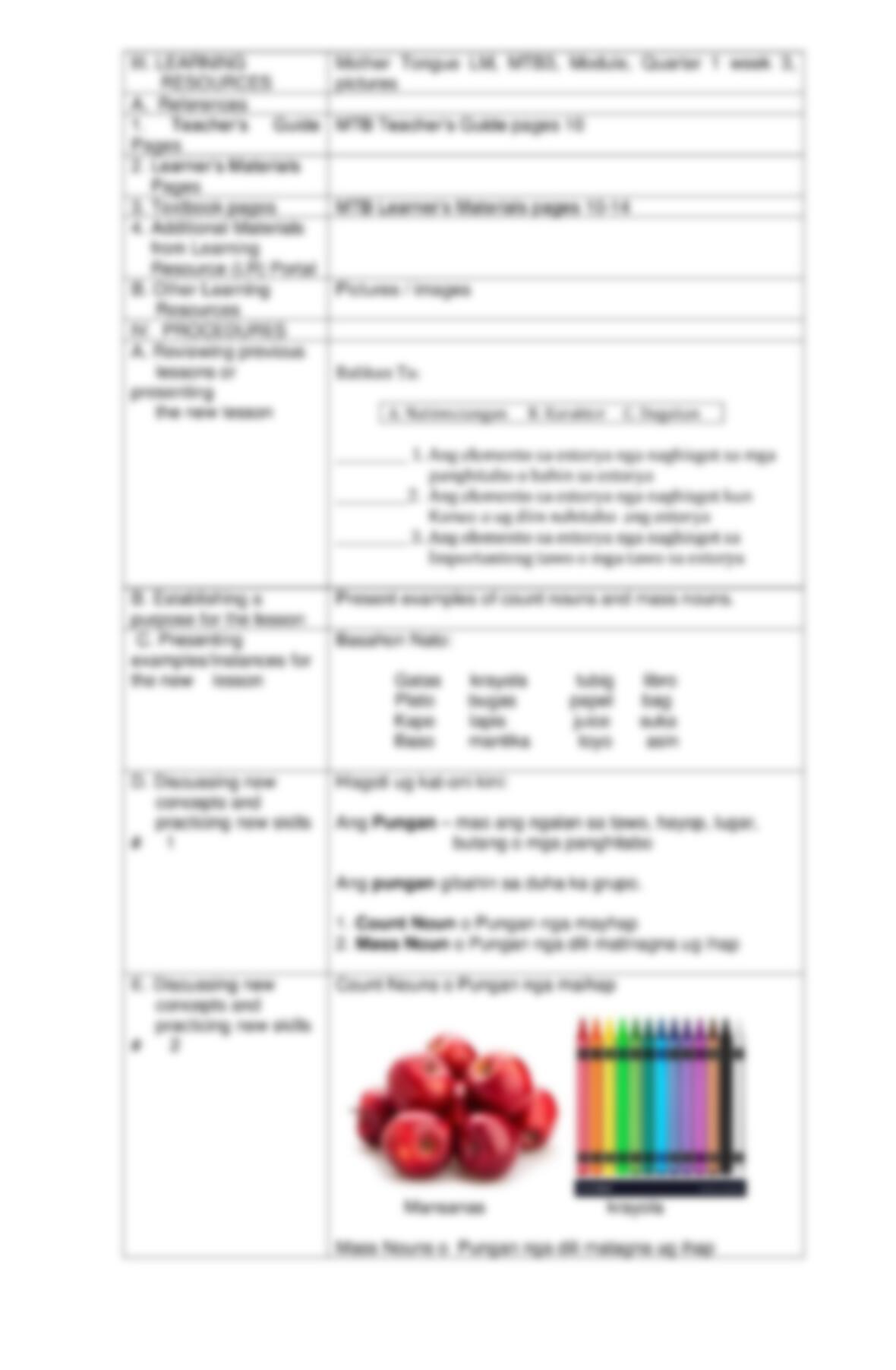
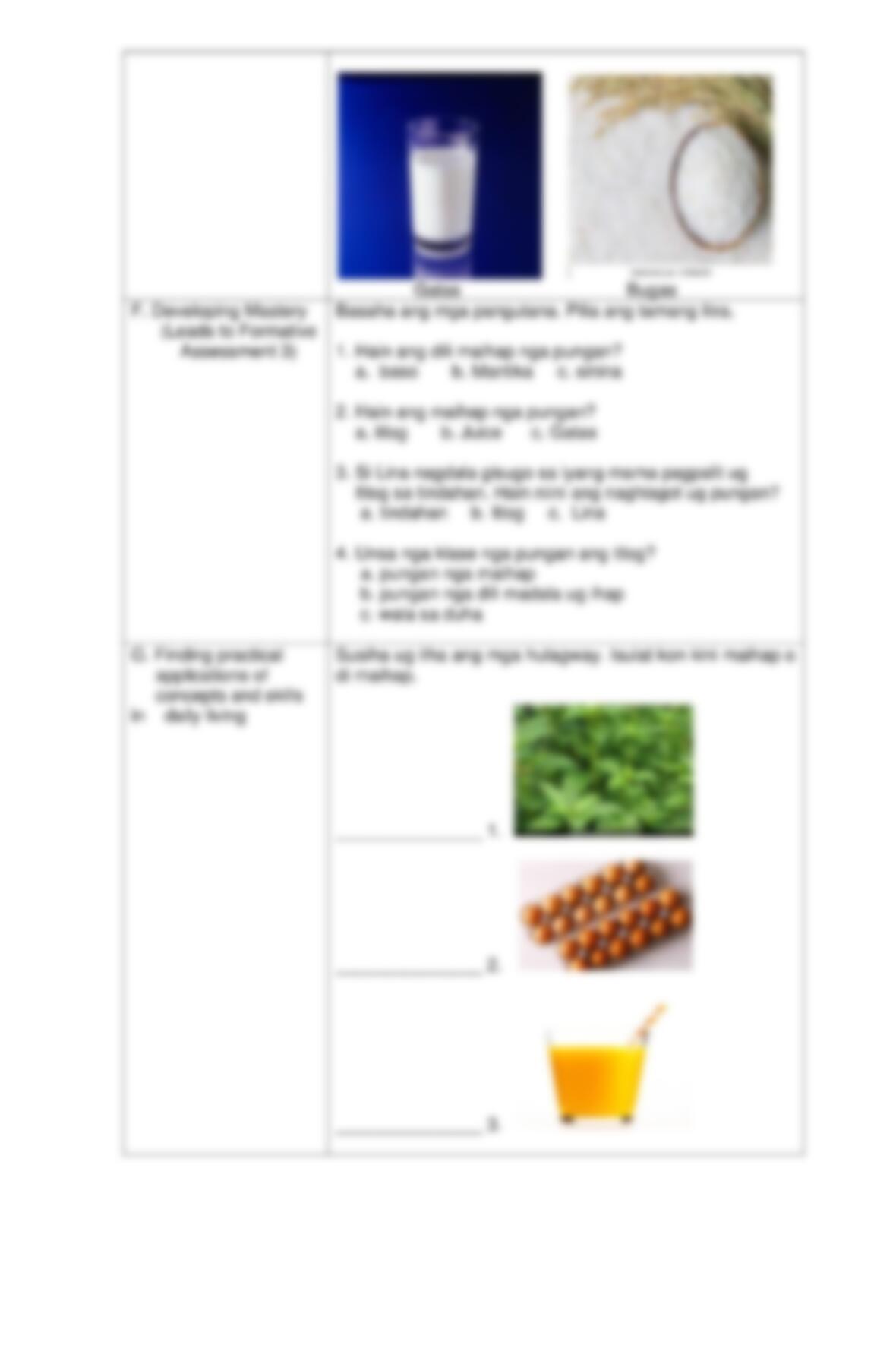
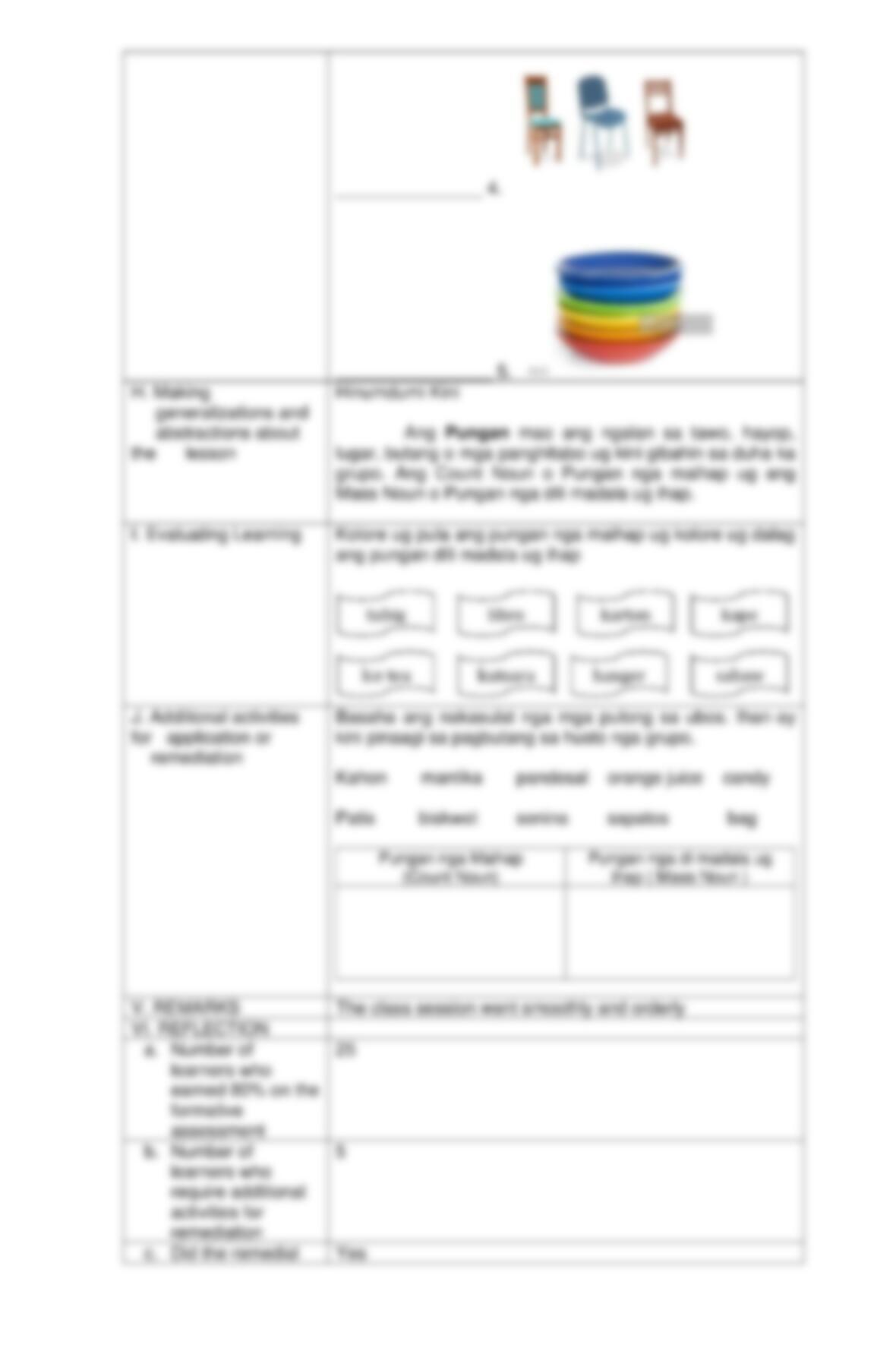
Part I. Observe the class of your Cooperating Teacher. Ask permission to copy the
lesson objectives and evaluation. Identify the domains and level of learning. Determine if
the assessment tools/ tasks are aligned to the level of the learning outcome. Then,
accomplish the template below.
Cognitive Levels
of Learning
Outcome (Bloom)
Learning Outcome/
Lesson Objective
from Teacher’s
Lesson Plan (Write
lesson objective in
the appropriate level
outcome)
Assessment Task
(Evaluation from
Teacher’s Lesson
Plan (Write it in the
appropriate level
outcome)
Is the level of
assessment
aligned to the
level of the
objective?
YES NO
1. Remembering
Memorize the
different parts of the
body
Memorize in front of
the class the
different parts of the
body.
Eyes
Ears
Mouth
Nose
Hands
Feet
Head
Legs
Arms
Yes
2. Understanding
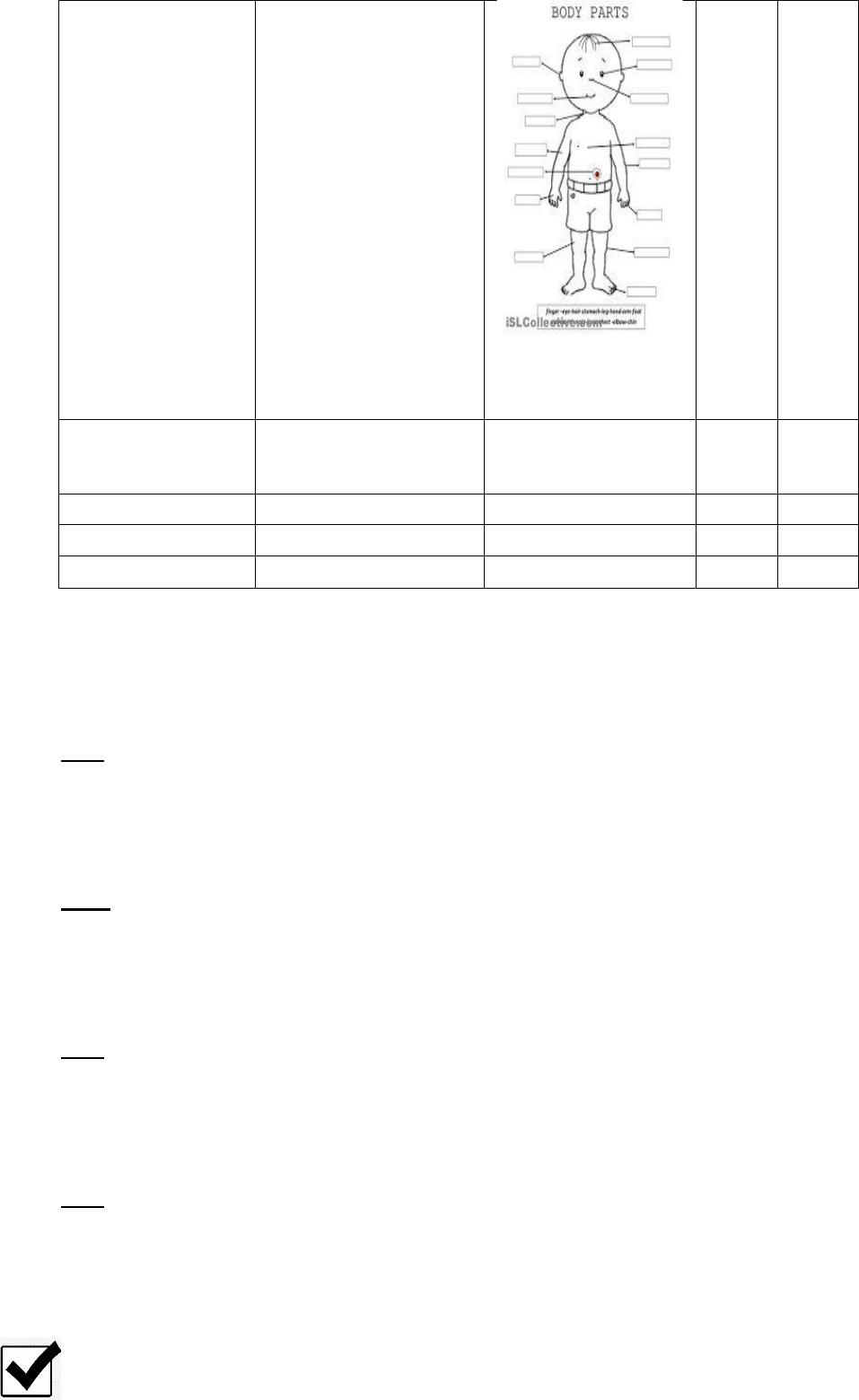
Identify the different
parts of the body
Identify the parts of
the body in the
image below
Yes
3. Applying
Appreciate the
importance of the
parts of the body
Explain the
importance of the
parts of the body
Yes
4. Analyzing
5. Evaluating
6. Creating
Part II. Write YES on the space provided before the number if the learning outcome
specified in the test question matches the learning outcome described in the
objective.
YES 1. Objective: Recall the names of the capitals of all provinces of Davao
Region.
Test Item: List the capitals of Davao Oriental, Davao de Oro, Davao
Occidental, Davao del Sur, and Davao del Norte.
YES 2. Objective: Discriminate fact from opinion in the President’s most recent
state of the nation’s address.
Test Item: Given a text of the state of the nation’s address, list three
examples of facts and three examples of opinions.
YES 3. Objective: The student will write complete instructional objectives
including behaviour, conditions, and criteria.
Test Item: Describe why instructional objectives must contain an observable
behaviour, conditions, and criteria.
YES 4. Objective: Using your text as a reference, recognize the names of the
various components of the central nervous system.
Test Item: From memory, list the various components of the central nervous
system.
ANALYSIS – Let’s Analyze
Part I.
1. What did you observe about assessment tasks and learning outcomes? Are they

aligned? Cite some pieces of evidence.
Yes, they are aligned. For example in item no.1 the objective is recall the names of
the capitals of all provinces of Davao Region And then the test item is list the
capitals of Davao Oriental, Davao de Oro, Davao Occidental, Davao del Sur, and
Davao del Norte. So they are aligned because Davao Oriental, Davao de Oro, Davao
Occidental, Davao del Sur and Davao Del Norte are the provinces that compose
Davao Region.
2. You study based on how you are tested. To avoid “teaching–to-the-test” or
superficial factual testing, what levels of knowledge processing should you use
more? Explain.
The students will be more active and involved in learning process through communicative
approach that is why I think the level of knowledge that we are going to use is evaluating
because evaluating uses many of the same strategies as analyzing, but takes one step
further. It involves making a value judgment about the thing under analysis. For example, a
student may determine something’s value and validity using their own critical thinking skills.
And for the teacher to assess on how well someone evaluated something, a teacher needs
to ask them to make value judgments and examine how logical or convincing those value
judgments truly are.
Part II.
1. What item number(s) that you answered YES? 1, 2, 3, 4
2. What item number(s) that you answered NO? None
3. What are your justifications of answering that item number(s) with YES?
Yes, because all the objectives are totally aligned on all the test items.
4. What are your justifications of answering that item number(s) with NO?
None….
5. What do you think is the basic rule to keep in mind when matching test items to
instructional objectives?
The behaviour and the condition specified in the objectives must match or aligned
or appropriate in the test items.
ABSTRACTION – Let’s Conceptualize
Clarity of Learning Targets
An instructional objective is defined as the statement of the expected behaviours
that you should display after instruction or teaching. Oriondo and Antonio (1989) said that
the question of what to evaluate in terms of pupil’s growth and progress should be given a
foremost priority. Learning targets need to be stated in behavioural terms that denote
something which can be observed through the behaviour of the students. If an objective is
stated as, “you should be able to write a test item that matches the objective’s learning
outcome and conditions given a complete instructional objective with 80% accuracy”, then
this clearly stated objective will be the focus of classroom evaluation. This is the reason
why you are required to state instructional objectives in behavioural terms.
In the above-mentioned objective, the content of instruction is “writing a test item
that matches the objective’s learning outcome and conditions”. The content of the test
should be similar to the content you have taught. With this mind, you are manifesting
adherence to the principle of clarity of learning.
Back to the objective stated above, the behaviour, which you want to be displayed
after instruction is “to write”. To make the test valid, you should choose a written-response
instrument as an appropriate item format, most specifically, multiple choice as to be
constructed to test higher order thinking skill if you wish to select which among the choices
is correct. An essay also can be an appropriate item format, provided it should be properly
planned to test your grasp of the higher level of cognitive skill like application, analysis,
synthesis, and judgment. The item in the test should be stated as, “Write an item that
matches the learning outcome and conditions of the following objective: The student will
add on paper 10 two-digit numbers without regrouping within one minute with 80%