Combang Zombie Homes: Abandoned Property Neighborhood Relief Act of
2016 Legislaon passed
By Kelsi Douglas
Execuve Summary
I.
In June 2016 a piece of legislation for the State of New York was signed by Governor
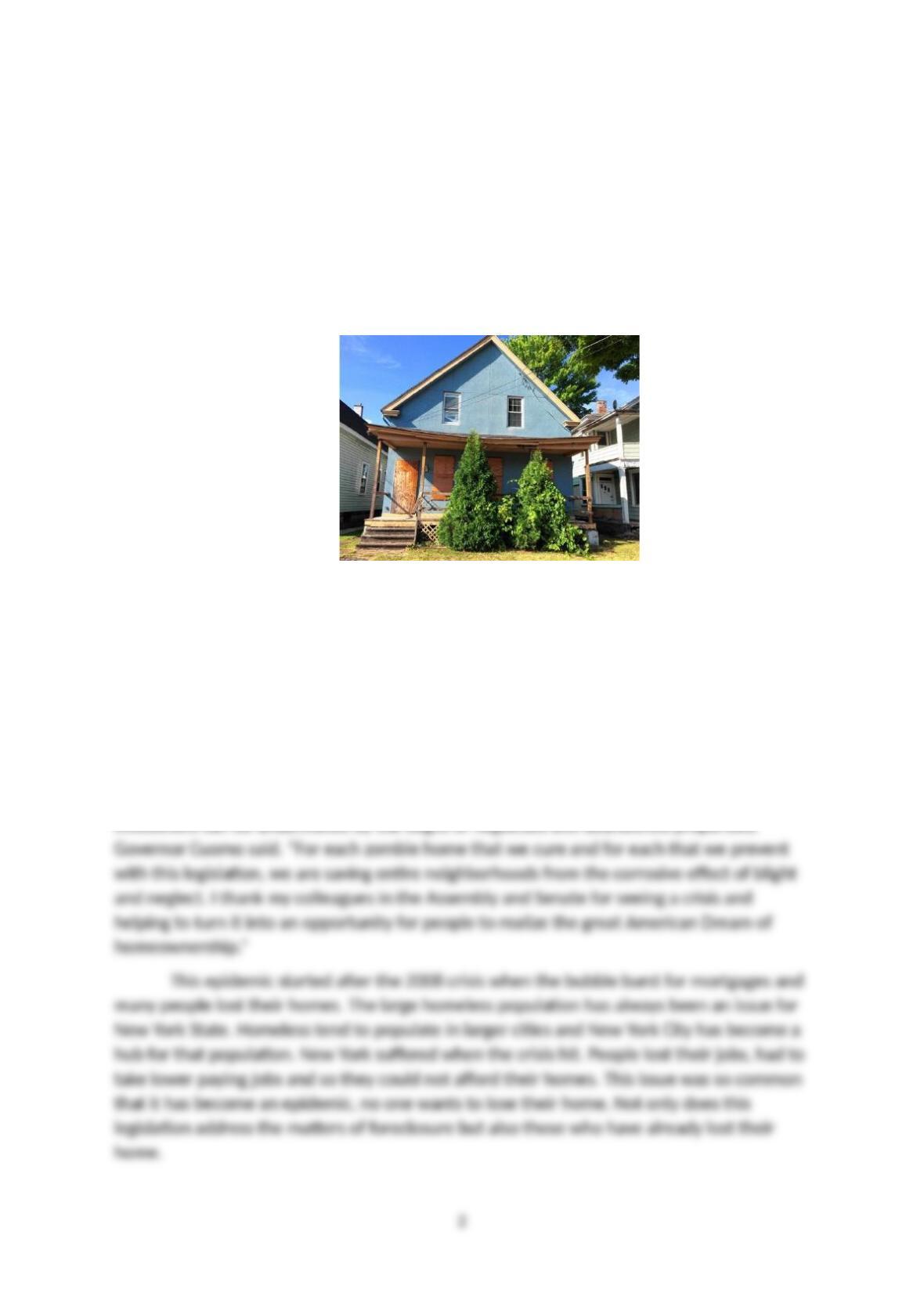
Cuomo on “Zombie Homes” or otherwise known as abandoned homes. This Legislation is
“New York State Abandoned Property Relief Act of 2016″. This piece of legislation is one
that enhances mandatory se2lement conferences and establishes a Consumer Bill of Rights
which helps people to remain in their own homes. It does this by imposing a duty on banks
and services for pre-foreclosure, allowing a faster process for houses that are foreclosed to
get back onto the market and having an electronic database that is a registry of already
abandoned homes.
The issues are more than just homes being abandoned but also about people not
being able to a6ord their homes; they cannot keep up the physical aspects of their home
and the payments, then the banks then foreclose on them. Then when the people cannot
a6ord their homes they become homeless. These issues have become an epidemic in the
United States especially a9er the economic recession of 2008. However, New York state has
decided to do something about it and passed the New York State Abandoned Property
Relief Act of 2016.
The amount of entities a6ected is abundant. Those most e6ectsed by this bill being
passed are the local and state governmental systems and then, the citizens of New York
State. The encompassment of those a6ected are state government, local government, the
Community Restoration Fund (CRF), Commissioner of NYS Homes & Community Renewal,
State of NY Mortgage Agency (SONYMA), EPA, Consumer Bill of Rights, Banks, Homeless
organizations, other restoration agencies, legal system, taxpayers, the homeless population
and homeowners. There are so many people and organizations a6ect by this legislation. It is
a huge bill with big plans. It is not a one or two step plan; it is a multifaceted plan with a
huge budget.
From a legal perspective, this issue is complex. The Banks who once triumphed in
foreclosure will now be limited. It maybe that banks will want to Dght this bill, for they are
in the brunt of the bill. This is because a foreclosure is a legal act, one brought to court by
the banks to get their money back. Houses that are not in good shape will lead to a Dne of
banks will be Dned for foreclosing. This is a tricky position for the bank, the bank may take
the Dne if it is deemed worth it to them. The Dne is $500 per day. Only time will tell if banks
want to Dght back this law.
Another major component in the legal system of this law is tort law. Tort law is
immediate and in this law because next the government/agencies citizens are the next
1
highest a6ected by this legislation being passed. This is due to the power shi9 from banks
to the people.It puts a pressure on both forms of government and the agencies, people now
have higher expectations of these entities. If these expectations listed in the legislation are
not meet, then they can be legally pursued. Therefore, each organization and the
governmental system have to be accountable and responsible for their listed
responsibilities.
II.
This legislation was passed in order to combat the rise in zombie homes, and
homeless New York citizen. It is a part from other legislation previously passed to fully
counteract the issue. Even more so within the cities of New York, Syracuse and Long Island.
New York State is a beautiful place to be but zombie homes are not so beautiful. They
remind us of the economic crisis and poverty in the United States. For a decent amount of
time banks have not su6ered from foreclosure on homes and the homeless have su6ered
majorly.
“For many New Yorkers, homes are our single most important investment, but that