Introductory Econometrics
Incorporating Qualitative Information in a Model
Farshid Vahid
2016

Recap
IWe have studied the multiple regression model and learnt:
1. to express it for a single observation, and, using matrix form,
for nobservations
2. the OLS estimator and its derivation in matrix form
3. the assumptions needed for the OLS estimator to be
3.1 an unbiased estimator
3.2 the best linear unbiased estimator
3.3 normally distributed
4. to model nonlinear relationships using the regression model
5. to interpret the parameters of a regression model
6. to test a simple hypothesis about a single parameter
7. to perform a joint test of multiple linear restrictions, and in
particular testing the overall significance of a model
8. to test a hypothesis involving a linear combination of
parameters

Lecture Outline
IIncorporating qualitative information with dummy (binary)
independent variables
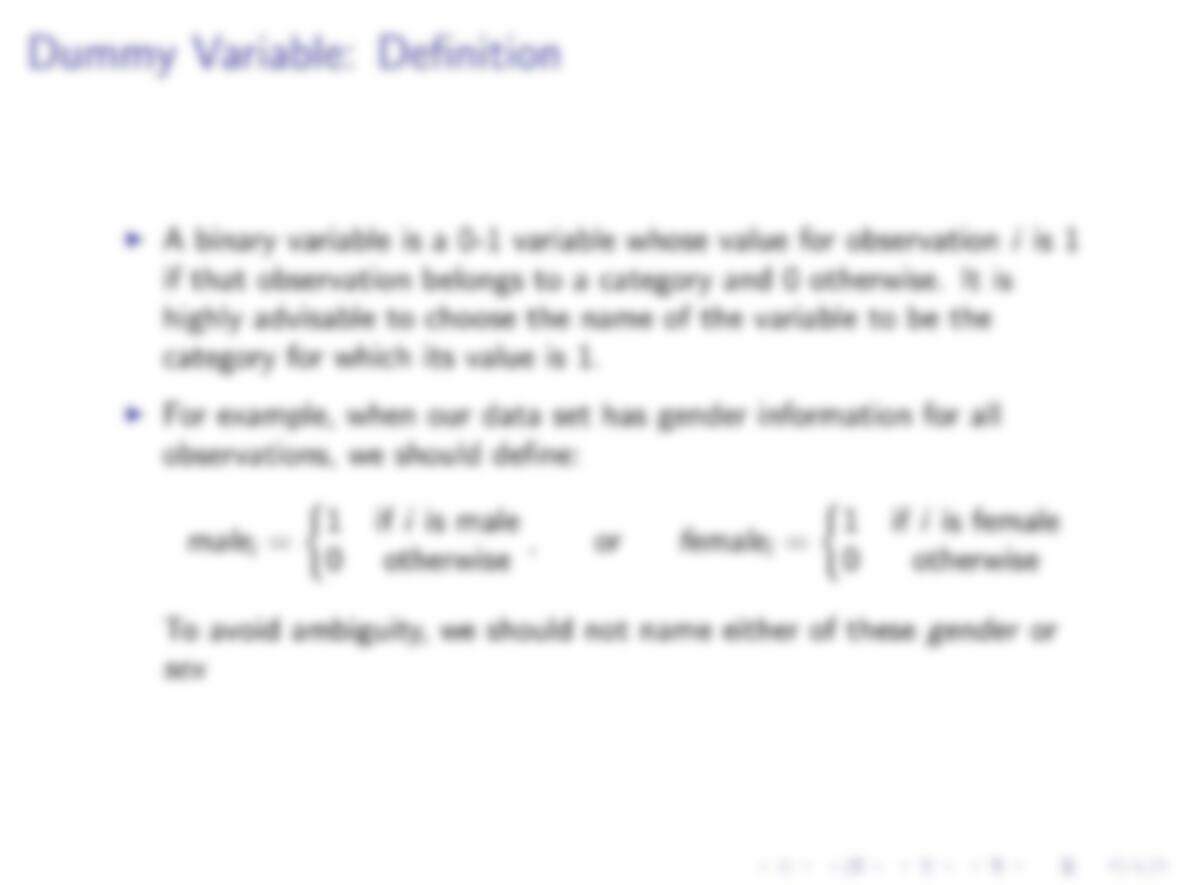
1. Definition of a dummy variable (textbook reference 7-1)
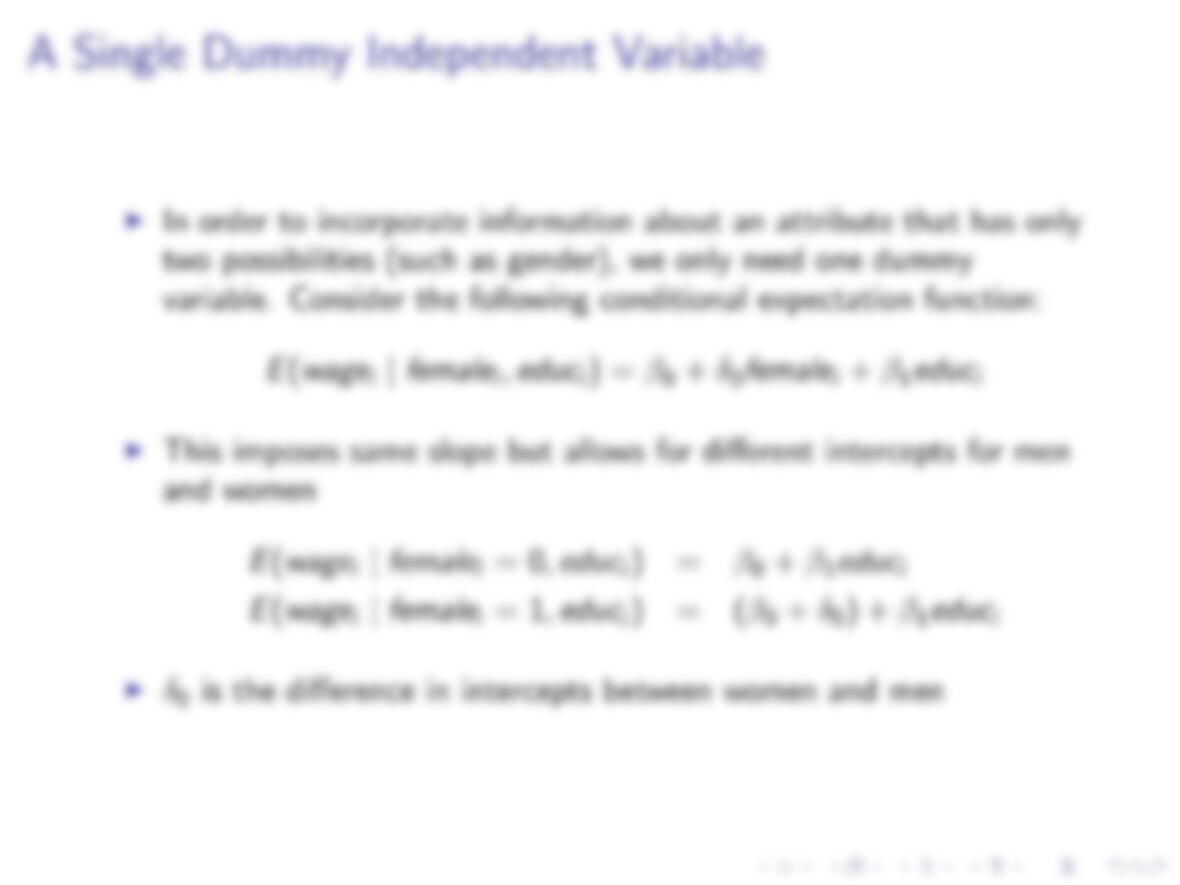
2. Using a single dummy variable to distinguish two categories
(textbook reference 7-2)
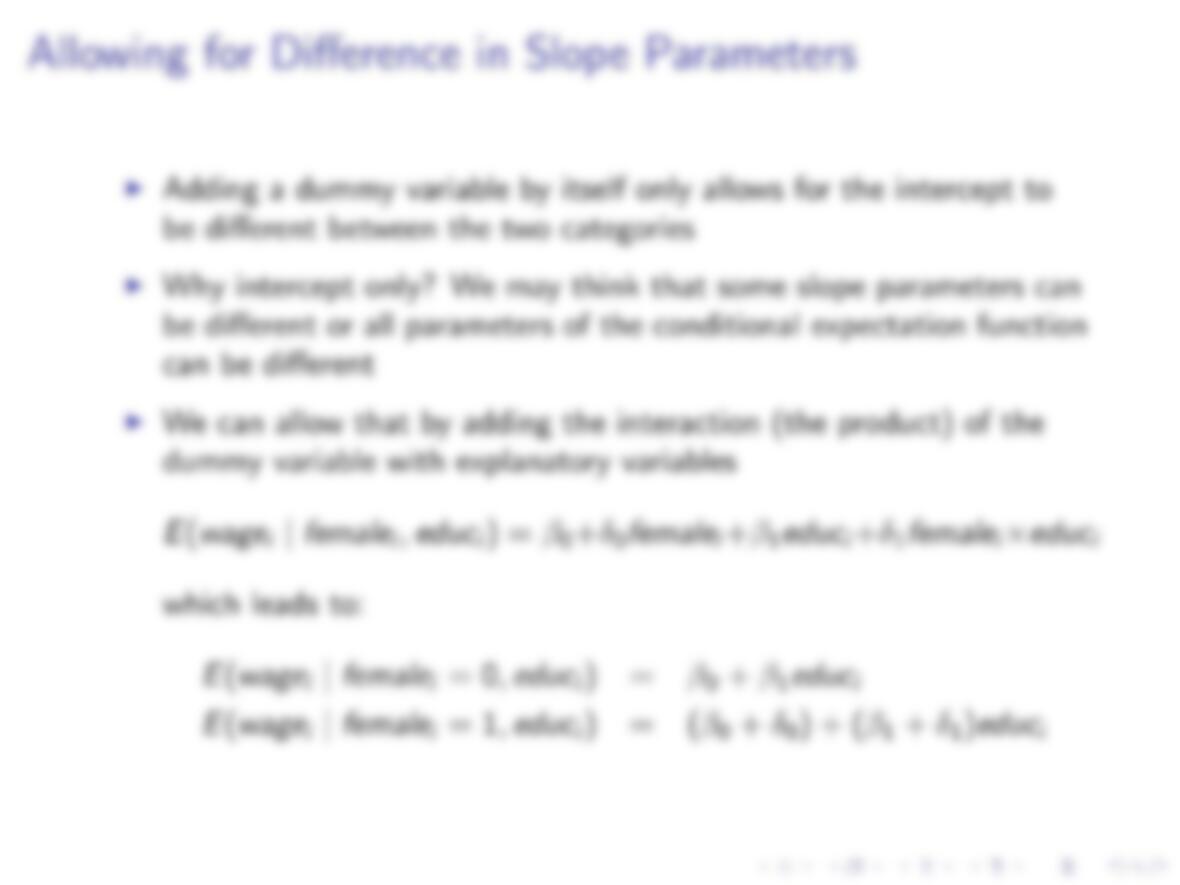
3. Testing for difference in regression functions across groups
(textbook reference 7-4)
4. Using several dummy variables for multiple categories
(textbook reference 7-3)
IWe will not cover binary dependent variables and program
evaluation (textbook sections 7-5, 7-6, 7-7). These will be covered
comprehensively in Applied Econometrics – ETC3410)

Qualitative Factors
IOften, qualitative factors are important for explaining the dependent
variable. Here are some examples:
IPeople with the same years of education and experience who are
employed in different occupations earn differently
IWe collect information about gender and race, to see if after
controlling for job market characteristics, these factors are still
significant in explaining variation in wages
IIn prediction of price of houses, if a house has ducted heating, a
pool, modern kitchen and bathrooms matters
IThe most important predictor of fatal accidents is whether the
accident has happened after 11 pm on a Friday or Saturday night
ISometimes we may even decide to take a quantitative variable and
categorise it:
IExample: Due to doubts about the accuracy of mothers
remembering on average how many cigarettes per week they
smoked during pregnancy, we may want to just use that
information to divide smokers and non-smokers