Lecture 3: The Time Value of Money: An
Introduction (Part 2)
FINA2303
Financial Management
Yan Xiong
HKUST
Chapter 3: Time Value of Money (Part 2) FINA 2303, 1/25

Recap
Cost-Benefit Analysis
Valuation principle: Accept project if benefits >costs
Valuation
Costs and benefits must be measured in cash-today terms
Use market prices, when available
Use present values, when cash flows will occur in the future
Law of one price (LOOP) and arbitrage
The same good will have same price in different locations
Transaction costs, limits to arbitrage, etc, might prevent
LOOP from holding
One-period future values
One-period present values
Chapter 3: Time Value of Money (Part 2) FINA 2303, 2/25

Plan for Today
1Future value of multiple cash flows and compounding
2Present value of multiple cash flows and discounting
Chapter 3: Time Value of Money (Part 2) FINA 2303, 3/25

Compounding
Future Value: One Period (Recap)
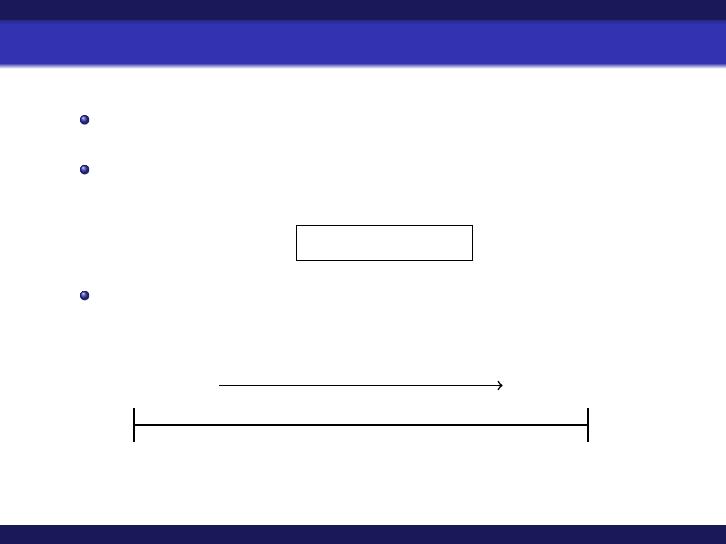
Future Value (FV) is the value of the investment at the end
of the period
In the one-period case with one-period interest rate r, the
future value of today’s cash flow C0is
FV =C0·(1 + r)
Let C0= $10,000 and r= 5%
x
Year 0
C0= $10,000
Year 1
FV = $10,500
C0·(1 + r)
$10,000 ·(1 + 0.05)
Chapter 3: Time Value of Money (Part 2) FINA 2303, 4/25
Future Value: Multiple Periods
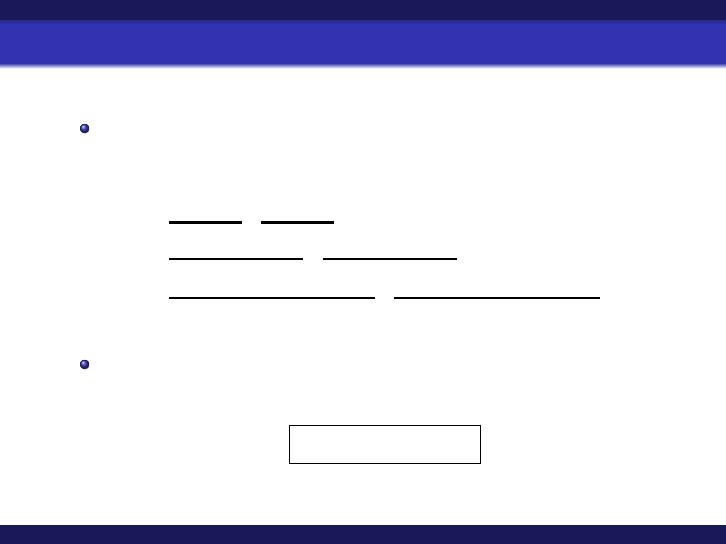
Suppose that you invested C0= $10,000 at the annual rate
r= 5% for Tyears instead. This investment will grow to
$10,000 ·(1 + 0.05)
| {z }
FV in 1 year: C0·(1+r)
·(1 + 0.05)
| {z }
FV in 2 years: C0·(1+r)·(1+r)=C0·(1+r)2
·… ·(1 + 0.05)
| {z }
FV in Tyears = C0·(1+r)·(1+r)·…·(1+r)=C0·(1+r)T
The general formula for the future value of an investment of
C0dollars for Tperiods at the rate rper period is
FV =C0·(1 + r)T
Chapter 3: Time Value of Money (Part 2) FINA 2303, 5/25
Future Value: Important Relationships
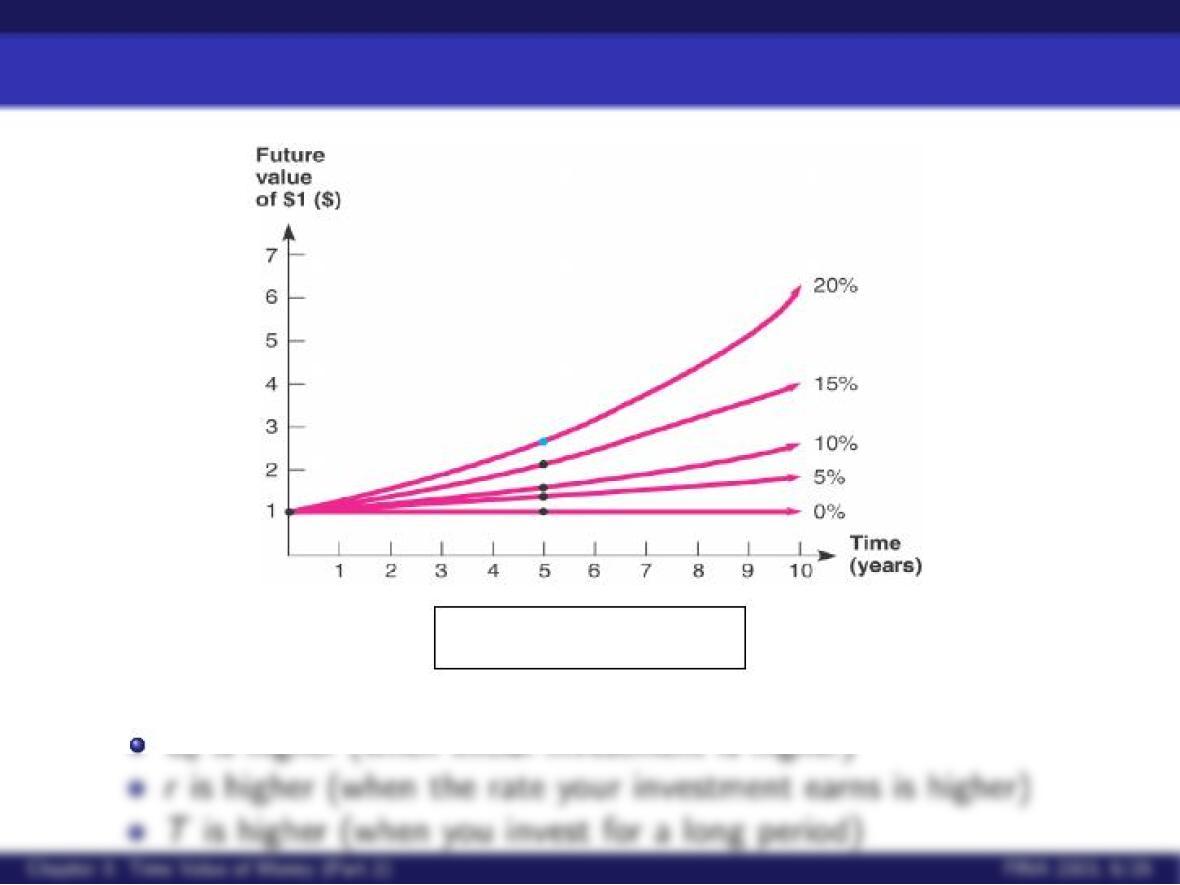
FV =C0·(1 + r)T
FV is higher when