IFRS 16
Leases
In April 2001 the International Accounting Standards Board (Board) adopted IAS 17 Leases,
which had originally been issued by the International Accounting Standards Committee
(IASC) in December 1997. IAS 17 Leases replaced IAS 17 Accounting for Leases that was issued
in September 1982.
In April 2001 the Board adopted SIC‑15 Operating Leases—Incentives, which had originally
been issued by the Standing Interpretations Committee of the IASC in December 1998.
In December 2001 the Board issued SIC‑27 Evaluating the Substance of Transactions Involving
the Legal Form of a Lease. SIC‑27 had originally been developed by the Standing
Interpretations Committee of the IASC to provide guidance on determining, amongst
other things, whether an arrangement that involves the legal form of a lease meets the
definition of a lease under IAS 17.
In December 2003 the Board issued a revised IAS 17 as part of its initial agenda of
technical projects.
In December 2004 the Board issued IFRIC 4 Determining whether an Arrangement contains a
Lease. The Interpretation was developed by the Interpretations Committee to provide
guidance on determining whether transactions that do not take the legal form of a lease
but convey the right to use an asset in return for a payment or series of payments are, or
contain, leases that should be accounted for in accordance with IAS 17.
In January 2016 the Board issued IFRS 16 Leases. IFRS 16 replaces IAS 17, IFRIC 4, SIC‑15
and SIC‑27. IFRS 16 sets out the principles for the recognition, measurement,
presentation and disclosure of leases.
Other Standards have made minor consequential amendments to IFRS 16,
including Amendments to References to the Conceptual Framework in IFRS Standards (issued
March 2018).
IFRS 16
© IFRS Foundation A801

CONTENTS
from paragraph
INTERNATIONAL FINANCIAL REPORTING
STANDARD 16 LEASES
OBJECTIVE 1
SCOPE 3
RECOGNITION EXEMPTIONS 5
IDENTIFYING A LEASE 9
Separating components of a contract 12
LEASE TERM 18
LESSEE 22
Recognition 22
Measurement 22
Presentation 47
Disclosure 51
LESSOR 61
Classification of leases 61
Finance leases 67
Operating leases 81
Disclosure 89
SALE AND LEASEBACK TRANSACTIONS 98
Assessing whether the transfer of the asset is a sale 99
APPENDICES
A Defined terms
B Application guidance
C Effective date and transition
D Amendments to other Standards
APPROVAL BY THE BOARD OF IFRS 16 LEASES ISSUED IN JANUARY 2016
FOR THE ACCOMPANYING GUIDANCE LISTED BELOW, SEE PART B OF THIS EDITION
ILLUSTRATIVE EXAMPLES
APPENDIX TO THE ILLUSTRATIVE EXAMPLES
Amendments to guidance on other Standards
FOR THE BASIS FOR CONCLUSIONS, SEE PART C OF THIS EDITION
BASIS FOR CONCLUSIONS
DISSENTING OPINION
APPENDIX TO THE BASIS FOR CONCLUSIONS Amendments
to the Basis for Conclusions on other Standards
IFRS 16
A802 © IFRS Foundation

International Financial Reporting Standard 16 Leases (IFRS 16) is set out in paragraphs
1–103 and Appendices A–D. All the paragraphs have equal authority. Paragraphs
in bold type state the main principles. Terms defined in Appendix A are in italics the
first time that they appear in the Standard. Definitions of other terms are given in the
Glossary for International Financial Reporting Standards. The Standard should be read
in the context of its objective and the Basis for Conclusions, the Preface to IFRS
Standards and the Conceptual Framework for Financial Reporting. IAS 8 Accounting Policies,
Changes in Accounting Estimates and Errors provides a basis for selecting and applying
accounting policies in the absence of explicit guidance.
IFRS 16
© IFRS Foundation A803

International Financial Reporting Standard 16
Leases
Objective
This Standard sets out the principles for the recognition, measurement,
presentation and disclosure of leases. The objective is to ensure that lessees
and lessors provide relevant information in a manner that faithfully
represents those transactions. This information gives a basis for users of
financial statements to assess the effect that leases have on the financial
position, financial performance and cash flows of an entity.
An entity shall consider the terms and conditions of contracts and all relevant
facts and circumstances when applying this Standard. An entity shall apply
this Standard consistently to contracts with similar characteristics and in
similar circumstances.
Scope
An entity shall apply this Standard to all leases, including leases of right-of-use
assets in a sublease, except for:
(a) leases to explore for or use minerals, oil, natural gas and similar non-
regenerative resources;
(b) leases of biological assets within the scope of IAS 41 Agriculture held by
a lessee;
(c) service concession arrangements within the scope of IFRIC 12 Service
Concession Arrangements;
(d) licences of intellectual property granted by a lessor within the scope of
IFRS 15 Revenue from Contracts with Customers; and
(e) rights held by a lessee under licensing agreements within the scope of
IAS 38 Intangible Assets for such items as motion picture films, video
recordings, plays, manuscripts, patents and copyrights.
A lessee may, but is not required to, apply this Standard to leases of intangible
assets other than those described in paragraph 3(e).
Recognition exemptions (paragraphs B3–B8)
A lessee may elect not to apply the requirements in paragraphs 22–49 to:
(a) short-term leases; and
(b) leases for which the underlying asset is of low value (as described in
paragraphs B3–B8).
1
2
3
4
5
IFRS 16
A804 © IFRS Foundation

If a lessee elects not to apply the requirements in paragraphs 22–49 to either
short-term leases or leases for which the underlying asset is of low value, the
lessee shall recognise the lease payments associated with those leases as an
expense on either a straight-line basis over the lease term or another systematic
basis. The lessee shall apply another systematic basis if that basis is more
representative of the pattern of the lessee’s benefit.
If a lessee accounts for short-term leases applying paragraph 6, the lessee shall
consider the lease to be a new lease for the purposes of this Standard if:
(a) there is a lease modification; or
(b) there is any change in the lease term (for example, the lessee exercises
an option not previously included in its determination of the lease
term).
The election for short-term leases shall be made by class of underlying asset to
which the right of use relates. A class of underlying asset is a grouping of
underlying assets of a similar nature and use in an entity’s operations. The
election for leases for which the underlying asset is of low value can be made
on a lease-by-lease basis.
Identifying a lease (paragraphs B9–B33)
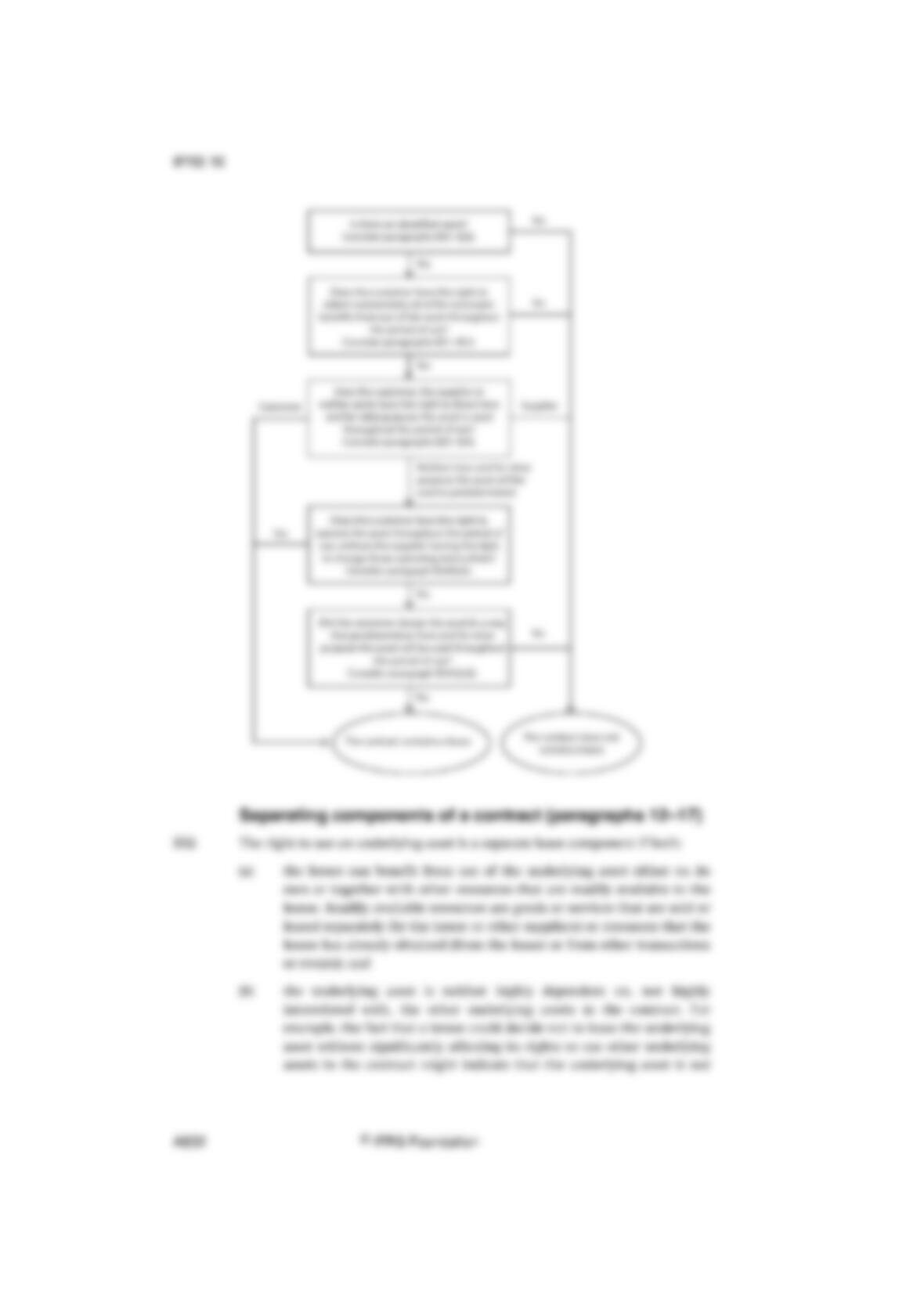
At inception of a contract, an entity shall assess whether the contract is, or
contains, a lease. A contract is, or contains, a lease if the contract conveys
the right to control the use of an identified asset for a period of time in
exchange for consideration. Paragraphs B9–B31 set out guidance on the
assessment of whether a contract is, or contains, a lease.
A period of time may be described in terms of the amount of use of an
identified asset (for example, the number of production units that an item of
equipment will be used to produce).
An entity shall reassess whether a contract is, or contains, a lease only if the
terms and conditions of the contract are changed.
Separating components of a contract
For a contract that is, or contains, a lease, an entity shall account for each
lease component within the contract as a lease separately from non-lease
components of the contract, unless the entity applies the practical expedient
in paragraph 15. Paragraphs B32–B33 set out guidance on separating
components of a contract.
Lessee
For a contract that contains a lease component and one or more additional
lease or non-lease components, a lessee shall allocate the consideration in the
contract to each lease component on the basis of the relative stand-alone price
of the lease component and the aggregate stand-alone price of the non-lease
components.
6
7
8
9
10
11
12
13
IFRS 16
© IFRS Foundation A805

The relative stand-alone price of lease and non-lease components shall be
determined on the basis of the price the lessor, or a similar supplier, would
charge an entity for that component, or a similar component, separately. If an
observable stand-alone price is not readily available, the lessee shall estimate
the stand-alone price, maximising the use of observable information.
As a practical expedient, a lessee may elect, by class of underlying asset, not to
separate non-lease components from lease components, and instead account
for each lease component and any associated non-lease components as a single
lease component. A lessee shall not apply this practical expedient to
embedded derivatives that meet the criteria in paragraph 4.3.3 of IFRS 9
Financial Instruments.
Unless the practical expedient in paragraph 15 is applied, a lessee shall
account for non-lease components applying other applicable Standards.
Lessor
For a contract that contains a lease component and one or more additional
lease or non-lease components, a lessor shall allocate the consideration in the
contract applying paragraphs 73–90 of IFRS 15.
Lease term (paragraphs B34–B41)
An entity shall determine the lease term as the non-cancellable period of a
lease, together with both:
(a) periods covered by an option to extend the lease if the lessee is
reasonably certain to exercise that option; and
(b) periods covered by an option to terminate the lease if the lessee is
reasonably certain not to exercise that option.
In assessing whether a lessee is reasonably certain to exercise an option to
extend a lease, or not to exercise an option to terminate a lease, an entity shall
consider all relevant facts and circumstances that create an economic
incentive for the lessee to exercise the option to extend the lease, or not to
exercise the option to terminate the lease, as described in paragraphs
B37–B40.
A lessee shall reassess whether it is reasonably certain to exercise an extension
option, or not to exercise a termination option, upon the occurrence of either
a significant event or a significant change in circumstances that:
(a) is within the control of the lessee; and
(b) affects whether the lessee is reasonably certain to exercise an option
not previously included in its determination of the lease term, or not
to exercise an option previously included in its determination of the
lease term (as described in paragraph B41).
An entity shall revise the lease term if there is a change in the non-cancellable
period of a lease. For example, the non-cancellable period of a lease will
change if:
14
15
16
17
18
19
20
21
IFRS 16
A806 © IFRS Foundation
(a) the lessee exercises an option not previously included in the entity’s
determination of the lease term;
(b) the lessee does not exercise an option previously included in the
entity’s determination of the lease term;
(c) an event occurs that contractually obliges the lessee to exercise an
option not previously included in the entity’s determination of the
lease term; or
(d) an event occurs that contractually prohibits the lessee from exercising
an option previously included in the entity’s determination of the lease
term.
Lessee
Recognition
At the commencement date, a lessee shall recognise a right-of-use asset and a
lease liability.
Measurement
Initial measurement
Initial measurement of the right-of-use asset
At the commencement date, a lessee shall measure the right-of-use asset at
cost.
22
23
IFRS 16