LEADING PEOPLE AND TEAMS – Séance 1
Introduction:
Individual > leadership > Organizational outcomes > Business goals
A. Organizational outcomes:
• Job satisfaction
• Job performance
• Withdraw behaviours (par ex absenteeism), deviance and all negative work attitudes
• Staff turnover
• Citizenship behaviour and other positive work attitudes
B. 3 levels of the factors that drive humans’ attitudes & behaviours in organizations:
1. Individual
2. Group
3. Organizational
I.Organizations
A. Definition
An organization is a group of people who work together in an organized way of share purpose.
Organizations have:
• Structure
• Culture and identity
• Standardized processes
• Polices and internal regulation
• Performance metrics and incentives…
Chain of command: a chain of command is a military or civil organization by which instructions
or orders are passed from one person to another. (=line of authority and responsibility)
Span of control: it’s the number of subordinates or functions one can efficiently manage
B. Tall vs. flat structures:
TALL STRUCTURES
PRO’S
CON’S
• Specialist approach
• Appropriate for training
• More career opportunities
• Compartmentalization
• Slow decisions
• Difficult to coordinate
FLAT STRUCTURES
PRO’S
CON’S
• Generalist approach
• Fast decisions
• Acess to CEO
• Work overload and multitasking
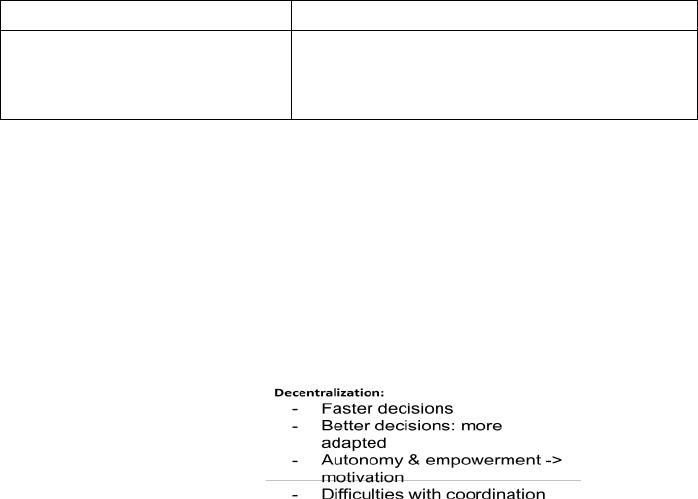
A. Centralization vs. decentralization
The goal is to put authority in the hands of a person closest to most knowledgeable about the
situation.
Centralisation:
• Better control
• Easier coordination
• Slower decisions
B. Formalization:
A formal organization is an organization with a fixed written set of rules regarding structures
and procedures.
Purpose of formalization:
• Efficiency (optimization of processes and communication)
• Easier control and coordination
• Quality management
• Automation
• Uniform quality across divisions and locations
C. 4 types of organizational structures:
• Simple (flat): startups and small teams
• Functional: most common one. People who do similar tasks are grouped together.
Employees specialize in one domain, it’s easy to coordinate and supervised. But the
difficulty is for cross-functional projects team, which are difficult to coordinate with
this type of organization.
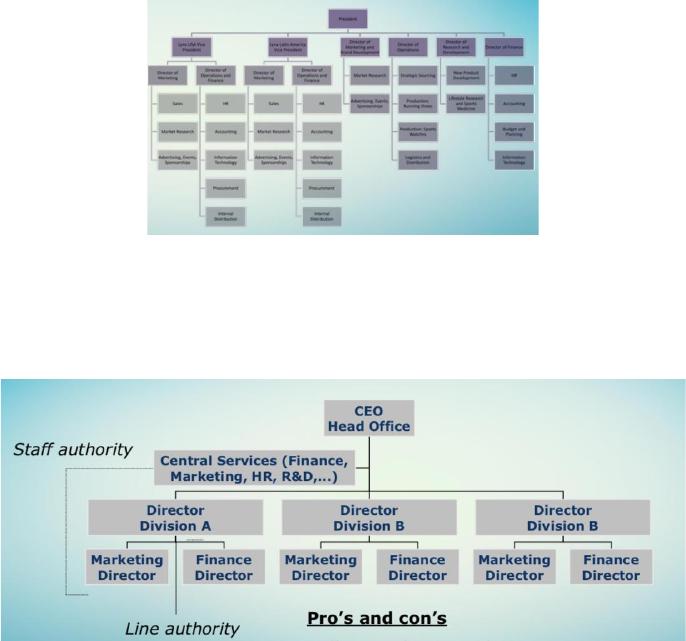
Multidivisional: typical for large MNCs. Workers are grouped into divisions based on the
products or projects that meet the needs of certain type of customer. It’s brought
• lot of efficiency for many companies, but it’s also brought rivalry among large divisions.
• Matrix: fusion of functional and multidivisional. Groups people into functional
departments of specialization, then further separates them into divisional projects and
products. Typical for organizations with diverse products lines and services.
I.People in organizations
A. Job satisfaction: is a measure of workers contentedness with their job, whether or
not they like the job or individual aspects or facets of jobs, such as nature of work, supervision,
reward ect…
2 slides of job satisfaction: Affective (emotional) and Cognitive (evaluative)
JDI: Job Descriptive Index: the most common measure:
• Co-workers
• Supervision
• The work itself
• Pay
• Opportunities of promotions
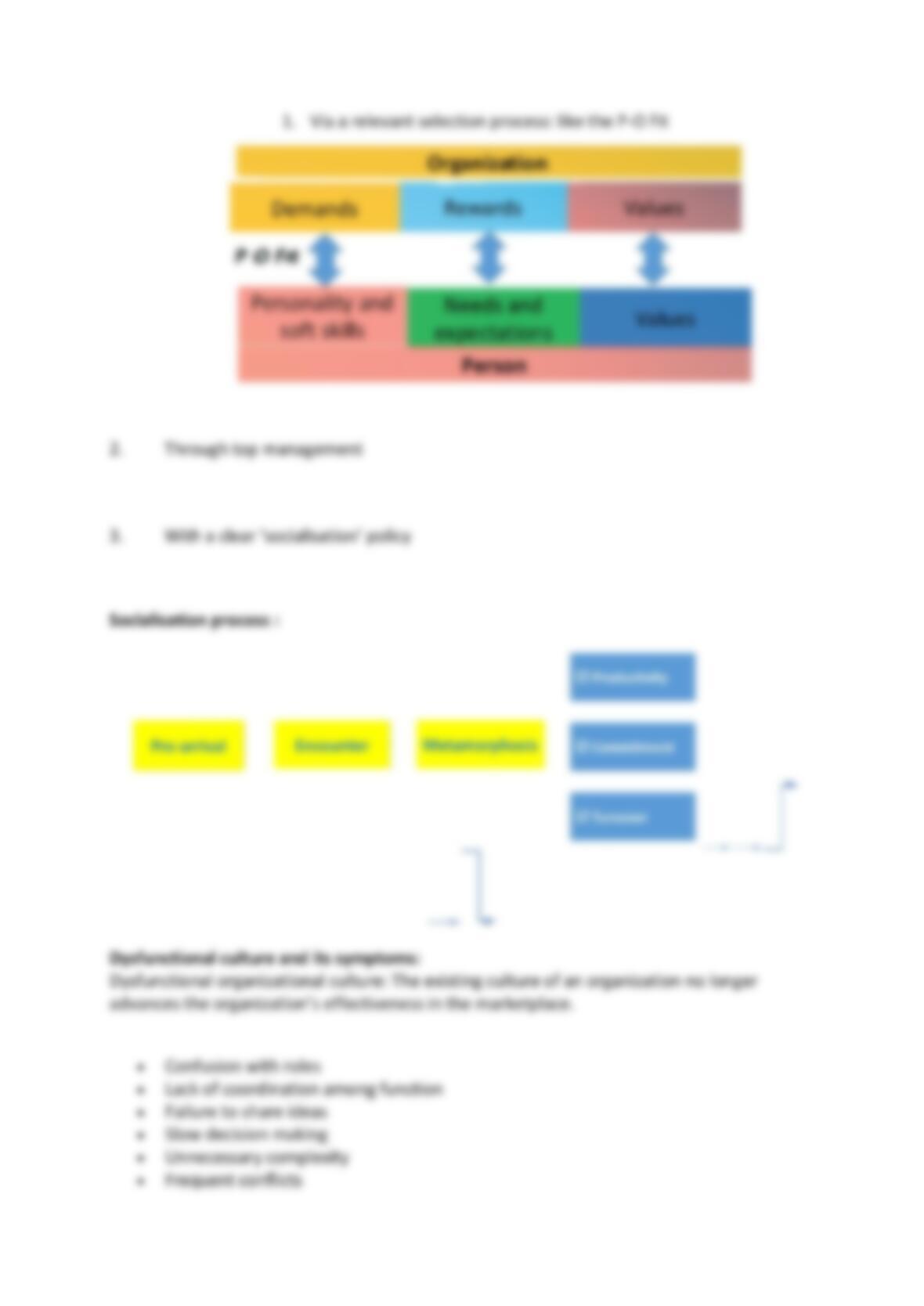
B. Personality-Organization fit (P-O):
Jobs who require certain personality traits and soft skills.
Ex: Heavy teamwork and collaboration, a lot of control and frequent feedback, a lot of
autonomy and no feedback…
The theory: hiring employees who are the best fit to this will decrease turnover and increase
employee satisfaction and performance
How to asses? With psychometric test (MBTI), situational analyses interview, simulations…
Exemples of soft skills / personality traits :
• Strong work ethix
• Time management
• Communication
• Flexibility
• Critical Thinking
• Decision making…
LEADING PEOPLE AND TEAMS – SEANCE 2 – Recruitment
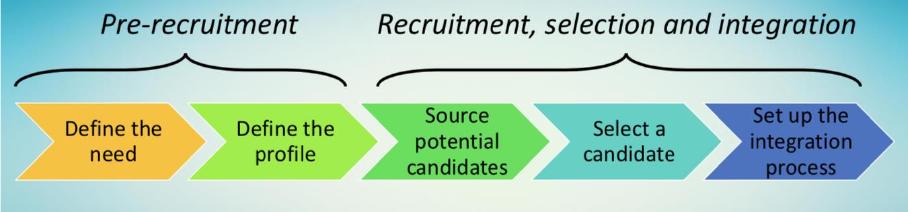
I.Five steps of recruitment and selection
a. Pre-recruitment
Defining external context and long-term needs.
PESTEL external factors:
• P: immigration policy, taxes and tariffs
• E: salary scales, competition
• S: demographics
• T: digitalization and automation
• E: reduction of impact, relocation
• L: labour law
Defining internal context:
• Structure: prepare a career development
• Culture: identify values, traits…
• Internationalization: language and mobility needs
• Resources: budget, equipment, staff, time…
Defining the profile:
• Job specification: qualifications, experiences, knowledge required
• Person specification: physical attributes, intelligence Levels, aptitudes, interests…
• Job description: title of the job, location, title of employee’s line manager, grade of
the job, tasks, details…
b. Recruitment
Sourcing the profiles:
• Internal: intranet, promotions and rotations, candidates previously applied
• External: company website, social media and job boards, recruitment
agencies/headhunters, higher education recruitment programme, current staff
recommendations

a. Selection
Interviewing
The form:
• Face to face: intersubjective
• Jury: objective to cross the perceptions with a common repository
• Collective: for invite candidates to introduce themselves, to discuss the job, to
discuss other subjects without directives
The organization:
• Directive: strict framework, answers excepted, shorts and precise
• Nondirective: the decision-maker ask the candidate about some points
• Semi-structured: conversation, the objective is to create the best conditions to
understand the candidate’s personality
Testing
OBJECTIVES
EXAMPLES
CAPACITIES
To measure particular capacities to
manage a specific job
Logical reasoning
Languages
General culture
PERSONALITY
To measure personality, ability to
socialize, ambition and dynamism
ASSESSMENT
CENTRES
To judge a candidate’s capacity and
behavior while dealing with a current
professional situation
• Case interview
• Situational Judgment
Test (STJ)
• Watson-Glaser Critical
Thinking Appraisal (W-
GCTA)
• In-tray test
• Call simulation
• Sales negotiation
• Critial event to solve
Situational Judgment Test (STJ)
• Popular psychological tool used to evaluate behavioral and cognitive abilities when
presented with hypothetical work-related situations. Candidates are required to
choose the best course of action from a list.
• SJT do not have a specific format and often have different criteria.
Watson-Glaser Critical Thinking Appraisal
• Critical thinking is the ability to consider a range of information derived from many
different sources, to process this information in a creative and logical manner,
challenging it analyzing it and arriving at considered conclusions which can be
defended and justified.
• You are given a statement and a list of arguments in support of the statement. You
need to assess the strength of the arguments.
• A strong argument is important and direct related to the question
• A weak argument is not directly related to the question or minor importance or may
be related to a trivial aspect or confuses correlation.
a. Integration
Employee integration