Leadership from theory to practical: the emergence of women as the leader
Introduction:
Leadership is a function, which is essential at all levels of management. In the top level, it
is important for getting co-operation in formulation of plans and policies. In the middle
and lower level, it is required for understanding and execution of plans and programs
framed by the top management. Leadership can be applied through supervision and
counseling of the subordinates at the time of carrying out of plans. The leaders, i.e., the
managers are said to be the representative of the enterprise. They have to represent the
concern at seminars, conferences, general meetings, etc. their roles are to communicate the
rationale of the enterprise to external public. They are also representative of the own
department that they lead. The leaders through leadership traits help to merge the personal
goals of the employees with the organizational goals. They seek to co-ordinate the efforts
of people towards a common purpose and thereby achieve objectives. The leaders must
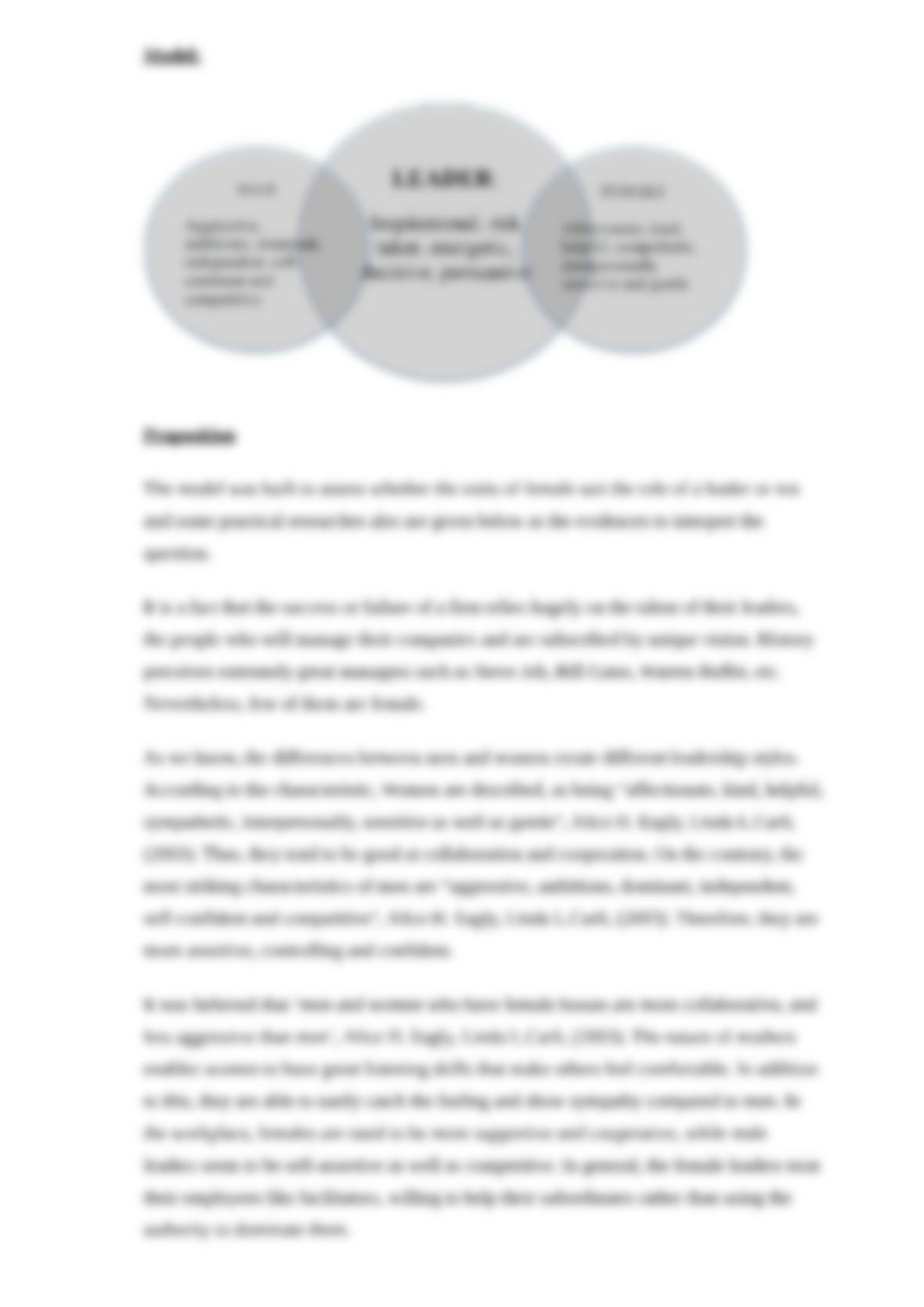
possess the three dimensional traits. They sometimes like friend by sharing the feelings,
opinions and desires with the employees. Besides, they also can be philosophers by
utilizing his intelligence and experience and thereby guiding the employees. In addition,
they can be guides by supervising and communicating the employees the plans and
policies of top management, securing co-operation to achieve the common goals.
The idea that women are effective leaders has jumped from the writers of feminist trade
books on management (e.g., Helgesen, 1990; Rosener, 1995) to the mainstream press and
is steadily making its way into the popular culture. Articles in newspapers and business
magazines reveal a cultural realignment in the United States that proclaims a new era for
female leaders. As Business Week announces that women have the ‘‘Right Stuff’’ (Sharpe,
2000), Fast Company concurs that ‘‘The future of business depends on women’’
(Hefferman, 2002, p. 9). Even more startling is Business Week’s subsequent cover story on
the ‘‘New Gender Gap,’’ maintaining that ‘‘Men could become losers in a global economy
that values mental power over might’’ (Conlin, 2003, p. 78). Before delving into these
issues of female advantage and disadvantage, we note that women’s corporate and political
leadership is on the rise. Whereas women held only 18% of managerial and administrative
positions in the United States in 1972, by 2002 that percentage had increased to 46% (U.S.
Bureau of Labor Statistics, 1982, 2002). The increase in female leaders has been