1
TABLE OF CONTENT
1.0 Introduction ………………………………………………………………………. 3
2.0 Literature Review and Preliminary Findings …………………………………….…… .. 4
2.1 What is Leadership?
2.2 The Value of Leadership
2.3 Sustainable Performance of Organization
2.4 Effective Leadership as the key value for sustainable organisation
performance
3.0 Discussion on the leadership influence the sustainability of …………………… 11
the organization’s performance
3.1 Global Context – Lesson learned from leadership failure
and impacted the sustainability of the organization’s performance
3.1.1. BP’s Deepwater Horizon oil spill
3.1.2. Volkswagen emissions scandal
3.2 Malaysia Context – Effective leadership and AirAsia’s sustainable
performance
3.2.1 The Journey
3.2.2 Effective leadership influence AirAsia’s sustainability of
performance
3.2.3 How Tony Fernandes and AirAsia looking to redefine the
role of an airline in a post-COVID world
4.0 Conclusion ………………………………………………………………………. 16
5.0 References ……………………………………………………………………….. 17
2
1.0 INTRODUCTION
The rapid growth of the economic environment as well as the emergence of the internet
made communicate with countries all over the world to be simpler. This in turn changed
the global business environment, causing a competitiveness in the market that increases
with each passing year (Friedman, 2007). Business owners discovered that, in order to
sustain their business and to stay competitive, they have to offer better quality products
at a lower cost, employ strategies that were uniquely suited for the organization to adapt
according to current business trends and also flexibility in facing the rapid change of
the business environment.
Given all these challenges, effective leadership become one of most essential parts of
the overall method for an organization to sustain their business in the face of problems
caused by the rapid growth of the economic environment. Leaders are the one who
control and take charge of the operation of an organization and good leaders are able to
set optimistic goals and objectives while steering the operation of the company towards
those goals through effective strategies. Other than that, good leaders can also influence
their employees and motivate them by strengthening a positive organization culture and
through generous employee benefits, for instance health care insurance, worker
compensation, leave benefit and others (CabezaErikson, Edwards, and Van Brabant,
2008).
Intelligent leaders also have the responsibility to use their skills and knowledge to guide
their business forward effectively and efficiently and to eliminate the insecurity feelings
in their employees resulting from that uncertainty. A leader has the power to influence
the success of the organization, due to his full power to control the direction of the
organization, as well as through the influence they exert on their employees that
motivates them to bring the company to greater performance.
The main objective of this report is to develop a methodological structure in assessing
the relationship between leadership and sustainable performance of an organization and
how effective leadership qualities influence the sustainable performance of a company.
3
2.0 LITERATURE REVIEW & PRELIMINARY FINDINGS
2.1 What is Leadership?
Leadership is defined as the ability to influence, motivate, and enable others to
contribute to the effectiveness and success of the organizations of which they are
members. Leaders use influence to motivate followers and arrange the work
environment, so they do the job more effectively.
Though formal leaders are responsible for leading others, but companies are far more
effective when everyone assumes leadership responsibilities in various ways and at
various times. This new idea, which is called shared leadership, has viewed a leadership
as a role rather than a formal position. Shared leadership empowers employees
throughout the organization to act informally as leaders whenever the occasion arises.
These situations include serving as champions for specific ideas or changes, as well as
filling leadership roles where it is needed (McShane, S.L., Von Glinow, M.A., 2018).
Most leadership concepts and practices can be organized into four perspectives:
a) Transformational
Transformational leadership views leaders as change agents. They create,
communicate, and model a shared vision for the team or organization. They
encourage experimentation so employees find a better path to the future.
Through these and other activities, transformational leaders also build
commitment in followers to strive for that vision (McShane, S.L., Von Glinow,
M.A., 2018).
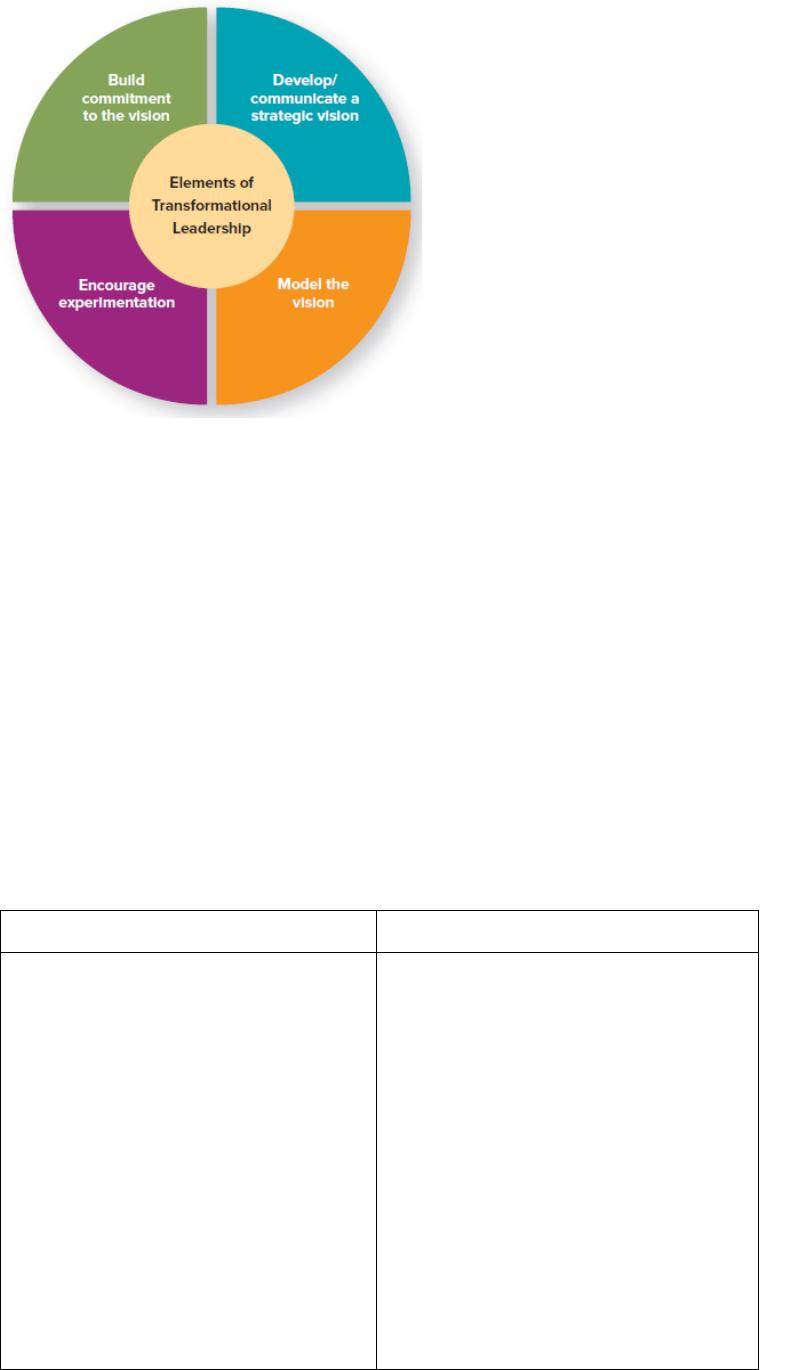
There are several models of transformational leadership, but four elements are
common throughout most of them and represent the core concepts of this
leadership perspective. These four elements are as illustrated below:
4
b) Managerial
Managerial leadership includes the daily activities that support and guide the
performance and well-being of individual employees and the work unit to
achieve current objectives and practices (McShane, S.L., Von Glinow, M.A.,
2018).
The managerial leadership is different from transformational leadership based
on the reasonably clear set of activities as below:
Managerial Leadership
Transformational Leadership
• Assumes the organization or
department’s objectives are
stable and aligned with the
external environment. It focuses
on continuously developing or
maintaining the effectiveness of
employees and work units toward
those established objectives and
practices.
• Assumes the organization is
misaligned with its environment
and therefore needs to change its
direction.
Exhibit 1.0 Elements of
Transformational Leadership
Managerial Leadership
Transformational Leadership
• More micro-focused and
concrete, because it relates to the
specific performance and well-
being objectives of individual
employees and the immediate
work unit.
• More macro-focused and abstract.
It is directed toward an imprecise
strategic vision for an entire
organization, department, or
team.
Although transformational and managerial leadership are discussed as two
leadership perspectives, but both are interdependent. Transformational
leadership behaviors are not enough for organizational success as it would
require managerial leadership to translate the abstract vision into more specific
operational behaviors and practices, and to continuously improve employee
performance and well-being in the pursuit of that future ideal. In contract,
Managerial leadership also depends on transformational leadership to set the