Organization Name: Nori Number of employees: approx. 20
Sector: Tertiary sector Organization lead(s):
Raymond
Region (country): Canada
Short Description of the Company
Nori Bento is a fast-dining Japanese restaurant located at University of British Columbia’s
(UBC) campus in Vancouver. Their menu caters to health-conscious consumers looking for
convenient fresh meals. With over 60,000 students and faculty members at UBC, the market
demographic is sufficient to sustain a small business. On average, Nori serves 500 customers a
day.
While the restaurant is part of a subsidiary under Umi Sushi Express, Nori differentiates itself
with its menu that’s focused on its handmade udon noodles. Additionally, they offer rice bowls
and tempura dishes. It also sources part of its supplies and ingredients independently, choosing
local whenever possible. As a food service provider at UBC, Nori follows waste management
practices provided by UBC Building Operations.
Environmental Concept and Biography of the Organization
As a food service provider at UBC, Nori aims to align its environmental standards with the
campus’ goal to increase recycling diversion to 80% by 2020 and become a Zero Waste
partner. They provide the standard waste diversion bins to their customers: Compost, recycling,
bottles, and landfill. The bowls are made of recycling paper material, however, the spoons are
made of plastic. Additionally, being in a LEED Gold certified building reduces its energy and
water consumption. The use of mass timber products in the infrastructure provides carbon
sequestration which further reduces GHG emissions for businesses like Nori. While Nori
maintains sustainable practices in some aspects of their supply chain management, there has
been little documentation of the process and neither have access to Life Cycle Assessment
(LCA) nor O-LCA studies to provide guidelines for further improvements to their environmental
management.
Experience–based pathways
Nori’s existing system belongs to Pathway 1, “Limited Initial Environmental Experience and
Information”.
The operation of Nori has some environmental goals, such as plastic clusters elimination and
waste classification. The rough estimates indicate about 50% of waste disposal goes to landfill.
No documentation has been done on food waste, though the top items thrown out are the soup
bases. The current method Nori uses to achieve these goals are very linear – compared the
monetary cost between the original and improved solutions with affordability being the dominant
determining factor.
Considering no environmental analysis tool was used and no comprehensive environmental
assessment was previously involved, this is defined as Pathway 1.

Motivation and Goals
Intended Application:
This O-LCA study is to assess the environmental impacts of the current value chain and
business processes for management to explore the potential improvements that can be made
within Nori Bento & Udon’s operation.
Reasons for Carrying Out the Study:
Nori Bento & Udon is continuously searching for improvements to its daily operation to achieve
their main core value to promote healthy fast food sourced sustainably and responsibly. The
decisions Nori has made to work towards their goal includes using wooden chopsticks and
partial paper wrap for take out orders, manually sorting misplaced garbage, and substituting
plastic straws for paper ones.
Furthermore, Nori’s long term goal is to branch out to other school campuses. By doing this LCA
study now, it will be easier for them when the time comes and they want to open up other
branches.
Intended Audience: The intended audiences for this study are the decision makers at the
restaurant, as well as whoever wishes to invest in this franchise in the future.
Subject of study:
This O-LCA study will assess the first franchise location of Nori Bento, located at 6055
University Boulevard, Vancouver, BC.
Consolidation method:
Operational control and a subsidiary of Umi Sushi Express
Reference period:
January 2018 to December 2018
Reporting flow:
● Number of meals served to customers
● Amount of Food/cutlery waste produced
System Boundaries
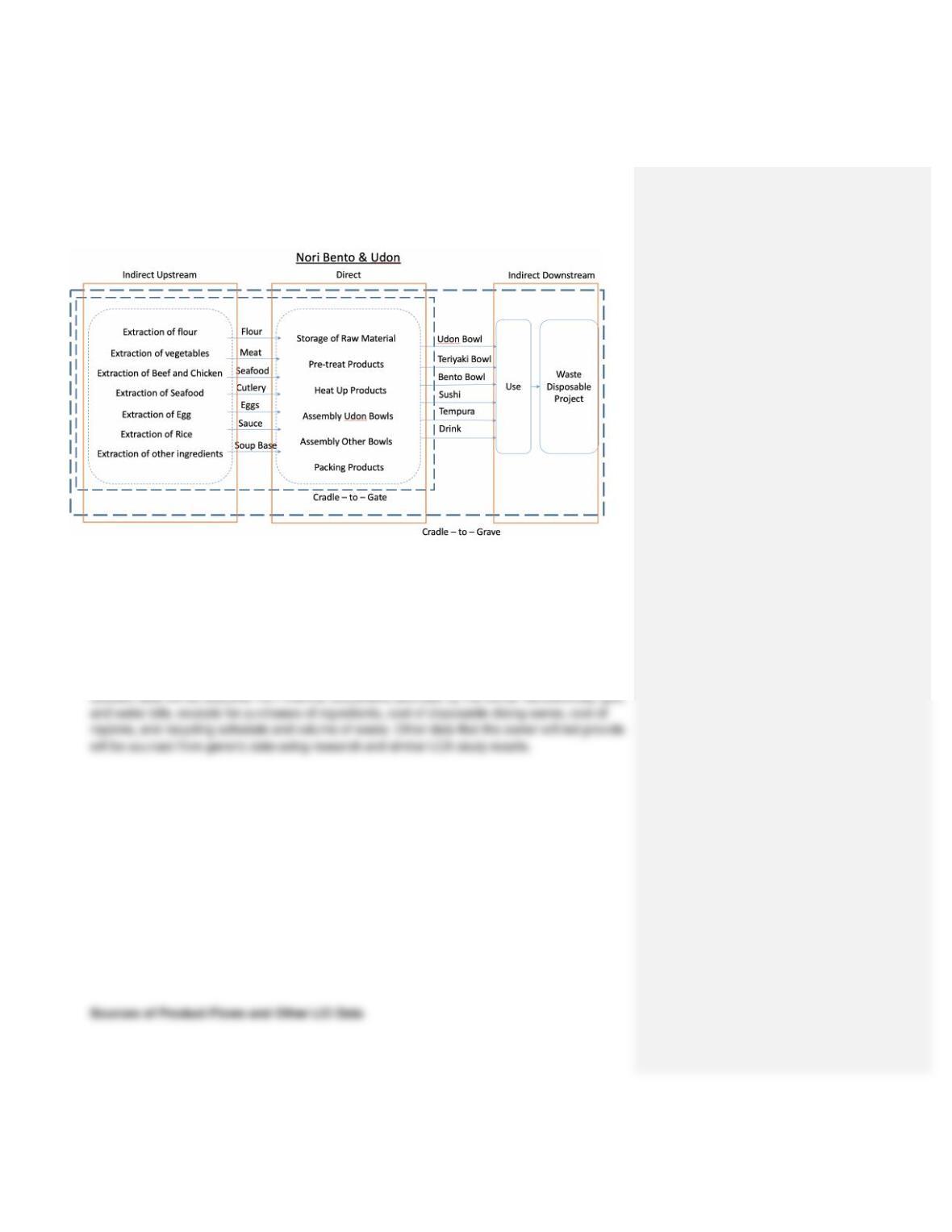
This study is a cradle-to-grave assessment of Nori Bento & Udon. Cradle-to-grave describes the
full life cycle assessment from the extraction of the raw materials to its disposal. At Nori, the raw
materials are delivered by suppliers three times a week due to storage limitations and fresh
quality standards. The ingredients are prepared into a variety of their menu items ordered by
customers is then consumed by the customers. Finally, the waste is disposed of in recycling
bins at the restaurant, thus completing the life cycle of the primary materials used.
Data Collection Approach
This study will use a bottom-up approach or a product-oriented approach. The direct and
indirect upstream activities will be referenced to the final product or per meal produced.
Data Sources