GE-PHY 101: PHYSICS FOR ALLIED HEALTH PROFESIONALS
DE LA SALLE MEDICAL AND HEALTH SCIENCES INSTITUTE
COLLEGE OF HUMANITIES AND SCIENCES
1 | P a g e
EXPERIMENT 2. LAWS OF MOTION
OBJECTIVES
1. Determine the mass of an object in static equilibrium.
2. Determine the moments of force in an equal arm balance.
3. Study 2nd Law of Motion.
THEORY
Dynamics is a branch of mechanics that study the relationship of motion to the forces that cause it.
Those causes of motion were clearly explained in three statements for the first time by Sir Isaac Newton
(1642-1727) who published them in 1687 in his Mathematical Principles of Natural Philosophy. These three
statements are called Newton’s laws of motion.
Law of Inertia
The first law states that when the net force on a body is zero, its motion doesn’t
change.
Law of
Acceleration
The second law relates force to acceleration when the net force is not zero.
Law of Interaction
The third law is a relationship between the forces that two interacting bodies exert
on each other.
MATERIALS
1 Xplorer GLX 1 Equal Arm Balance
1 Dynamics Track 1 each 20, 50, 100g
1 Angle Indicator 1 A-Base
1 Universal Clamp 1 Nylon Thread String
1 Table Clamp 2 Dynamics Track Stopper
1 Pivot Clamp 2 Metal Rods
1 Force Sensor 1 Stopwatch
1 Dynamics Cart 1 Super Pulley
GE-PHY 101: PHYSICS FOR ALLIED HEALTH PROFESIONALS
DE LA SALLE MEDICAL AND HEALTH SCIENCES INSTITUTE
COLLEGE OF HUMANITIES AND SCIENCES
PROCEDURE
PART I. LAW OF INERTIA (EQUILIBRIUM)
A.1. Translational Equilibrium
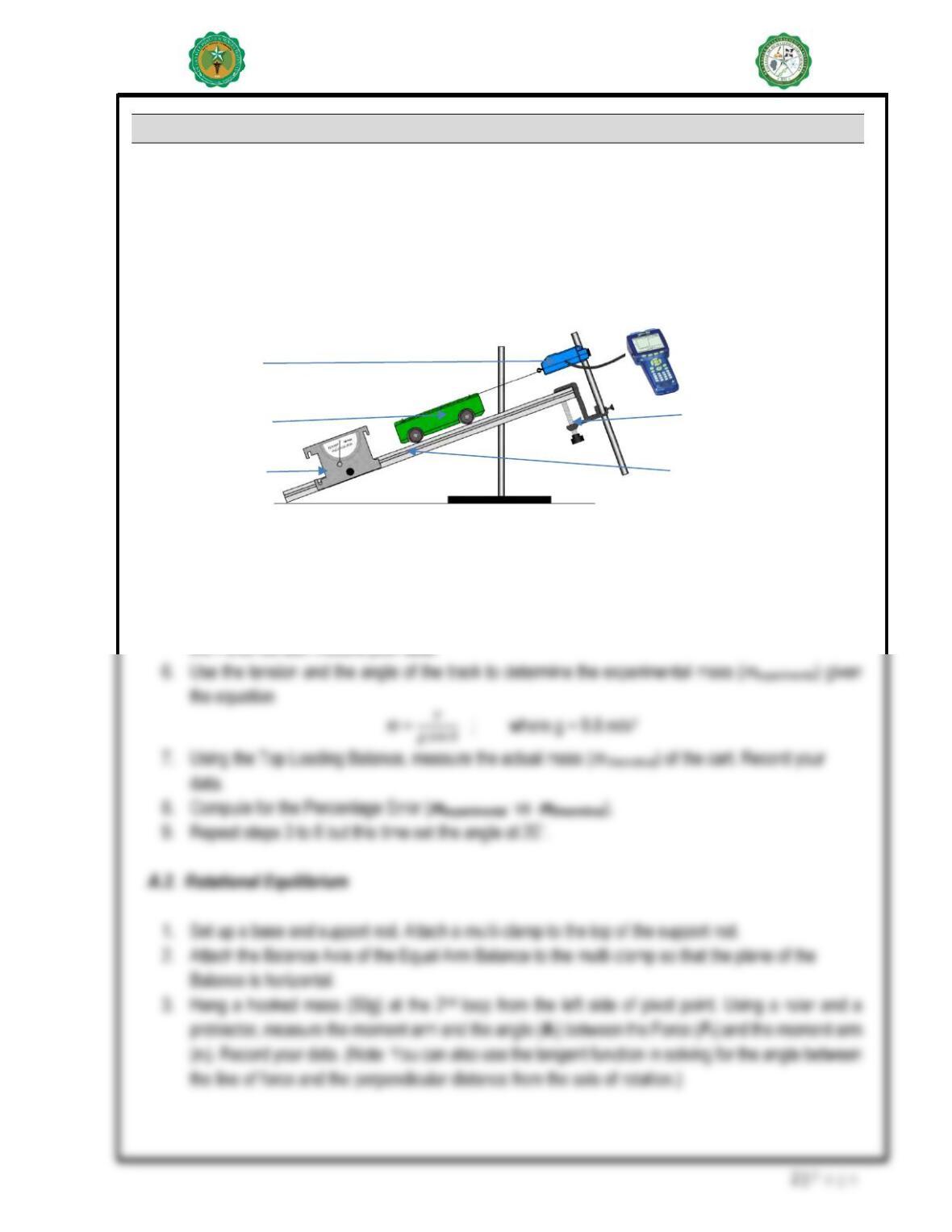
1. Set up the Dynamics Track, Dynamics Cart, Angle Indicator, Force Sensor and Xplorer GLX as
shown below.
2. Set the angle of the Inclined Dynamics Track to 15˚.
3. With no tension on the string, press the zero button of the Force Sensor.
4. Release the cart connected by a nylon thread string to the hook of the Force Sensor.
5. Click on the play button of the Xplorer GLX to start measuring the tension in the string attached to
Universal Clamp
Force Sensor
Angle Indicator
Dynamics Cart
Dynamics Track