Law of Diminishing Returns
The law of diminishing returns states that the additional (marginal) utility gained after each
additional unit of labor is added will decrease and eventually there will be no benefit to adding an
additional unit of labor. The first scenario in the assignment involves one worker cutting paper circles
out of a sheet of paper. The worker is supplied with unlimited paper, one pencil, and one pair of
scissors. The firm in this scenario has introduced a very specific way of producing paper circles: first, the
worker will fold the paper into 8 sections (3 folds in half), next the worker will draw two circles side by
side on the paper; after that, the worker picks up a pair of scissors and cuts them out. This method
produces sixteen paper circles each time. With one worker doing all the work, the smallest number of
circles can be produced. In the next scenario, another worker is hired to increase the productivity of the
firm. In this situation, one worker will oversee folding the paper and drawing the circles and the other
worker will be cutting the circles out. This method caused a huge spike in the production of circles and
was very efficient. Next, there is another pair of scissors added to the production cycle. The firm decides
that one worker will prep folded paper for the first 30 seconds of production while the other one cuts.
After the first 30 seconds, the worker will pick up a pair of scissors and help their co-worker cut the
prepped paper. This was slightly more efficient than the previous method, however it still resulted in an
increase. The increase jump from the first scenario to the second scenario was larger than the jump
from the second scenario to the third scenario. This is example of the law of diminishing returns and
shows that adding more workers has a smaller increase with additional units. In the fourth scenario,
another worker is added. The firm tells the new employee to fold paper and draw circles while the other
two members cut. This caused a decent increase in circle production. In the next situation, another
employee joined the team. One folded, one drew circles, and the other two cut. This caused the biggest
increase in circle production so far. In the last scenario, another worker was hired to the firm. Two
folded paper, one drew circles, and the other two cut the circles out. This was the most efficient method
in the process. Although this firm had great results by hiring new employees, a competitor firm across
the street used a different method: they did not fold the paper, just had an employee draw 16 circles
and cut them out. By the fourth worker, they were not gaining any marginal utility which clearly
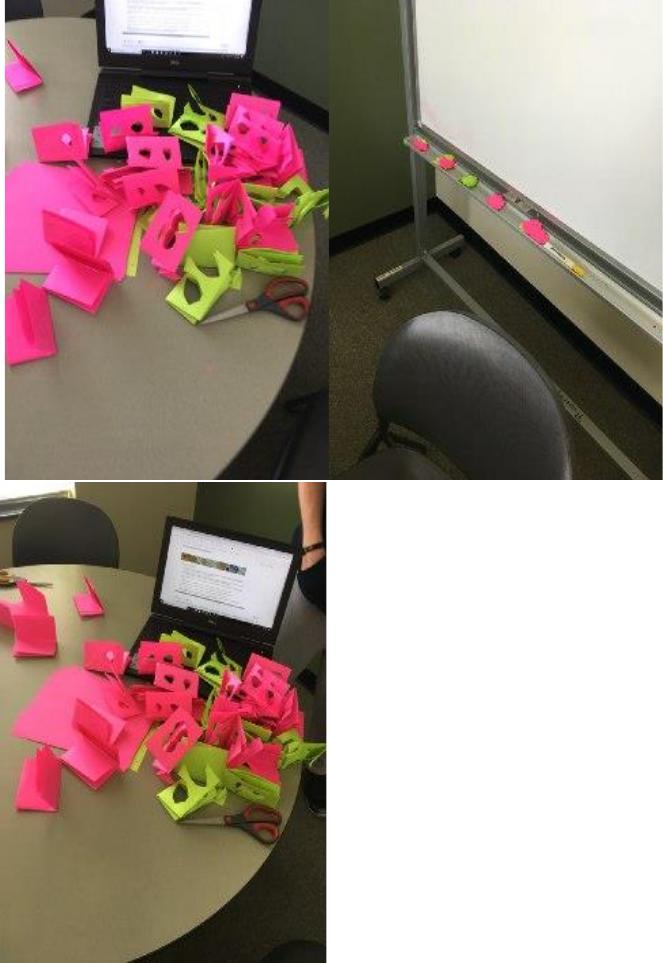
Pictures of the aftermath: