1
Law & Economics — Lecture 5
Tort Law
When person A harms person B, the legal term is a tort. Note: crimes are also
torts.
Examples of torts:
A’s car hits B.
A’s factory pollutes the air around B’s house.
A does a surgical operation on B and messes it up.
A produces a product that injures B. (product liability)
A injures B while committing a robbery.
A interferes with B’s negotiation to sell her factory to C (tort of interference
with contract).
A punches B.
2
Three elements of a tort:
1. Def breached a duty of care to plaintiff.
2. Plaintiff suffered harm.
3. Def’s breach of duty was a proximate cause of plaintiff’s harm.
3
1. Duty of care owed by def to plaintiff. Varies in different circumstances
from
• No duty
• Duty to avoid negligence
• Strict liability
• Absolute liability (even stricter than strict)
Ex: no duty of care to trespassers on your own property.
duty to avoid negligence to invitees on your property.
Extreme duty of care if you are using explosives (must protect
bystanders from harm)
Often the duty of care is to act like a “reasonable man”
4
(2) Def’s liability for the plaintiff’s harm – what is the legal standard for
damages?
Usually that damages should fully compensate for harm. Types of damage:
• Medical expenses
• Property damage (i.e., cost of car repair)
• Lost wages while injured
• “pain and suffering” (non–economic damages)
• hedonic damages (for loss of enjoyment)
• “loss of consortium” to spouse
• (sometimes) punitive damages
Damages can be for both past and future loss. The victim and his/her family
have different damages.
5
Examples:
• death of a child: parents suffer hedonic damages but no ec damage.
• death of one spouse: the other spouse suffers hedonic damage and lost
wages.
• damage in 9/11 terror attacks: victims’ P/S while waiting for rescue in the
WTC.
Difficult to measure P/S or hedonic damage. The dollar value of pain is the
amount that people would pay to avoid experiencing it.
Punitive damages are damages > harm suffered. Intended to penalize a
defendant for reckless behavior and discourage future parties from behaving in
the same way.
6
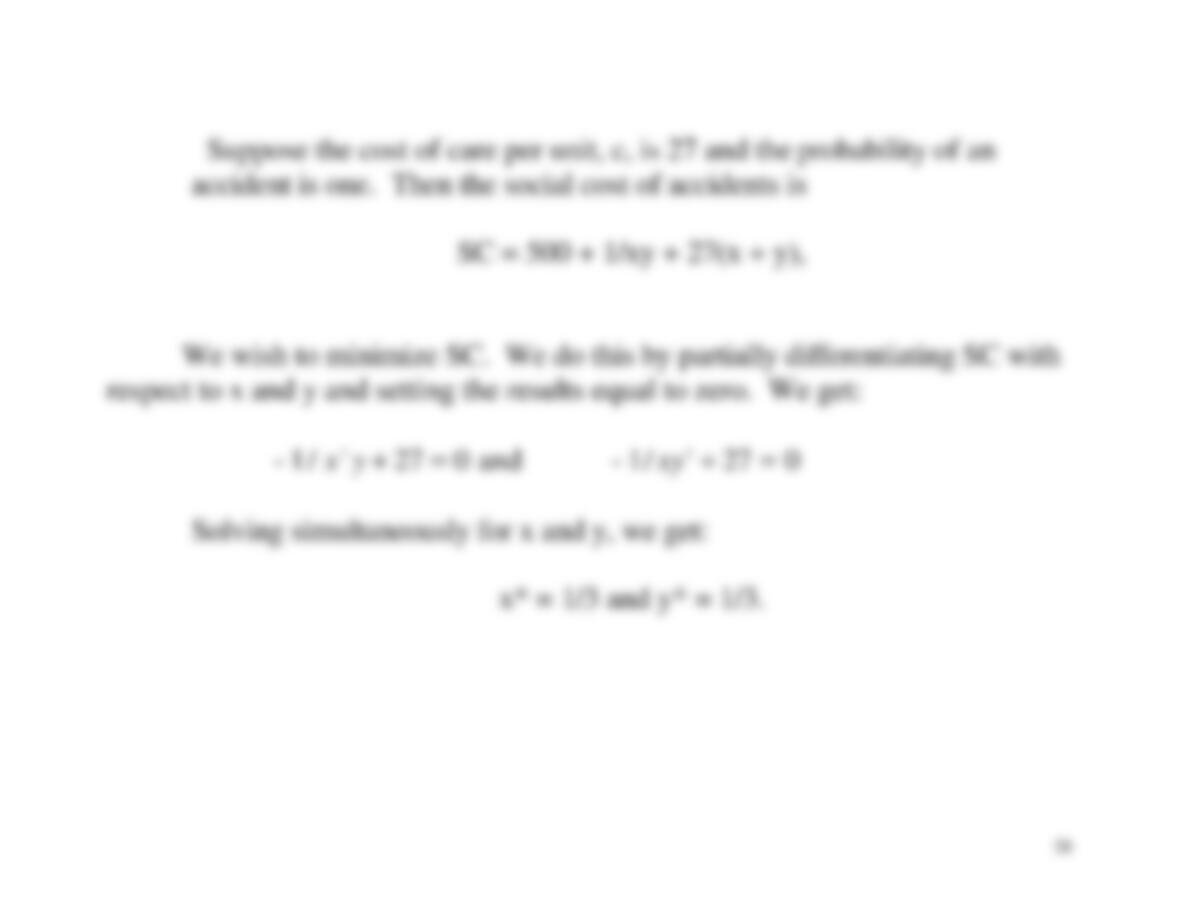
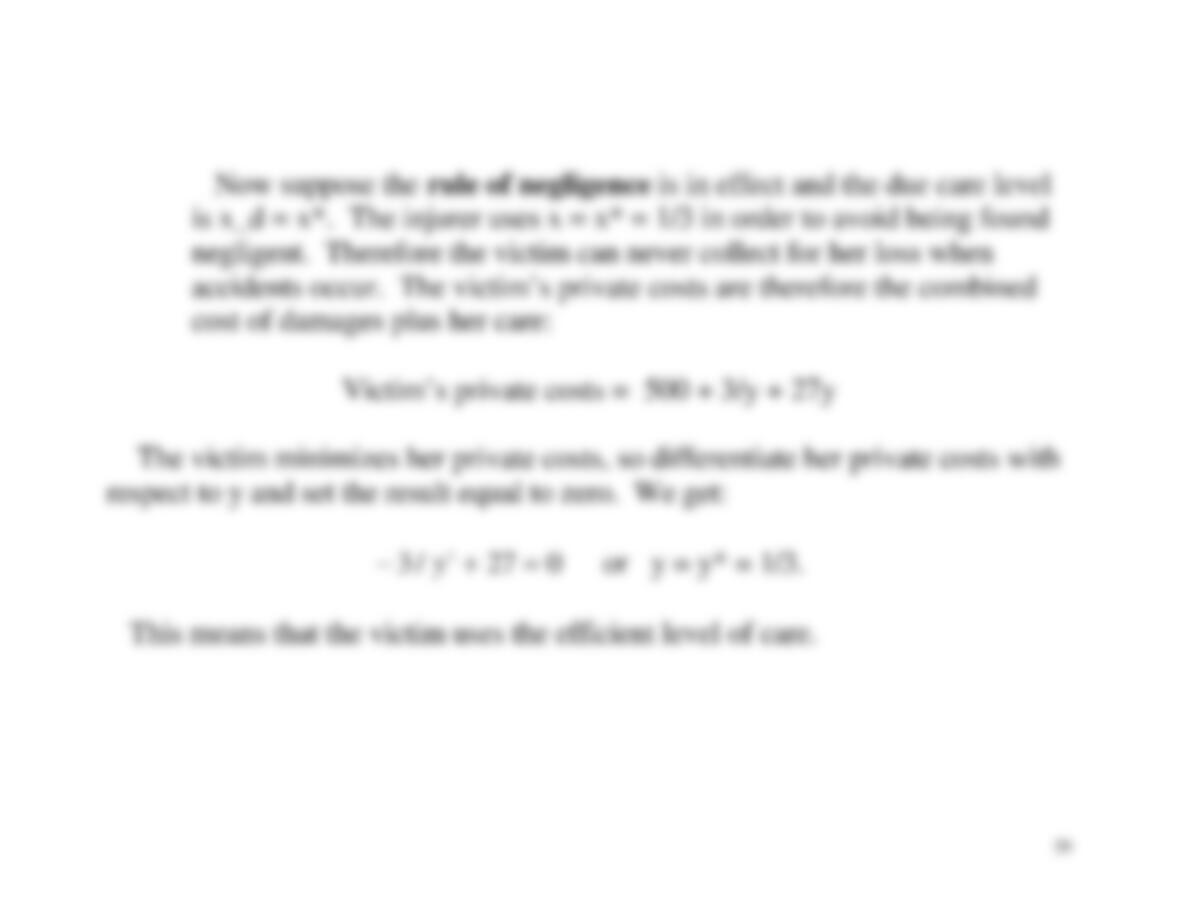
Why should liability for damages equal harm suffered (D),
rather than 2D or .5D?
Liability for actual harm suffered (D) is efficient since it forces potential
injurers to behave efficiently since they take into account the damage they
cause. It puts victims’ harm on injurers’ books by making them pay for harm
done (i.e., the externality is internalized).
Liability for more than D or less than D gives potential injurers a too strong
or too weak incentive to avoid harming people.
Note: this doesn’t always work, because some victims don’t sue, courts
make errors, etc.
(We’ll come back to this in discussing incentives for injurers to use care to
avoid accidents.)
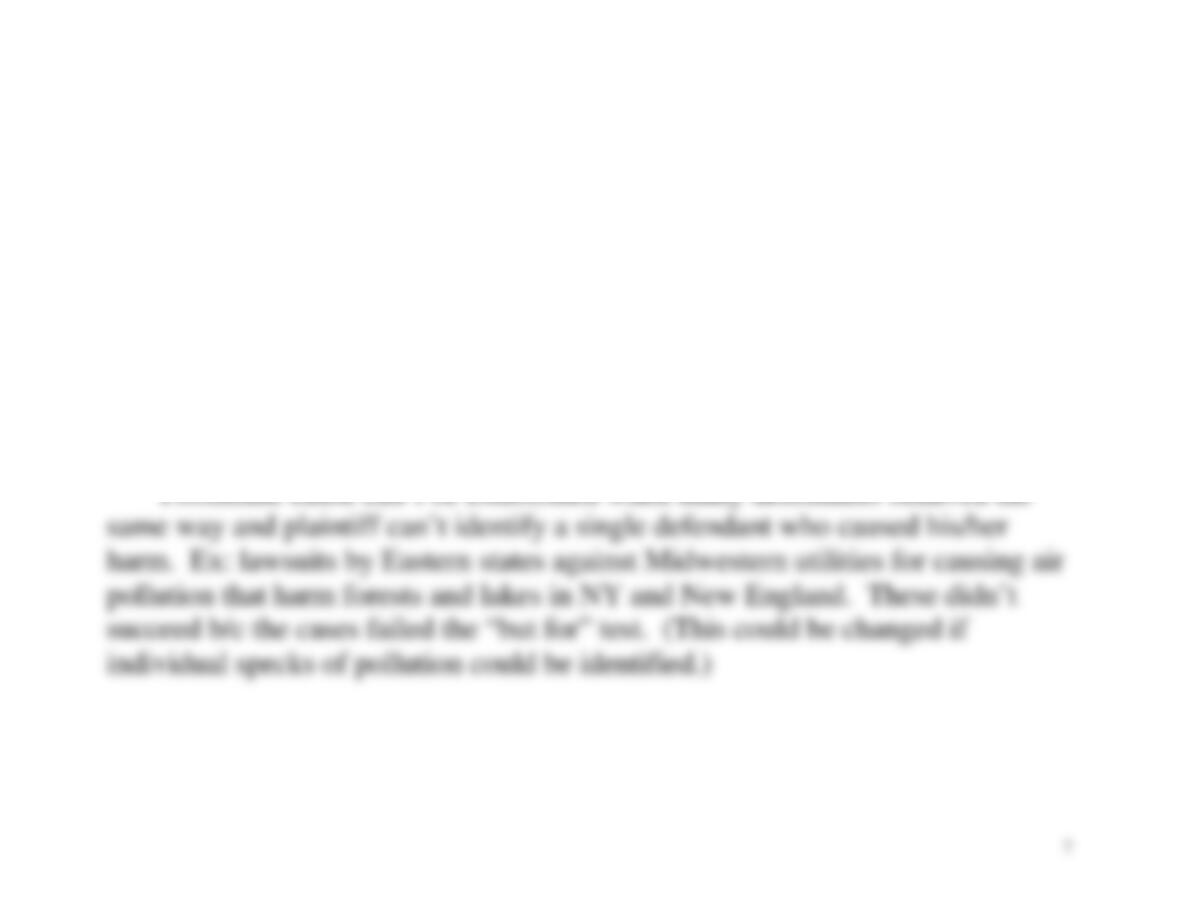
(3) Proximate cause:
Def must be identifiable and causation must not be too remote.
Palsgraf v. Long Is. RR: many intervening events between def’s
behavior and plaintiff’s harm.
“But for” test: But for A’s behavior, would the harm to B have
occurred? Must be able to answer no.