Ariosto Group
Dr. Frank Rakas
LAC 1000C: Italian
Gerianne Hayes
Brittany Hurst
Frank Kurre
Tralee McElroy
John O’Neill

Ariosto2
Leonardo da Vinci
Leonardo da Vinci was one of the most famous artists, as a sculptor and a painter.
Many of his sculptures did not survive and only fifteen of his paintings are still pure.
Some of his most famous paintings were, The Last Supper, The Madonna of the Rocks,
and the Mona Lisa. In 1489, Leonardo was commissioned by Ludovico to paint his
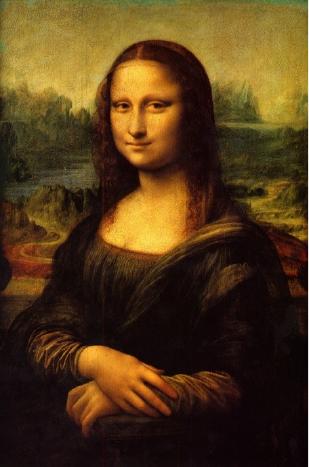
mistress, Cecilia Gallerani, who became known as the Mona Lisa. “According to
historian Paul Johnson, ‘the work is as close to perfection as a painting can be’”
(Sprezzatura, 167). In 1495, Leonardo was commissioned to paint a mural of the Last
Supper by Ludovico for the Santa Maria delle Grazie. Three years later, the mural was
completed and it displayed his expertise in color, anatomy, and architecture. The Last
Supper is one of the most popular, reproduced paintings of all time. It is a very important
painting and part of history because it is the last time that Jesus and the twelve disciples
gathered together and had a meal; the first celebration of the Eucharist. This is very
important to the Catholic faith, as it is still performed today. One of his last paintings was
St. John the Baptist. Leonardo was called the “Universal Genius”.
Ariosto3
Critics of Leonardo Da Vinci
The Mona Lisa
Jean-Pierre Cuzin, – Curator of the Louvre – claims that “the entire history of
portraiture depends on the Mona Lisa” because paintings from the Italian Renaissance
through the nineteenth century were all “inspired by this painting.” Leonardo was known
for being fascinated by the way light would fall on curved surfaces. This fascination
inspired the “gauzy veil” of Mona Lisa’s hair as well as the “glow” about her face, which
was created by many layers of transparent colors giving the appearance of not only a
glow, but also a “magical quality.” The realism of this painting was a “result of
Leonardo’s diverse scientific observations.” He developed a mathematical system for
determining size in space, which was incorporated in the Mona Lisa’s torso, head and
eyes. Leonardo took the “approach of a scientist” and for him it was the knowledge that
counts not the actual painting.
Ariosto4
The Last Supper
Leonardo da Vinci also created many great works of art in his lifetime. One of his
works, which is considered to be one of the greatest masterpieces of all time, is The Last
Supper. The painting The Last Supper remains one of the most studied paintings in
history even though it was painted over 500 years ago. A person who has given their
opinion and views of Leonardo da Vinci’s The Last Supper is Shawn Campbell. Shawn
Campbell says that Leonardo da Vinci had brilliant brush work in his painting The Last
Supper. Through his brilliant brushwork, Leonardo was able make the moment he
depicted come to life. He made the painting come to life by the personification of each of
the twelve disciples, demonstrating their personal reactions to the announcement through
facial expressions and movement. Shawn Campbell also says that Leonardo cleverly
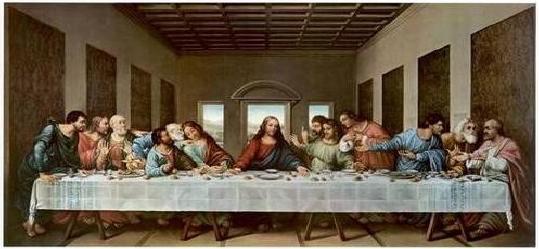
divided the 12 disciples into groups of 3, surrounding Christ, who is in the center of the
painting. In the center, Christ’s arms lay open, encompassing him into a triangular shape.
This triangular shape is expressive of the Divine Trinity. Lastly geometric shapes form
the painting and aid in creating the painting’s dialogue, like many of Leonardo’s other
works.
Ariosto5
Another critic of Leonardo da Vinci’s work The Last Supper is Ross King. Mr.
King tells us that Leonardo shows Jesus and his betrayer, Judas, as the main focus of The
Last Supper. Mr. King shows us that Leonardo used light and shade and spacing to make
Jesus and Judas stand out in his painting. Ross King also tells us that Leonardo made
Jesus significantly larger than the other figures, and he also highlighted him by “placing
him against a window that opens onto a landscape of clear sky and bluish contours,” in
effect giving him a kind of halo.
Mr. King says in the case of Judas, Leonardo was able to downgrade him by
darkening his face with shadow and by not using expensive ultramarine pigment he
lavished on Jesus and some of the other disciples, but the cheaper blue azurite medium.
Lastly Mr. King said that over the centuries, restorers reworked Judas’ features to make
him look more evil then when Leonardo created this work.
A third critic of Leonardo’s painting The Last Supper is the website
artandcritique.com. On this website they write what is going on in Leonardo’s painting
and what the viewer can see in the painting and its meaning. Artcritique.com says that in
The Last Supper Leonardo narrows in on the faces of the apostles, their features. The
faces of the apostles become vehicles of emotional expressions in the way that Leonardo
saw them. Artcritique.com feels that here Leonardo may be giving the viewers a glance
into his own emotional realm through the way he depicts the apostles. Artcritique.com
believes that the works main strength is at the table where the immediacy of the gestures
exposes heartfelt, genuine, and piercing emotions.
Ariosto6
Lastly, Carmen Bambach gives her critiques of Leonardo da Vinci’s painting The
Last Supper. She says that The Last Supper is one of the most renowned paintings of the
High Renaissance. Carmen Bambach feels that despite the dramatic reaction of the
apostles, Leonardo was able to show a sense of order in this painting. She also says that
Christ’s head is at the center of the composition, and it is being framed by a halo-like
architectural opening. Christ’s head is also the vanishing point of the work and all lines of
the work go towards him. The apostles are arranged around him in four groups and each
group has 3 apostles. The apostles posture and gesture unites them into their separate
groups
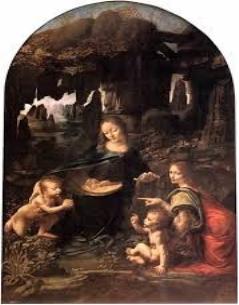
Madonna(Virgin) of the Rocks
The Madonna of the Rocks is also a beautiful picture. It was painted in 1483. It is
a delicate and beautiful painting of Mary, Jess, and St. John the Baptist. Jesus is tucked in
close to his mother, Mary.
James Kettlewell, an art historian, point out in his analysis of the painting, “The
style of the work requires special consideration, though it is not the subject of this essay.
The forms are painted in Leonardo’s soft manner, quite different from the harder edged,
linear forms characteristic of fifteenth century art.” Mr. Kettlewell praises, “he introduced
Ariosto7
an extensive modeling with shadows which achieves a greater illusion of physical mass.”
Leonardo da Vinci was ahead of his times.
Again Dr. Steven Zucker, Dr. Beth Harris share their input on a Renaissance art.
They instantly point out the position the Holy Mother is in and her looks, “Here, in
contrast, we see Mary seated on the ground. This type of representation of Mary is
referred to as the Madonna of Humility…We immediately notice Mary’s ideal beauty and
the graceful way in which she moves, features typical of the High Renaissance.” Dr.
Zucker brings up the fact that there are no halos in this painting, “This is the first time
that an Italian Renaissance artist has completely abandoned halos.”
Tamsyn Taylor, an art critic and avid blogger, pointed out the da Vinci’s outside