COMPUTER SIMULATIONS AND PROBLEMS
1.
Answer the following bolded questions.
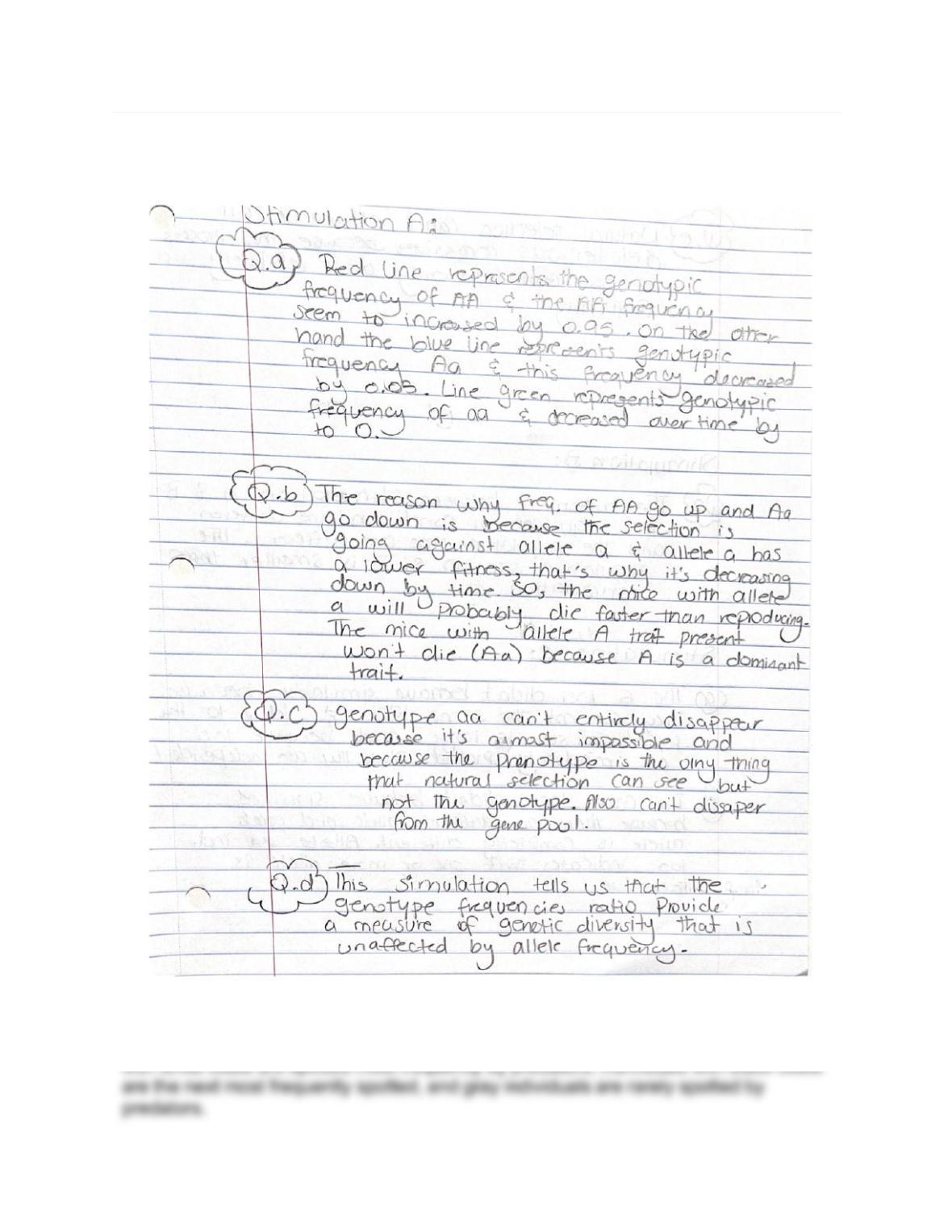
a.
Identify the lines representing the 3 genotypes. What happens to each
one?
b.
If AA and Aa have equal fitness, why does the frequency of AA go up
and the frequency
of Aa go down?
c.
If aa is bad, why doesn’t that genotype disappear entirely? Why
doesn’t the a allele
disappear? In fact, go back to the Plot Options
box and check “p vs. t”. This shows how the allele frequency (p =
frequency of allele A) changes over time. What do you see?
d.
What does this simulation tell us about the relationship between
fitness and genotypic
frequency?
e.
Natural selection is very good at driving deleterious recessives into
rarity, but it’s not so
good at eliminating them entirely. What does
this say about rare genetic diseases?
f.
Change the initial frequency of the A allele to 0.1 (leave everything else the
same). In
other words, we’re assuming that for whatever reason, white
mice outnumber dark mice
on the island prior to the arrival of owls. So, why
does the aa line start so high and drop
so fast? Why does Aa increase,
then decrease?
g.
Plot “p vs. t” for this scenario. What does this tell you about how selection
can work?
Simulation B: Here we will simulate the same large, isolated population of mice with
no
appreciable mutation in coat color alleles, random mating, and where individuals