1
Lab 10: Mechanisms of Speciation
The concept of a species is familiar to many people, however, defining what a species
actually is can be rather complicated. A species is often loosely defined as a group of
potentially interbreeding individuals (the biological species concept).
Species: groups of interbreeding populations that are evolutionarily
independent of other populations.
At first glance this definition appears adequate, however, caveats occur often. Does
this definition really include asexual reproducing organisms? What about hybrid
organisms?
Although difficult to define, a species is known as being the largest grouping of available
genes for a given organism. That is to say, that the entire gene pool for a given
organism is present at a species level.
As you are already aware, species often become divided into populations which are still
the same species but may contain geographic differences unique to each population.
Once a population has survived and successfully reproduced for multiple generations,
speciation may occur when enough differences between populations have
accumulated. Speciation is the forming of new species from an extant species.
Speciation: the forming of new species from an extant species
Although the causes of speciation are situationally dependent, one cause of speciation
is reproductive isolation.
Reproductive Isolation: when populations of an organism do not reproduce
or fail to produce fertile offspring when they attempt to reproduce
When a population becomes reproductively isolated from the rest of their species, its
members become unable to create viable offspring with members of the species outside
of the population.
There are different causal factors of reproductive isolation within, or between,
populations. Some of the more common causes of reproductive isolation are listed
below.
1. Geographic Isolation: this situation arises when a physical geographic barrier
contributes to the isolation of a population.
2. Mechanical Isolation: this scenario arises when the genitals, or other reproductive
structures, become unable to interact between individuals of a fragmented
population and the rest of their species.

2
3. Behavioral Isolation: this type of isolation includes phenomena like mating rituals,
courting behaviors and mating seasons which change within the newly
fragmented population and become foreign to the main group.
It is important to note that often viable offspring can still be produced if interbreeding
were to occur; however, the behavioral changes become so great that often other
populations do not recognize these rituals as mating behaviors or the mating seasons
(or times of day) no longer coincide for the new population and the entirety of the
others.
Three Main Types of Speciation Events:
Although the causes of reproductive isolation, and thus speciation, may differ
throughout species type or scenario, the result of any prolonged reproductive isolation
is speciation. However, three types of speciation exist. The first and most common type
of speciation is allopatric speciation. In allopatric speciation events, speciation occurs
due to the separation of the “parental” population and the newly formed population from
which a new species will arise. Typically, this type of speciation is caused primarily by
geographic barriers that result in eventual genetic divergence. Thus, allopatric
speciation is also known as geographic speciation.
Allopatric Speciation: speciation that results from physical separation between
populations; populations diverge because selection and drift act on them
independently
Conversely, sympatric speciation occurs when there is no physical separation
between the species. With mutations and gradual changes over time the two species
become different from each other.
Sympatric Speciation: a speciation event in which the newly formed species
arise in the same range with no physical separations.
Parapatric speciation is a rare phenomenon that occurs when adjacent populations
diverge into two different species due to limited reproduction between them. However
limited their contact, the two populations are not completely separated. In this situation
habitat preferences are often different (and reinforced) throughout both populations, but
interbreeding continues to occur at the barriers between the different preferred habitats.
This process results in the formation of hybrids. Often hybrids are found in intermediate
habitats from either “parental” population. Hybrids may be able to continue mating with
either initial population well after reproductive isolation occurs between the two original
populations.
3
Getting Started:
In this exercise, you will investigate real data collected on several species of
salamanders in California including their geographic distributions, likely evolutionary
relationships, and the probable sequence of formation from the ancestral form.
The small salamanders of the genus Ensatina are strictly terrestrial. They even lay their
eggs on land. Nevertheless, these salamanders need a moist environment and do not
thrive in arid regions. Ensatina are a type of organism known as a ring species. These
types of organisms are known to interbreed among proximate populations, however
populations at the extreme ends of the home range no longer can interbreed. Ensatina
species produce numerous phenotypes and exhibit many different types of coloration.
Some Ensatina species exhibit cryptic coloration, or camouflage. This type of
coloration is developed to allow for an organism to hide from predators. The second
type of coloration exhibited by Ensatina species is aposematic coloration. In contrast
to cryptic coloration patterns, aposematic coloration is often bright with distinct warning
colors that alert predators and other animals that might harm them that they are often
toxic to ingest and should be left alone.
Cryptic coloration: camouflage
Aposematic coloration: warning colors of harmful defenses
In California, the species Ensatina eschscholtzii has been studied by R.C. Stebbins at
the University of California (Berkeley). This investigation is based on his work.
Some of the concepts you should learn in this activity include:
1. Isolation of members of a species in different environments may result in
the formation of a number of subspecies or even separate new species.
2. Speciation typically involves reproductive isolation, ecological
differentiation (niche separation) and eventual genetic differentiation.
3. Natural selection and other evolutionary forces can lead to modifications
within lineages, and speciation leads to evolutionary branching and
diversification.
PART A COLLECTION AREAS:
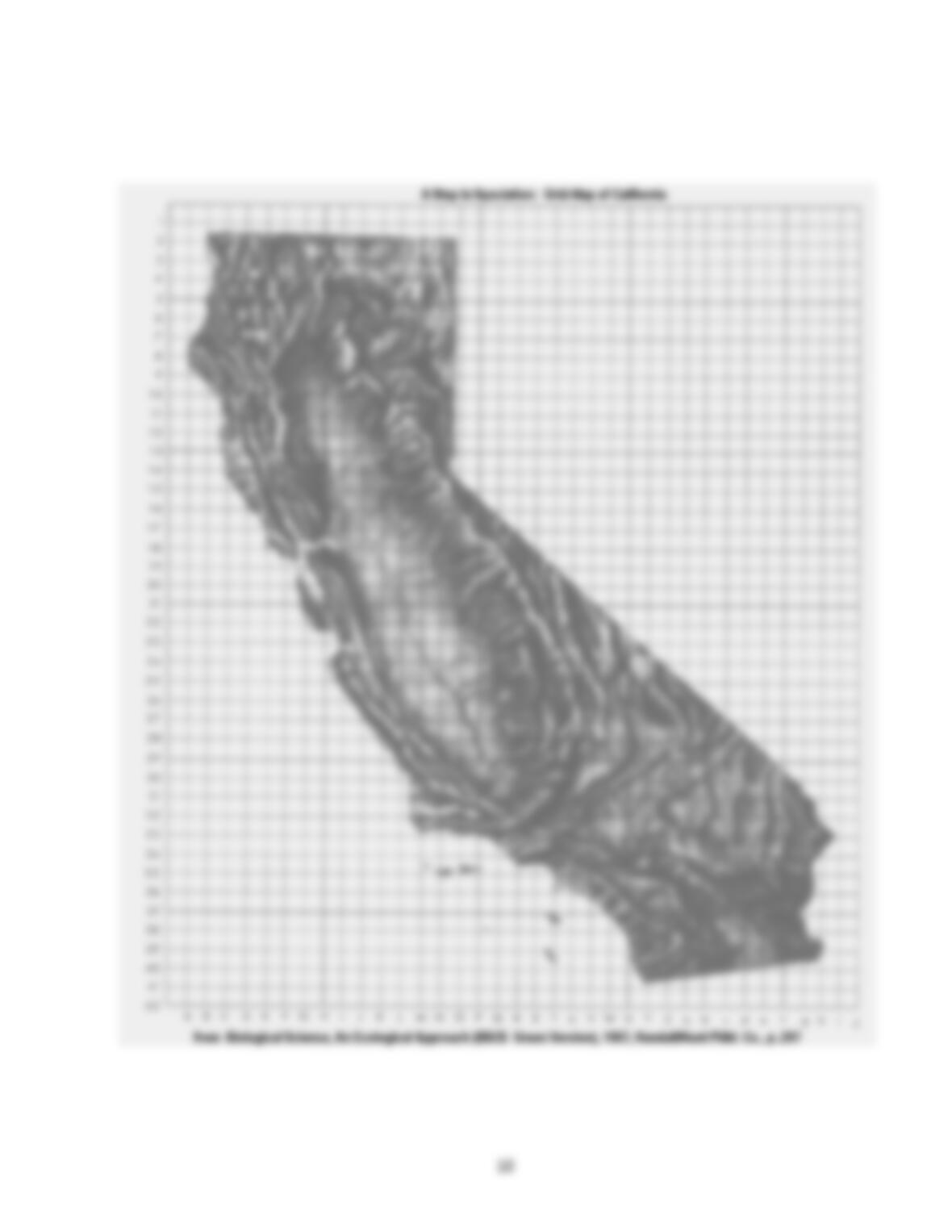
Imagine that you are working with Stebbins’ salamander specimens:
In the list below, the salamanders are identified by subspecies, a geographically
restricted population that differs consistently from other populations of the same
species.
Subspecies: geographically restricted populations that differ significantly from
others of their species but have yet to become reproductively isolated
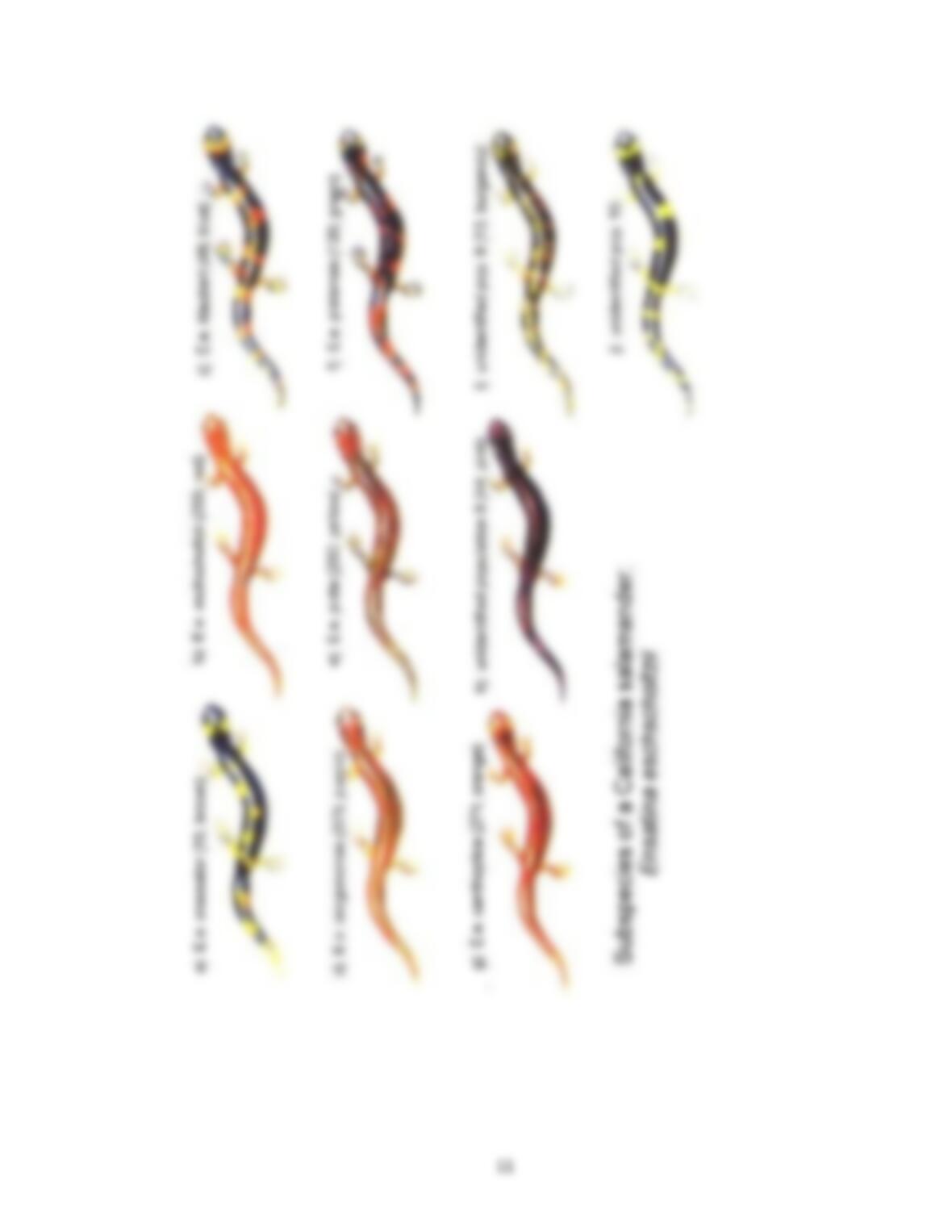
For example, the first one is Ensatina eschscholtzii croceator, shortened to E.e.
croceator. “Croceator” indicates a particular subspecies of Ensatina eschscholtzii.
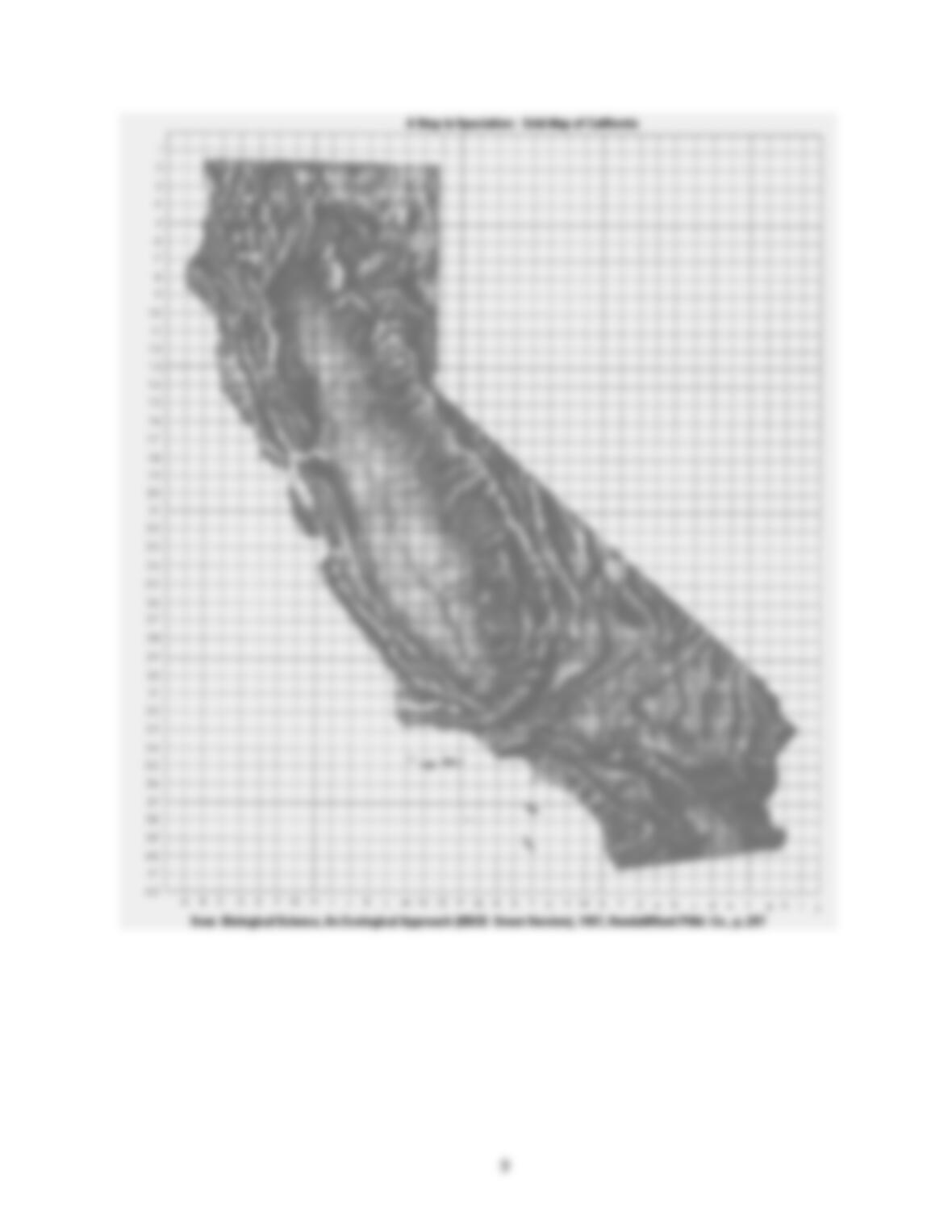
1. The parentheses after each subspecies name contain a number and a color.
The number is the total of individuals Stebbins had available for his study. The
color is the one you should use for that subspecies when you plot its collection
area on the California map.
2. Following the parentheses is a list of grid codes indicating where on the map the
subspecies was collected.
For example, 32/R means that one or more specimens were collected near the
intersection of horizontal Line 32 and vertical Line R. The letter before the subspecies
name indicates the corresponding salamander picture on the color sheet.
For example, E.e. eschscholtzii is picture b on the color sheet.
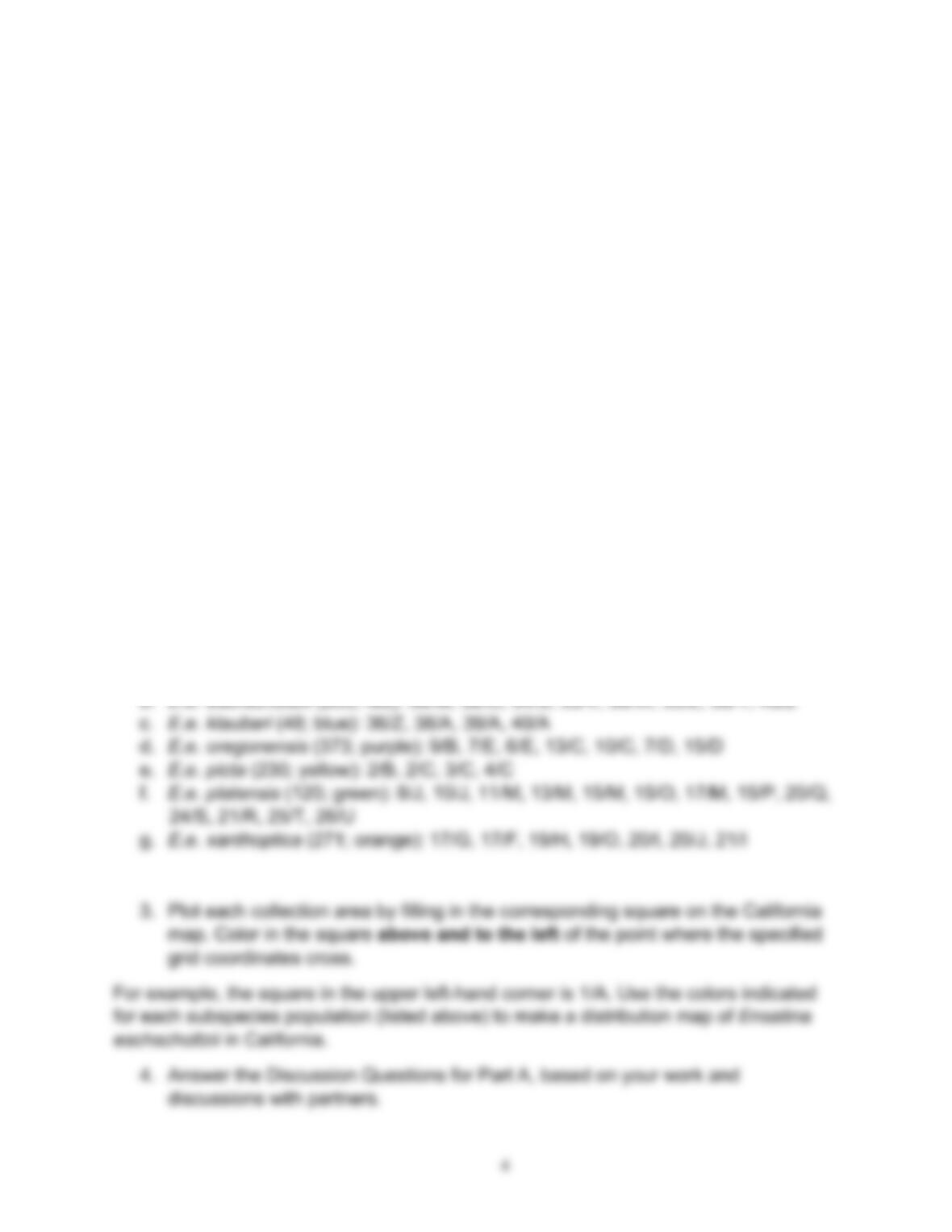
a. E.e. croceator (15; brown): 32/R, 32/S, 30/T, 31/T