Kathmandu University
Dhulikhel, Kavre
Environmental Modelling
ENVS 404
Lab Report – 9: Fugacity based multimedia modeling
2nd August, 2021
Submitted by:
Ashim Sharma
Roll no. 25
ENE 4th year
Submitted to:
Dr. Kundan Lal Shrestha
Department of Environmental
Science and Engineering

Fugacity based multimedia modeling
Objective
Multimedia fugacity model are utilized to study and predict the behavior of chemicals in
different environmental compartments. Chemicals tend to move from one media to another
media. This is a continuous process and is affected by the properties of media that the
chemical is present in
Introduction
a. Background
The models are formulated using the concept of fugacity, which was introduced by Gilbert N.
Lewis in 1901 as a criterion of equilibrium and convenient method of calculating multimedia
equilibrium partitioning. There are four levels of multimedia fugacity Models applied for
prediction of fate and transport of organic chemicals in the multi-compartmental
environment. Here, we use the level II which is an open system in equilibrium.
b. Principle
The models are formulated using the concept of fugacity as a criterion of equilibrium and
convenient method of calculating equilibrium partitioning. The fugacity of chemicals is a
mathematical expression that describes the rates at which chemicals diffuse, or are
transported between phases. The transfer rate is proportional to the fugacity difference that
exists between the source and destination phases.
𝑓 = 𝐶
𝑍
where, Z is the fugacity capacity of the phase.
The Z-values are calculated using the equilibrium partitioning coefficients of the chemicals,
Henry’s law constant and other related physical-chemical properties. The value of f is same
for a system that is at equilibrium for each media. Fugacity capacity depends upon the nature
of chemical, nature of media, and temperature

c. Modelling applications
The model can help in identification of the relative importance of chemical specific
partitioning and transformation.
It can help in determination of bioaccumulation in organisms in different trophic levels
of the food web and in checking the consistency of monitoring data
It can be used for the prediction of chemical distribution, the result of which can be
useful in understanding the fate and transport of the chemical in a multimedia
environment.
It can act as a decision supporting tool documenting the sources and nature of
contamination and feasible remedial strategies.
It can be used to understand a chemical’s behavior in the natural environment, which
can then be put to use in designing a chemical with desired environmental
characteristics, managing environmental emissions of said chemical, ranking
chemicals, and environmental policy making.
Modelling methods
For building the model, the initial step is to set up a mass balance equation for each phase
in question that includes fugacities, concentrations, fluxes and amounts. The values for
different characteristics of the media like it’s volumes (Vi), fugacity capacities (Zi), advective
flows through compartments (Gi), inflow concentrations (CB,i), and the first order reaction
rates (ki) are also required. The Z values for air (1), water (2), soil (3), and sediment (4)
compartments can be calculated from the physical-chemical properties of the chemical as
follows:
𝑍1= 1
𝑅𝑇 𝑍2= 1
𝐻
𝑍3= 𝐾𝑠−𝑤𝑍2= 0.41𝑌
𝑠𝑜𝑖𝑙𝐾𝑂−𝑊𝜌𝑠𝑜𝑖𝑙
𝑍4= 𝐾𝑠−𝑤𝑍2= 0.41𝑌
𝑠𝑒𝑑𝐾𝑂−𝑊𝜌𝑠𝑒𝑑
Here,
R = Ideal gas constant
T = Absolute temperature
H = Henry’s constant of the chemical
Y = Organic content of soil or sediment
KO-W = Octal-water partition coefficient of the chemical
𝜌 = density of soil or sediment
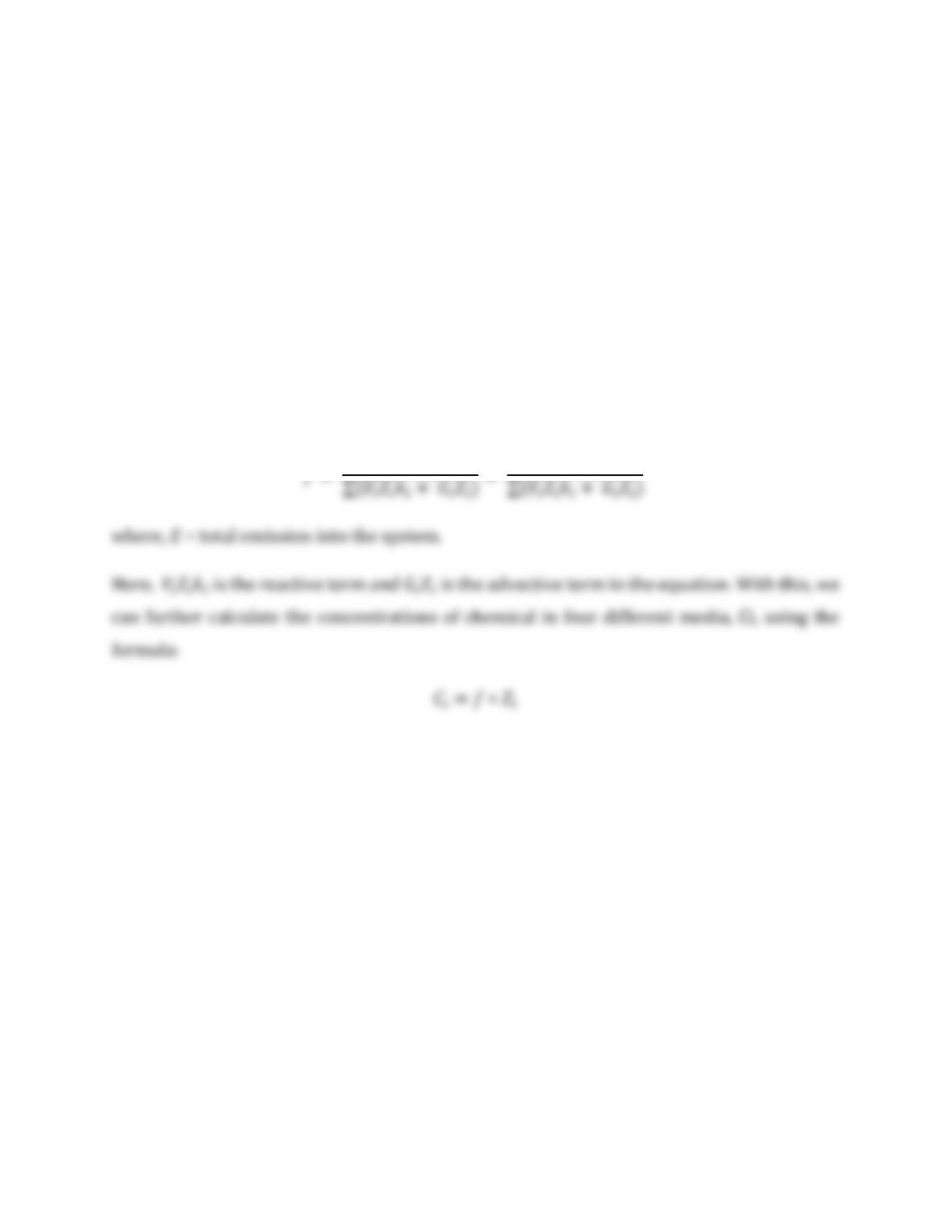
The fugacity of the system, f, equilibrium can be calculated from the following