FACULTY OF SCIENCE AND NATURAL RESOURCES
SCIENCE COMPLEX
BIOTECHNOLOGY PROGRAMME (HG07)
SEMESTER 1 2019/2020
LABORATORY REPORT 1
NAME : MILA ATIQAH BINTI MANSUR
MATRIC NO. : BS19110062
TITLE : PREPARING SOLUTIONS
LECTURER’S NAME : ASSOC. PROF. DR. ZALEHA ABDUL AZIZ
DEMONSTRATOR NAME : FLORISA LANDA
SUBJECT : BASIC BIOTECHNOLOGY (SY12103)
DATE OF EXPERIMENT : 24 SEPTEMBER 2019
DATE OF SUBMISSION : 15 OCTOBER 2019
INTRODUCTION
A solution is defined as a homogenous mixture of two or more substance which may
exist in any phase. It also consists of a solute and a solvent. A solute is a substance that
dissolved in the solvent and the amount of solute that can be dissolved in solvent is called its
solubility (Anne, 2019). When two liquids dissolve in each other, the major component is called
the solvent and the minor component is called the solute. There are three types of solutions
which are gaseous, liquid and solid solutions. Meanwhile a dilution is a solution made by
adding more solvent to a more concentrated solution which called a stock solution and this
will reduces the concentration of the solute. For instance, tap water is a dilute solution because
it is mostly water with a small amount of dissolved minerals and gasses.
There are so many different measures of solution concentration that exist because
these solutions play important roles in any reaction, especially in biotechnology and chemistry
field. Usually, the solutions are prepared at a particular concentration to ensure an optimal
condition for a reaction to occur. The concentration of solution can be measured by a few
units of expression such as Molarity (M), Molality (m), Normality (N) and parts per million
(ppm). Molarity is defined as the number of moles of solute per litre of solution. Meanwhile,
molality is the number of moles of solute per kilogram of solvent and normality is the number
of mole equivalents per litre of solution. Although their spellings are similar, molarity and
molality cannot be interchanged. Molarity is a measurement of the moles in the total volume
of the solution, whereas molality is a measurement of the moles in relationship to the mass
of the solvent (Carolina, 2018). When the solute is present in trace quantities, it is easy to
express the concentration of solutions in parts per million (ppm). In samples of water from
the environment, for example, concentrations of metal ions can be in the range of a few parts
per million — it is impractical and potentially misleading to express this tiny concentration as
a molarity or mole fraction. Although molarity is a convenient measure of concentration for
stoichiometry calculations involving chemical reactions, molality is more appropriate in studies
of certain colligative properties (Moshe, 2019).
OBJECTIVES
1. To be able to prepare solutions at various concentrations.
2. To be able to explain different types of units used in expressing the concentrations of
solutions.
EQUIPMENTS
• Ten millilitre glass pipette
• Two millilitre glass pipette
• Beakers ( one hundred millilitre )
• Magnetic stirrer
• Magnetic bars
• Pipette filter
• Analytical balance
• Aluminium foil
• Spatula
• Volumetric flasks ( one hundred millilitre, two hundred fifty millilitre and five hundred
millilitre )
• Glass rods
MATERIALS
• Sodium hydroxide (NaOH)
• Distilled water
• Acetic acid
• Hydrochloric acid (HCl)
PROCEDURE
A. Preparing solution in molar solution = the number of moles of solute per
litre of solution
1. Ten grams of sodium hydroxide was dissolved in water using a two hundred
and fifty millilitre capacity beaker.
2. The mixture was stirred using a glass rod to dissolve the palette.
3. The bottom of the beaker was touched to feel the warmth before being
transferred into a two hundred and fifty millilitre volumetric flask and the
beaker was rinsed three times with distilled water.
4. The rinsed water was poured into the volumetric flask to be filled up until the
bottom of the meniscus is levelled to the calibration line on the flask.
5. The flask was inverted and swirled a few times to mi the content.
6. The solution was transferred into a clean and dry blue capped glass bottle.
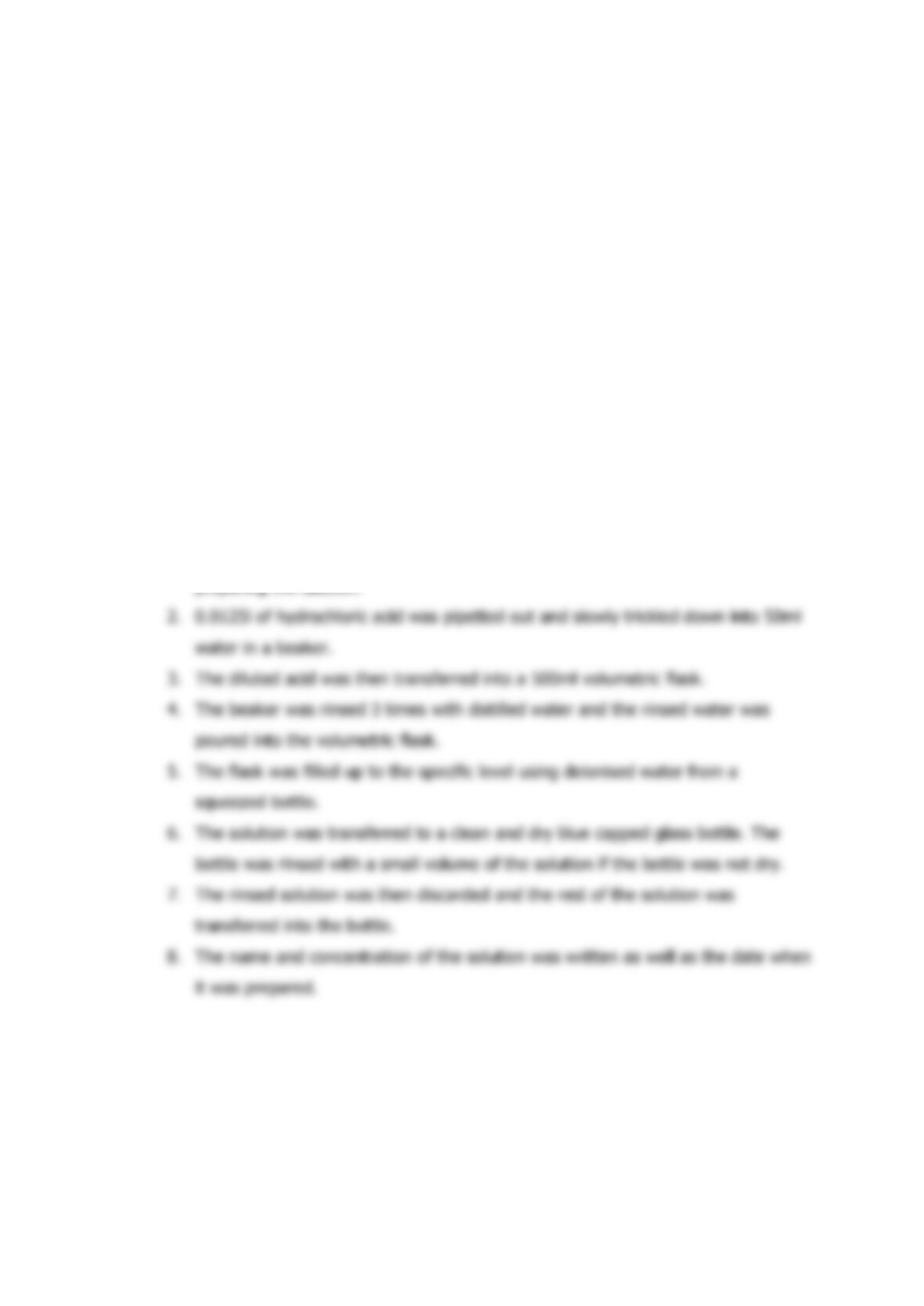
7. The solution was labelled with its name, concentration and the date it was
prepared.
B. Preparing solution in Percent solution
1. Five millilitre concentrated acetic acid was pipetted out by placing the tip of the
pipette on the inner wall of the beaker and the acid was slowly trickled down into
a fifty millilitre water in a beaker.
2. The diluted acid was transferred into a one hundred millilitre volumetric flask and
the beaker was rinsed three times with distilled water before being the rinsed
water being poured into the volumetric flask.
3. The flask was filled up until the specified level by using deionised water from
squeeze bottle.
C. Diluting a concentrated solution (Dilution)
1. The volume and molar concentration of the resulting solution was decided before