School of Chemical, Biological and Materials Engineering and Sciences
1st Quarter S.Y. 2021-2022
Experiment No. 1.3 and 1.4
Thin Layer Chromatography
Submitted by:
Delos Reyes, Louis Andrei M.
Group 6
Date Submitted:
September 11, 2021
PROF. NANETTE D. SANTOS
Faculty In-charge
CM132-2L – SECTION
School of Chemical, Biological and Materials Engineering and Sciences
1st Quarter S.Y. 2021-2022
1. INTRODUCTION
The most effective fundamental methodologies for the separation of closely related
substances within a mixture is Chromatography. Differences in the equilibrium distribution of
the elements among two immiscible liquids, namely the stationary phase and the mobile
phase, influence separation in this case. Such variations in the equilibrium distribution are
caused by the components’ structure and level of engagement with these phases.
The stationary phase is a granular medium like silica and alumina, wherein the
sample mixture filters down underneath the effect of a moving solution which is the mobile
phase. There are many interactions between samples and the stationary phase, which have
been thoroughly studied to accomplish chemical separation.
On the other hand, Thin Layer Chromatography is a method for separating
components inside one mixture. It could use it to detect the amount and identify the various
compounds in a reaction mixture and observe the development of a reaction. The same
principle underlies all kinds of chromatography.
This experiment of where a solvent will be used in the procedure to quantitively
analyze it different substances.
HPLC or High-Performance Liquid Chromatography is a method to analyze,
separate, and identify small compounds or proteins in a mixture. Because of the various
solubilities of the mixtures, the two phases force the components to flow along the column at
the different distribution of velocities, resulting in the separation of these mixtures. The
pumped solution is referred to as the mobile phase, while the stationary phase is referred to
as the phase in the column.
2. METHODOLOGY
This will show the procedure of how Thin Layer Chromatography will be done.
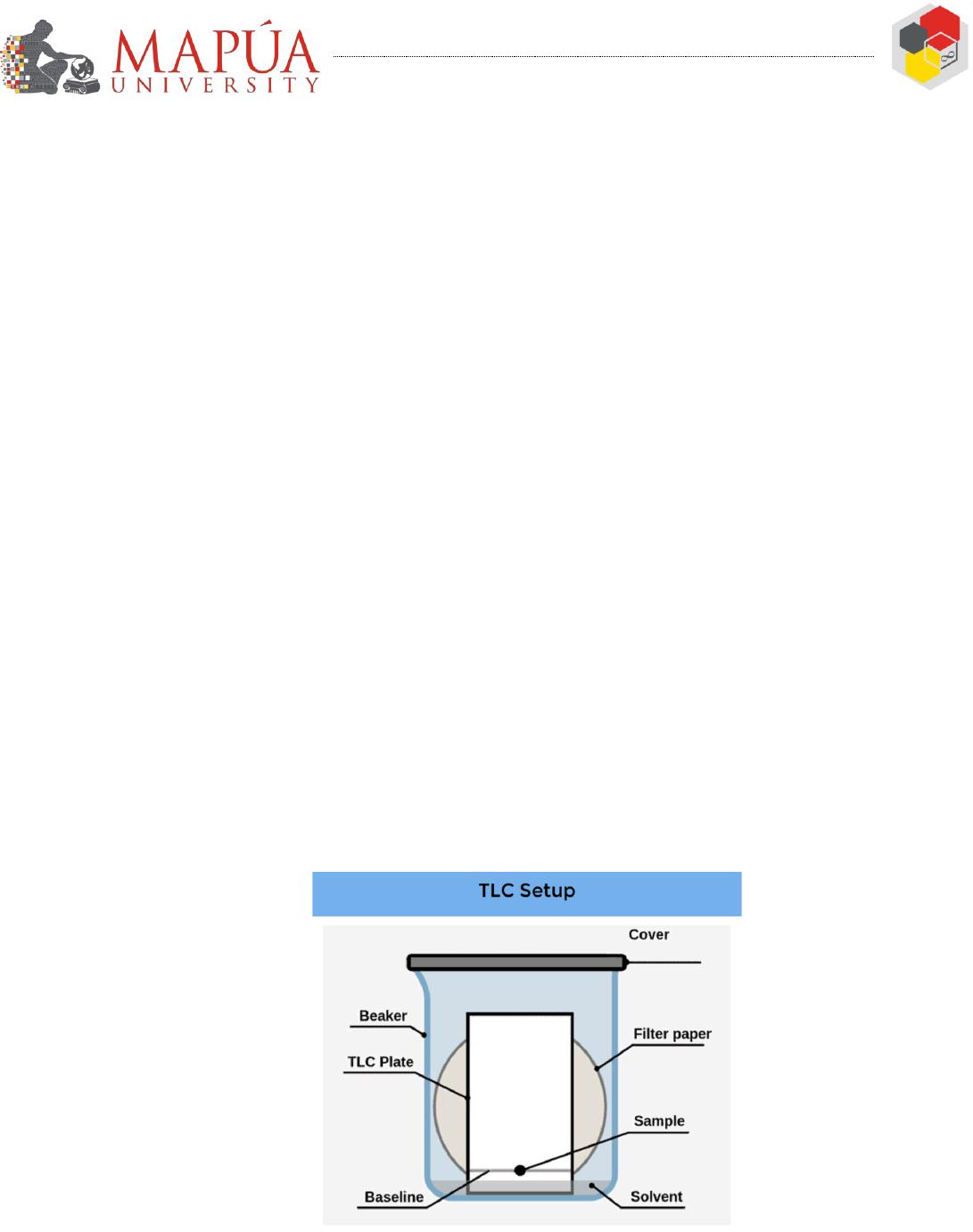
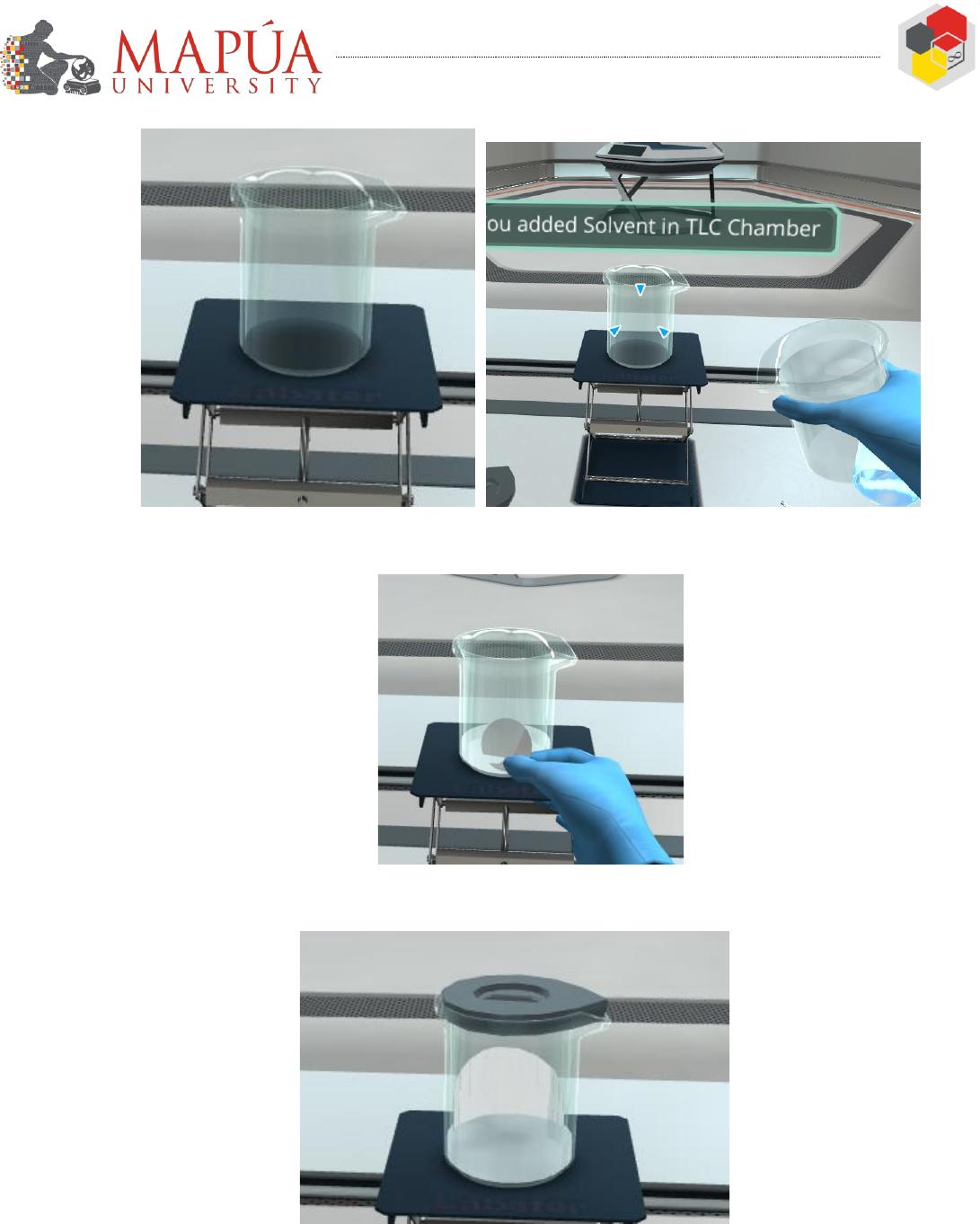
First Step: Prepare the container where the TLC will be done.
School of Chemical, Biological and Materials Engineering and Sciences
1st Quarter S.Y. 2021-2022
Prepare a beaker wherein the solvent will be poured to a depth with 1.0 cm or less than 10.0
mL where within the baseline of the TLC Plate.
A filter paper is added in the beaker in order to saturate the air in the beaker with the
solvent’s molecules. This will be ensuring the beaker to not dry out.
Cover the beaker with a stopper and swirl it lightly and allow it to sit in.
School of Chemical, Biological and Materials Engineering and Sciences
1st Quarter S.Y. 2021-2022