Payton Kennedy-Wexler (ID # 018308990)
Art History 111; M 12:45-1:45
Professor Cachia
December 13, 2020
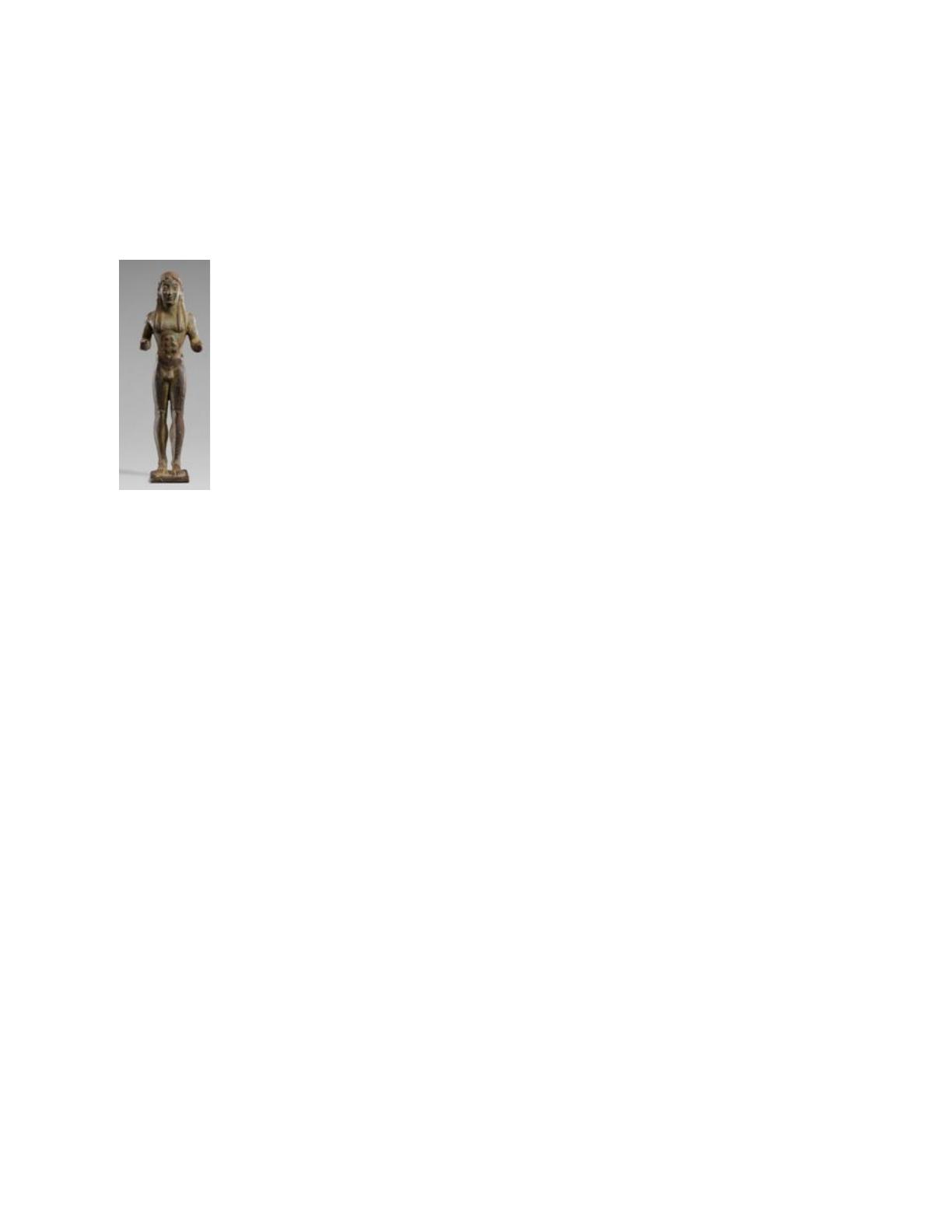
Votive Statuette of a Male Youth
This small bronze statue is one of a boy named Hyamos. We can tell that
this piece is from the Archaic period of Greek Art, because it looks like so many
other pieces around this period of young nude males called kouros
(plural,
kouroi
) which means youth. The statues were more of a symbol than an exact
portrait of a person. Kouros statues symbolized male youth in their prime or
their peak of manhood which is often demonstrated in the artwork of this time using details
like for instance, muscle definition. Their purpose was usually as an offering to gods such as
Athena or as a grave marker. This piece was meant to be given as an offering to Apollo. The
piece is more realistic in that it has more details than artwork that preceded this time period,
but it is still very stylized and not entirely realistic.
The statues of the young males were nude because the Greeks focused on a
perfect and ideal human body as a way to emulate the gods and goddesses of their religion.
Nudity allowed them to show that the clothes weren’t hiding imperfections. Male statues were
mostly made nude and the females were usually portrayed with clothing, although still in a
sensual way that implied perfection and femininity. Because nudity symbolized citizenship, the
fact that males were portrayed nude and females generally weren’t gives hints as to what the
gender roles were during this time. This implies that men were probably still more valuable and
respected at this point in history.

The face of the Votive Statuette of a Male Youth is oval shaped with curved corners and
a little slimer around the chin area unlike other kouros
sculptures such as the New York kouros
which was much more triangular. This observation suggests the fact that art at this time is
getting close to making the transition into more realistic art which is a characteristic seen first
in the classical period of Greek art. The facial features are another demonstration as to how the
portrayal of their standard of beauty and perfection was of more importance than an exact
depiction of a real face as seen on this figure and many others that all share a similarly shaped
long nose and slightly protruding chin. The eyes aren’t inlaid as seen in sculptures made in later
periods with more sophisticated art, they are simply outlined. The face is also flat for the most
part like most statues of kouroi
during the Archaic period.
That being said, there is some
definition in the cheeks which wasn’t as common until the end of the archaic period, as can be