BPMG2013 FUNDAMENTAL OF TRANSPORT AND LOGISTICS
SECOND SEMESTER SESSION 2019/2020 (A192)
GROUP ASSIGNMENT
GROUP C
KLANG VALLEY TRANSPORTATION SYSTEM
SUBMITTED TO:
EN. ZULKUFLI BIN AZIZ
PREPARED BY:
MUHAMMAD ZAIM ZAHIRUDDIN BIN MUSA
259320
MUHAMMAD IRFAN BIN IZHAR
263479
ABU DZAR BIN ABD AZIZ
263968
29 APRIL 2020
i
TABLE OF CONTENT
No.
Content
Pages
1.
Introduction
1
2.
Background
2
3.
Type of Transportations
3 – 12
4.
Advantages of Klang Valley Transportation System
13 – 14
5.
Disadvantages of Klang Valley Transportation System
15 – 16
6.
Conclusion
17
7.
References
1
1.0 INTRODUCTION
Originally, the various systems had been run by different competing firms and these
rail systems evolved independently and at different times. As a result, many of these rail
lines are not well integrated with the others or with the overall rail systems itself and making
it difficult for passengers to switch from one station to another station.
In addition, the less efficient pedestrian network system in Kuala Lumpur has caused
passengers to move a lot, stair climbing and escalator-use. So, when there are many train
lines built and a system that uses payment methods such as Touch ‘n Go cards, it will be
able to facilitate the movement of passengers from one station to another station.
Since 28 November 2011, the paid areas of shared stations along the Kelana Jaya Line
LRT, Ampang and Sri Petaling Line LRT and the KL Monorail from 1 March 2012, have
been integrated physically under a common ticketing system, effectively making those
stations into interchange stations.
With the addition of the latest rapid transit line on 17 July 2017, the MRT Sungai Buloh
– Kajang Line, the integrated system has been further expanded to enable commuters to
transfer between lines the interchange stations without buying a new ticket each time.
However, the fare integration for the Rapid KL rail integrated system does not include other
rail systems such as KTM Komuter and Express Rail Link.
The KTM Komuter was introduced in 1995 as the first rail transit system to provide
local rail services in Kuala Lumpur and the surrounding Klang Valley suburban areas. Light
Rapid Transit (LRT) and Monorail Line were introduced later on as to serve urban Kuala
Lumpur area and Its satellite cities.
While the Mass Rapid Transit (MRT) Sungai Buluh – Kajang (SBK) Line aims to
connect from the north west region of Kuala Lumpur for example Sungai Buluh,
Damansara to the south east region of Kuala Lumpur for example Cheras, Kajang through
the heart of the Kuala Lumpur City Centre.

2
2.0 BACKGROUND
The Klang Valley district involves the elements of Federal Territory of Kuala Lumpur and
seven other metropolitan committees of the territory of Selangor. Its present populace is about
4.7 million and this is anticipated to increment to about 7.0 million by 2020. Another 7.0
million individuals are relied upon to be living inside the prompt external Klang Valley area.
There is about 182 km of rail organized inside the valley worked by four various administrators,
for example the monorail, the Putraline (light rail), the StarLine (light rail), and the KTM
Commuter (substantial rail). The current modular split of people in general to private
transportation is about 20:80. This circumstance is unreasonable and more current methods of
transport systems should be thought of. Previously, different transportation reads have been
attempted for the area, however these have been to a great extent concentrated on roadway
arrange 3.1 advancement. What’s more, Other arranging concentrates inside the unique nearby
specialists have suggested disconnected rail systems that provide food inadequately for intra
and between territorial travel. The Klang Valley Secretariat (an arranging and organizing body
built up in 1981) as of late connected with a group of neighborhood and remote advisors to
propose future rail passageways. These were intended to improve open transportation ridership
and furthermore to improve the model split nearer to 40:60.
3
3.0 TYPE OF TRANSPORTATION
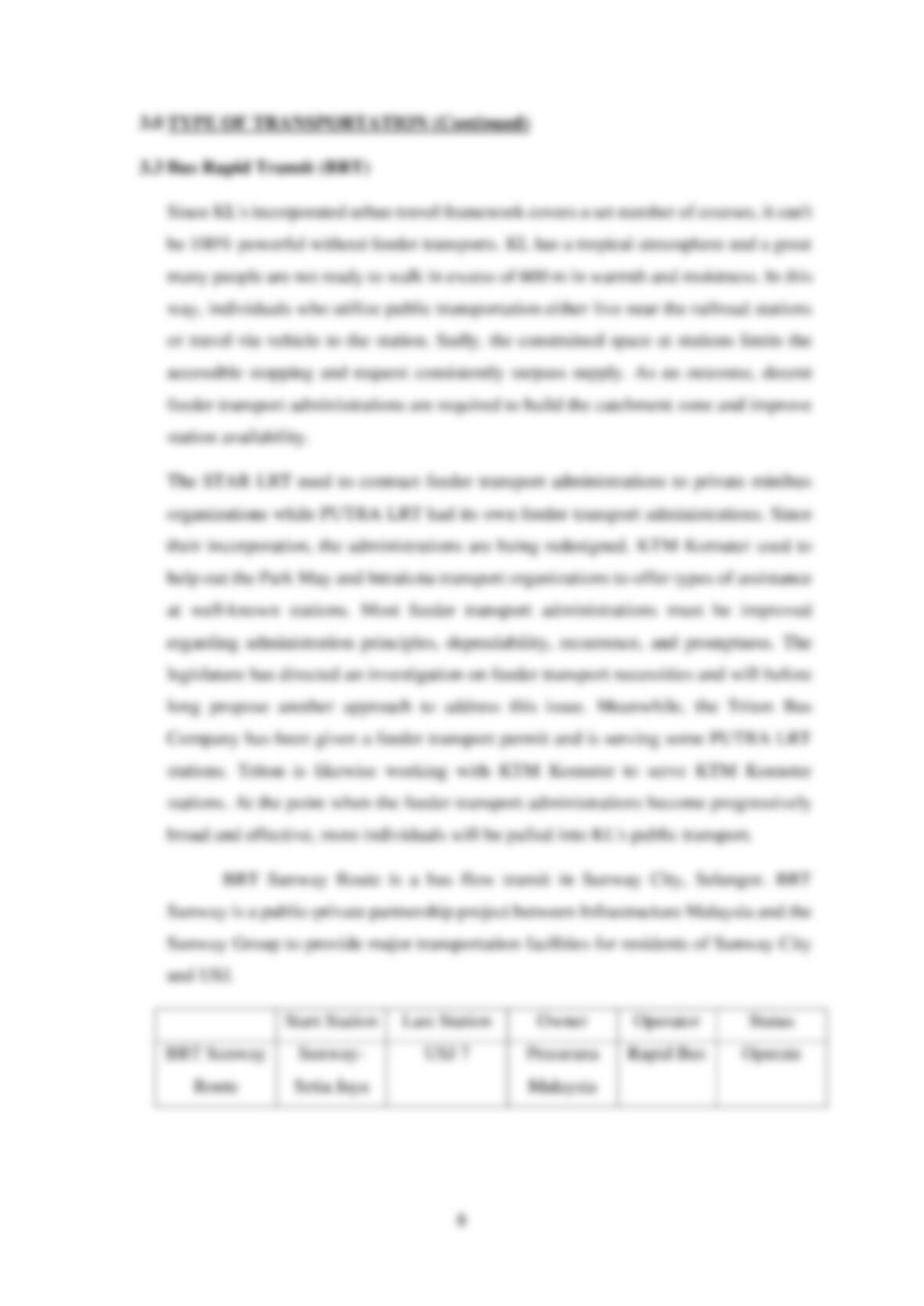
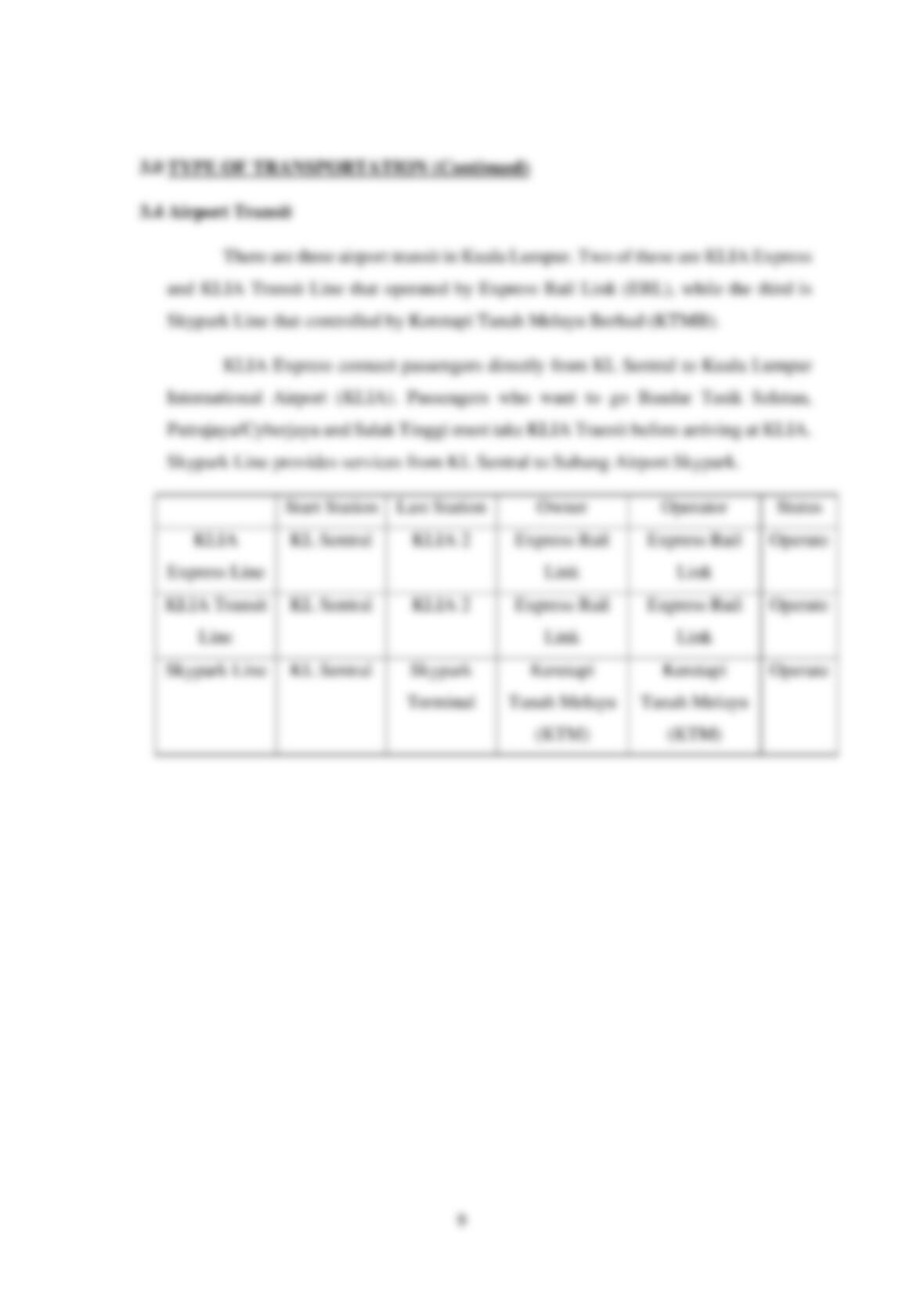
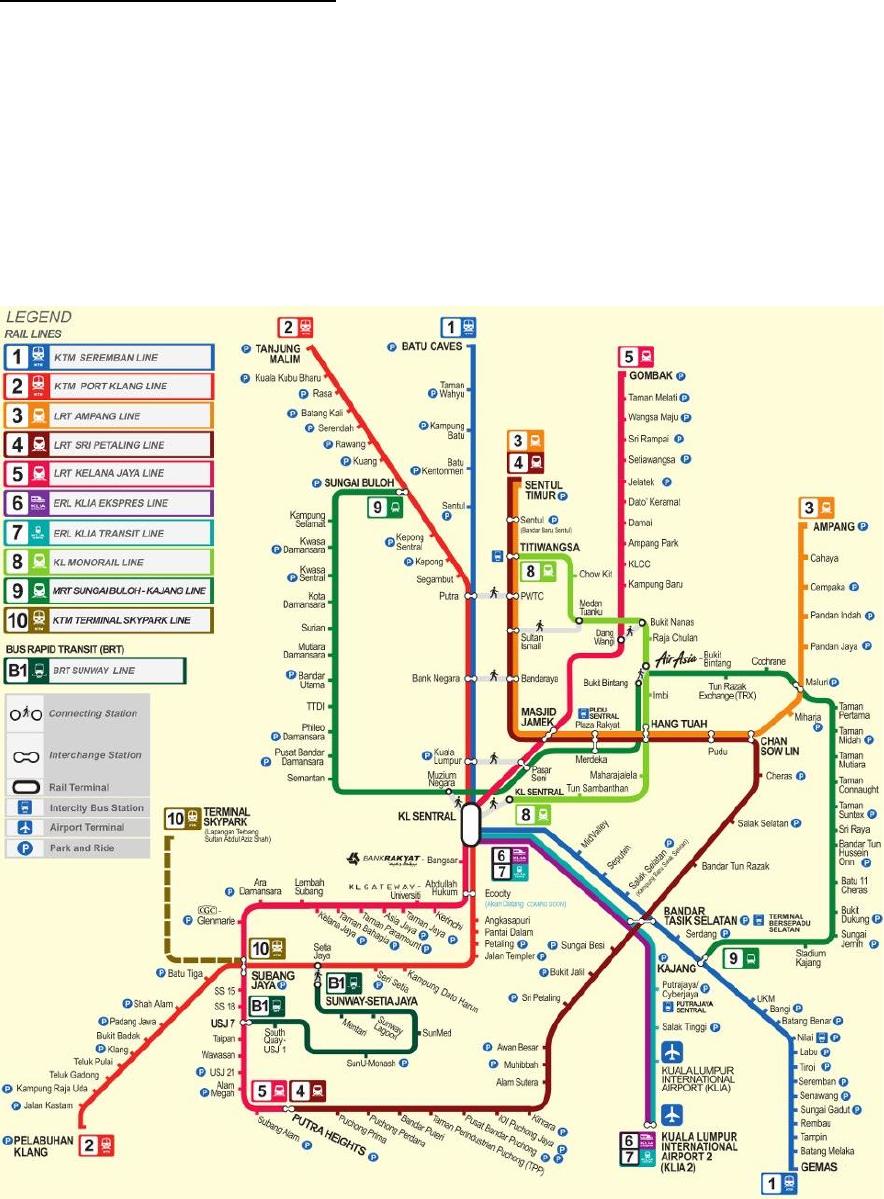
The Klang Valley Integrated Transit System is the railway network that primarily serve
the area of Klang Valley. This integrated network currently consists of 11 fully operating
rail lines which is 2 commuter rail line, 5 rapid transit lines, 1 bus rapid transit line and 2
airport rail links to Kuala Lumpur International Airport (KLIA) and another one to Subang
Airport.
Figure 1 : Klang Valley Integrated Transit Map

4
3.0 TYPE OF TRANSPORTATION (Continued)
3.1 Commuter Rail Line
KTM Commuter has two in the Klang Valley which is Seremban Line and Port
Klang Line. Seremban Line and Port Klang Line starting from different places, but both
will be connected from Putra Station to KL Sentral that making it an exchange station.
Seremban Line starting from Batu Caves Station and the last station is Pulau
Sebang/Tampin, while Port Klang Line starting from Tanjung Malim Station and the
last station is Port Klang Station.
Start Station
Last Station
Owner
Operator
Status
Seremban
Line
Batu Caves
Pulau Sebang
/ Tampin
Keretapi
Tanah Melayu
(KTM)
Keretapi
Tanah Melayu
(KTM)
Operate
Port Klang
Line
Tanjung
Malim
Port Klang
Keretapi
Tanah Melayu
(KTM)
Keretapi
Tanah Melayu
(KTM)
Operate
3.2 Light Rail Transit (LRT)
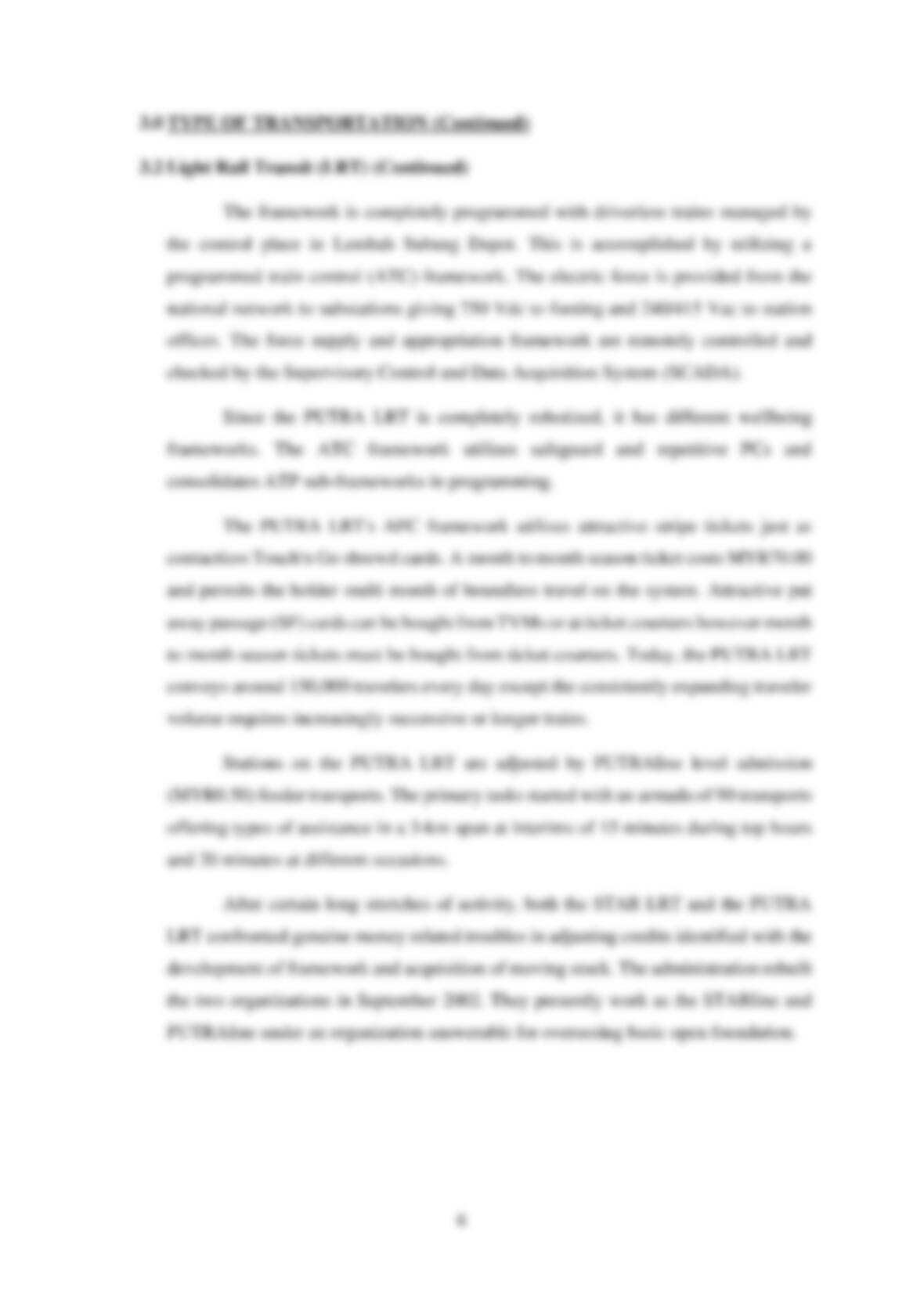
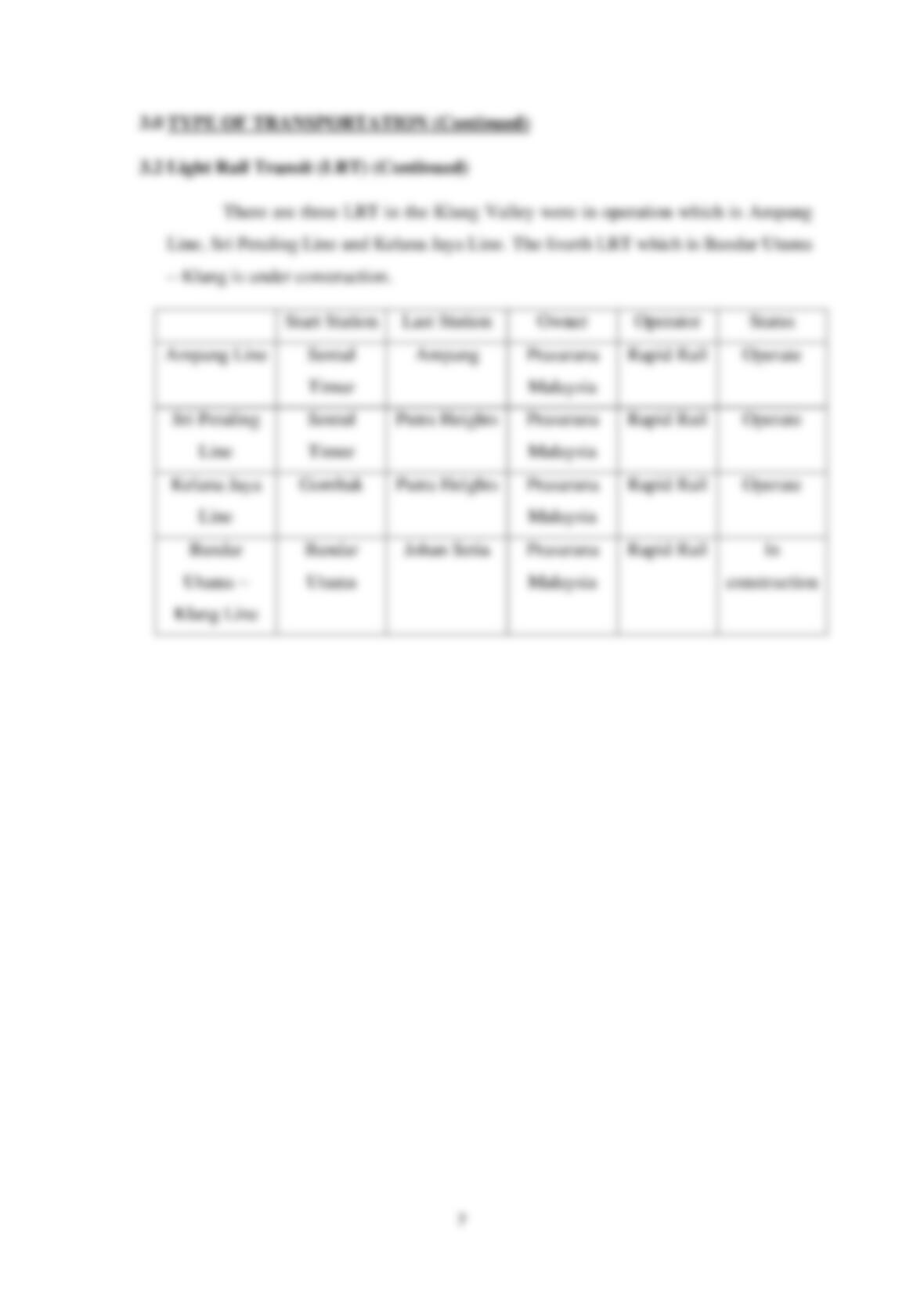
Kuala Lumpur has two light rail travel (LRT) frameworks—the STAR LRT and
the PUTRA LRT. The STAR LRT framework was set up as a BOT venture with a
multiyear rent in November 1991. Income tasks began on 16 December 1996 for stage
1 from Ampang to Sultan Ismail (12 km). The line from Pudu to Ampang runs basically
on a deserted line in the past worked by KTMB. After KL was granted the 1998
Commonwealth Games in 1994, the administration chose to stretch out a line southward
to serve the National Sport Complex. As remuneration for working this low-thickness
augmentation, STAR got endorsement for 3-km expansion northwards from Sultan
Ismail to Sentul Timur into a high-thickness local location.
The southern augmentation (stage 2) between Chan Sow Lin and Sri Petaling
was finished 2 months before the Commonwealth Games and KL invested heavily in
the smooth vehicle administrations gave by the STAR LRT and KTM Komuter to a
great many observers. The northern augmentation was finished in December 1998,
expanding the absolute course length to 27 km.
3.0 TYPE OF TRANSPORTATION (Continued)
3.2 Light Rail Transit (LRT) (Continued)
Initially, each STAR LRT train comprised of three single-explained, two-area
carriages with a mechanized bogie at each end and a trailer bogie under the explanation.
The two end carriages each had a driver‘s taxi and were semi-for all time coupled
consecutive to the middle of the road carriage to shape a three-vehicle set. The trains
are presently designed with four and six vehicles.
The STAR LRT utilizes a 750-Vdc third rail charge framework. The flagging
depends on trackside flagging sponsored up by an ATP framework. The AFC
framework utilizes attractive stripe innovation with station doors. Travelers can
purchase tickets either from TVMs or at ticket counters. The STAR LRT trains start at
06:00 and stop at 24:00. The administration recurrence ranges from one train like
clockwork during top hours to one train at regular intervals at different occasions. The
limit is 33,200 travelers toward every path every hour. At present, the STAR LRT
conveys around 92,000 travelers every day.