ACCOUNTING HORIZONS American Accounting Association
Vol. 33, No. 4 DOI: 10.2308/acch-52451
December 2019
pp. 1–14
COMMENTARY
The Kinney Three Paragraphs (and More) for Accounting
Ph.D. Students
William R. Kinney, Jr.
The University of Texas at Austin
SYNOPSIS: This Commentary is intended to help beginning Ph.D. students identify, evaluate, and communicate
essential components of proposed empirical accounting research using a three-step process. The first step is a
structured top-down approach of writing answers to three related questions—What, Why, How—that emphasize the
central role of conceptual thinking in research design, as well as practical relevance. The second step is a predictive
validity assessment that anticipates concerns likely to arise in the scholarly review process, and the third is
consideration of the likely outcome and potential problems to be encountered if the proposal is implemented as
planned. First-hand accounts of Ph.D. student experiences using the three paragraphs and three-step approach are
presented, along with an exercise that beginners can use to help themselves identify, analyze, and anticipate
problems to improve chances for research success ex ante.
Keywords: communicating research; experiential and discovery learning.
I. INTRODUCTION
In planning research or evaluating the research of others, a useful practice is to give early attention to the purpose of
the research through preparation of a three-short-paragraph abstract, synopsis, or working model of the research. The
first paragraph answers the question ‘‘ What is the problem?’’ The second asks, ‘‘ Why is it an important problem?’’ and
the third, ‘‘ How will it be solved?’’ Alternatively, the questions might be: ‘‘ What are you (or the researcher) trying to
find out?’’ ,‘‘ Why?’’ , and ‘‘ How will it be done?’’
—Kinney (1986, 349, fn. 18)
We believe that the objective of accounting research is to create legitimate, consequential belief revision about issues
associated with accounting-related decision settings. That is, the purpose of accounting research is to change the way
informed and creatively skeptical people think about an accounting issue that is important to them or to others.
—Maines, Salamon, and Sprinkle (2006,86)
You probably have some insights about real-world accounting—how the accounting world works, what causes what
(and perhaps why), and maybe how to fix what seems broken. You know you must do accounting research, but how
do you know if your ideas are good and how can you convince your professors and others to help you? One way to
get started is by answering the three related questions (from Kinney above) designed to effectively identify and communicate
the essentials of proposed empirical accounting research and to motivate others to listen to your ideas.
Figure 1 diagrams a three-step research process that can help you evaluate whether your idea is a ‘‘ good bet’’ for research
success—before you do the hard work of implementation. Step I results in a single-page response that provides answers for the
What, Why, How questions. Step II is an ex ante predictive validity analysis of your What and How answers that will help you
Dedicated to the Ph.D. students at The Unviersity of Iowa, University of Michigan, The University of Texas at Austin, and elsewhere, who, over 45 years,
helped me understand the power of the three paragraphs, and especially to the late Linda McDaniel who also encouraged student presentations of three
paragraphs for group discussions. My sincere thanks to Dan Collins, Vicky Hoffman, and Sandra Vera-Mu˜
noz for their helpful comments on an early
version, and to the exceptional reviewer plus former student users Sandeep Nabar, Russ Lundholm, Dave Burgstahler, Brian Carver, Marsha Keune, Lisa
De Simone, and Rebecca Lester. Thanks also to the late Nick Dopuch and to Katherine Schipper who showed me the value of careful and compact
exposition, and to Thomas Cook, Bob Libby, and Deirdre McCloskey for timely encouragement. Finally, special thanks to Carolyn Kinney, Ph.D., R.N.,
for non-accounting reality checks over 60 years.
Editor’s note: Accepted by Teri Lombardi Yohn.
Submitted: April 2017
Accepted: March 2019
Published Online: May 2019
1
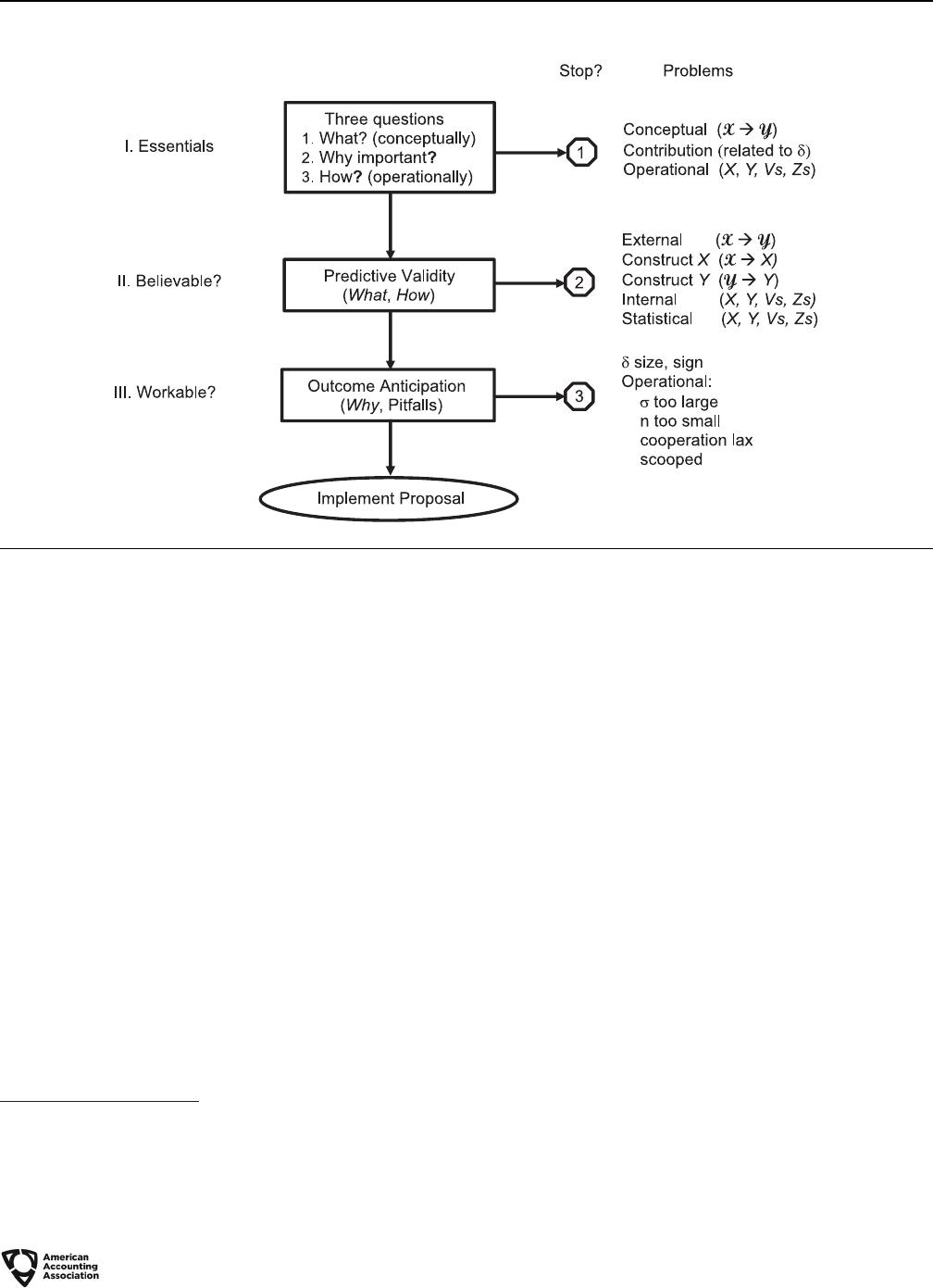
anticipate common concerns likely to be raised by scholarly readers and editors. Step III addresses the basis for Why that
provides the link between What and How, and also anticipates critical research outcome perils that may disrupt implementation.
All three steps will help you build intuition about how to structure, refine, and present your own ideas and each of the three has
a‘‘ Stop Sign’’ to warn of conditions that may seriously imperil the success of your project.
The three-step approach is then illustrated with experiences and insights of Ph.D. students who have applied the three steps
over the years. These experiences include benefits of student presentation of preliminary versions of the What, Why, How of
Step I to fellow students. As a presenter, you may get insights by explaining to non-expert peers the essence of complex
accounting matters, and merely trying to explain the essentials may help you see what is unique, important, or even missing in
your proposal.
1
As a listener, you may learn how to quickly ‘‘ get a handle’’ on the work of others by reversing the process, and
focusing on only what you need to put their ideas into the ‘‘ universal’’ three-paragraph format and then asking them questions.
Two caveats: This is not a generic one-size-fits-all research plan that works ‘‘ as is’’ for all empirical accounting-related
research ideas (e.g., Kinney 1986;Cooper and Zeff 1992;Kinney 1992). Most of the concepts and ideas are borrowed and
adapted; their combination and the student experiences are new. And, you need not follow the exact wording format in the final
version of your paper (but because the three questions are commonly asked, you should include enough so readers could
formulate the answers for themselves).
I begin with Steps I, II, and III of Figure 1. The approach and opt-out points (Stop Signs) are then illustrated with
experiences of former Ph.D. students who, over time, helped me improve and better articulate the three-step research approach,
and I’ll close with some hints that will help you apply the approach today.
II. STEP I—THREE PARAGRAPHS FOR COMMUNICATING RESEARCH
Your ideas about ‘‘ what causes what’’ in accounting are based on your experiences and your knowledge of theories,
concepts, and organization structures from your courses in accounting and other disciplines.
2
Your basic idea might be a
FIGURE 1
Three Steps from Ideas to a ‘‘ Good Bet’’ Proposal
1
Appendix A presents a Scholarly Improv exercise that has been used in small group sessions to quickly evaluate and refine research ideas at five AAA
Doctoral Consortiums, two Ph.D. Project Annual Meetings, and extended workshops at The University of Arizona; Indiana University; 2006 Kentucky-
Tennessee Ph.D. Colloquium; Michigan State University; Rutgers, The State University of New Jersey; Nanyang Technological University; and Texas
A&M University.
2
Following Kinney 1986, research is defined as developing and testing new theories about ‘‘ how the world works’’ or refutation of widely held existing
theories.
2Kinney
Accounting Horizons
Volume 33, Number 4, 2019

reasoned prediction of why an accounting method choice or a change in method would affect real-world outcomes such as
valuation, performance, or risk perceptions. And you may have thought about testing your ideas with archived accounting data
from a particular domain and time period, or originating data via an experiment applying hypothetical accounting treatments
where participants are randomly assigned to accounting methods. So—how best to put it all together?
Simply put, answering the three questions below can convert the core of what is in your head to a standard research format
that can be understood by others. Using the format and 150 to 300 well-chosen words, most readers can understand enough
about your proposal to be able to assess aspects of relevance and research quality—and maybe give you some advice for how to
make it better.
3
The three questions (the basis for the three paragraphs) are:
1. What are you trying to find out, conceptually? (What concepts or theories underlie your idea?)
2. Why is an answer important and to whom? (Who will care about your answer and why should they care?)
3. How will you find the answer, operationally? (What research method and data will you use to find the answer?)
That’s it. Just answer these three questions and avoid the temptation to explain non-essentials (of which there are many).
The questions are not easy to answer, but you can get a quick start by copying the bold part of these three lines as a template
and then filling in the blanks in your own words:
1. I am trying to find out whether _____.
2. It is important to find out because _____.
3. I will find out by _____.
Populating this single page will make you focus on research essentials from the beginning—you can ‘‘pretty it up’’ and make
the words sing after you cover the essentials.
Some notation will help understanding. The What response for question 1 is usually expressed as a theory or policy
positing a ‘‘ causal’’ connection between conceptual factor, X,thatinsomeway‘‘ causes’’ an effect on another conceptual
factor, Y(or X!Y), perhaps across multiple real-world contexts. The Why response for question 2 explains the importance
to others and usually depends on the sign and magnitude of the connecting link, d,between concepts Xand Y, as measured
by Xand Yin the real-world context studied, other things equal.
4
As an example, the real-world dmay be important because
it is large, so small as to be inconsequential (such as an ineffective policy), or whose sign is opposite of that widely assumed
by others.
The question 3 ‘‘ How’’ response relates the research method applied (say, experiment versus archival), the context or
setting, the Xand Yyou use to measure Xand Y, how you estimate covariation of Xand Y, and how you satisfy ‘‘ other things
equal.’’ We’ll assume that ‘‘ other things equal’’ means adjusted for the effects of known and measurable causes of Yother than
X—some of which occurred prior to X(denoted Vs) and some concurrent with X(denoted Zs), or X!Yafter adjusting for
effects of prior Vs and concurrent Zs.
5
Most new researchers focus prematurely on How. Students often ask, ‘‘ How can I improve my experiment or regression
model?’’ Some ask, ‘‘ What additional Vs and Zs should I add?’’ ;‘‘ Who would be the best participants?’’ ;or‘‘ What estimators
might be better?’’ These are good How questions, but the answers depend upon first answering What you are trying to find out
conceptually, or Why it is important to find out. Others can help you evaluate and refine How––but only if they understand your
What and Why.
What is usually key—if all else fails, try theory—and Why is a close second. You know that authors get more scholarly
credit for illuminating important theoretical or major policy-based ideas that have broad real-world application. So careful
articulation of What you are trying to find out––in conceptual or policy terms if possible––is often critical to designing your
particular experiment or regression to best address the question you want to answer.
Why is the most overlooked response––surprisingly so, because before you read a research paper, don’t you ask yourself,
‘‘ What’s in it for me?WhatcanIlearn?’’ Your readers will want to know why they should seriously attend to your paper, and you
3
I have used versions of these paragraphs since 1973 and believe they work because the method translates what is in your head into what might be called
‘‘ universal research language’’ that your readers can understand to varying degrees and help everyone stay focused on what is most likely to help you.
4
In words, the magnitude of the link (d) is the true average change in Yfor a one unit change in X, other things equal. Also, the sign of dis the same as
the sign of the correlation coefficient between Xand Y.
5
This X,Y,V, and Zclassification (from Simon and Burstein 1985) helps identify classes and timing of variables to consider and also illustrates one
difference between experiments and archival studies. For example, assume a regression model where a dichotomous variable X
0
¼1 indicates
application of a ‘‘ new’’ accounting method at time t¼0 and V
1
and Z
0
measure the only other prior and contemporaneous causes of Y
1
at t¼1. The
equation is: Y
1
¼aþbX
0
þcV
1
þdZ
0
þe, where b is the estimate of d, the effect of X
0
, c and d are the effects of ‘‘ other things’’ on Y
1
, and the
standard deviation of the e’s reflects r. Later we’ll discuss the roles of dand ras they relate to your research outcome risks.
The Kinney Three Paragraphs (and More) for Accounting Ph.D. Students 3
Accounting Horizons
Volume 33, Number 4, 2019

can help yourself by giving them a good answer. Figuring out why others might care is hard and requires some thinking about the
relevance of what you are proposing. I’ve often heard, ‘‘ Bill, I have a good What and How, and no one has ever ‘examined’ the
association of this particular Xand Ycombination, but I just can’t think Why others should care––can you help?’’
Sometimes I can help and here are some hints.
6
Sometimes you can explain why others haven’t tested the particular
empirical association—because others didn’t have the benefit of your new theory, data access, or your design and estimation
skills. Sometimes you just need to think beyond the particular accounting context in your How paragraph and reflect on the
broader conceptual, theoretical, regulatory, or behavioral implications of your What paragraph in order to address importance in
Why. Again, ‘‘ if all else fails, try theory’’ and try thinking top-down—‘‘ Does my potential contribution go beyond the specific
accounting mechanics that I study?’’ Sometimes your subconscious mind knows the answer and it eventually will come to
you—especially if first you try hard, and then take a break to let your subconscious mind reveal it to you.
Overall, what’s in the three paragraphs is needed to articulate and convey your own unique potential contribution to
knowledge about accounting. Think about it: the only thing you have to offer, your research raison d’ˆ
etre, is your insight into
some slice of the accounting domain. What is it? What is new—is it your theory, data, or estimation (that’s about all there is)?
Give the essentials (and only the essentials) in a few well-chosen words.
7
An Example Proposal Illustration
Figure 2 shows a one-page, double-spaced example of what an informative title and a What, Why, How proposal (e.g., no
data or results) can convey, and how these responses anchor the three-step process. The proposal is based on Kinney, Palmrose,
Scholz (2004) (KPS).
8
The ten-word title captures some of the research idea and suggests a real-world controversy, while the 216 words of text––
that easily fit on half of a single page, double-spaced, 12pt font, and normal margins––provide essentials of the planned research.
If these 226 words were a proposal for an accounting workshop paper and were all that you read before the presentation, then
could you ask the presenter two or three sensible questions about the context, methods, and prospects for success?
Your questions will depend on your background, and diversity is good because KPS (like most accounting studies)
combines multiple knowledge domains. For example, an audit expert might ask about the operational How problem: ‘‘ Will big
audit firms give you confidential (and contentious) fees from their audit clients?’’
9
If you could ask two or three such questions,
4Kinney