Module No. 1: Initial firm selection and review.
1. Provide a brief history of the company.
Tire Group International Ltd. (TGI) is a distributor and wholesale tire company with headquarter located
at 7500 NW 35th Terr., Miami, Florida. The company was founded in 1992 by Antonio Gonzalez and
Agustin Herran and at that time its staff was only eight employees. The business began from a narrow
facility until big warehouse with many distributor centers into about 70 countries. The company carries
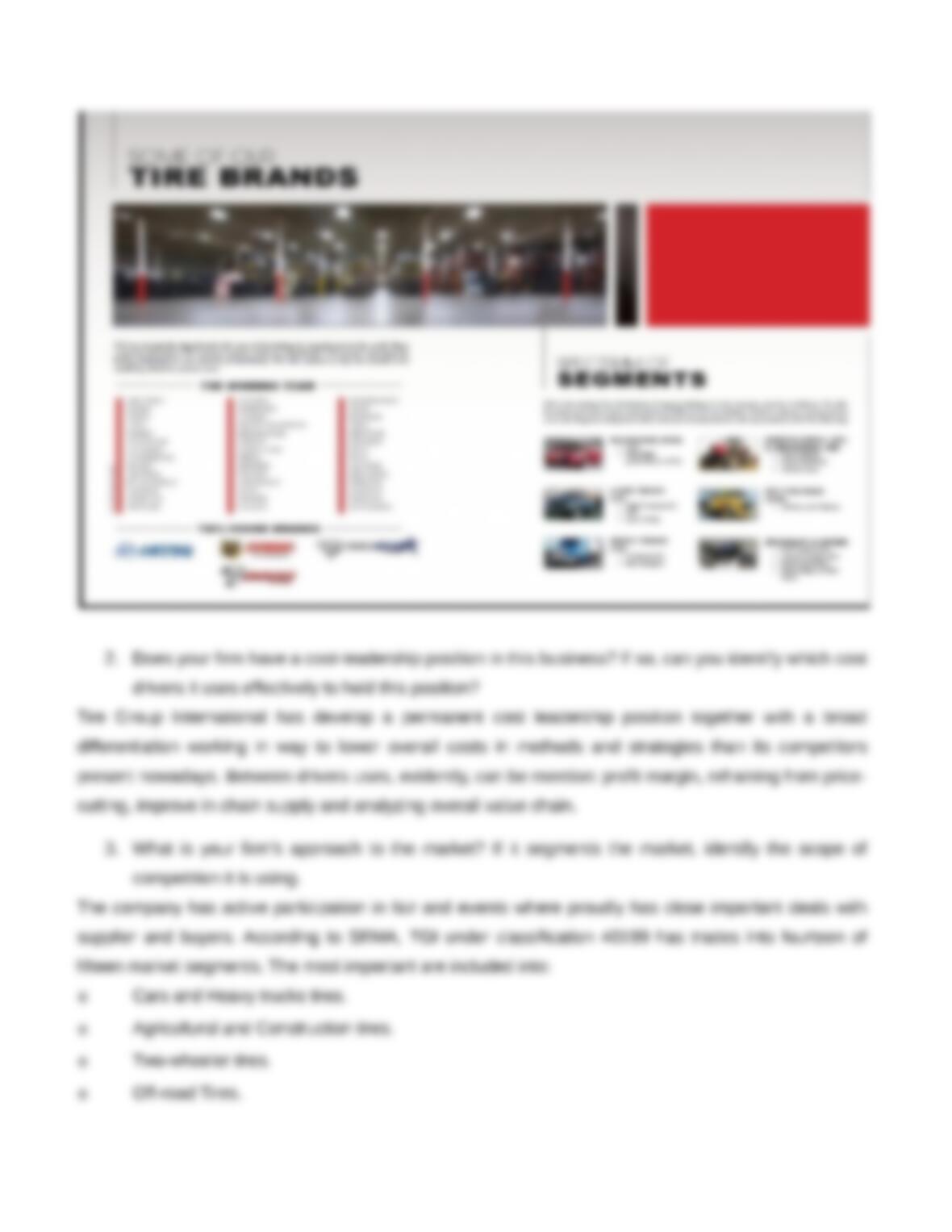
around 40 brands of tires, including products from its own private labels and leading exclusive
distribution from national manufacturers such as Goodyear, Michelin, Cooper and Pirelli. Tire Group
International have being going forward and have done strategic association with Penske Corporation
and McLarty Group. allowing an important participation in foreign market of 4 continents. Its operations
were closed in 2013 with sales over 124.7 millions of dollars and 1.84 millions of tires over world. Other
activities develop are radial tubes, automotive and industrial wheels and freight forwards services,
employing 480 workers and four international subsidiaries. TGI has a slogan: “Where ever you are
talking about a tire: We have it”.
2. Use the top management of the firm and note what experience and leadership skills they bring to
the firm. If a large conglomerate, list both: corporate and business managers.
Tire Group International is based in its organizational pyramid structure (hierarchical) as centralized and
formalized system where most important decisions are taking by top level of management. It can be
defined as:
a) CEO: Antonio Gonzalez: more than 20 years of experience in tires market and brokerage.
b) CFO: Alberto Olivares: background in more than 4 industries in Venezuela, Colombia and USA.
Bachelor in Accounting and International Finances.
c) COO: Orlando Delgado: has a huge experience in logistic and marketing. More than 20 years on
exports and imports from Asian market.
d) CIO: Joaquin Gonzalez: bachelor in Business Administration. Professional experience inside TGI
developed its informatics syst ems and marketing process.
e) TGI has a board integrated by shareholders, investors and partners, and its operations are
divided according markets and operations in 4 vice presidents, 7 divisions and 9 departments.
3. What is the principal model of the firm (how does the firm make most of its profits).
TGI, as a wholesale, sells to detail repair facilities business or companies who has a trucks or cars, all
tires required for their vehicles. This activity includes from light car, light and heavy trucks, industrial and
OTR trucks to special machineries for land, construction, docks. The mean profit comes from its own
brands: Cosmo, Luna, Orion, Astro that usually are manufactured in India and Chine, but also TGI has a
longtime quote right to sell some other brand being the exclusive distributor in Florida state. Its profits
are from commercial margin applied over sales, income and costs.
Module No. 2: Mission, goals and the strategic management process.
1. Search for a mission statement for the firm. Not all organization publish such a statement, so
alternatively you can look for enduring principles and values upon which the firm seems to be
anchored. This information is often available at the firm’s websites (though it may take some
searching) or is contained in its annual reports. You may also interview a manager of the firm or
contact “investor relations”.
The company has defined it professional mission and perspective in its field of operation in many online
places as Facebook, where has being settle as Mission:
“At Tire Group International, we build long-term relationships through dedicated people and quality tires.
It is our sincere goal to exceed your expectations every time you call or visit our company”.
2. Identify the major goals of the company.
According to its Operation Manual, in association with its partnerships (Transportation Resources
Partners and its affiliates, Penske Corporation and McLarty Group) Tire Group International pretend to
positioned itself as one of the leading organizations in the worldwide wholesale distribution of tires and
South Florida’s largest independent tire wholesaler. Tire Group International looks to specializes in the
wholesale and distribution of tires and tubes on a worldwide basis, conducting business this year (2014)
in over 80 countries. TGI has expanded its headquarters located in Miami, Florida and has opened
offices in key markets like China, Mexico, Dominican Republic, Venezuela, Peru and Brazil to unfold its
strategic plan.
3. Does the firm seem to have any longer term challenging or stretch goals that would serve as its
strategic intent?
The company has huge strategic goals on work it when it has been grated with a Foreign Trade Zone
(FTZ) 281-4 status for its Miami operation. This designation gives to TGI the ability to defer, reduce and
eliminate customs duties or products brought into U.S. distribution center for re-export. Some other
benefits for business are: duty referral, insurance benefits, duty exemption, tax savings, international
returns and quality controls. This award is result and affirmation of the quality of TGI’s staff and internal
controls and become an important advantage to bring benefits to the company’s customer “by being
able to offer them a wider array of cost-effective and quality products and quality products and to the
global manufacturers with TGI deals bringing their brands throughout Latin American and the Caribbean.
For TGI this action is one more way to show customers and vendor the real commitment to grow
business and to help its partners do the same.
4. Trace any changes in strategy that you can identify over time. Try to determine whether the
strategic changes of your select firm are a result of intended strategies, emergent strategies, or
some combination of both.
Through 22 years of experiences have been many strategies delineated according market changes,
products availability and prices and U.S. laws. The most important can be into two principal segments:
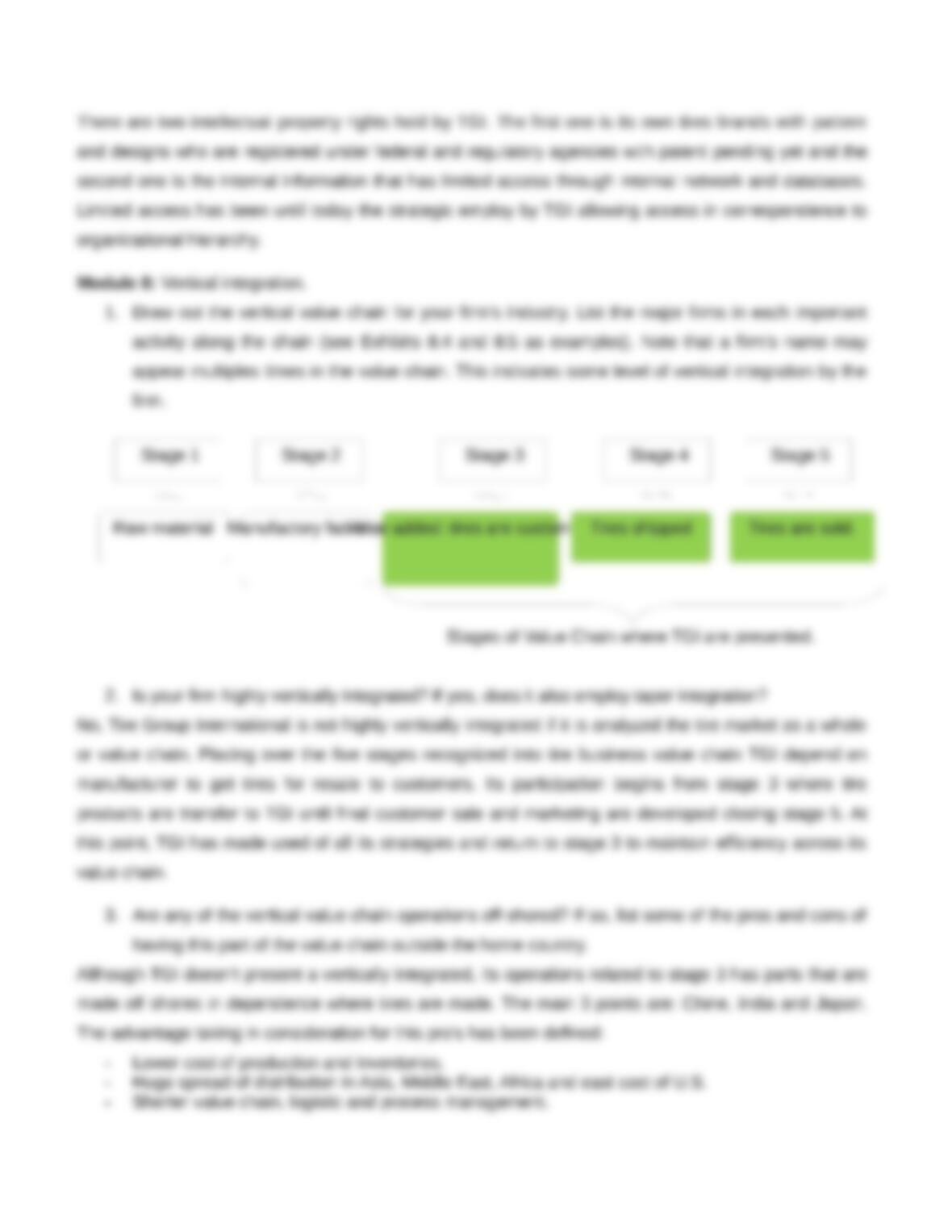
a) Strategically association with one of the most important international transportation service
company with constant growth in west coast and central states in U.S. and acquiring two minor
tire business that has license to sell OTR tires in Florida
b) Development in TGI’s own brands to insert it in American Latin market.
The first action has been an intended strategic to increase sales levels in almost all kind of tires and the
second one provide (as emergent strategy) to customers the option to buy tires in their country, where
some official U.S. brand has high duties, a product manufacture in U.S. plant but under TGI’s brand
names.
Module No. 3: External analysis.
1. Are any changes taking place in the macro environment that might have a positive or negative
impact on the industry in which your company is based? Apply the PESTEL framework to identify
which factor may be the most important in your industry. What will be the effect on your industry?
There are evidences in all of six aspects analyzed under the PESTEL framework, being positive and
negative into TGI’s system. A brief resume is show below:
Political factors:
Positive: Free Trade Agreement between U.S and other countries.
Negative: Instability in important markets as Venezuela and increase in U.S. duties for imports.
Economic factors:
Positive: TGI Foreign Trade Zone that reduces costs.
Negative: impact of U.S. economic crisis in disposable income from buyers.
Social factors:
Positive: presence and recognition of TGI’s name between retail businesses in South Florida.
Negative: rejection in customers about Chinese tires and brands.
Technological factor:
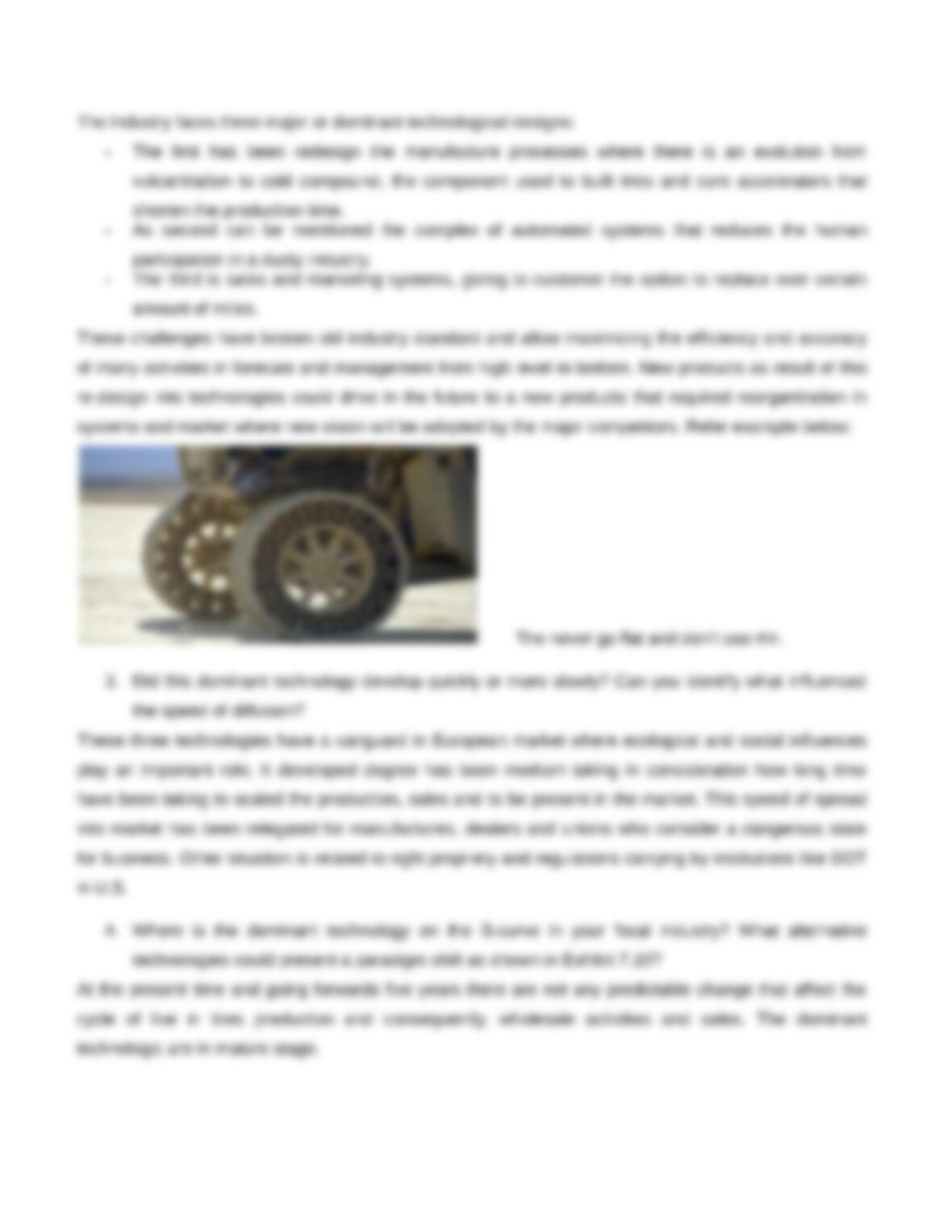
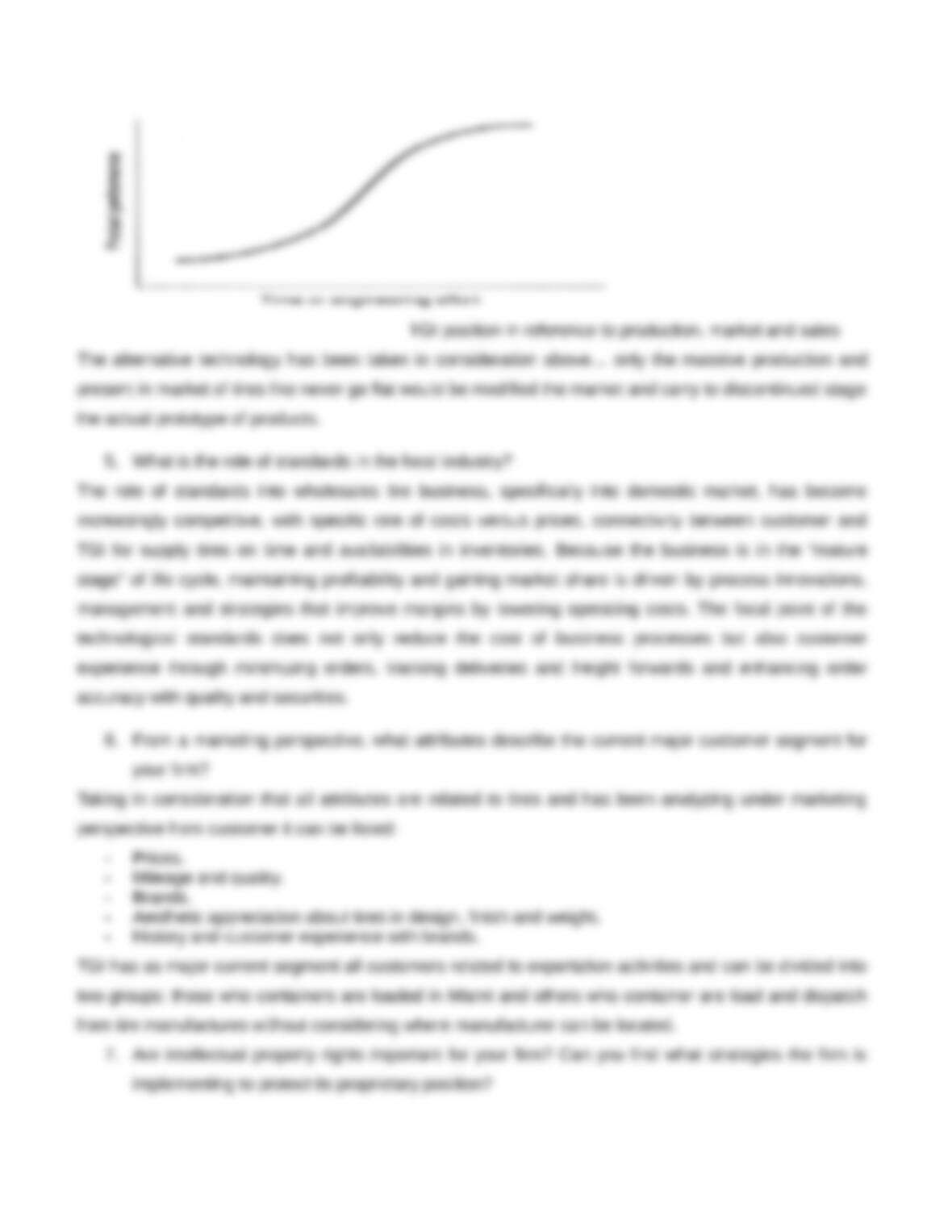
Positive: new process and materials to obtain a durable tire. Examples: tire that never go flat and
regroovable tires
Negative: cost of production for run flat and special color tires.
Environmental factors:
Positive: tires manufactures are joined effort to develop sustainable production of natural rubber and
increase its volume in production.
Negative: waste disposal politics and second hand used tires on roads (law about its inability was
denied).
Legal factors:
Positive: DOT and test requirements are more specific regarding about consumer protection.
Negative: Antidumping and countervailing has been approved from tires made in Asian countries.
2. Apply the five forces model to your industry. What does this model tell you about the nature of
competition in the industry?
Competition identified by TGI is concentrated in 2 other wholesales whom also are trying to insert in the
local market its own brands. The difference in competition might be the internal systems implemented
with a good control over costs and ingenious marketing for loyalty in customers and buyers according to
inventories, quality and prices. Although there are in develop some products that can extend lifespan on
tires the same procedure in built the product has been kept it and it is a product over which there will be
a constant needed for cars and trucks.
For other hands, to buyer as supplier the scenario is in constant motion. Analyzing an internal graph, the