Keda’s SAP Implementation Analysis
Tianyu Chen, ISYS 869
Keda is a Chinese machinery manufacturing company established in 1992. The company
mainly supplies machinery for ceramics, wall materials, stone, and clean energy. It is the biggest
ceramic machine and clean coal gasification system supplier in China. In 2015, Keda reported
total revenue of CNY 813 million (Keda, n.d.). A flexible corporate culture and working
processes had led to Keda’s product and business innovation, which had driven Keda’s success.
However, these success drivers created several problems for Keda. To deal with the problems
and take business to the next level, Keda introduced an enterprise resource planning (ERP)
system in 2011.
Four Drivers for ERP
There were four factors driving Keda to embark on an ERP implementation project: (1)
the company lacked integration; (2) Chinese government agencies put pressure on local
enterprises; (3) inventory management needed to be optimized; and (4) the old system did not
support Keda’s new multi-plant mode.
Keda had a silo-based model that gave the company a freewheeling culture. The culture
made the company innovative but generated several issues. Each business unit was isolated, and
with limited transparent information flowing between them. Departments often reproduced tasks,
resulting in increasing resource waste and operating costs. Managers could not make the right
decisions efficiently because of a lack of timely and accurate information transfer between
departments. The lack of integration negatively affected Keda’s strategic deployments.
Political factors are always the most significant factor considered by Chinese enterprises.
The Chinese government has strong power to influence behaviors of firms. In 2006, the State
Council of PRC released several policies to encourage indigenous innovation in domestic
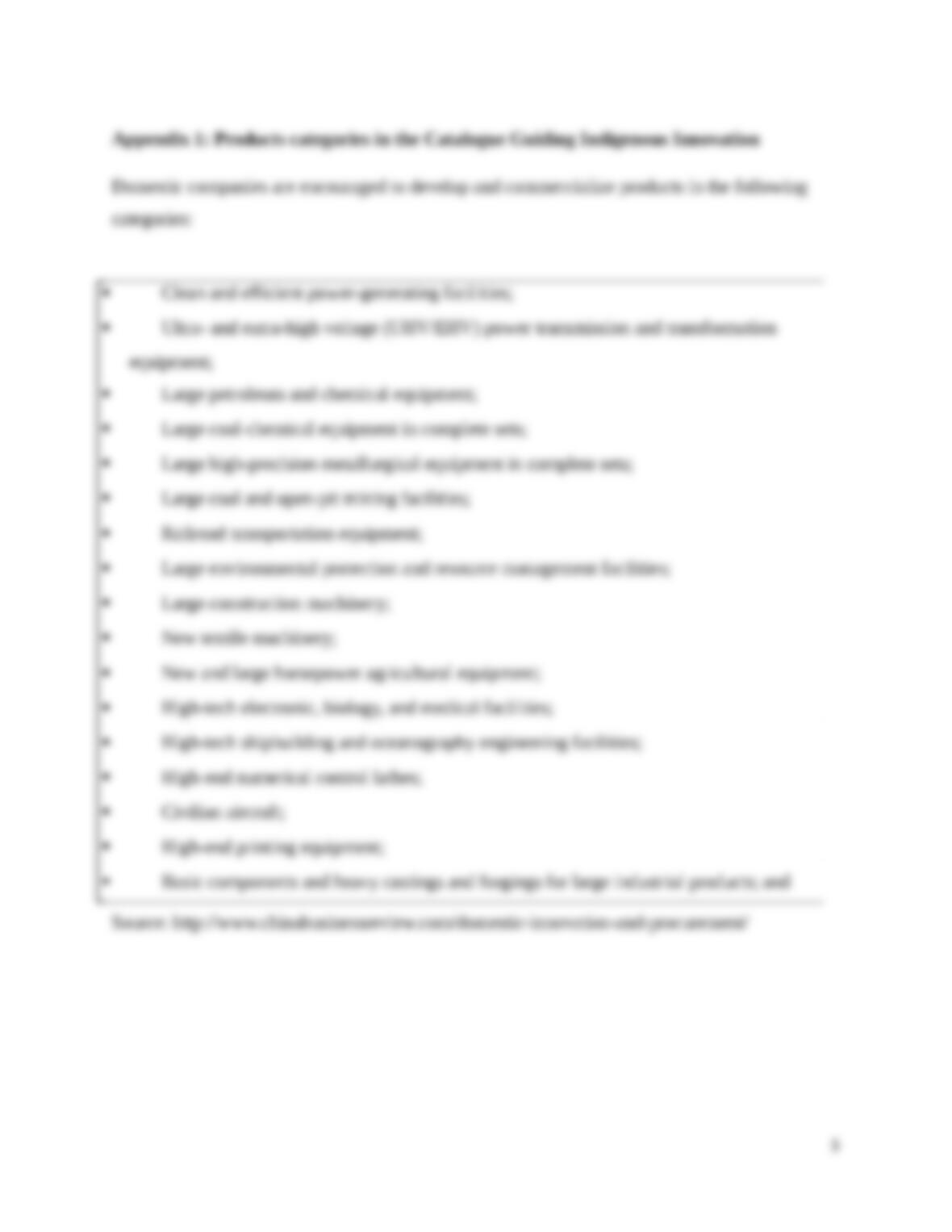
enterprises (US China Business Council, 2010). On December 29, 2009, a new encouragement
policy aimed at the equipment manufacturing industry was announced (see Appendix 1). The
government offered a mix of tax and financing incentives. As a machinery manufacturing
company, Keda did not want to miss this opportunity.
Keda’s business was characterized by customization. This characteristic resulted in a
rising diverse product line and a large quantity of unique mechanical parts. Cost of product could
1
hardly be calculated accurately, so it was difficult for the company to price products. Keda was
also troubled by waste machine usage time and material waste. The utilization of a key facility
was only 24.6%, which was significantly lower than the 90% usage rate of a Japanese
competitor.
To gain competitive advantage, Keda expanded its product lines. Because a single
production plant mode did not fit the new expansion strategy, Keda introduced a multi-plant
mode in 2004. However, the previous manufacturing resource planning (MRO-II) system did not
support the new mode. So to align business strategy with information system strategy, Keda
needed to introduce a new system.
Major Processes
First, Keda identified the core needs of the company. Clear strategic goals and
expectations were defined. Keda’s vice general manager, Dr. Fan Zhu, drew up a 5-year
computerization plan to help the company achieve short-term and long-term goals.
Considering the high cost of capital and time to develop a system independently, Keda
chose to purchase ERP from a vendor, which presented a difficult decision. Keda did an in-depth
assessment of 20 vendors by discussing Keda’s needs, visiting the existing clients of those